BQUQ explains extrusion profile heat sink design: 6063 alloy, fin aspect limits, die cost and tolerances. Dongguan source factory, quotes in 12 hours.
Designing an Extrusion Profile for a Heat Sink
Short answer: most extruded heat sinks are 6063-T5 or T6 aluminum, and a sensible first design keeps fin height at or below about 10× fin thickness, fin pitch between 2.5 and 4 mm, and base thickness between 3 and 8 mm. Practical profile width is usually 50–200 mm because the die must fit the press; fin thickness below 1 mm and pitch below 2.5 mm make the die fragile and raise cost. Budget typically $1,000–$3,500 for the extrusion die, 2–4 weeks for samples, and expect a minimum run around 300–500 kg. Keep the shape extrudable first, and let CNC and stamping add the details after.
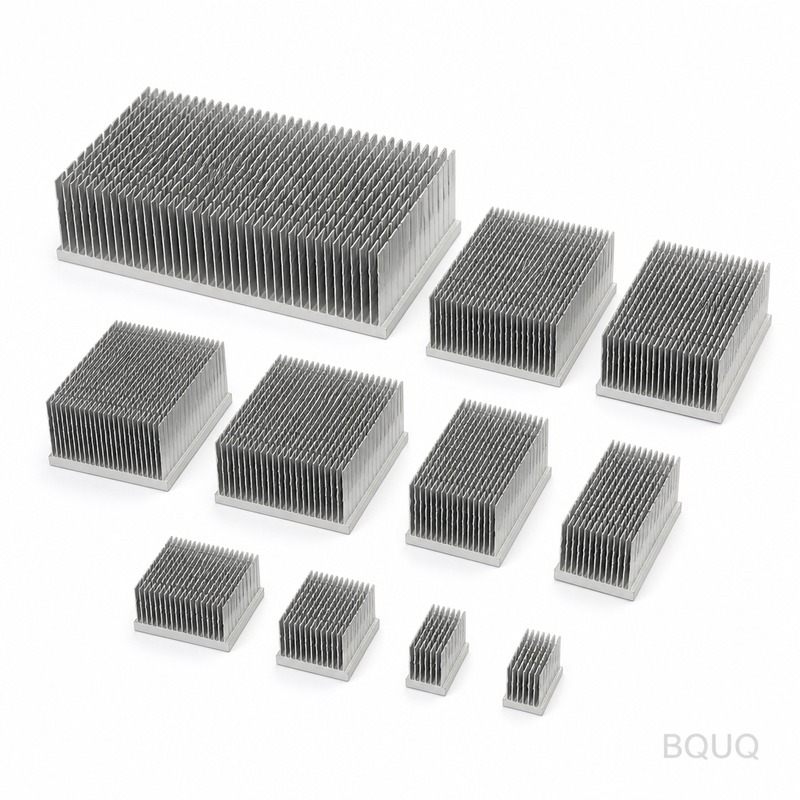
Extrusion is how the world makes most aluminum heat sinks, and for good reason: the process squeezes a long, constant cross-section through a steel die, so one tool produces an infinite length of profile that you simply cut to size. That makes it the cheapest way to build a finned sink in volume. But the process has hard geometric rules, and every rule you break shows up as die cost, tooling fragility, or a sink that comes out twisted. Designing the profile correctly on paper saves a round of die rework that typically costs more than the die itself in lost schedule.
Start From the Extrusion Rules, Not the Thermal Ideal
Thermal engineers left alone would design fins 2 mm apart and 100 mm tall because more surface looks better on paper. Extruders cannot deliver that: molten aluminum must flow through the die gaps, and the steel fingers that form the fin gaps must survive thousands of meters of extrusion pressure. The practical envelope is set by the ratio of fin height to fin gap and fin height to fin thickness. Keep fin height at or below about 10× the fin thickness, and fin height at or below about 8–10× the gap between fins. A profile with fins 20 mm tall works comfortably at 2 mm thickness and 2.5 mm gaps; pushing to 1 mm fins and 1.5 mm gaps at that height moves you into thin-fin tooling that costs more and wears faster.
| Design parameter | Comfort zone | Possible with cost penalty | Why |
|---|---|---|---|
| Fin thickness | 1.2–2.0 mm | 0.8–1.0 mm | Thin fins mean fragile die fingers and slower extrusion speed |
| Fin pitch (center to center) | 2.5–4.0 mm | 2.0–2.5 mm | Tight pitch raises die pressure and surface finish risk |
| Fin height / thickness | Up to 10:1 | 12:1 with special dies | Higher ratios stall metal flow at fin tips |
| Base thickness | 3–8 mm | Down to 2.5 mm | Thin base spreads heat poorly and distorts on cutting |
| Profile width | 50–200 mm | Up to ~300 mm on large presses | Width is limited by the press circle the die fits |
| Profile length | 0.5–6 m as extruded | Longer by special order | Length set by press runout and handling |
The numbers are industry-typical guidance, not a spec table — every extruder has its own envelope and will happily tell you their limits before you pay for a die. The design habit that saves money: assume the comfortable zone in the first draft, then push one parameter only when a thermal calculation proves the profile cannot otherwise meet its target. Pushing everything at once is how dies get re-cut.
Choose the Alloy Before You Draw the Fins
The alloy decision belongs at the front of the design because it sets conductivity, finish and cost. 6063 is the default heat sink alloy: it extrudes easily, gives a smooth anodized surface, and in T5 or T6 temper delivers roughly 190–210 W/m·K — better than 6061's roughly 167 W/m·K in T6. Use 6061 when the profile must carry mechanical load or see hard service, accepting slightly lower conductivity and a rougher extrusion surface. If strength and conductivity must both be high, remember that the extrusion mill controls the temper, so specify the temper explicitly: a 6063-T6 profile conducts better than a T5 of the same shape, but T6 costs a little more and adds straightness risk during aging.
| Property | 6063-T5/T6 | 6061-T6 |
|---|---|---|
| Thermal conductivity | ~190–210 W/m·K | ~167 W/m·K |
| Extrudability | Excellent, smooth surface | Good, slightly rougher surface |
| Yield strength | ~130–180 MPa | ~240–276 MPa |
| Typical heat sink use | Default for finned profiles | Structural bases, mounting plates |
| Anodized finish | Bright, even | Slightly less even, fine after etch |
Do not over-spec. A 6061 profile for a purely thermal part costs more and conducts less than 6063; a 6063 profile carrying a heavy bracket load may sag where 6061 would not. Match the alloy to the weakest requirement — the same logic as choosing between aluminum and copper heat sinks, where the question is always what the application actually needs.
Draw the Profile With the Die and Secondary Ops in Mind
Three drawing habits separate profiles that quote fast from profiles that bounce between engineering desks. First, keep the cross-section balanced: aim for a symmetrical shape or at least balanced metal distribution, because asymmetric profiles cool unevenly and come out of the die curved or twisted, and every straightening step adds tolerance risk. Second, call out tolerances only where they matter: profile cross-section tolerances follow EN 755-9 style classes, with standard running tolerances roughly ±0.3–0.5 mm on overall width depending on size; there is no point holding ±0.05 mm on a profile that will be machined anyway. Third, remember the profile is a raw material: the holes, slots, threads and mounting faces are secondary operations that usually belong to CNC machining after cutting, not to the extrusion die.
Extruded length is where buyers lose money without noticing. Profiles are extruded in long bars — commonly 3 to 6 m — then cut to final length, and the per-meter price drops as the total order weight rises because die cost and setup spread further. Minimum orders typically sit around 300–500 kg for a standard profile, which is why small quantities of custom profiles are expensive per piece: you are paying for a die and a setup, not for metal. If your quantity is under that level, ask whether an existing profile near your envelope can be machined instead, or whether a CNC-machined heat sink from solid stock is cheaper until volume justifies the die.
| Cost element | Typical range (indicative) | Notes |
|---|---|---|
| Extrusion die, simple solid profile | $800–$1,500 | Solid shapes, no hollows |
| Extrusion die, finned profile | $1,000–$2,500 | Standard finned heat sink |
| Extrusion die, complex multi-cavity | $2,000–$3,500+ | Tight fins or hollows raise price |
| Die sample lead time | 2–4 weeks | First samples for approval |
| Typical MOQ per profile | 300–500 kg | Depends on extruder and profile size |
| Secondary anodizing | ~$1–$3 per kg of surface area | Black anodizing costs most |
From Raw Profile to Finished Heat Sink
An extruded profile leaves the mill as a long, bare aluminum shape, and the product you actually ship is made by the operations after extrusion: cutting to length with square ends, CNC machining for holes, slots, steps and mounting faces, deburring, cleaning, and anodizing for corrosion protection and better radiation. Black anodizing matters thermally, not just cosmetically: the coating raises surface emissivity from roughly 0.1 on bare aluminum to about 0.9, which improves natural-convection performance noticeably — the reason so many passive heat sinks ship black.
The division of labor between extrusion mill and source factory is a sourcing decision. Many buyers order raw profiles from an extruder and then need a second supplier for cutting, machining and anodizing — two vendors, two quality systems, two lead times. A factory that takes the profile in and runs the finishing internally controls the tolerance chain end to end: the mounting face that must sit flat against your IGBT is machined and checked in the same building where the profile is cut, which is how you get a sink that mounts flat instead of rocking on three corners. When comparing quotes, ask explicitly which operations are in-house and which are subcontracted, because the subcontracted step is where schedule slips and quality surprises live.
Frequently Asked Questions
Q: What is the maximum fin height I can extrude on a heat sink profile?
A: Practically, keep fin height at or below about 10× the fin thickness and about 8–10× the fin gap. With 1.5 mm thick fins and 2.5 mm gaps, fins around 20–25 mm tall are routine; taller or thinner fins need special dies and cost more, so confirm with the extruder before committing.
Q: What is the minimum order quantity for a custom extrusion profile?
A: Typically 300–500 kg per profile at most extruders, because the die and setup costs must be spread across the run. Below that, compare the per-piece price against machining a standard profile or a CNC-machined sink from solid stock.
Q: How much does an extrusion die cost and how long does it take?
A: Indicatively $800–$3,500 depending on complexity, with finned heat sink dies typically in the $1,000–$2,500 range, and first samples in about 2–4 weeks. Die cost is a one-time charge, so it matters most at low volumes.
Q: Should my heat sink profile be 6063 or 6061 aluminum?
A: Use 6063-T5 or T6 for the default thermal part: it conducts better (~190–210 W/m·K), extrudes cleaner and anodizes more evenly. Use 6061 only when the profile carries mechanical load, accepting lower conductivity and higher cost.
Q: Can you machine features into an extruded profile after cutting?
A: Yes, and that is the standard route. Holes, slots, threads and flat mounting faces are CNC-machined after the profile is cut to length, which keeps the die simple and the tolerance where it belongs. Send the profile drawing plus the machining drawing and get one combined quote.
Related Resources
- Extrusion heat sink design guide — deeper geometry rules for fin fields and bases.
- Extruded vs CNC vs stamped vs skived heat sinks — comparing the four main heat sink manufacturing routes.
- About BQUQ: an ISO9001 source factory in Dongguan cutting, machining and finishing heat sink profiles under one roof.
- Contact us: send your profile and machining drawings for a quote within 12 working hours.
Authored by the BQUQ Engineering Team. BQUQ is an ISO9001-certified source factory in Dongguan, China, running CNC machining, metal stamping, custom springs, heat sink and collet lines under one roof. Send drawings to sc@bquq.com or WhatsApp +86 13713157787 for a quote within 12 working hours. www.bquq.com