Extruded, CNC-machined, stamped, and skived heat sinks compared: tooling cost, fin density, and which wins at your volume, from a Dongguan source factory.
Custom Heat Sinks for Electronics: Extruded vs CNC vs Stamped vs Skived
Short answer: extrusion is the volume workhorse — die tooling typically runs $800–$2,500 (indicative), fins are limited to roughly 1 mm thick with about 1.5 mm gaps, and unit cost collapses at 1,000+ pcs. CNC machining costs nothing in tooling but more per piece, and wins for prototypes, low volume, and odd geometries. Stamping makes very thin folded fins cheaply once the die exists. Skiving cuts ultra-dense fins from solid aluminum and suits high-performance, mid-volume designs. Pick the process by volume, thermal need, and geometry — not by habit.
Every electronics enclosure eventually meets the same wall: the chips got smaller, the power did not, and something has to move the heat out. The heat sink that solves it can be made four fundamentally different ways, and the manufacturing process decides as much about your cost and lead time as the thermal design does. Here is how the four processes compare and when to use each.
What Are the Four Ways to Make a Custom Heat Sink?
Extruding pushes hot aluminum through a steel die to form a continuous finned profile that is then cut to length. CNC machining carves fins from a solid block with rotating cutters. Stamping blanks and folds thin sheet metal into fin shapes. Skiving shaves fine fins up out of a solid block, peeling them like a wood plane curls a board. Same goal — maximum surface area for air to scrub heat off — four completely different cost structures.
Extruded Heat Sinks: The Volume Workhorse
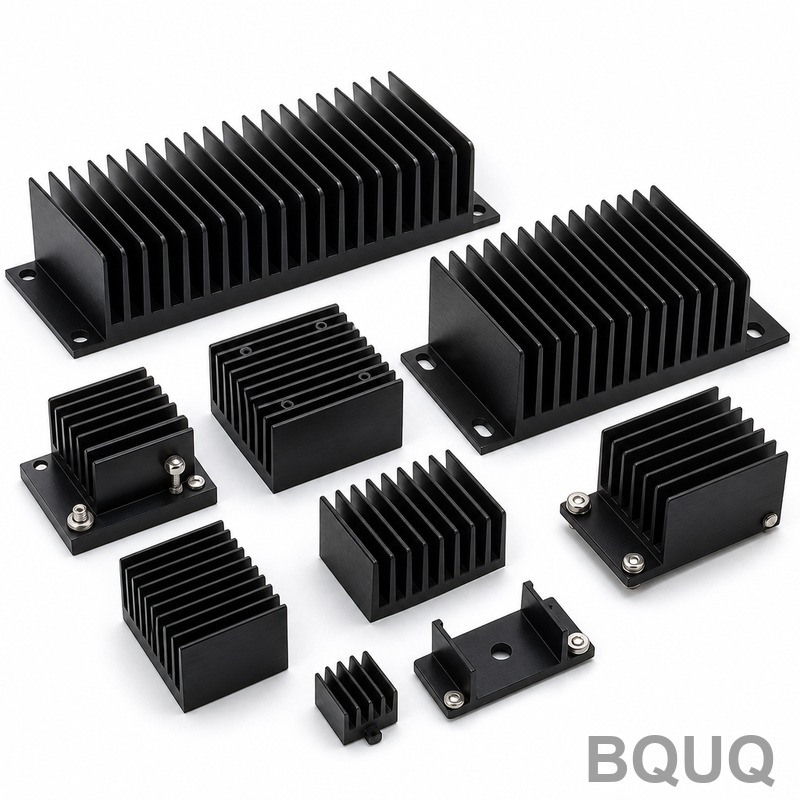
Extrusion starts with a die, a block of tool steel with the profile shape cut through it. Aluminum billet is heated and forced through the die, producing an endless finned bar that gets sliced to length and then machined for mounting holes and steps. This is the process behind 90% of the standard heat sinks in catalogs.
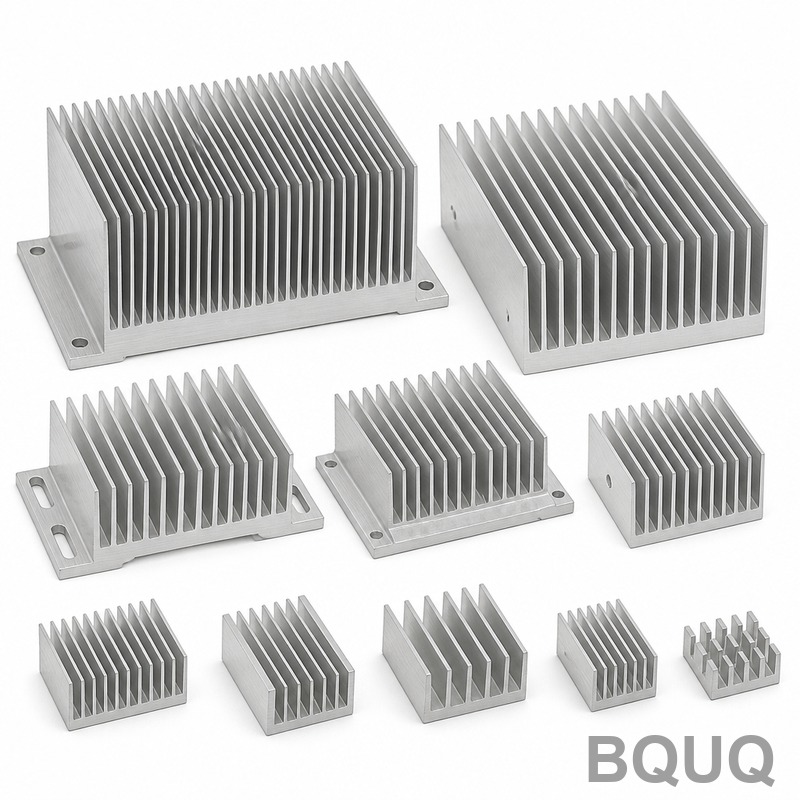
The constraints come from the die. Fins cannot be too thin or too tall relative to their gap, because the aluminum must flow evenly through narrow slots. Practical limits are around 1 mm minimum fin thickness and roughly 1.5 mm minimum fin gap, with fin height limited to about 10–15 times the gap. Extrusion is also a two-step process in practice: the profile comes off the press, then a CNC operation machines the base, holes, and any steps. Many suppliers, ourselves included, run that secondary machining in-house.
Tooling is modest — typically $800–$2,500 for the die (indicative, varies with profile complexity). At 1,000 pieces and up the unit cost is the lowest of the four processes, which is why extruded heat sinks dominate volume electronics: LED drivers, power supplies, IGBT coolers, telecom enclosures.
CNC-Machined Heat Sinks: No Tooling, Total Freedom
A CNC-machined heat sink starts as a solid block of aluminum — usually 6061 or 6063 — and the fins are milled away out of the material. No die, no minimum order tied to tooling amortization. Change the design between batches and the only cost is reprogramming.
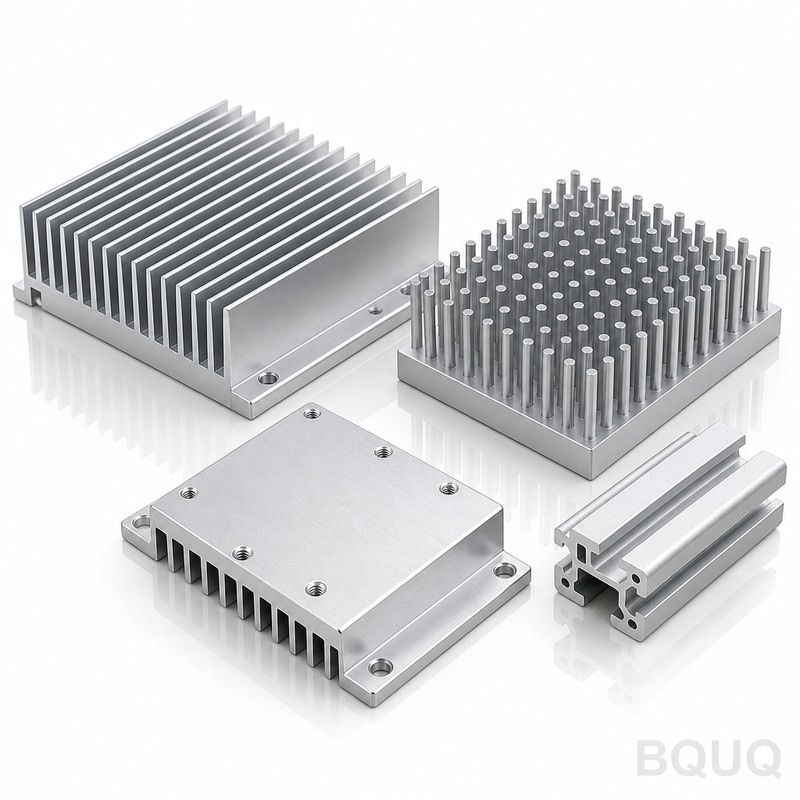
Trade-offs: machining is slower than extruding, so per-piece cost runs higher, and fin geometry is limited by cutter reach and diameter — deep, narrow slots need long thin tools that deflect. Machined fins typically end up no thinner than about 0.8–1 mm with gaps of 1 mm and up. What machining gives back is freedom: stepped bases, mounting bosses, integrated standoffs, odd footprints, and heat sinks for prototypes that will move to another process later.
The sweet spot is 1 to a few hundred pieces, complex shapes, and anything with a deadline. For production heat sink runs, CNC-machined designs with high feature complexity still make sense — think baseplates with integrated fins and precision mounting surfaces.
Stamped Heat Sinks: Thin Fins for Tight Spaces
Stamping forms heat sinks from sheet aluminum or copper. A progressive die blanks the fin pattern and folds the fins up, often in an accordion or folded-fin arrangement. Because the starting stock is thin sheet — typically 0.3–0.8 mm — stamped fins are far thinner than extruded ones, which means more fins per centimeter and more surface area in the same footprint.
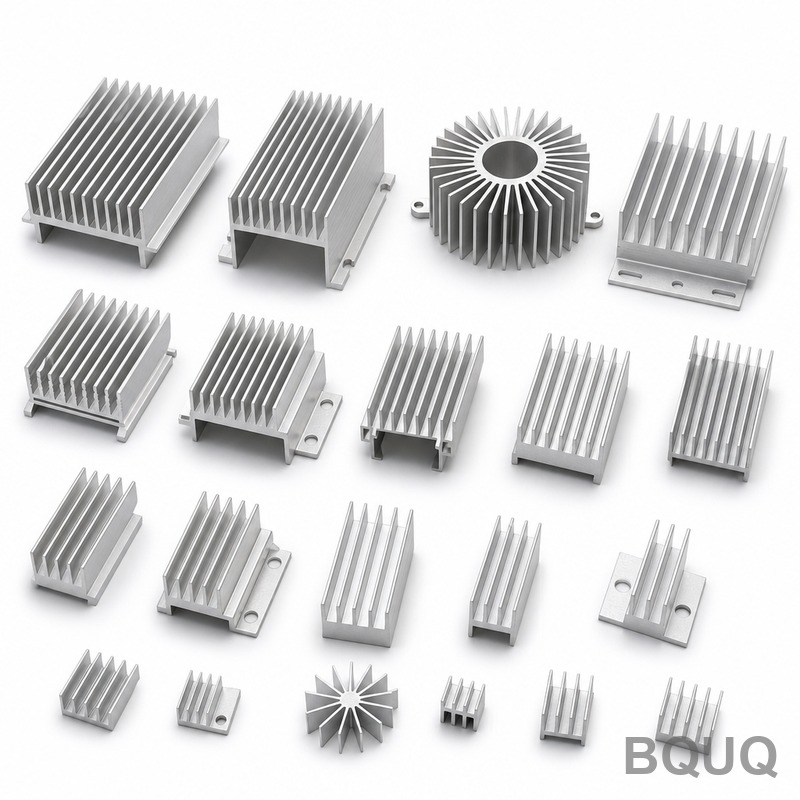
The catch is tooling. A progressive die for a folded heat sink is real money, typically $3,000–$20,000 (indicative, varies with part size and station count), so stamping pays off at higher volumes. Stamped heat sinks frequently appear as folded aluminum fin packs on CPU coolers, LED assemblies, and power modules, sometimes bonded to a machined baseplate.
Skived Heat Sinks: The Density Specialist
Skiving is the least known process and the one that surprises people. A sharp tool peels continuous fins up out of a solid block of aluminum or copper — each fin is one continuous piece of metal with the base, so there is no interface resistance between fin and base. Fins can be extremely thin — 0.2–0.5 mm — and densely packed, giving excellent surface area per volume.
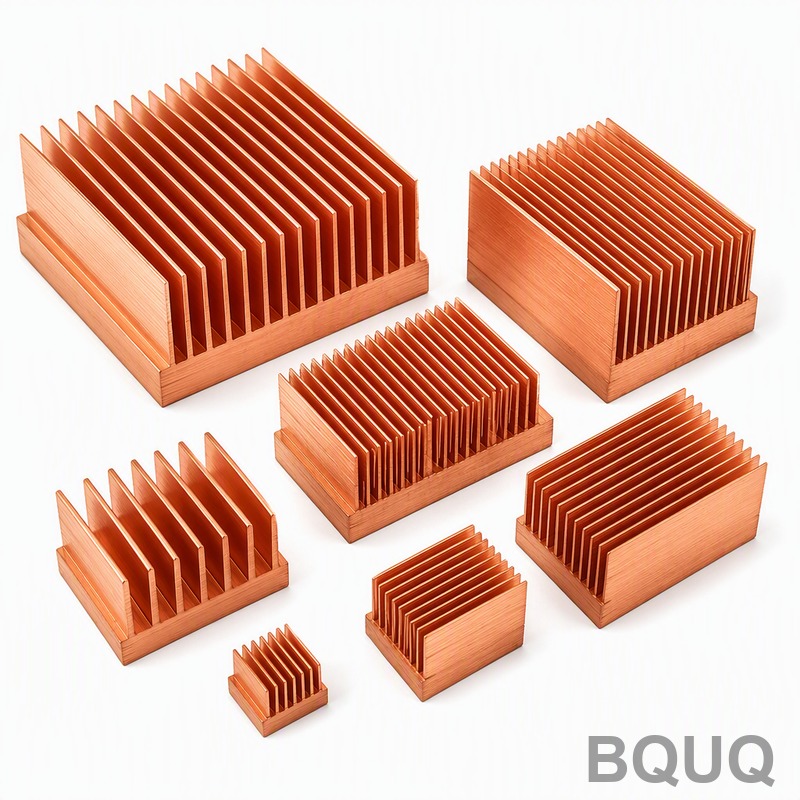
Skiving has no die and works from a simple block, so it suits medium volumes and high-performance designs: inverter modules, laser diodes, high-density LED arrays. It is slower per part than extrusion, so you pay for the thermal performance. It fills the gap between low-volume CNC and very high-volume extrusion.
How Do the Four Processes Compare Head to Head?
| Process | Typical fin thickness | Tooling (indicative) | Unit cost at 1,000+ pcs | Best volume | Design freedom |
|---|---|---|---|---|---|
| Extruded | ~1.0–1.3 mm | $800–$2,500 die | Lowest | 1,000+ | Limited by die geometry |
| CNC-machined | ~0.8–1.0 mm | None | Higher | 1–500 pcs | Highest |
| Stamped | 0.3–0.8 mm | $3,000–$20,000 die | Low | 5,000+ | Limited by fold geometry |
| Skived | 0.2–0.5 mm | Minimal | Medium | 500–10,000 pcs | Moderate |
The thermal takeaway from the thickness column: thinner fins mean more fins per inch, more surface area, and lower thermal resistance for the same envelope — but each process that buys you thin fins charges for it somewhere else, in tooling or in cycle time.
Which Heat Sink Should You Choose for Your Application?
| Application | Recommended process | Why |
|---|---|---|
| LED driver, power supply, 1,000+ pcs | Extruded | Lowest cost at volume, proven profiles |
| Prototype or 50-pc run, odd shape | CNC-machined | No tooling, fast turnaround |
| CPU/LED fin pack, 5,000+ pcs | Stamped | Thin folded fins, low unit cost |
| Inverter, laser, high flux density | Skived | Dense thin fins, no fin-base joint |
| Heatsink plus brackets/terminals in one assembly | Extruded or CNC + stamping | Cross-process assembly from one factory |
Decision Tree: Four Questions That Pick Your Process
Answer in order and the manufacturing route mostly selects itself:
- Prototype, 1–50 pcs, or a shape no die can produce? → CNC machining. No tooling, 5–10 day lead time, higher per-part cost.
- Volume 1,000+ and the profile fits extrusion limits (fin ≥1 mm, gap ≥1.5 mm)? → Extruded. Lowest unit cost once the die is amortized.
- Low-power LED/CPU, 5,000+ pcs, need very thin folded fins? → Stamped. Sheet-metal fins at the lowest cost per fin.
- High power density — inverter, laser — needing dense fins extrusion cannot reach? → Skived. Thin fins cut from solid stock, no fin-to-base joint.
- Your assembly also needs brackets, clips or terminals? → Combine processes in one factory — extrusion or CNC body plus stamped clip, one DFM review, one freight bill.
Data basis: fin limits, die-cost ranges and quoted lead times are BQUQ factory-standard figures from in-house manufacturing records (2024–2026 update). Every quote is confirmed against your drawing before order.
A source factory that runs several of these processes under one roof can be blunt with you in a way a single-process shop cannot. We make extruded heat sinks, CNC-machined heat sinks, and stamped heat sinks in the same Dongguan plant, and when a job is better skived we will tell you to go to a skiving specialist instead of stretching our own process. That honesty saves you money; it costs us nothing because the other two lines still get the business.
What Should You Send When Ordering a Custom Heat Sink?
The thermal spec matters more than the pretty CAD. Send four numbers: heat load in watts, maximum allowed component or case temperature, ambient temperature, and available air flow (natural convection or forced, and how much). Then add the envelope — max length, width, height — mounting hole pattern, and the target thermal resistance if you have one. If you do not have the numbers, our engineering team can help you work them out; our thermal resistance guide walks through the calculation step by step.
With those inputs we can recommend a process, sketch a fin layout, and give you a quote within 12 hours on working days. Air freight for samples runs 5–7 days; production by sea takes 25–40 days. And since material choice matters as much as geometry, check our 6063 versus 6061 comparison for heat sinks before you finalize the alloy on the drawing.
Get a Custom Heat Sink Quote
Send the numbers — component power (W), allowed temperature rise, airflow, envelope L×W×H and mounting requirements — to sc@bquq.com or WhatsApp +86 137 1315 7787. Our engineers reply within 12 hours on working days with a process recommendation, a DFM note and a price.
Which heat sink process fits? (Decision tree)
| If your case... | Choose | Why |
|---|---|---|
| Uses a standard profile at 1,000+ pcs | Extruded | Lowest unit cost once the die exists |
| Is a prototype, low volume or odd shape | CNC machined | No tooling, fast turnaround |
| Needs thin folded fins at high volume | Stamped | Thin fins at low unit cost |
| Has high flux density at mid volume | Skived | Dense fins, joint-free fin base |
| Dissipates more than about 300 W | Heat pipe assembly | Spreads heat beyond the base footprint |
| Is sealed with no airflow | Conduction to chassis or cold plate | Convection is not available |
Frequently Asked Questions
Which type of heat sink is cheapest?
A: Extruded, at volume. The die costs a few hundred to a few thousand dollars and unit price falls sharply past 1,000 pieces. For small runs, CNC machining has no tooling cost and usually wins on total cost.
Do stamped heat sinks perform as well as extruded ones?
A: Stamped fins are thinner, so a stamped sink can pack more surface area into the same space — sometimes better thermal performance per volume. But folded fin packs often need bonding to a baseplate, and that joint adds thermal resistance if done poorly.
What is the difference between skived and CNC-machined heat sinks?
A: CNC milling cuts fins away from a block, leaving gaps where material was removed. Skiving peels continuous fins up from the block, so fins are thinner, denser, and one piece with the base — no joint resistance.
Can I make a prototype heat sink before paying for an extrusion die?
A: Yes, and you should. A CNC-machined prototype proves the thermal design and the fit for a few pieces and a short lead time. Once the design is validated, the extrusion die investment is a safe decision.
What is the minimum order for custom heat sinks?
A: It depends on the process. CNC-machined heat sinks have no practical MOQ — one piece is fine for testing. Extrusion and stamping carry tooling cost, so economics favor larger runs, and we will show you the crossover point before you commit.
Related Articles
- Aluminum 6063 vs 6061 for Heat Sinks: Which Conducts Better? — 6063-T5 conducts roughly 200 W/m·K vs 155–170 for 6061-T6. When the alloy matters for heat sinks and when strength wins. Typical values explained.
- Heat Sink Thermal Resistance: How to Calculate What You Need — R = ΔT/Q with a worked example, plus typical convection values (natural 5–10, forced air 25–100 W/m²·K) and the thermal spec your factory needs.
Related Resources
- About BQUQ: an ISO9001-certified source factory in Dongguan running four production lines under one roof.
- Heat sink products: compare extruded heat sinks, CNC machined heat sinks, and stamped heat sinks for your thermal design.
- Industry trends: manufacturing, material market, and sourcing analysis for buyers.
- Technical articles: engineering guides on CNC, heat sinks, springs, and stamping — more where this one came from.
- FAQ hub: quick answers on CNC, stamping, springs, and heat sinks.
- Case studies: real parts and real numbers from projects we engineered and delivered.
- Contact us: send your drawing and get a quote within 12 working hours.
Authored by the BQUQ Engineering Team. BQUQ (Dongguan) runs CNC machining (±0.005 mm), metal stamping, custom springs, and heat sink production in one ISO9001 factory. Source-direct from Dongguan, China — quote in 12 hours: sc@bquq.com | WhatsApp +86 13713157787 | www.bquq.com