Why black anodized heat sinks radiate better: emissivity numbers, when radiation matters, how to spec it. BQUQ (ISO9001, Dongguan) quotes in 12 hours.
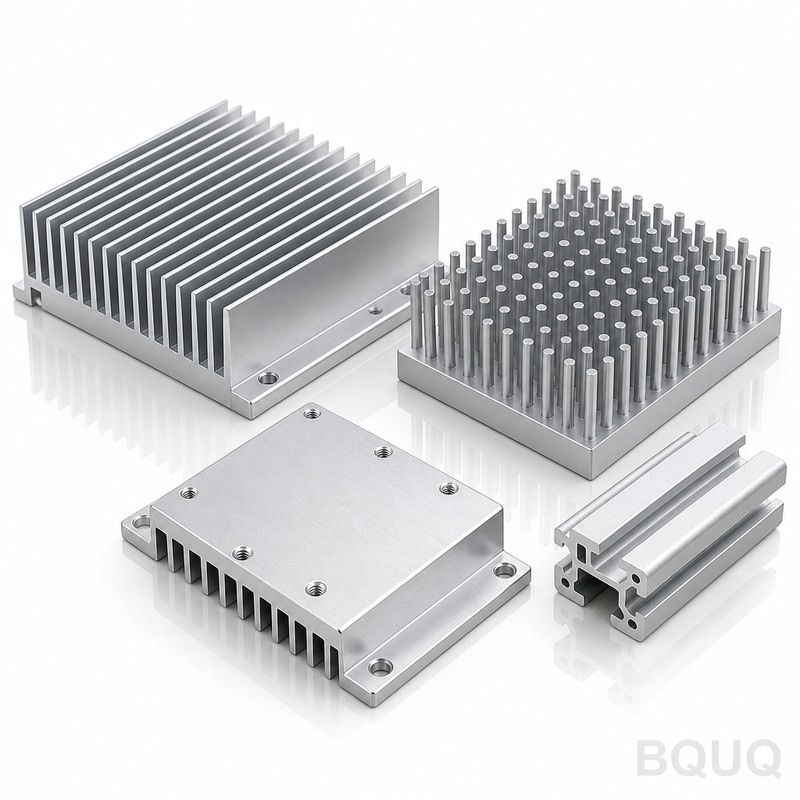
Black Anodized Heat Sinks: Why Color Improves Thermal Performance
Black anodizing raises a heat sink's surface emissivity from roughly 0.05-0.10 (bare aluminum) to about 0.85-0.95, and in natural convection that can add 15-35% more cooling because radiation carries a real share of the heat. What matters is not the visible color but infrared emissivity: a bare bright extrusion radiates almost nothing, while the same profile black anodized sheds heat in every direction, even in still air.
Every heat sink cools by two parallel paths: convection to air and radiation to surrounding surfaces. Convection gets the attention because fins are designed around airflow, but radiation is free — it needs no air movement at all. Aluminum's problem is that bare metal is a mirror in the infrared: it emits almost none of the radiation it could. A thin anodic coating changes that completely, and this guide explains when that change is worth real degrees and when it is mostly cosmetic.
Emissivity: It Is Infrared, Not Visible Color
Emissivity is a surface's effectiveness at radiating thermal (infrared) energy compared with a perfect black body, on a 0-1 scale. The visible color you see matters almost not at all — what counts is the surface's behavior in the 2-20 µm infrared band. Shiny metals have very low emissivity because they reflect infrared instead of emitting it. The porous oxide layer created by anodizing behaves like a ceramic surface, which is an excellent emitter.
| Surface | Typical emissivity |
|---|---|
| Polished aluminum | 0.04-0.09 |
| Bare extruded aluminum (mill finish) | 0.08-0.20 |
| Lightly oxidized/aged aluminum | 0.2-0.4 |
| Clear (undyed) anodized aluminum | 0.70-0.85 |
| Black anodized aluminum | 0.85-0.95 |
| Matte black paint | 0.90-0.96 |
Takeaway: the single biggest jump in emissivity comes from anodizing itself — bare aluminum, even aged, stays far below any anodized finish. Black dye adds a bit more and, more importantly, gives a consistent, repeatable surface from batch to batch.
The Radiation Math: Watts per Square Meter
Radiation follows the Stefan-Boltzmann law: flux equals emissivity times a constant times the fourth power of absolute temperature. Fourth power means the hotter the surface, the more radiation dominates. At typical electronics temperatures the numbers are surprisingly large:
| Sink surface temperature | Radiated flux, black anodized (ε 0.9) | Radiated flux, bare aluminum (ε 0.1) |
|---|---|---|
| 40 °C above ambient | ~120-150 W/m² | ~13-17 W/m² |
| 60 °C above ambient | ~230-270 W/m² | ~25-30 W/m² |
| 80 °C above ambient | ~350-420 W/m² | ~40-45 W/m² |
Takeaway: at a 60 K rise, every square meter of black anodized surface radiates roughly 250 W to the surroundings, where the same bare surface manages only about 25-30 W. Multiply by the total exposed sink area and the difference becomes tens of watts of real cooling.
When Radiation Actually Matters
Radiation's share of total cooling depends on the airflow regime. Under a strong fan, convection is huge and radiation shrinks to a few percent. In free air, radiation becomes a serious partner. Inside a sealed or confined enclosure with little airflow, radiation can carry a third or more of the total heat — and it is often the only path that works.
| Cooling regime | Typical radiation share (black anodized) |
|---|---|
| Ducted forced air, 3-5 m/s | 5-15% |
| Open natural convection | 20-30% |
| Sealed enclosure, little airflow | 30-45% |
| Vacuum / no convection | Near 100% |
Takeaway: black anodizing earns its keep on passively cooled products — LED luminaires, amplifiers, sealed power supplies, and extruded heat sinks in consumer enclosures. On a fan-cooled IGBT block it is a minor assist plus corrosion protection, not the main event.
Does the Coating Block Conduction? No
An anodic layer is thin — typically 8-25 µm for Type II sulfuric anodizing — and aluminum oxide conducts poorly, so engineers sometimes worry the coating insulates the fins. Run the numbers: at 25 µm with oxide conductivity near 1 W/m·K, the added thermal resistance is about 0.025 K·m²/W. At a realistic heat flux of a few thousand W/m² at the fin base, the temperature penalty is well under 0.1 K. The coating is thermally invisible in the conduction path; its entire thermal effect is the emissivity gain on the outside surface.
Practical Benefits Beyond the Physics
Black anodize is specified on CNC-machined heat sinks and extrusions for reasons beyond radiation: it hardens the surface against handling scratches, hides fingerprints and smudges that make bare fins look dirty, provides uniform appearance across batches, and gives a durable corrosion barrier that bare aluminum lacks in humid or coastal environments. It also prevents the galvanic staining that appears where aluminum touches other metals. If your product sits in a retail environment, the finish is half the reason to anodize; if it sits in a hot sealed box, the emissivity is the other half.
Specifying Black Anodize Correctly
When you call out the finish on a drawing, say what you actually need. Type II sulfuric anodize, black dyed, 8-25 µm coating thickness, is the standard for thermal parts. Add "no dichromate seal" only if a supplier's process calls for it — sealing is normal and does not hurt emissivity. Specify masking if threads or mounting faces must stay bare for electrical contact or tight fits. For heat sink quotes, one line — "black anodized, Type II, ~15 µm, per customer sample" — is enough; the factory's process control keeps the emissivity consistent from lot to lot.
Email sc@bquq.com or WhatsApp +86 137 1315 7787 with your PDF/DXF/STEP file. An engineer reviews it and replies with price, lead time and DFM notes on working days.
Frequently Asked Questions
Q: Does the color of anodizing matter, or only black?
A: Only infrared emissivity matters, and most anodized colors land in the same high range around 0.8-0.9. Black is marginally the best and the most consistent, which is why it is standard — but dark blue or green anodize cools nearly as well.
Q: Why is bare aluminum such a poor radiator?
A: Bright metal reflects infrared instead of emitting it, so emissivity sits near 0.05-0.2. The porous oxide layer from anodizing turns the surface into an emitter at 0.85-0.95 — the same reason anodized parts look matte rather than shiny.
Q: How much real cooling does black anodizing add?
A: In natural convection, roughly 15-35% more heat rejection than bare aluminum, rising in sealed enclosures where radiation is the dominant path. Under strong forced air the gain drops to 5-15%, so prioritize it on passive designs.
Q: Does anodizing insulate the heat sink and hurt conduction?
A: No — a 10-25 µm anodic layer adds under 0.1 K of temperature rise at realistic heat fluxes. The coating's thermal effect is almost entirely the emissivity improvement on the radiating surface.
Q: Should I paint a heat sink instead of anodizing it?
A: Paint reaches emissivity around 0.9 and cools similarly, but it is thicker, less durable, and can chip or peel under thermal cycling. Anodizing is integral to the aluminum surface, so it survives handling and repeated heat cycles without maintenance.
Related Articles
- heat-sink-thermal-resistance-calculation — More from the BQUQ Thermal Management engineering series.
- heat-sink-mounting-methods-guide — More from the BQUQ Thermal Management engineering series.
- air-cooling-vs-liquid-cooling-electronics — More from the BQUQ Thermal Management engineering series.
Data Sources and Verification
Tolerances, cycle times and price ranges in this guide come from BQUQ production records at our Dongguan plant, where CNC machining (±0.005 mm), stamping, custom springs and heat sinks run under one roof. BQUQ is an ISO 9001:2015 certified factory; the certificate and batch inspection reports are available on request with every quotation.
Related Resources
- About BQUQ: an ISO9001-certified source factory in Dongguan running four production lines under one roof.
- Heat sinks and thermal parts: extruded, CNC-machined and stamped options from the thermal line — extruded heat sinks, CNC-machined heat sinks, stamped heat sinks.
- Industry trends: manufacturing, material market, and sourcing analysis for buyers.
- Technical articles: engineering guides and process comparisons — more where this article came from.
- FAQ hub: quick answers on CNC, stamping, springs, and heat sinks.
- Case studies: real parts and real numbers from projects we engineered and delivered.
- Contact us: send your drawing and get a quote within 12 working hours.
Authored by the BQUQ Engineering Team. BQUQ is an ISO9001-certified source factory in Dongguan, China, running CNC machining, metal stamping, custom springs and heat sink lines under one roof. Send drawings to sc@bquq.com or WhatsApp +86 13713157787 for a quote within 12 working hours. www.bquq.com