Mounting method sets contact pressure and thermal performance: clips, screws and adhesives compared. BQUQ (ISO9001, Dongguan) quotes in 12 hours.
Mounting Heat Sinks: Clips, Screws, Adhesives and Thermal Performance
Mounting method is a thermal decision, not just a mechanical one: the contact pressure between a heat sink and its component sets the interface resistance, and typical thermal pads and greases want 10-50 psi of clamp force to work properly. Screws deliver the highest, most repeatable pressure and the best thermal performance; stamped spring clips give controlled force with fast, tool-free assembly; adhesives and tapes trade performance and reworkability for the ability to mount a sink where no hole or fastener can exist.
The best heat sink in the world performs no better than its mounting joint. Too little pressure and the interface material sits proud, leaving air gaps; too much and you crack the component, bow the base, or crush a package. Clips, screws, and adhesives each impose a different force, a different thermal result, and a different manufacturing and service story. This guide compares them with real numbers and tells you which to reach for.
Why Contact Pressure Is a Thermal Specification
Heat crosses the joint between component and sink through the thermal interface material — grease, pad, or adhesive. That material only performs when compressed to a thin, uniform bond line. Below roughly 10 psi the pad does not conform to surface roughness and contact is patchy; performance climbs with pressure and levels off in the 50-100 psi region where the joint is as thin as the material allows. More pressure beyond that plateau buys nothing but risk.
| Contact pressure | Interface behavior |
|---|---|
| Under ~5 psi | Poor contact, air pockets, high impedance |
| 10-30 psi | Soft pads begin to conform properly |
| 30-80 psi | Grease and pads near their rated impedance |
| Above ~100 psi | No thermal gain; risk of component damage |
Takeaway: specify the mounting force the same way you specify torque on a bolt — the interface material datasheet states a pressure range, and the mounting hardware must land inside it. This is why the mounting method deserves a line in the thermal resistance calculation, not an afterthought.
Screws: The Performance Reference
A screw-mounted sink with grease is the performance benchmark: controlled torque gives controlled pressure, the joint is thin and stable, and the sink can be removed for rework without damage. Screw mounting needs a hole pattern in the PCB or component flange, access for a driver, and care with torque — overtightening a bare aluminum base into a ceramic package is a classic way to crack a module. Use a shoulder washer or spring washer and, for vibration, a threadlocker or captive screw.
| Mounting method | Typical clamp force | Interface quality | Rework |
|---|---|---|---|
| Screw + grease | 100-500 N per screw (torque-controlled) | Best, repeatable | Easy |
| Screw + pad | Same force | Good | Easy |
| Spring clip + pad | 5-50 N per clip, design-controlled | Good | Very easy |
| Thermal tape | ~0 (bonding only) | Moderate | Destructive |
| Thermal epoxy | ~0 (bonding only) | Good if thin | Destructive |
Takeaway: if performance leads and the layout allows holes and tool access, screws with grease are the answer — which is why power modules and CPUs are mounted this way. The base of the sink should be machined flat to match, which is a standard feature on CNC-machined heat sinks for module mounting.
Spring Clips: Controlled Force at Production Speed
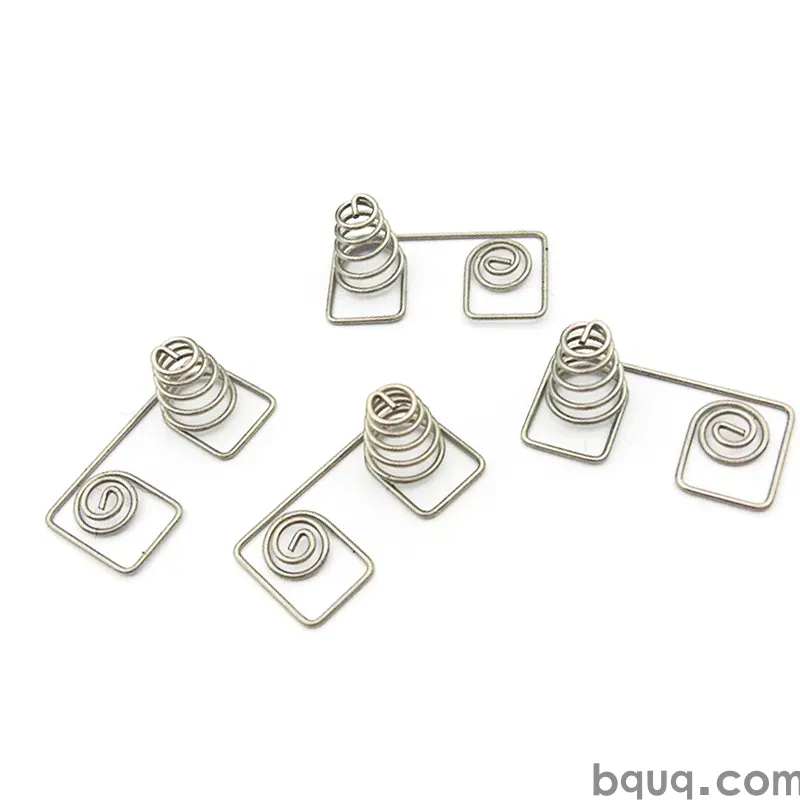
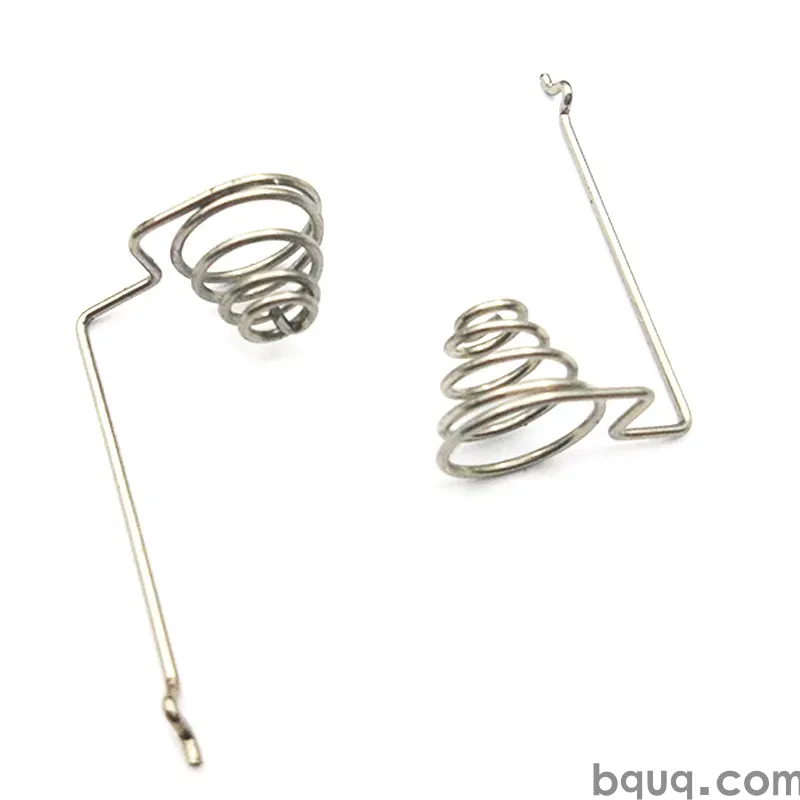
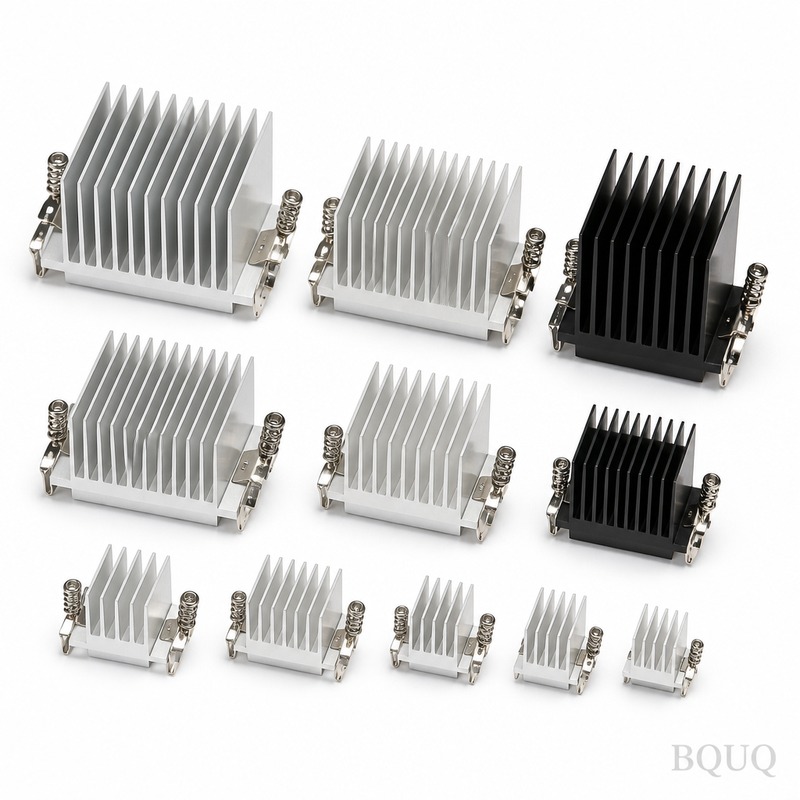
Spring clips — stamped metal or wire forms that hook over the sink and component — apply force without tools and without torque scatter. A well-designed clip holds the sink down with a repeatable force that does not depend on the assembler's wrist, and clips tolerate thermal expansion because they flex. This is the default for PCB components like TO-220, TO-247, and memory or chipset sinks, and it is why stamped clip-on stamped heat sinks dominate high-volume consumer electronics.
The clip is a spring, which means it has a rate and a fatigue life. Force must be checked at the extremes of component height tolerance — a clip designed for the nominal package height may exert too little on a short component or too much on a tall one. When we build clip-on sinks at BQUQ, the spring steel clip and the aluminum body come from the same factory, which keeps the force specification honest: the clip is tested at the sink it ships on, not on paper. Springs and stampings are everyday work for us, and the two product lines meet exactly here.
Adhesives and Tapes: Mounting Where Holes Cannot Go
When there is no component flange, no PCB hole, and no access for a driver, bonding is the answer. Thermally conductive tapes are pressure-sensitive adhesives filled with conductive ceramic — peel, place, press. They are fast and automated, but their impedance is the highest of the mounting methods, they creep under sustained load and temperature, and removal usually destroys the tape and often the part. Thermally conductive epoxies give a better, thinner bond line and higher strength, but they need cure time, dispensed volume control, and they are permanent.
| Bonding method | Typical impedance | Strength | Max continuous temp |
|---|---|---|---|
| PSA thermal tape | 1-5 K·cm²/W | Low-moderate | 80-120 °C |
| Conductive epoxy | 0.3-1.5 K·cm²/W | High | 120-200 °C |
| Solder (where applicable) | 0.05-0.2 K·cm²/W | High | Solder-dependent |
Takeaway: bonding is for low-to-moderate power and permanent assembly — LED boards to housings, small sinks on drivers, sensors on heatsinks. It is the wrong tool above a few tens of watts of dissipation, where the interface impedance and the lack of a pressure path cost too much. When a bonded joint must also isolate vibration, keep the bond area small and the adhesive thick enough to flex — but remember thicker adhesive means more thermal resistance.
Matching Method to Scenario
The right mounting method falls out of four questions: how much heat, can the board carry holes, does the product need service access, and what volume is assembly running at. The scenario table below is the practical shortcut:
| Scenario | Recommended mounting |
|---|---|
| Power module, high watts, serviceable | Screws + grease, flat machined base |
| TO-220 / TO-247 on a PCB | Spring clip + pad |
| High-volume consumer board | Clip-on stamped sink or tape |
| LED board bonded into a housing | Thermal tape or epoxy |
| Vibration environment | Screws with threadlocker or clip with positive lock |
Takeaway: when in doubt, choose the method that lets the interface material see its rated pressure — a screw or clip doing that beats an adhesive that cannot. And remember the sink itself must suit the method: stamped bodies take clips naturally, machined bases take precision screw joints, and both are worth comparing on your actual part. Send the component, the watts, the PCB layout, and the service requirement with the inquiry, and a factory running both stamped and machined lines — like our Dongguan plant — can quote the mounting strategy as part of the sink, not as an afterthought.
Email sc@bquq.com or WhatsApp +86 137 1315 7787 with your PDF/DXF/STEP file. An engineer reviews it and replies with price, lead time and DFM notes on working days.
Frequently Asked Questions
Q: How much pressure does a heat sink mounting really need?
A: Most thermal pads and greases perform best at 10-50 psi of contact pressure, with diminishing returns beyond ~100 psi. The mounting hardware — screw torque or clip design — should be chosen to land the joint inside that window.
Q: Are spring clips better than screws for mounting heat sinks?
A: Clips win on assembly speed, no-tool installation, and force consistency that does not depend on assembler torque. Screws win on maximum, most repeatable force for high-power joints. Choose clips for PCB components and volume; screws for power modules.
Q: When can I use thermal tape instead of screws or clips?
A: When power is low (roughly under 10-20 W), the assembly is permanent, and no hole or fastener access exists — for example LED boards bonded into housings. Tape impedance is highest of the methods and removal is destructive, so it is not for serviceable or high-power joints.
Q: Does overtightening a heat sink screw hurt thermal performance?
A: Yes — excess pressure can bow the sink base, crack the component package, or squeeze grease out of the joint, all of which raise interface resistance. Torque to the specification and use a spring or shoulder washer to keep pressure stable over temperature.
Q: Do mounting clips lose force over time?
A: Spring clips relax slightly with thermal cycling and can creep if stressed near their elastic limit. Design the clip with margin, check force at component height extremes, and for sustained high-temperature applications prefer a clip material rated for the service temperature.
Related Articles
- led-heat-sink-selection-guide — More from the BQUQ Thermal Management engineering series.
- thermal-interface-materials-guide — More from the BQUQ Thermal Management engineering series.
- aluminum-6063-vs-6061-thermal-conductivity — More from the BQUQ Thermal Management engineering series.
Data Sources and Verification
Tolerances, cycle times and price ranges in this guide come from BQUQ production records at our Dongguan plant, where CNC machining (±0.005 mm), stamping, custom springs and heat sinks run under one roof. BQUQ is an ISO 9001:2015 certified factory; the certificate and batch inspection reports are available on request with every quotation.
Related Resources
- About BQUQ: an ISO9001-certified source factory in Dongguan running four production lines under one roof.
- Heat sinks and thermal parts: extruded, CNC-machined and stamped options from the thermal line — extruded heat sinks, CNC-machined heat sinks, stamped heat sinks.
- Industry trends: manufacturing, material market, and sourcing analysis for buyers.
- Technical articles: engineering guides and process comparisons — more where this article came from.
- FAQ hub: quick answers on CNC, stamping, springs, and heat sinks.
- Case studies: real parts and real numbers from projects we engineered and delivered.
- Contact us: send your drawing and get a quote within 12 working hours.
Authored by the BQUQ Engineering Team. BQUQ is an ISO9001-certified source factory in Dongguan, China, running CNC machining, metal stamping, custom springs and heat sink lines under one roof. Send drawings to sc@bquq.com or WhatsApp +86 13713157787 for a quote within 12 working hours. www.bquq.com