BQUQ compares thermal adhesives, tapes and bonded heat sinks against clips and screws: conductivity, strength, temperature limits and cost decisions.
Thermal Adhesives and Bonded Heat Sinks: When Glue Beats Clips
Short answer: adhesive attachment wins when the part is light, the heat flux is modest, and you want to eliminate screws, clips, labor and stress points — below roughly 15–30 W and 100–200 g of sink mass, a filled epoxy or thermal tape is often the cheapest reliable answer. Screws and clips win when power is high, the sink is heavy, or the assembly must be serviced. A structural thermal epoxy conducts 1–3 W/m·K with bond lines of 0.05–0.15 mm, versus 0.5–1.5 W/m·K for PSA tape and 3–8 W/m·K for quality paste that needs clamping pressure to work.
The phrase "glue beats clips" sounds like a shortcut, but in thermal design it is a real engineering choice with defined boundaries. Adhesive bonding removes the spring clip, the screw, the hole pattern and the assembly labor, and on the right application it is cheaper, lower-stress and thermally adequate. On the wrong application it is a field-failure generator. The skill is knowing which side of the line you are on, and the line is drawn in watts, grams and service requirements.
Two Different "Adhesive" Questions
There are two separate decisions hiding in this topic. One is attaching a heat sink to a component with adhesive instead of a clip or screw, which is what most buyers mean by "glue the sink on." The other is how the heat sink itself is manufactured: bonded-fin heat sinks assemble thin aluminum fins into a base with epoxy or brazing, versus an extruded or machined monolith. Both are worth understanding because they answer different questions, and the word "bonded" on a heat sink datasheet usually refers to the construction, not your assembly.
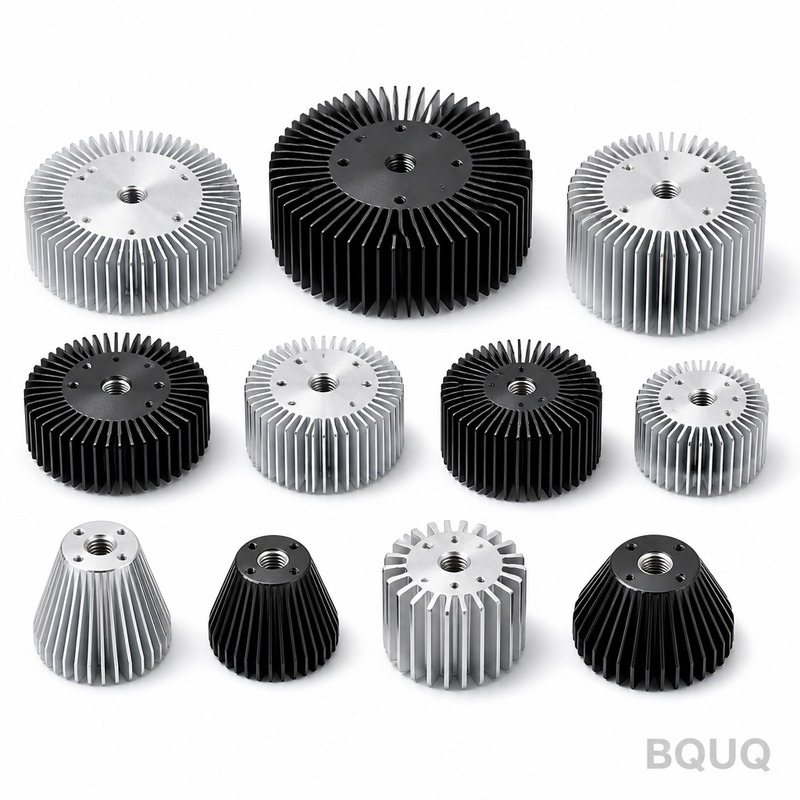
Construction first, briefly: bonded-fin sinks use thin fins, typically 0.2–0.6 mm aluminum, epoxied or brazed into a base plate, reaching surface densities that extrusion cannot. The epoxy-bonded version is cheaper than brazed and runs at lower service temperatures, typically up to 150 °C versus 250 °C+ for brazed aluminum. Our heat sink type comparison (extruded vs CNC vs stamped vs skived) covers when bonded construction earns its cost. This article focuses on the assembly decision, where the adhesive competes with clips and screws.
The Thermal Physics of the Joint
Every attachment method is a thermal joint, and its quality is measured in resistance per unit area. The joint's job is to conduct heat across the interface with the thinnest possible gap, because still air trapped in a gap conducts about 0.03 W/m·K, roughly 100× worse than the metal on either side. An adhesive fills the gap and conducts instead, but adhesives are inherently poor conductors because their polymer matrix conducts heat badly; manufacturers load them with ceramic or metal fillers to reach usable values.
| Attachment method | Conductivity | Typical thickness | Pressure needed | Removable |
|---|---|---|---|---|
| PSA thermal tape | 0.5–1.5 W/m·K | 0.1–0.25 mm | Light, hand | Difficult |
| Filled epoxy adhesive | 1–3 W/m·K | 0.05–0.15 mm | Cure with light clamp | No |
| Phase-change or paste + clip | 3–8 W/m·K | 0.03–0.10 mm | Clamp 50–200 kPa | Yes |
| Solder / braze | 20–60 W/m·K | ~0.05 mm | Process heat | No |
| Direct metal contact + screw | — | ~0.02 mm voids | High | Yes |
The table explains the real trade. Paste with a clip is thermally best because the paste itself is highly filled and the clip supplies pressure to keep the bond line thin. Adhesives give up some conductivity to gain structure: they hold the sink on without any clamp. The resistance penalty of a 1–2 W/m·K adhesive at a 0.1 mm bond line works out to an added 0.05–0.2 K/W across a typical 25 × 25 mm interface, which is acceptable below roughly 15–30 W and unacceptable at high flux where every 0.1 K/W is budget.
Where Adhesive Attachment Genuinely Wins
Adhesive attachment shines in four situations. Space-constrained assemblies where a clip needs keep-out area or a screw needs a boss: glue adds nothing outside the footprint. Vibration-sensitive stacks: a clip transmits and can fret, while a compliant adhesive layer damps. Fragile components, like a ceramic package or a small transistor that a spring clip could crack: adhesive spreads the load. And cost-driven high-volume assembly: one drop of epoxy or one tape preform replaces a clip part, a screw part and two placement operations, and automation applies adhesive faster than it torques screws.
| Application | Typical heat | Typical sink weight | Adhesive verdict |
|---|---|---|---|
| Small MOSFET / regulator on PCB | 1–5 W | 5–30 g | Wins on cost and simplicity |
| LED board to housing | 3–15 W | 20–80 g | Wins if no service needed |
| Chipset on motherboard | 5–25 W | 50–150 g | Tape common in laptops |
| CPU / GPU class | 65 W+ | 200–500 g | Clips or screws required |
| Inverter module baseplate | 100 W+ | 500 g+ | Screws with paste, always |
The weight and power lines above are indicative and interact: a heavy sink under shock loading generates shear at the bond that thin layers of brittle epoxy resist poorly, and a hot sink drives thermal cycling that fatigues the bond over years. When both power and mass are low, the adhesive joint is usually over-engineered in favor of gluing; when either is high, the mechanical methods earn their cost. The middle band is where CTE mismatch matters: adhesive must tolerate the different expansion rates of, say, an aluminum sink (23 ppm/K) and a ceramic or FR-4 surface, which is why high-CTE-mismatch joints want a compliant adhesive, not a rigid one.
Specifying the Bond So It Stays Bonded
If the decision lands on adhesive, the specification decides whether it survives. Define the maximum service temperature and check the adhesive's continuous rating with margin: many epoxies soften around 120–150 °C and tapes degrade above roughly 80–125 °C. Define the bond area and the worst-case shear load from shock and vibration, then verify the adhesive's lap-shear strength in the range of several hundred psi to over 1,000 psi for structural epoxies against your surface preparation. Define the surface prep, because adhesive joints fail on dirty or oily surfaces: degreasing, and for aluminum often a light abrasion or conversion coating, is what makes the bond repeatable in production.
| Adhesive type | Service temp | Shear strength class | Cure | Best use |
|---|---|---|---|---|
| Acrylic PSA tape | −40 to 125 °C | Low–moderate | Instant, pressure | Light sinks, assembly speed |
| Filled epoxy (two-part) | −40 to 150 °C | High | Heat or room cure | Structural, permanent |
| Silicone adhesive | −50 to 200 °C+ | Low–moderate | RTV cure | High temp, needs compliance |
| Thermally conductive film | −40 to 150 °C | Moderate | Heat and pressure | Preforms, automation |
Process control is the part factories earn their keep on: consistent adhesive volume, consistent placement, controlled cure, and 100% bond-line inspection where the joint is thermal-critical. At BQUQ we machine heat sinks with flat, clean bonding faces, and we quote the machined sink and the stamped or machined clip options side by side so the choice is made on numbers, not habit. If your assembly people can place a screw, they can place a clip; the question is whether your service plan allows the sink to be permanent. If it does, adhesive often wins on total cost. If a field technician must ever remove the sink, choose clips or screws with paste, and let the mounting methods guide settle the details.
Qualifying the Bond Before Volume Production
An adhesive joint that looks fine on a bench can fail in the field, so qualification has to exercise the real service conditions. The standard battery includes thermal cycling across the expected range, typically hundreds of cycles from about −40 °C to the maximum service temperature, which drives the CTE-mismatch fatigue that kills rigid bonds on aluminum-to-ceramic or aluminum-to-PCB stacks. Add vibration and shock representative of shipping and operation, and a humidity soak if the assembly lives outdoors, because moisture attacks both the bond interface and the aluminum surface under it.
Define the pass criteria before the test, not after. Shear strength at temperature, not just at room temperature, is the number that matters for a sink that will run hot. Bond-line thickness should be measured on cross-sections or inferred from the thermal result, because a thick, uneven bond line is both a mechanical and a thermal defect. And decide what inspection runs in production: process controls on surface preparation and adhesive application, plus sampling of pull or shear strength per batch, with the sample rate tied to how catastrophic a loose sink would be in service.
Production control is where adhesive attachment either earns its reputation or destroys it. The variables are mundane and unforgiving: degreasing quality, abrasion consistency, adhesive mix ratio and pot life for two-part epoxies, cure temperature and time, and the pressure applied during cure. Each one drifts on a production line, and each drift moves the bond from structural to decorative. A factory that documents these parameters and checks them on a schedule is qualified to bond; one that applies adhesive like paint is not, whatever the datasheet says.
When the application is serviceable, the answer is not adhesive at all, and the honest supplier says so. Clips and screws with a quality TIM remain the standard for anything a technician may need to remove, and the choice between them and adhesive is a service-plan decision before it is a thermal one. At BQUQ we machine clean, flat bonding faces, offer anodize for adhesion and radiation, and quote the stamped or machined clip alternative in the same email so the comparison is arithmetic. Send the watts, mass, service temperature and serviceability requirement to sc@bquq.com or WhatsApp +86 13713157787 for a quote within 12 working hours.
Frequently Asked Questions
Q: Is thermal adhesive as good as thermal paste with a clip?
A: Thermally, no: quality paste conducts 3–8 W/m·K and the clip holds the bond line thin, while filled epoxy runs 1–3 W/m·K and must also carry the mechanical load. Practically, yes for low-power, light-sink assemblies where eliminating the clip saves more cost than the extra 0.05–0.2 K/W costs.
Q: What is the maximum power for gluing a heat sink on?
A: There is no hard number, but adhesive attachment is typically comfortable below roughly 15–30 W and 100–200 g of sink mass for standard epoxies and tapes. Above that, joint resistance and mechanical risk grow faster than the savings, and clips or screws with paste become the reliable choice.
Q: What temperature can thermally bonded heat sinks survive?
A: Epoxy-bonded fin construction typically serves up to about 150 °C, brazed construction well above 250 °C, and acrylic tapes in attachment duty roughly 80–125 °C. Check the specific material's continuous rating and derate for thermal cycling before finalizing the design.
Q: Why did my bonded heat sink come loose in the field?
A: The usual causes are surface contamination at bonding, an adhesive rated below the actual service temperature, a bond area too small for the shock and vibration loads, or thermal cycling fatigue from a CTE mismatch. Fix with surface prep, a compliant adhesive, and a shear-load calculation against your worst-case environment.
Q: Can BQUQ supply heat sinks ready for adhesive bonding?
A: Yes. We machine flat, clean bonding faces, offer anodized finishes that improve both adhesion and radiation, and can supply machined or stamped clips as the alternative so you can compare cost both ways. Send your watts, sink mass and service temperature to sc@bquq.com or WhatsApp +86 13713157787 for a quote within 12 working hours.
Related Resources
- Heat Sink Mounting Methods Guide — clips, screws, adhesives and tape compared across applications.
- Thermal Interface Materials Guide — from paste to phase-change, what sits between sink and source.
- CNC-machined heat sinks — flat bonding faces and machined mounting features from Dongguan.
- Contact us — send your drawing for a quote within 12 working hours.
Authored by the BQUQ Engineering Team. BQUQ is an ISO9001-certified source factory in Dongguan, China, running CNC machining, metal stamping, custom springs, heat sink and collet lines under one roof. Send drawings to sc@bquq.com or WhatsApp +86 13713157787 for a quote within 12 working hours. www.bquq.com