6063-T5 conducts roughly 200 W/m·K vs 155–170 for 6061-T6. When the alloy matters for heat sinks and when strength wins. Typical values explained.
Aluminum 6063 vs 6061 for Heat Sinks: Which Conducts Better?
Short answer: for conducting heat, 6063-T5 wins — roughly 200 W/m·K versus 155–170 W/m·K for 6061-T6, about 15–25% better, and it is the alloy made for extruding. 6061 is the stronger alloy (about double the yield strength), machines cleaner, and is the default for CNC-machined sinks and structural parts. Rule of thumb: extruded heat sink profile — 6063; machined sink or sink-plus-structure — 6061; and never let a 15% conductivity gap talk you into a weaker part when surface area does the real work.
Both alloys are 6000-series aluminum, both anodize well, both are everywhere in electronics. But they are not interchangeable, and the differences that matter for thermal parts are conductivity, extrudability, strength, and surface finish. This guide gives you the numbers and the decision rule, with typical published values — check the specific temper and supplier certificate when the design is critical.
Why Do 6063 and 6061 Conduct Heat Differently?
Conductivity in aluminum alloys drops as alloying elements are added, because those elements scatter the electrons that carry heat. 6061 carries more alloy content — higher magnesium and silicon, plus small amounts of copper and iron. Copper especially is efficient at wrecking conductivity. 6063 is a leaner alloy: less magnesium and silicon, no intentional copper. Less alloy scatter, more heat flow.
That is also why 6063 is the extrusion alloy of the industry. Lean chemistry flows through a die more easily, fills thin fin slots more reliably, and allows faster extrusion speeds. 6061 can be extruded, but fin profiles come out slower, and thin sections are harder to fill evenly. When you see a finned aluminum profile, it is almost always 6063.
How Much Thermal Performance Do You Lose With 6061?
The honest answer: less than the datasheet panic suggests. Published typical values put 6063-T5 around 200 W/m·K and 6061-T6 in the 155–170 W/m·K range. That is a real gap of roughly 15–25%.
| Property (typical values) | 6061-T6 | 6063-T5 |
|---|---|---|
| Thermal conductivity | 155–170 W/m·K | ~200 W/m·K |
| Tensile strength | ~310 MPa | ~185–205 MPa |
| Yield strength | ~275 MPa | ~145 MPa |
| Extrudability | Good, slower on thin fins | Excellent |
| Anodize appearance | Can show streaking | Bright, uniform |
| Machinability | Clean chips, good finish | Softer, slightly gummy |
| Typical use | Machined sinks, structural parts | Extruded fin profiles |
Here is the engineering reality: heat sink performance scales with total surface area and air flow far more than with the last 20% of alloy conductivity. A 6061 sink with one extra fin, or a slightly taller fin, easily beats a 6063 sink of identical envelope. Conductivity matters most when space is so tight that every fin counts — and that is exactly when you also want the thin, dense fins that only the best extrusion alloys can produce.
When Should You Choose 6063?
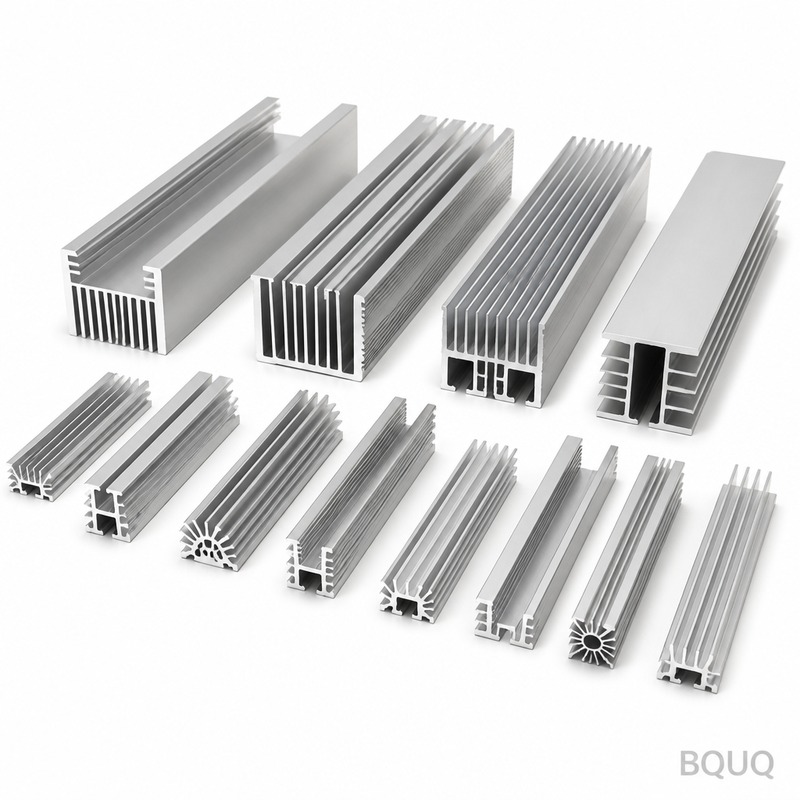
Choose 6063 when the heat sink is extruded. It is the standard for a reason: it extrudes faster, fills thin fin sections better, and conducts better. Extruded heat sinks for LED drivers, power supplies, amplifiers, and telecom gear are almost universally 6063, and the anodized surface comes out brighter and more uniform — visible value when the sink is part of the product's look.
Choose 6063-T5 versus T6 carefully. T5 means the profile is cooled and artificially aged right off the press — cheaper, and fine for most heat sinks since mechanical loads are modest. T6 gets a solution heat treatment and full aging for higher strength, at added cost. A heat sink that also carries mounting loads may justify T6; a plain finned profile does not.
When Should You Choose 6061?
Choose 6061 when the part is doing two jobs — conducting heat and carrying structure. A CNC-machined heat sink that is also the chassis wall, an enclosure baseplate that mounts boards and connectors, a cold plate with threaded mounting holes that get assembled and disassembled repeatedly — those want 6061's roughly double yield strength and its cleaner machining behavior. Threads in 6063 strip more easily; tapped holes in 6061 hold up to torque.
Machined heat sinks are usually 6061 for a practical reason too: it cuts cleanly and holds tight tolerances without smearing, which matters when you are milling thin fins and precision mounting surfaces in the same setup. Our CNC-machined heat sinks run 6061 by default unless the drawing specifies otherwise, and we machine 6063 profiles when a part transitions from extrusion to finished product.
| Scenario | Recommended alloy | Reason |
|---|---|---|
| Extruded fin profile, LED/power supply | 6063-T5 | Conductivity, extrudability, cost |
| Extruded sink carrying mechanical load | 6063-T6 | Strength without losing the alloy's thermal edge |
| CNC-machined sink, prototype or low volume | 6061-T6 | Machinability, strength, no die involved |
| Sink integrated into chassis or enclosure wall | 6061-T6 | Structural duty, threaded features |
| Highest-density fin design, tight envelope | 6063 (skived or extruded) | Best conductivity per gram of fin |
What About Anodizing and Surface Finish?
Both alloys anodize well, and for a heat sink the anodize layer is usually a plus: the hard, dark coating radiates heat slightly better than bare metal. The difference shows in cosmetics. 6063 anodizes to a bright, even finish with few streaks — one more reason it dominates visible extruded products. 6061's copper and iron content can show up as subtle color streaks or smut on large anodized surfaces, especially in dark colors like black. For a purely functional sink that gets hidden inside an enclosure, nobody cares. For a visible heat sink that is part of industrial design, 6063 looks better on the shelf.
One caution: anodize is an insulator, and a thick hard-coat layer adds measurable thermal resistance at the air surface. For high-performance sinks, designers sometimes mask the base contact area or specify thin decorative anodize. If thermal resistance targets are tight, run the numbers — our thermal resistance guide shows how to account for coatings in the calculation.
Does the Alloy Choice Change the Thermal Resistance Target?
Marginally. The thermal resistance of a heat sink is dominated by the air-side convection — the fins and the airflow — not by the alloy. Alloy conductivity shows up in the spreading resistance inside the base: how efficiently heat travels from the component footprint out to the fins. With a thick base and a small heat source, 6061 versus 6063 can shift spreading resistance a few tenths of a K/W on a small sink, and nearly nothing on a large one. If you are chasing fractions of a degree, spend the effort on fin area and airflow first, then take the alloy upgrade as a bonus.
If you are still deciding between processes and alloys together, start with our heat sink types guide, which compares extruded, CNC-machined, stamped, and skived manufacturing. And when you send us your thermal spec — watts, ambient, max temperature, envelope — we will quote the right alloy and process within 12 hours on working days, from extruded heat sinks to CNC-machined ones, all made in our ISO9001 Dongguan plant.
Email sc@bquq.com or WhatsApp +86 137 1315 7787 with your PDF/DXF/STEP file. An engineer reviews it and replies with price, lead time and DFM notes on working days.
Which heat sink process fits? (Decision tree)
| If your case... | Choose | Why |
|---|---|---|
| Uses a standard profile at 1,000+ pcs | Extruded | Lowest unit cost once the die exists |
| Is a prototype, low volume or odd shape | CNC machined | No tooling, fast turnaround |
| Needs thin folded fins at high volume | Stamped | Thin fins at low unit cost |
| Has high flux density at mid volume | Skived | Dense fins, joint-free fin base |
| Dissipates more than about 300 W | Heat pipe assembly | Spreads heat beyond the base footprint |
| Is sealed with no airflow | Conduction to chassis or cold plate | Convection is not available |
Frequently Asked Questions
Is 6063 or 6061 better for a heat sink?
A: For heat transfer alone, 6063 — about 200 W/m·K versus 155–170 for 6061. But 6061 is roughly twice as strong and machines better. Use 6063 for extruded fins, 6061 when the sink doubles as structure.
Why is 6063-T5 used for most extruded heat sinks?
A: Lean alloy chemistry gives it better conductivity and it flows through extrusion dies faster, filling thin fin sections reliably. It also anodizes to a brighter, more uniform finish.
What is the thermal conductivity of 6061-T6 aluminum?
A: Typical published values are 155–170 W/m·K. Compare that with 6063-T5 at roughly 200 W/m·K and pure aluminum around 210–230 W/m·K.
Can I machine a heat sink from 6063 instead of 6061?
A: Yes, but 6063 is softer and more gummy to cut, so thin fins and tight features are easier in 6061. Most CNC-machined sinks use 6061-T6; 6063 stays on the extrusion line.
Does the aluminum alloy really matter for my heat sink's performance?
A: Less than fin area and airflow, but it is not nothing. Alloy differences shift base spreading resistance a little. Pick the alloy for process and structural reasons first, then optimize fins and airflow for the thermal budget.
Related Articles
- Custom Heat Sinks for Electronics: Extruded vs CNC vs Stamped vs Skived — Extruded, CNC-machined, stamped, and skived heat sinks compared: tooling cost, fin density, and which wins at your volume, from a Dongguan source factory.
- Heat Sink Thermal Resistance: How to Calculate What You Need — R = ΔT/Q with a worked example, plus typical convection values (natural 5–10, forced air 25–100 W/m²·K) and the thermal spec your factory needs.
Data Sources and Verification
Tolerances, cycle times and price ranges in this guide come from BQUQ production records at our Dongguan plant, where CNC machining (±0.005 mm), stamping, custom springs and heat sinks run under one roof. BQUQ is an ISO 9001:2015 certified factory; the certificate and batch inspection reports are available on request with every quotation.
Related Resources
- About BQUQ: an ISO9001-certified source factory in Dongguan running four production lines under one roof.
- Heat sink products: compare extruded heat sinks, CNC machined heat sinks, and stamped heat sinks for your thermal design.
- Industry trends: manufacturing, material market, and sourcing analysis for buyers.
- Technical articles: engineering guides on CNC, heat sinks, springs, and stamping — more where this one came from.
- FAQ hub: quick answers on CNC, stamping, springs, and heat sinks.
- Case studies: real parts and real numbers from projects we engineered and delivered.
- Contact us: send your drawing and get a quote within 12 working hours.
Authored by the BQUQ Engineering Team. BQUQ (Dongguan) runs CNC machining (±0.005 mm), metal stamping, custom springs, and heat sink production in one ISO9001 factory. Source-direct from Dongguan, China — quote in 12 hours: sc@bquq.com | WhatsApp +86 13713157787 | www.bquq.com