Copper conducts ~2x aluminum but weighs 3.3x more and costs ~10x per volume. When it earns its price. BQUQ (ISO9001, Dongguan) quotes in 12 hours.
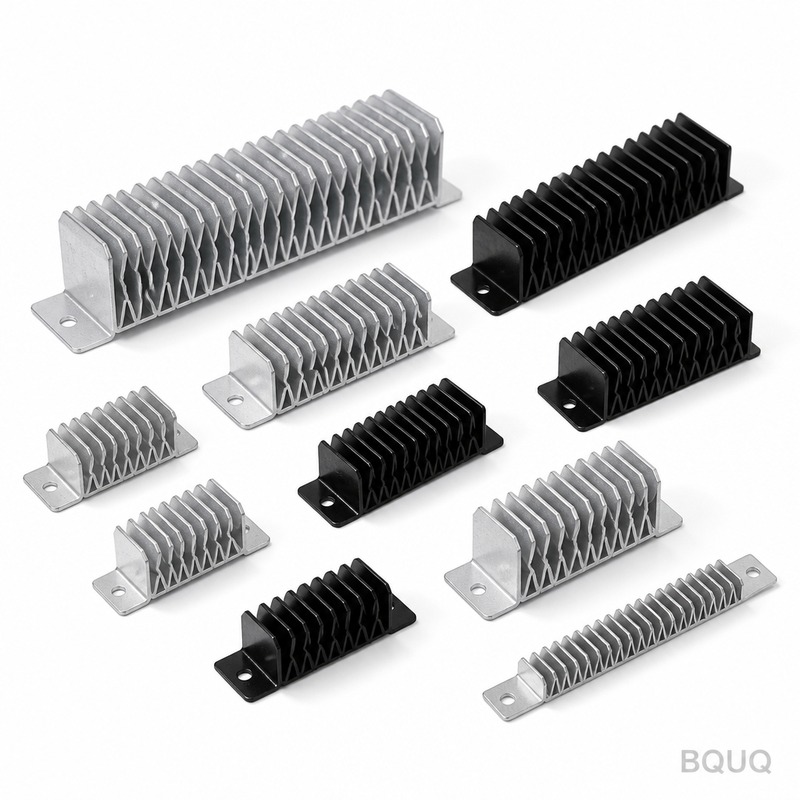
Aluminum vs Copper Heat Sinks: Thermal, Weight and Cost Tradeoffs
Copper conducts heat roughly twice as well as aluminum — about 385-400 W/m·K against 160-200 for the common heat sink alloys — but it weighs 3.3 times more per unit volume and costs roughly 10 times more for the same part geometry. The result: solid copper heat sinks are the exception, not the rule, and most of the time the smartest design is an aluminum fin block with copper only where the heat is most concentrated.
Every material choice in a heat sink is a negotiation between spreading heat and moving it to air. Aluminum spreads well, weighs little, and extrudes into complex fin shapes cheaply — which is why the overwhelming majority of heat sinks are aluminum. Copper spreads better, which matters when heat flux is high and space is tight, but its weight, cost, and manufacturing difficulty punish anything larger than it needs to be. This guide quantifies the tradeoff and shows where copper genuinely earns its price.
The Material Facts, Side by Side
Start with the properties that drive the decision. The gap in conductivity is real but smaller than marketing suggests — a factor of two, not ten — while the penalties in weight and cost are much larger.
| Property | Aluminum 6063-T5 | Aluminum 6061-T6 | Copper (C110/C101) |
|---|---|---|---|
| Thermal conductivity | ~200 W/m·K | ~155-170 W/m·K | 385-400 W/m·K |
| Density | 2.70 g/cm³ | 2.70 g/cm³ | 8.96 g/cm³ |
| CTE | ~23 ppm/K | ~23 ppm/K | ~16.5 ppm/K |
| Relative cost per volume | 1× | ~1.1× | ~10-14× |
| Relative weight (same part) | 1× | 1× | 3.3× |
Takeaway: copper's real advantage is a 2× conductivity gain for heat spreading — but you pay for it in three dimensions: roughly 10-14× the material cost per part and 3.3× the weight. Those ratios are why solid copper sinks are rare outside specialty electronics.
Why Aluminum Wins the Default Design
Aluminum does not just cost less — it allows better fin geometry. Extrusion turns 6063 into long, thin, densely packed fins at low tooling cost, and the added fin surface area usually outweighs copper's conductivity advantage. A fin's job is to shed heat to air, and air-side convection is the bottleneck; once fins are reasonably efficient, extra fin area beats extra fin conductivity. This is why an extruded heat sink in 6063, with its ~200 W/m·K and low density, is the standard answer from LED luminaires to power electronics.
Add manufacturing economics and the case closes further. Aluminum extrudes, machines fast, and anodizes; copper does not extrude into the same fin geometries economically, machines slower with more tool wear, and weighs down any structure it joins. For most products the honest calculation is: can the extra spreading copper provides be replaced by slightly more aluminum surface? Usually yes, and the 6063-versus-6061 choice inside the aluminum family matters more than most designers think — the details are in our 6063 vs 6061 conductivity guide.
When Copper Earns Its Price
Copper wins in exactly three situations. First, high heat flux at a small source: a 300 W IGBT or laser diode on a 30 mm footprint concentrates so many watts per square centimeter that spreading resistance dominates — a copper base pulls heat sideways far faster than aluminum. Second, space-constrained designs where the sink cannot grow: doubling conductivity is worth more than doubling surface area when neither dimension can change. Third, weight-tolerant industrial gear where the sink doubles as a busbar or structural conductor. In all three, copper is used precisely because nothing else fits the envelope.
| Design situation | Aluminum | Copper |
|---|---|---|
| High flux, small source, tight space | Struggles to spread | Spreads ~2× faster |
| Ample envelope, natural convection | Best value | Waste of cost/weight |
| Fan-cooled, dense fins | Excellent | Marginal gain |
| Vibration / shock environment | Lighter, easier to support | 3.3× mass penalty |
Takeaway: ask first whether the problem is spreading heat sideways from a small hot spot or moving it out of a large fin area. Spreading problems are copper's territory; surface-area problems are aluminum's — and most heat sink problems are the second kind.
The Hybrid Answer: Copper Where It Counts
The engineering sweet spot is usually neither pure material but a hybrid: a copper base or embedded copper spreader under the hot components, with aluminum fins bonded or clipped above it. The copper handles the high-flux spreading zone where its conductivity matters; the aluminum carries the large, low-cost fin area where conductivity matters less. This is the standard architecture in high-end CPU coolers, IGBT assemblies, and laser mounts.
| Hybrid construction | Typical use | Tradeoff vs solid copper |
|---|---|---|
| Copper base + bonded aluminum fins | High-end CPU / GPU coolers | Much lighter, cheaper |
| Copper plate embedded in aluminum base | IGBT modules | Simpler bond, less copper |
| Copper heat pipe in aluminum fin block | Laptops, compact gear | Moves heat before fins |
| Skived copper fins on copper base | Extreme flux | Costly, for specialty |
Takeaway: hybrid designs capture most of copper's spreading benefit at a fraction of the weight and cost penalty. The engineering cost is the bond between copper and aluminum — brazed, soldered, or mechanically clamped joints must stay thin and reliable across thermal cycling, and CTE mismatch between the two metals is a real fatigue consideration.
Manufacturing Reality and Total Cost
Material cost is only the start. Copper is gummy to machine, so CNC-machined heat sinks in copper run slower feeds, shorter tool life, and typically a 30-100% machining premium over aluminum equivalents. Skived copper fins and brazed copper-base assemblies add process steps. Aluminum extrusion dies are cheap and fast; copper profiles are a niche. When you compare quotes, compare the assembled, finished part — a copper sink that performs 15% better but costs 4× is rarely the right buy, while a copper base plate that doubles the spreading of a $0.50 aluminum fin block can be excellent value. Send the factory your watts, source size, envelope, and weight limit together with the drawing; a shop that builds both aluminum and copper versions of the same part — as our heat sink lines in Dongguan do — can quote the pair so the crossover is visible in dollars, not feelings.
Email sc@bquq.com or WhatsApp +86 137 1315 7787 with your PDF/DXF/STEP file. An engineer reviews it and replies with price, lead time and DFM notes on working days.
Frequently Asked Questions
Q: Is copper always better than aluminum for heat sinks?
A: No. Copper conducts about twice as well, but heat sink performance is usually limited by air-side convection, where aluminum's cheaper, denser fin geometry wins. Copper earns its cost mainly for high heat flux, tight spaces, or spreading from small sources.
Q: How much more does a copper heat sink cost than aluminum?
A: Roughly 10-14× more per part by material volume, plus a 30-100% machining premium and denser, harder-to-form geometry. The finished-part price gap is why solid copper sinks are reserved for designs that truly need the spreading.
Q: Why do many high-end coolers use copper even though aluminum is cheaper?
A: Because they combine a copper base for fast heat spreading from a small CPU die with aluminum fins for cheap surface area. The hybrid captures copper's benefit where it matters and aluminum's economy where it matters — the best of both.
Q: Can copper and aluminum be joined reliably in one heat sink?
A: Yes — by brazing, soldering, or mechanical clamping — but the joint must stay thin and stable across thermal cycles, and the CTE mismatch between copper and aluminum creates fatigue stress. Design the bond area and its temperature swing carefully.
Q: When should I choose 6063 aluminum over copper for a heat sink?
A: Whenever the envelope allows enough fin surface — which covers most LED, consumer, and industrial designs. 6063's ~200 W/m·K with dense extruded fins delivers the required performance at a fraction of copper's weight and cost.
Related Articles
- heat-sink-thermal-resistance-calculation — More from the BQUQ Thermal Management engineering series.
- black-anodized-heat-sink-why — More from the BQUQ Thermal Management engineering series.
- natural-vs-forced-convection-heat-sinks — More from the BQUQ Thermal Management engineering series.
Data Sources and Verification
Tolerances, cycle times and price ranges in this guide come from BQUQ production records at our Dongguan plant, where CNC machining (±0.005 mm), stamping, custom springs and heat sinks run under one roof. BQUQ is an ISO 9001:2015 certified factory; the certificate and batch inspection reports are available on request with every quotation.
Related Resources
- About BQUQ: an ISO9001-certified source factory in Dongguan running four production lines under one roof.
- Heat sinks and thermal parts: extruded, CNC-machined and stamped options from the thermal line — extruded heat sinks, CNC-machined heat sinks, stamped heat sinks.
- Industry trends: manufacturing, material market, and sourcing analysis for buyers.
- Technical articles: engineering guides and process comparisons — more where this article came from.
- FAQ hub: quick answers on CNC, stamping, springs, and heat sinks.
- Case studies: real parts and real numbers from projects we engineered and delivered.
- Contact us: send your drawing and get a quote within 12 working hours.
Authored by the BQUQ Engineering Team. BQUQ is an ISO9001-certified source factory in Dongguan, China, running CNC machining, metal stamping, custom springs and heat sink lines under one roof. Send drawings to sc@bquq.com or WhatsApp +86 13713157787 for a quote within 12 working hours. www.bquq.com