Natural convection moves 3-10 W/m2-K; forced air 25-100+. When passive wins, when a fan wins. BQUQ (ISO9001, Dongguan) quotes in 12 hours.
Natural vs Forced Convection Heat Sinks: Which Cooling Strategy
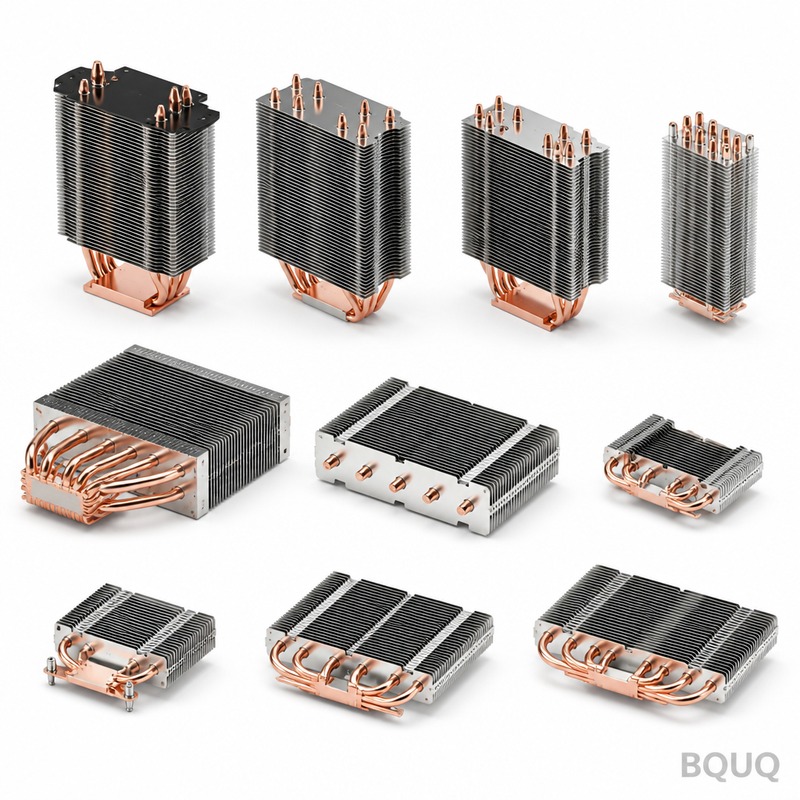
Natural convection moves roughly 3-10 W per square meter per degree of temperature difference; forcing air across the same fins at 2-3 m/s raises that to 25-60, and at 5 m/s toward 100. That 5-20× multiplier is why a 100 W passive design needs a large finned extrusion while a fan-cooled sink of a third the size handles the same load — the real choice is between free space and moving parts.
Every electronics enclosure eventually asks the same question: let the air come to the sink, or push air through it? Passive cooling is silent, free, and has nothing to wear out, but it demands volume and openness. Forced air shrinks the heat sink dramatically but adds noise, dust, a fan with a finite life, and a failure mode your thermal design must survive. This guide lays out the numbers and the decision rules so the choice is engineering, not fashion.
What Each Regime Actually Delivers
The convective coefficient is the single number that separates the regimes. It describes how many watts each square meter of fin surface can shed per degree of temperature difference between fin and air. Everything else — fin count, sink size — follows from it.
| Air condition | Typical convective coefficient | What it means for sink size |
|---|---|---|
| Still air (natural) | 3-10 W/m²·K | Needs large, widely spaced fins |
| Gentle fan, ~1-2 m/s | 15-40 W/m²·K | ~3-4× smaller than passive |
| Real forced air, 3-5 m/s | 40-100 W/m²·K | 5-10× smaller than passive |
| Ducted high-velocity air | 100-250 W/m²·K | Compact, dense fin arrays |
Takeaway: the coefficient is your lever. Doubling air velocity roughly doubles the heat a given fin area removes, which is why a modest fan at the right place beats a heroic fin block in a bad place.
The Envelope Reality: Same Watts, Different Size
Compare a 100 W load with a 50 °C allowable rise — a sink-to-air budget of about 0.5 K/W. A passive design needs roughly 0.1-0.15 m² of exposed fin surface with 8-12 mm fin pitch, which typically means a hefty extrusion around 150-250 mm long. Forced air at 3 m/s reaches the same resistance with a third of the surface and much denser fins.
| 100 W, 50 K rise design | Natural convection | Forced air (3 m/s) |
|---|---|---|
| Typical convective coefficient | 3-8 W/m²·K | 40-70 W/m²·K |
| Required fin surface | ~0.10-0.15 m² | ~0.03-0.05 m² |
| Typical fin pitch | 8-12 mm | 3-6 mm |
| Indicative sink size | 200 × 150 × 60 mm | 120 × 100 × 40 mm + fan |
| Moving parts / noise | None / zero | Fan / 25-45 dBA |
Takeaway: forced air buys back enclosure space at the price of noise and a wear item. For products where space is the constraint — servers, motor drives, compact power supplies — the fan almost always wins; for anything where silence or outdoor reliability leads, passive is the honest answer.
Where Natural Convection Is the Right Answer
Passive cooling wins whenever the application punishes moving parts. Outdoor LED street lights and floodlights run passive because a fan in a sealed IP65 head is a maintenance liability with a short life in heat and dust. Consumer audio, medical devices, and home electronics go passive for acoustics. The design rules for good passive sinks are strict: fins vertical, gaps 6-10 mm, enclosure open top and bottom so air can chimney through, and generous extruded heat sink surface. If the enclosure is sealed and cramped, passive is fighting physics — radiation helps, but the numbers rarely close above a few tens of watts.
The quiet but powerful trick is the hybrid: natural convection for normal operation with a thermostatically switched fan for peaks. The sink is sized for continuous load; the fan covers the worst case and rarely runs, so acoustics and fan life both stay acceptable. Many high-end amplifiers and industrial drives run exactly this profile.
Where Forced Air Earns Its Keep
Above a few hundred watts, or whenever the envelope is fixed and small, forced air stops being optional. Motor drives, welders, inverters, and high-bay LED fixtures with compact heads all rely on it. Forced air also makes the thermal design predictable in a way passive never is: you control the flow, so the performance no longer depends on how the customer mounts the unit or whether a shelf blocks the chimney.
Design it properly, though. A fan blowing at the side of a fin block wastes much of its air around the edges; duct or shroud the flow through the channels. Dense fins (3-5 mm pitch) need higher static pressure than an axial fan delivers at low speed — match the fan curve to the sink's pressure drop or the flow collapses. Sinks with integral fan mounting, where the profile is extruded to accept the fan frame, are the standard answer and available across our heat sink product range.
Fan Realities: Noise, Life, Failure
Fans are the least reliable component in most thermal systems. A typical 40-60 mm ball-bearing fan is rated 40,000-70,000 hours at 40 °C, but life drops sharply at elevated temperature, and sleeve bearings fare worse. Plan for the fan's death: either the load survives without it (over-sized passive margin or thermal derating), or the design includes a thermal shutdown. Noise is the other constraint — doubling airflow roughly doubles noise in dBA terms, and customers hear the difference between a 28 dBA and a 38 dBA product instantly. Sizing the sink to let the fan run at low speed is the cheapest acoustic engineering you will ever do.
| Fan speed / airflow | Typical noise | Typical use |
|---|---|---|
| Low, ~20-40 cfm | 18-28 dBA | Consumer, office |
| Medium, ~40-80 cfm | 28-38 dBA | Industrial electronics |
| High, 80+ cfm | 38-50 dBA | Power stacks, welding |
Takeaway: choose the fan last, after the sink and duct are defined, and run it as slow as the thermal budget allows — the quietest fan setting that still holds temperature is the correct one, and it doubles as the reliability setting.
Decision Rules That Never Change
Pick passive when: watts are modest (roughly under 50-100 W), the product must be silent, it lives outdoors or in dust, or the enclosure openly vents. Pick forced air when: watts are high, space is tight, the environment is controlled, or airflow can be ducted predictably. When in doubt, run the thermal resistance calculation both ways — the size and noise penalty of passive, versus the reliability and acoustic penalty of the fan — and let the numbers argue. The heat sink types guide helps match the manufacturing route to whichever regime you land in, and sending watts, ambient, and envelope to a factory that builds both styles gets you a straight comparison instead of a sales pitch.
Email sc@bquq.com or WhatsApp +86 137 1315 7787 with your PDF/DXF/STEP file. An engineer reviews it and replies with price, lead time and DFM notes on working days.
Frequently Asked Questions
Q: How much smaller is a forced-air heat sink than a natural-convection one?
A: Roughly 3-10 times smaller for the same watts and temperature rise, because forced air raises the convective coefficient from single digits to 40-100 W/m²·K. The tradeoff is fan noise, dust, and a moving part with a finite life.
Q: When does natural convection stop being viable?
A: Somewhere around 50-100 W in a realistic enclosure, depending on envelope and venting. Above that the passive surface area becomes impractical — that is when a fan or a switch to a different cooling architecture becomes the engineering answer.
Q: Do fans really fail often enough to design around?
A: Yes. Typical small fans are rated 40,000-70,000 hours at 40 °C, less at higher temperatures. Every forced-air product needs a plan for fan failure — thermal derating, a shutdown, or enough passive margin to survive short outages.
Q: Can a heat sink use both natural and forced convection?
A: Yes — the hybrid design sizes fins for natural convection at normal load and switches a fan on for peaks. The fan runs rarely, so noise and wear stay low while worst-case temperatures stay controlled.
Q: What fin spacing should a fan-cooled heat sink use?
A: About 3-6 mm pitch with a ducted fan that can push through the pressure drop. Wider fins suit weak axial fans; dense fins need higher static pressure, so match the fin array to the fan curve or airflow collapses.
Related Articles
- aluminum-vs-copper-heat-sinks — More from the BQUQ Thermal Management engineering series.
- heat-sink-types-extruded-vs-cnc-vs-stamped-vs-skived — More from the BQUQ Thermal Management engineering series.
- black-anodized-heat-sink-why — More from the BQUQ Thermal Management engineering series.
Data Sources and Verification
Tolerances, cycle times and price ranges in this guide come from BQUQ production records at our Dongguan plant, where CNC machining (±0.005 mm), stamping, custom springs and heat sinks run under one roof. BQUQ is an ISO 9001:2015 certified factory; the certificate and batch inspection reports are available on request with every quotation.
Related Resources
- About BQUQ: an ISO9001-certified source factory in Dongguan running four production lines under one roof.
- Heat sinks and thermal parts: extruded, CNC-machined and stamped options from the thermal line — extruded heat sinks, CNC-machined heat sinks, stamped heat sinks.
- Industry trends: manufacturing, material market, and sourcing analysis for buyers.
- Technical articles: engineering guides and process comparisons — more where this article came from.
- FAQ hub: quick answers on CNC, stamping, springs, and heat sinks.
- Case studies: real parts and real numbers from projects we engineered and delivered.
- Contact us: send your drawing and get a quote within 12 working hours.
Authored by the BQUQ Engineering Team. BQUQ is an ISO9001-certified source factory in Dongguan, China, running CNC machining, metal stamping, custom springs and heat sink lines under one roof. Send drawings to sc@bquq.com or WhatsApp +86 13713157787 for a quote within 12 working hours. www.bquq.com