What to send a CNC shop for an accurate quote: drawings, tolerances, material, finish, quantity — and omissions that inflate price. BQUQ: 12-hour quotes.
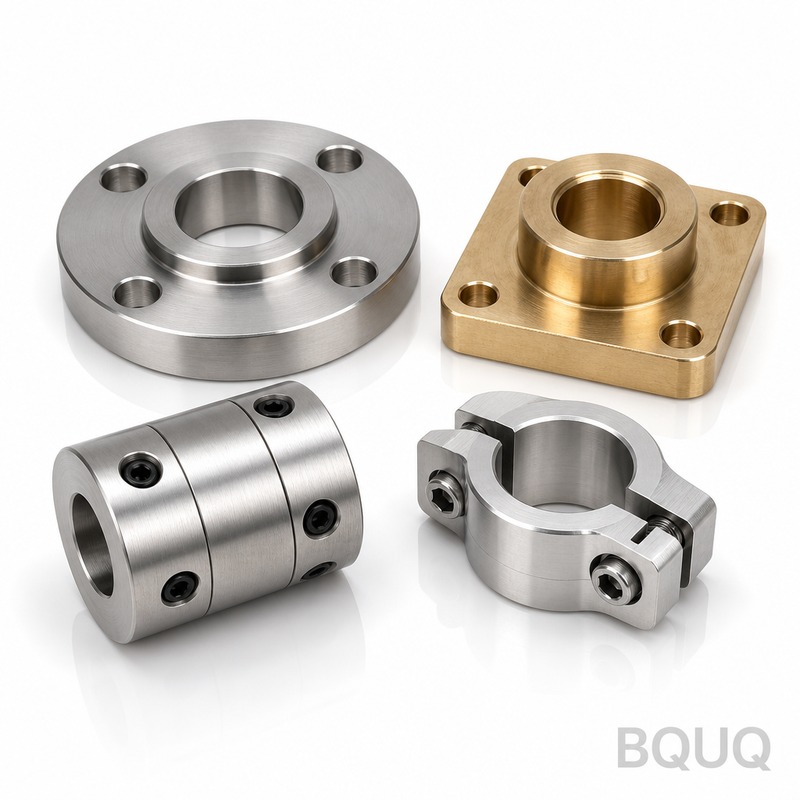
How to Get an Accurate CNC Quote: What to Send a Machine Shop
Short answer: an accurate CNC quote starts with a complete inquiry — a STEP or PDF drawing with explicit tolerance callouts, the material grade, quantity, surface finish and delivery target. Every piece of information you leave out does not lower the price; it forces the factory to assume, and assumptions are always priced at the expensive end. A supplier that quotes accurately from a one-line email is not accurate — it is guessing.
The gap between a vague inquiry and a machinable one is often the difference between a fair price and a padded one. Shops price risk into quotes: if your drawing says "aluminum" with no grade, expect 7075 money for what might be a 6061 part; if tolerances are missing, expect the tightest — and slowest — interpretation. This guide is the exact checklist our own engineers use when they receive an inquiry, so you can send the version that gets priced on reality rather than worst case.
What a Complete RFQ Contains
A professional request for quote is one page of information, not a paragraph of description. The table below is the checklist our quoting engineers work from; an inquiry that covers every row gets a cleaner, faster and usually lower number than one that forces follow-up emails.
| Item to send | Why it matters | If missing |
|---|---|---|
| 3D model (STEP/IGES/X_T) | Real geometry for programming and cycle-time estimate | Shop works from PDF guesswork |
| 2D drawing with tolerances | Defines what is critical and what is not | Tightest interpretation assumed |
| Material grade, not family | 6061 vs 7075 and 303 vs 316 price very differently | Priced on the costliest grade |
| Quantity and order split | Setup cost spread changes unit price | Quote may not match your plan |
| Surface finish spec | Anodize, plating, bead blast or none | Finish added at default pricing |
| Thread and hole callouts | Class of fit, depth, tapped or threaded insert | Non-standard threads discovered late |
| Critical features flagged | Where tolerances truly matter | Every feature treated as critical |
| Delivery target | Rush vs standard changes scheduling | Lead time may not suit you |
Takeaway: the RFQ is a risk-transfer document. Each blank cell transfers pricing risk from the shop back to you, in the form of conservative assumptions. Filling every row does not take an hour of work, and it routinely cuts quoted prices by double digits because the shop no longer needs to protect itself from your ambiguity.
File Formats That Quote Fast
Send both a 3D model and a 2D PDF. The model lets the shop program and estimate cycle time; the PDF carries the tolerances, notes and revision control that the model alone cannot express. STEP (.stp) is the most portable neutral format and is preferred by virtually every CAM system. IGES and Parasolid (X_T) are acceptable; STL is not — it is a faceted mesh with no exact geometry and no tolerances, useful for printing, useless for quoting machined parts.
A drawing that quotes fast also has a title block with revision number, a material callout that names the grade and temper, a general tolerance note such as ISO 2768-mK or a block tolerance, and finish notes that say what and where — "Type II black anodize, mask bore Ø6.0" beats "anodize" every time. If your part is an update of an earlier version, name the previous part number and revision; a shop that already holds the program can quote a delta instead of a whole new part.
Tolerances: The Single Most Expensive Omission
Tolerance is where vague inquiries cost the most, because machining time roughly tracks how tight the callout is. The table below shows how tolerance class moves cycle time and price for the same geometry — indicative ranges for a mid-size milled aluminum part.
| Tolerance situation | Quoting behavior | Effect on price |
|---|---|---|
| No tolerances on drawing | Shop assumes tightest it can safely hold | +20–50% hidden margin |
| General note ±0.1 mm, critical features blocked | Clear priorities, fast programming | Baseline |
| Everything at ±0.02 mm | All features machined slowly and inspected | +30–80% vs baseline |
| ±0.005 mm on many features | Multiple finish passes, CMM checks, scrap risk | +80–150% or more |
| Conflicting callouts | Shop must call you; delay and re-quote | Delays, not discounts |
Takeaway: tolerance is bought, not assumed. The professional move is a loose general tolerance (say ±0.1 mm or ±0.05 mm) with tight values blocked only on the features that functionally need them — a bearing bore, a mating face, a critical true position. That single habit does more for your part price than any negotiation, and it is the core of what we teach in the DFM guide for CNC.
Notes That Slow or Poison a Quote
Certain phrases in an inquiry force a callback or a cautious quote. "Polish to mirror finish" with no Ra value leaves the shop guessing between hand polishing and lapping — both slow. "Surface finish 0.8" with no symbol is ambiguous between Ra and Rz, which differ by roughly 4–6×. "Thread M6" without depth or class leaves tap selection open. "Material: steel" could mean 1215, 1045, 4140 or a dozen others, each with different machinability and price.
The fix is precision in the notes, not more words. Say "M6 × 1.0, 12 mm deep, 6H tapped hole," "Ra 0.8 µm on sealing face only," "6061-T6, plate," and the quote comes back clean. If a requirement is genuinely flexible — "any corrosion-resistant stainless" — say so explicitly and let the shop propose the economical grade rather than silently picking the expensive one. For a fuller breakdown of how these variables stack into final pricing, the CNC machining cost guide walks every line item with ranges.
Comparing Quotes: Like for Like
When the quotes come back, compare the assumptions, not just the totals. The low quote may have assumed ±0.5 mm, "aluminum" plate stock, no inspection report and no finish; the higher one may have quoted your drawing exactly. Ask each supplier three questions: what tolerance did you program to, what material grade and stock form did you price, and what inspection is included. If the answers differ, the prices are not comparable, and the cheapest number is not a bargain — it is a future change order.
Two more comparison signals are worth asking for. One is estimated cycle time per part; it is the most honest single number in any quote and it explains price differences immediately. The other is the finish and packaging assumption — a part quoted bare and a part quoted with Type II anodize and individual packaging can differ by dollars per piece with identical machining. When you are ready to send a complete inquiry, BQUQ quotes from drawings within 12 working hours on CNC turning, CNC milling and precision components — email sc@bquq.com or WhatsApp +86 13713157787 with the checklist above filled in, and the number you get back is based on your geometry, your grade and your tolerances, not on what a salesperson assumed you meant.
Email sc@bquq.com or WhatsApp +86 137 1315 7787 with your PDF/DXF/STEP file. An engineer reviews it and replies with price, lead time and DFM notes on working days.
Frequently Asked Questions
Q: What file format should I send for a CNC quote?
STEP (.stp) for the 3D model plus a PDF 2D drawing with tolerances and notes. IGES and X_T work too. Avoid STL files — they carry no exact geometry or tolerances and cannot be quoted accurately.
Q: Why is my quote higher when I do not specify tolerances?
Because the shop must assume the tightest interpretation it can safely hold, then add margin. Adding a general tolerance note like ±0.1 mm with critical features blocked routinely lowers quoted prices.
Q: How many quotes should I get for CNC parts?
Two to three, from comparable suppliers. The value is not in the lowest number but in comparing assumptions — tolerance, material grade, inspection, finish. Like-for-like comparison beats bargain hunting.
Q: Do I need a formal drawing if I have a 3D model?
Yes, for toleranced parts. A model shows shape but not criticality. The 2D drawing carries tolerance callouts, thread specs, finish notes and revision control that tell the machinist what matters.
Q: What is a reasonable CNC quote turnaround time?
A complete inquiry gets a solid quote within one to two working days; BQUQ returns quotes within 12 working hours on working days. Incomplete inquiries take longer because every missing detail costs a follow-up round.
Related Articles
- cnc-turning-vs-milling-guide — More from the BQUQ CNC Machining engineering series.
- cnc-machining-materials-guide — More from the BQUQ CNC Machining engineering series.
- cnc-304-vs-316-stainless-guide — More from the BQUQ CNC Machining engineering series.
Data Sources and Verification
Tolerances, cycle times and price ranges in this guide come from BQUQ production records at our Dongguan plant, where CNC machining (±0.005 mm), stamping, custom springs and heat sinks run under one roof. BQUQ is an ISO 9001:2015 certified factory; the certificate and batch inspection reports are available on request with every quotation.
Related Resources
- About BQUQ: an ISO9001-certified source factory in Dongguan running four production lines under one roof.
- CNC products and services: turning, milling and precision components from the machining line — CNC turning parts, CNC milling parts, CNC precision components.
- Industry trends: manufacturing, material market, and sourcing analysis for buyers.
- Technical articles: engineering guides and process comparisons — more where this article came from.
- FAQ hub: quick answers on CNC, stamping, springs, and heat sinks.
- Case studies: real parts and real numbers from projects we engineered and delivered.
- Contact us: send your drawing and get a quote within 12 working hours.
Authored by the BQUQ Engineering Team. BQUQ is an ISO9001-certified source factory in Dongguan, China, running CNC machining, metal stamping, custom springs and heat sink lines under one roof. Send drawings to sc@bquq.com or WhatsApp +86 13713157787 for a quote within 12 working hours. www.bquq.com