What metals and plastics CNC actually machines: cost, machinability and strength compared — from an ISO9001 Dongguan source factory. Quote in 12 hours.
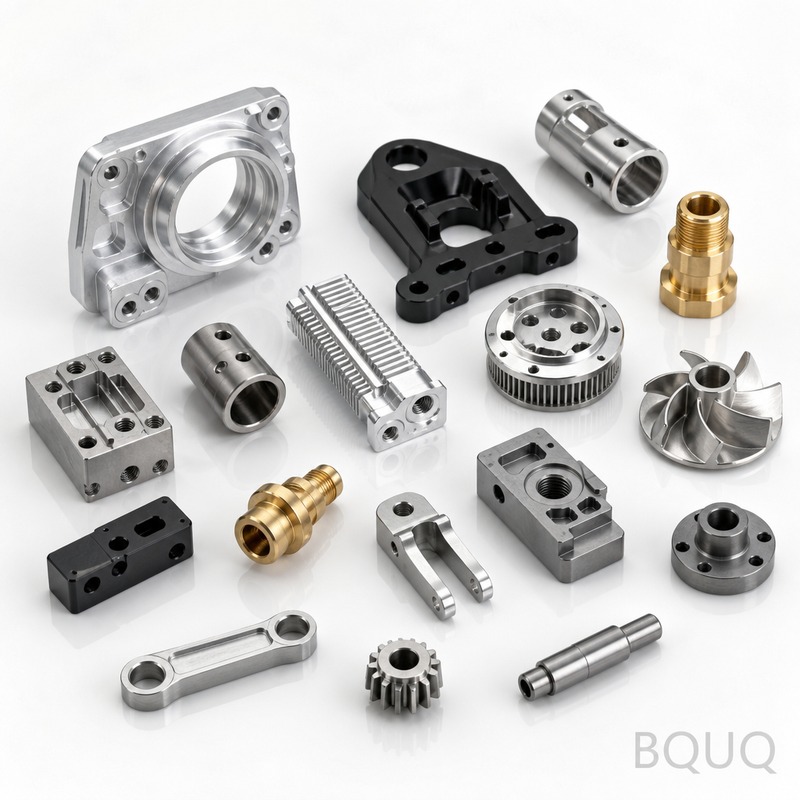
CNC Machining Materials: What Can Actually Be Machined (and What It Costs)
Short answer: a CNC machine can cut nearly any engineering material that exists, but "can be machined" and "should be machined" are two different questions. The practical menu is aluminum alloys, carbon and alloy steels, stainless steels, brass and copper, titanium, and a short list of engineering plastics. Material choice typically drives 30–50% of your part price, and machinability drives how much of that is cycle time rather than raw stock, so what you spec on the drawing board shows up directly on the invoice.
Over 20 years of running CNC lines in Dongguan, the material mix we cut daily is narrower than most engineers expect: aluminum dominates, steel and stainless split the middle, and brass, copper, titanium and plastics fill the specialty slots. This guide maps what each material actually costs you in machinability, price and risk, so you can stop guessing between grades and start specifying with intent.
The Metals That CNC Machines Actually Cut
The machinability index below compares how fast and easily each alloy cuts, with free-machining brass and 12L14 steel set at 100 as the reference. A rating of 50 does not mean the material cannot be machined — it means roughly double the cycle time and tool wear of the reference, and that difference is real money at quantity.
| Material | Machinability index (ref = 100) | Relative stock cost vs 6061 | Typical parts |
|---|---|---|---|
| Aluminum 6061-T6 | ~90 | 1.0× (baseline) | Brackets, enclosures, housings, robot parts |
| Aluminum 7075-T6 | ~70 | 1.5–1.8× | High-stress frames, gimbal and drone parts |
| Free-cutting steel 12L14 | ~100 | 1.0–1.2× | High-volume turned shafts and fittings |
| Alloy steel 4140 pre-hard | ~65 | 1.2–1.6× | Gears, shafts, structural components |
| Stainless 303 | ~75 | 2.8–3.5× | Fasteners, valve bodies, fittings |
| Stainless 304 | ~45 | 3.5–4.5× | Food, medical, architectural parts |
| Stainless 316 | ~35 | 4.0–5.0× | Marine, chemical and implant-adjacent parts |
| Brass C360 | ~100 | 2.5–3.5× | Terminals, pneumatic fittings, small precision parts |
| Copper C110 | ~60 | 3.0–4.0× | Bus bars, RF components, heat spreaders |
| Titanium 6Al-4V | ~25–30 | 15–25× | Aerospace, medical, high-end racing parts |
Takeaway: machinability index and stock cost are two separate levers, and the expensive alloys pull both in the wrong direction. 316 stainless costs more than 304 and cuts slower, which is why it should be specified only when chlorides, seawater or chemical exposure are actually on the table. If you are designing a CNC-machined stainless part that will live indoors in a dry assembly, 303 or 304 will do the job at a fraction of the machining cost.
Where Aluminum Wins
Aluminum 6061-T6 is the default CNC material for a reason: it cuts fast, holds tight tolerances, weighs little, anodizes cleanly, and the stock is cheap and always in supply. It is the right answer for anything where stiffness per gram matters more than raw strength — which is most brackets, housings and moving parts. 7075-T6 roughly doubles yield strength but costs more and machines slower, so it earns its place only where 6061 genuinely flexes or fatigues.
Aluminum does have real limits. It softens above roughly 150 °C operating temperature, it is not wear-resistant against sliding contact, and it will not survive salt water without a protective coating. When a drawing calls for aluminum in those conditions, the honest engineering answer is a different material, not a different temper.
Stainless Steel: Machinability Is the Hidden Cost
All stainless steels work-harden as they cut, which punishes dull tools and timid feeds. 303 was formulated to solve that — sulfur is added to break chips — which is why it machines at nearly twice the speed of 304. The trade-off is slightly lower corrosion resistance and slightly worse weldability, neither of which matters for most machined components.
| Grade | Corrosion resistance | Machining speed vs 303 | Typical use |
|---|---|---|---|
| 303 | Good | 100% (reference) | Fittings, shafts, fasteners, anything machined from bar |
| 304 | Better | ~55–65% | Welded assemblies, food contact, general industry |
| 316 | Best of the three | ~45–55% | Marine, chemical, pharmaceutical, coastal outdoor |
| 17-4 PH | Similar to 304 | ~60–70% (annealed) | High-strength precision parts, valve spindles |
The takeaway: for a fully machined part with no welding, 303 often beats 304 on both price and delivery — the application has to justify the premium. If you are unsure which grade your CNC turning supplier is quoting, ask. A quote written for "stainless steel" with no grade is usually priced on the cheapest interpretation, and that is how parts rust in service.
Brass, Copper and the Conductive Alloys
Brass C360 machines beautifully — chips break short, tools last, and surface finish comes easy. That makes it the default for terminals, pneumatic fittings, valve components and anything where electrical conductivity, corrosion resistance and machinability all matter. Copper C110 conducts heat and electricity better than brass but is gummy: it wants sharp tooling, low speeds and plenty of coolant, and it work-hardens if you let the tool rub instead of cut.
These alloys are heavier and pricier than aluminum, so they are used selectively — almost always because conductivity or anti-sparking properties demand them. For bus bars, RF housings and heat spreaders they are worth every dollar; for a plain structural bracket they are a waste of the customer's money, and we will say so.
Titanium: Capable but Costly
Titanium 6Al-4V is fully machinable on standard CNC equipment — we cut it regularly for medical and aerospace customers — but it is slow, hot and expensive. Low thermal conductivity means the heat stays in the cutting zone, not the chip, so speeds run at a fraction of aluminum's and tooling costs multiply. Expect 3–6× the machining time of 6061 for the same geometry.
| Property | 6061-T6 | 6Al-4V Ti | Effect on part design |
|---|---|---|---|
| Density | 2.7 g/cm³ | 4.4 g/cm³ | Titanium ~1.6× heavier than aluminum |
| Yield strength | ~276 MPa | ~880 MPa | Titanium far stronger per cross-section |
| Strength-to-weight | ~102 | ~200 | Titanium wins the structural race |
| Machining time vs 6061 | 1× | 3–6× | Cycle time dominates part cost |
| Stock cost vs 6061 | 1× | 15–25× | Raw material is a major line item |
Takeaway: titanium earns its cost when strength-to-weight or biocompatibility is non-negotiable — aerospace brackets, implantable instruments, high-end racing hardware. For everything else, the engineer who specifies titanium for a desktop fixture is paying aerospace prices for a shelf part. If the design truly needs it, we will machine it and quote it honestly; if it does not, we will tell you before you spend the money.
Engineering Plastics: Fully Machinable, Different Rules
CNC machines cut plastics cleanly, and machined plastic parts are often better than molded ones at low volume because there is no tooling cost and no molded-in stress. The practical list is short and specific.
| Plastic | Typical use | Machining notes | Relative stock cost |
|---|---|---|---|
| POM (Delrin) | Gears, bushings, rollers | Best all-round machinable plastic, stable to ~0.01 mm | 1.0× (baseline) |
| Nylon 6/66 | Wear parts, insulators | Absorbs moisture; sizes shift after machining | ~1.1–1.4× |
| PTFE | Seals, chemical parts | Soft, gummy; holds loose tolerances only | ~2–3× |
| ABS / PC | Housings, prototypes | Machines fine but is often better 3D-printed | ~1–1.5× |
| PEEK | High-temp, medical, aerospace | Expensive, tough on tools, excellent properties | ~10–15× |
Plastics behave differently from metals in three ways that matter on a drawing: they expand roughly 5–10× more per degree, they need sharp tooling and coolant to avoid melting and smearing, and thin walls flex rather than hold form. POM is the workhorse — it machines to tight tolerances, holds dimensions well, and is the default for machined gears and bushings. If you are going to machine plastic parts in volume, read the DFM guide first, because wall thickness and draft rules that keep metal parts rigid will not save a plastic one.
What "Can Be Machined" Means for Hardness
A standard CNC shop machines material in the soft or pre-hardened condition, typically under about 45 HRC. Above that, carbide tooling wears fast and cutting becomes uneconomical. Hardened steel above 45–50 HRC is normally cut with wire EDM or ground, not milled. This matters at the design stage: if a part needs a hard, wear-resistant surface, the economical route is usually to machine it soft, then heat-treat, then finish-grind only the critical faces — not to ask the CNC mill to chew through 60 HRC tool steel.
How Material Choice Changes Your Quote
Material moves your price through two channels: raw stock cost and cycle time. A 6061 bracket and a 316 version of the same part can differ 4–6× in unit price before a single tolerance is tightened. That is why every quote request should name the grade, not the family — "aluminum" means nothing to a machinist, "6061-T6" means something precise.
At BQUQ we keep 6061, 7075, 1215/12L14 steel, 303/304/316 stainless, brass, copper and common plastics in routine stock, so standard grades quote fast and ship fast. Less common alloys like titanium, PEEK and 17-4 PH add a few days of sourcing lead time — nothing dramatic, but worth knowing if your schedule is tight. Send your drawing with the grade specified to sc@bquq.com or WhatsApp +86 13713157787 and you will get a price based on your actual material within 12 working hours, not a guess based on "aluminum."
Email sc@bquq.com or WhatsApp +86 137 1315 7787 with your PDF/DXF/STEP file. An engineer reviews it and replies with price, lead time and DFM notes on working days.
Frequently Asked Questions
Q: What is the cheapest material to CNC machine?
Aluminum 6061 and free-cutting steel 12L14 are the cheapest to machine overall — low stock cost, fast cycle times and long tool life. Brass cuts fast too but the raw material costs more.
Q: Can CNC machines cut hardened steel?
Only up to roughly 45 HRC economically with carbide tooling. Harder parts should be machined soft, heat-treated, then ground or wire-EDM finished on the critical faces. Plan that sequence into your design.
Q: Is 316 stainless worth the extra cost over 304?
Only where chlorides, seawater or chemical exposure is real — 316 resists pitting where 304 corrodes. For indoor, dry or food-contact applications, 304 or even 303 delivers the same part at a lower price.
Q: Which plastics are actually machined, not molded?
POM, nylon, PTFE and PEEK are the common ones, machined when volumes are too low for injection molding or when tolerances exceed what molding holds. POM is the default for precision machined plastic parts.
Q: Does the factory need to know the exact material grade to quote?
Yes. "Aluminum" or "stainless" forces assumptions, and assumptions get priced with safety margin. Specify 6061-T6, 303, or whatever your design truly needs and the quote reflects reality, not worst case.
Related Articles
- cnc-machining-cost-guide — More from the BQUQ CNC Machining engineering series.
- cnc-surface-finish-ra-guide — More from the BQUQ CNC Machining engineering series.
- cnc-prototyping-low-volume-guide — More from the BQUQ CNC Machining engineering series.
Data Sources and Verification
Tolerances, cycle times and price ranges in this guide come from BQUQ production records at our Dongguan plant, where CNC machining (±0.005 mm), stamping, custom springs and heat sinks run under one roof. BQUQ is an ISO 9001:2015 certified factory; the certificate and batch inspection reports are available on request with every quotation.
Related Resources
- About BQUQ: an ISO9001-certified source factory in Dongguan running four production lines under one roof.
- CNC products and services: turning, milling and precision components from the machining line — CNC turning parts, CNC milling parts, CNC precision components.
- Industry trends: manufacturing, material market, and sourcing analysis for buyers.
- Technical articles: engineering guides and process comparisons — more where this article came from.
- FAQ hub: quick answers on CNC, stamping, springs, and heat sinks.
- Case studies: real parts and real numbers from projects we engineered and delivered.
- Contact us: send your drawing and get a quote within 12 working hours.
Authored by the BQUQ Engineering Team. BQUQ is an ISO9001-certified source factory in Dongguan, China, running CNC machining, metal stamping, custom springs and heat sink lines under one roof. Send drawings to sc@bquq.com or WhatsApp +86 13713157787 for a quote within 12 working hours. www.bquq.com