CNC prototyping and low-volume production: quantity bands, lead times, costs, and when CNC beats molding — from an ISO9001 Dongguan source factory.
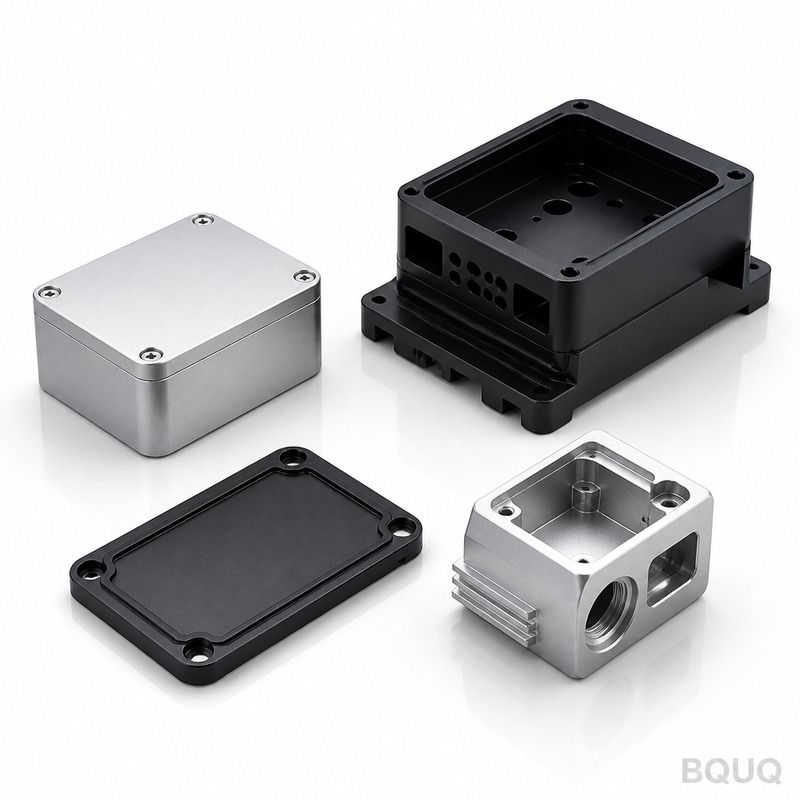
CNC Prototyping and Low-Volume Production: When It Makes Sense
Short answer: CNC machining is the most sensible production route for quantities from one piece to roughly 1,000–2,000 parts when the part is metal, tolerances matter, or the design is still changing — because there is no tooling investment and every part is made from the final material with final accuracy. Beyond that volume, molding, stamping or casting usually wins on unit cost, but CNC remains the right bridge while that tooling is being built.
Most engineers default to CNC for a one-off prototype and assume production is a different world. In reality, the same CNC process often carries the part from first concept through pilot runs to the first production batches, and the only real question is where the volume crossover falls. This guide maps that crossover with realistic quantity bands, lead times and costs, so you can plan a prototype-to-production path instead of guessing at each step.
Why CNC Is the Natural Prototyping Process
CNC needs no mold, no die and no minimum order. A prototype is programmed from the same CAD file as the production part and machined from the same material the final product will use — 6061 aluminum prototype and 6061 aluminum production part behave identically in testing, which is more than can be said for resin 3D prints or soft-tooled samples. That single fact drives most engineering decisions: when the test results must mean something for the final product, machine the prototype.
The other advantage is iteration speed. Design changes between prototypes cost programming time, not tooling rework. A mold modification can take weeks and thousands of dollars; a CNC design change is a new toolpath and a fresh piece of stock. For products still finding their shape — brackets, housings, robot links, medical instruments — CNC lets you burn through design revisions cheaply while the geometry is still fluid.
Quantity Bands: What Each Range Costs
Per-part price falls fastest at the low end because setup cost — programming, fixturing, first-article inspection — spreads over more pieces. The bands below are typical for a mid-complexity CNC aluminum part at a China source factory; treat them as planning ranges, not quotes.
| Quantity | Typical per-part range | What dominates the price |
|---|---|---|
| 1–10 pcs | $20–$150 | Setup and programming share per part |
| 10–50 pcs | $10–$60 | Setup diluted; cycle time starts to matter |
| 50–300 pcs | $6–$25 | Cycle time and material dominate |
| 300–1,000 pcs | $4–$15 | Near the flat part of the curve |
| 1,000–5,000 pcs | $3–$10 | Consider stamping, casting or molding |
Takeaway: the steepest per-part savings happen between 1 and 50 pieces; after a few hundred, unit price falls slowly because material and cycle time — costs that do not care about batch size — now dominate. If your design will eventually live at 50,000 pieces a year, the crossover conversation should start at the 500-piece mark, not after you have already ordered 5,000 machined parts.
Lead Times at Low Volume
CNC lead time has three components: programming and fixture prep, machining, and finishing. At low volume the first and last dominate, which is why small batches from China typically run 5–10 working days plus shipping, while a repeat order of an already-programmed part can ship in 3–5 days.
| Order type | Typical lead time (working days) |
|---|---|
| First prototype, simple geometry | 3–7 |
| First prototype, complex multi-face part | 7–12 |
| Repeat order, existing program | 3–5 |
| Batch of 100–500, with anodizing | 7–12 |
| Batch with hard coat or plating | 10–15 |
Takeaway: if your schedule is tight, the cheapest lead time you will ever get is on a repeat order of an unchanged part number. Design freeze, then order volume — every mid-stream revision restarts the programming clock.
The Prototype-to-Production Path
The cleanest low-volume strategy is to treat CNC as the process for phases one through three of a product launch. Phase one is functional prototypes — one to ten parts, machined from final material, used to validate fit, function and assembly. Phase two is pilot or beta units — tens to a few hundred parts, machined to production tolerances, often with the final finish, shipped to early customers. Phase three is the bridge: CNC parts keep the product on sale while an injection mold or stamping die is being built, since a simple aluminum mold typically takes 4–8 weeks and a progressive die longer.
This staged path has a concrete advantage beyond cash flow: it separates product risk from process risk. If the product fails in field testing, you are out the cost of machined parts, not a mold. If it succeeds, the production process was validated on real geometry — the CNC precision components you field-tested are dimensionally the same parts the mold will replicate, minus the draft and wall-thickness adjustments molding requires. Our case studies show several products that ran 200–800 machined units through market launch before committing to tooling, and the mold buy-in was made with sales data instead of projections.
When CNC Stops Making Sense
CNC is not the answer at every volume, and an honest supplier says so. Once annual demand passes roughly 5,000–10,000 pieces of a stable design, look hard at alternatives: aluminum die casting or extrusion plus machining for housings, progressive stamping for brackets and terminals, molding for plastic parts. The crossover point depends on part complexity and material — a small brass terminal crosses over to stamping at a few hundred thousand pieces, while a large machined enclosure may stay economic on CNC far longer because its tooling would be enormous.
The signal is not the volume alone; it is design stability plus volume. A design still changing weekly should never be molded, no matter the forecast — every change becomes a mold revision. A frozen design at high volume should not stay on CNC out of habit. Because BQUQ runs CNC machining, metal stamping, springs and heat sinks under one roof, we can quote the alternative process honestly when your volume justifies it, rather than defending the machine that is already running.
How to Use CNC for Low Volume Without Overpaying
Three habits keep low-volume CNC costs down. First, consolidate revisions: batch design changes into one prototype order instead of five single-piece orders, since each order carries a setup charge. Second, standardize materials and finishes across your part family — one aluminum grade and one anodize spec means racking, tooling and programs are reusable. Third, order the pilot run at the quantity your testing actually needs; there is no volume discount worth paying for parts that will be redesigned.
The economics of CNC prototyping and low-volume machining are simple in structure — setup, cycle time, material, finish — and the CNC cost guide breaks each line item down with real ranges. When you are ready to move, send the drawing with quantity and target finish to sc@bquq.com or WhatsApp +86 13713157787; we quote within 12 working hours, machine from one piece up with no MOQ, and will tell you plainly when your volume has outgrown CNC.
Email sc@bquq.com or WhatsApp +86 137 1315 7787 with your PDF/DXF/STEP file. An engineer reviews it and replies with price, lead time and DFM notes on working days.
Frequently Asked Questions
Q: What is the minimum order quantity for CNC prototyping?
One piece. CNC has no tooling, so single prototypes are normal and useful for validation. Setup cost makes the first piece the most expensive, but there is no MOQ barrier at any real CNC factory.
Q: At what volume does CNC stop being economical?
Roughly 1,000–5,000 pieces for simple parts, higher for complex metal parts where tooling would be expensive. The crossover depends on material, geometry and design stability — a frozen design at high volume should migrate to molding, stamping or casting.
Q: Can I use machined parts while my mold is being built?
Yes, this is a standard bridging strategy. CNC parts keep product on the market during the 4–8 week mold build, funded by early sales instead of upfront tooling risk.
Q: How is CNC prototyping different from 3D printing?
CNC parts are machined from the final material with production tolerances and real mechanical properties. 3D printing is faster and cheaper for form studies, but printed parts rarely test like the production part. Many teams print to explore, then machine to validate.
Q: Do low-volume CNC parts cost more per piece from China?
No — the reverse. Setup labor is the same anywhere, but Chinese shop rates are lower, so small batches quote competitively. The per-piece setup share is higher at low volume, but the absolute numbers still favor a direct source factory.
Related Articles
- cnc-surface-finish-ra-guide — More from the BQUQ CNC Machining engineering series.
- cnc-machining-cost-guide — More from the BQUQ CNC Machining engineering series.
- cnc-dfm-guide — More from the BQUQ CNC Machining engineering series.
Data Sources and Verification
Tolerances, cycle times and price ranges in this guide come from BQUQ production records at our Dongguan plant, where CNC machining (±0.005 mm), stamping, custom springs and heat sinks run under one roof. BQUQ is an ISO 9001:2015 certified factory; the certificate and batch inspection reports are available on request with every quotation.
Related Resources
- About BQUQ: an ISO9001-certified source factory in Dongguan running four production lines under one roof.
- CNC products and services: turning, milling and precision components from the machining line — CNC turning parts, CNC milling parts, CNC precision components.
- Industry trends: manufacturing, material market, and sourcing analysis for buyers.
- Technical articles: engineering guides and process comparisons — more where this article came from.
- FAQ hub: quick answers on CNC, stamping, springs, and heat sinks.
- Case studies: real parts and real numbers from projects we engineered and delivered.
- Contact us: send your drawing and get a quote within 12 working hours.
Authored by the BQUQ Engineering Team. BQUQ is an ISO9001-certified source factory in Dongguan, China, running CNC machining, metal stamping, custom springs and heat sink lines under one roof. Send drawings to sc@bquq.com or WhatsApp +86 13713157787 for a quote within 12 working hours. www.bquq.com