CNC vs 3D printing vs injection molding: volume, material, tolerance, tooling and lead time compared — decision route from an ISO9001 Dongguan factory.
CNC vs 3D Printing vs Injection Molding: Picking a Production Route
Short answer: quantity and material pick the process — 3D printing wins for quick form studies under 10 pieces, CNC machining wins from one functional metal part up to a few thousand pieces with no tooling cost, and injection molding wins only when a plastic design is frozen and volume passes roughly 5,000–10,000 parts a year. Molding's tooling investment, typically $3,000–$50,000+, must be spread over real volume; until that volume exists, CNC is usually the honest answer.
Engineers argue about these three processes as if they were competitors. They are not — they are stages. A typical product life uses 3D printing to explore shape, CNC machining to validate function in real material, and injection molding to scale a frozen design. The skill is knowing when to switch, and the switch points are governed by numbers: tooling cost, per-part cost, material properties and design stability. This guide lines those numbers up so the route picks itself.
What Each Process Actually Is
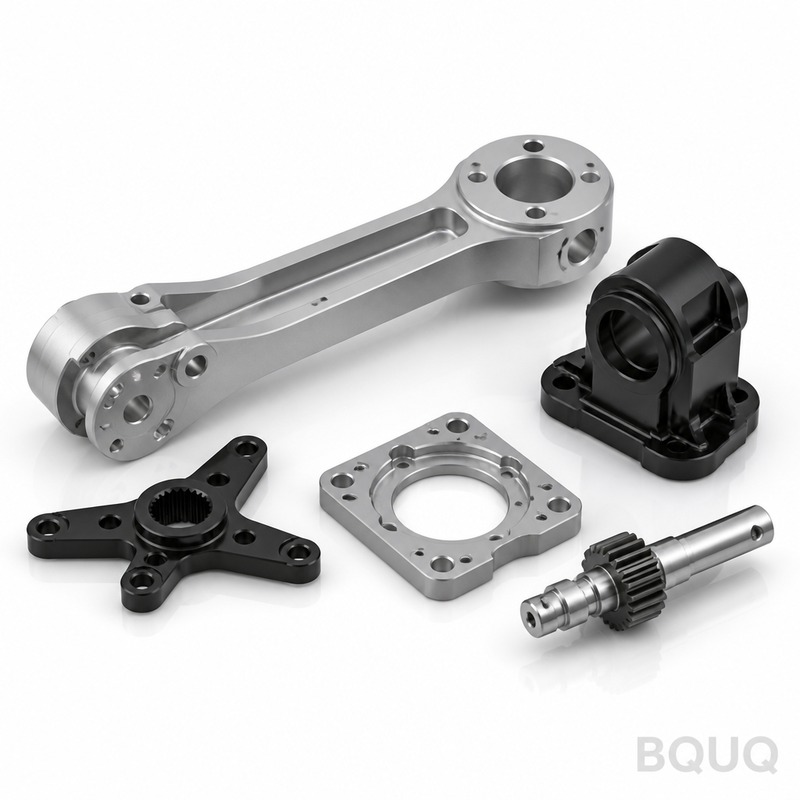
CNC machining cuts parts from solid metal or plastic stock with rotating tools. There is no tooling investment beyond fixturing, tolerances are the tightest of the three, and the part is made from the final material with the final mechanical properties. CNC machining works on aluminum, steel, stainless, titanium, brass and engineering plastics, from one piece to thousands.
3D printing builds parts layer by layer from CAD, with no tooling and essentially no setup cost, which makes it unbeatable for the first few pieces of a design. But printed polymer parts are anisotropic, weaker than molded or machined equivalents, limited in material choice, and slow at quantity. Metal printing exists but is expensive and carries its own limitations.
Injection molding forces molten plastic into a steel mold under pressure. Once the mold is paid for, per-part cost is the lowest of the three and cycle times are seconds. The catch is the mold: typically $3,000 for a simple single-cavity mold to $50,000+ for a complex multi-cavity tool, plus 4–8 weeks of build time, and every design change after mold cutting is an expensive modification.
| Factor | CNC machining | 3D printing | Injection molding |
|---|---|---|---|
| Typical tolerance | ±0.005–0.05 mm | ±0.1–0.3 mm (polymer) | ±0.05–0.25 mm |
| Tooling cost | Minimal (fixtures) | None | $3,000–$50,000+ |
| Per-part cost | Medium, falls with volume | High at volume | Very low at volume |
| Materials | Full metal + plastic range | Polymers dominate | Thermoplastics |
| Mechanical properties | Same as bulk material | Anisotropic, weaker | Good, molded-in stress |
| Best volume band | 1–2,000 pcs | 1–20 pcs (form/fit) | 5,000+ pcs |
| Lead time to first part | Days | Hours–days | Weeks (mold first) |
Takeaway: the three processes sit at different points on the same two axes — tooling cost and per-part cost. 3D printing front-loads nothing but pays per part forever; molding front-loads everything and pays pennies per part at scale; CNC sits in the middle with no tooling and medium per-part cost, which is exactly why it owns the middle of the volume curve.
Where the Volume Crossover Falls
The crossover numbers below are typical for a mid-size plastic or aluminum part and will shift with complexity, but the shape of the curve is stable: additive owns the single digits, CNC owns the hundreds, molding owns the tens of thousands.
| Annual quantity | Typical best route | Why |
|---|---|---|
| 1–10 pcs | 3D printing or CNC | Setup cost decides; printing wins for polymer form studies |
| 10–100 pcs | CNC machining | Functional parts in real material, no tooling |
| 100–1,000 pcs | CNC machining | Unit price now reasonable; tooling not yet justified |
| 1,000–5,000 pcs | CNC, or mold if design frozen | Evaluate mold payback on the real forecast |
| 5,000–50,000 pcs | Injection molding (plastic) | Mold amortized; per-part cost collapses |
| 50,000+ pcs | Molding, or stamping/casting (metal) | Process chosen by material and geometry |
Takeaway: the crossover from CNC to molding is not a fixed number — it is the quantity at which the mold cost divided by pieces saved per unit beats the CNC price gap, and that point lands between roughly 1,000 and 10,000 parts depending on the part. If the design is still changing, no volume justifies a mold. If the design is frozen, run the arithmetic with real quotes instead of rules of thumb; the CNC cost guide gives you the per-part numbers to compare against mold amortization.
Material and Mechanical Reality
The most dangerous assumption in process selection is that a prototype behaves like a production part. A 3D-printed nylon bracket and a molded glass-filled nylon bracket share a name but not a stiffness, fatigue life or dimensional story. Machined parts have no such gap — the CNC precision components you test are metallurgically identical to the material on the drawing.
Material availability also differs sharply. If the production part is aluminum, steel, stainless or titanium, injection molding is not an option at all and CNC is the route until volume justifies casting or stamping. If the part is plastic, all three processes compete, but molded parts permit geometries CNC cannot reach economically — thin walls under 1 mm, internal lattice, complex draft-free detail — and machined parts permit tolerances and material grades molding cannot hold. The right process is the one whose material and geometry limits match your drawing.
Tolerance and Quality Expectations
| Requirement | CNC | 3D printing | Injection molding |
|---|---|---|---|
| Tightest practical tolerance | ±0.005 mm | ±0.1 mm | ±0.05 mm on controlled features |
| Surface finish (Ra) | 0.8–3.2 µm machined | 3–15 µm layer lines | 0.2–1.6 µm from polished steel |
| Dimensional stability in batch | Excellent | Poor to fair | Good once process settled |
| Inspection standard | Full dimensional reports | Limited | SPC on critical dims |
Takeaway: if your application lives on tight fits, sealing faces or bearing bores, CNC holds what the other two cannot, and molding only approaches it on well-controlled features of a mature tool. Spec the process that holds the tolerance you need without paying for capability you do not — that is the entire game.
Lead Time and the Hybrid Route
Molding's true cost is calendar time. A mold takes 4–8 weeks; a design revision after mold cutting costs weeks and thousands. CNC's first article can ship in days, and revision number seven costs the same as revision number one. That is why the standard professional sequence is additive for shape exploration, then CNC for functional validation and early sales, then molding for scale — often with machined parts bridging the market while the mold is being built.
The hybrid route is underused: mold a plastic body for the bulk geometry, then machine the critical faces — sealing surfaces, press-fit bores, threaded inserts — after molding, where molding tolerance is not enough. Post-machining of molded parts is routine in automotive and medical work, and combining CNC milling with molding gives you the mold's low per-part cost and the machined tolerance where it matters, without forcing the whole mold to hold ±0.01 mm.
Decision Rules That Work
Apply these in order. If the part is a quick shape study or a visual mockup, print it. If it must function in metal or hold real tolerances, machine it — from one piece to a few thousand. If it is plastic and frozen and the forecast clears the mold payback line, mold it. And when volume outgrows CNC on a metal part, look at casting or stamping rather than assuming molding applies. Because BQUQ runs CNC, metal stamping, springs and heat sinks under one roof in Dongguan, the process recommendation you get is the one that fits the drawing — we are ISO9001 certified and quote from drawings within 12 working hours at sc@bquq.com or WhatsApp +86 13713157787. If your project is still in the decision phase, the prototyping and low-volume guide covers the bridge strategy in more detail.
Email sc@bquq.com or WhatsApp +86 137 1315 7787 with your PDF/DXF/STEP file. An engineer reviews it and replies with price, lead time and DFM notes on working days.
Frequently Asked Questions
Q: When is 3D printing better than CNC machining?
For the first few pieces of a polymer design where speed and cost of iteration matter more than material properties. Printed parts are weaker and less accurate, so functional validation in the final material still belongs on CNC.
Q: At what quantity does injection molding become cheaper than CNC?
Typically somewhere between 1,000 and 10,000 parts, depending on mold cost and part complexity. Divide the mold cost by the per-part savings against CNC to find your break-even; below it, CNC is cheaper with zero tooling risk.
Q: Can injection molded parts match CNC tolerances?
Not across the whole part. Molding holds about ±0.05–0.25 mm typically; CNC holds ±0.005–0.05 mm. The fix is molding the bulk geometry and post-machining only the critical features.
Q: Is metal 3D printing a substitute for CNC?
Rarely for production. Metal printing has no tooling, which suits complex one-offs, but parts are costlier, slower and often need CNC finishing anyway. For ordinary metal brackets and housings, CNC is faster and cheaper per part.
Q: Which process should I use for my first production batch?
CNC, unless the part is a simple polymer with a frozen design and volume already above the mold payback line. Machining the first batch validates the design in final material and keeps the mold decision based on sales data.
Related Articles
- cnc-304-vs-316-stainless-guide — More from the BQUQ CNC Machining engineering series.
- cnc-anodizing-finishes-guide — More from the BQUQ CNC Machining engineering series.
- cnc-turning-vs-milling-guide — More from the BQUQ CNC Machining engineering series.
Data Sources and Verification
Tolerances, cycle times and price ranges in this guide come from BQUQ production records at our Dongguan plant, where CNC machining (±0.005 mm), stamping, custom springs and heat sinks run under one roof. BQUQ is an ISO 9001:2015 certified factory; the certificate and batch inspection reports are available on request with every quotation.
Related Resources
- About BQUQ: an ISO9001-certified source factory in Dongguan running four production lines under one roof.
- CNC products and services: turning, milling and precision components from the machining line — CNC turning parts, CNC milling parts, CNC precision components.
- Industry trends: manufacturing, material market, and sourcing analysis for buyers.
- Technical articles: engineering guides and process comparisons — more where this article came from.
- FAQ hub: quick answers on CNC, stamping, springs, and heat sinks.
- Case studies: real parts and real numbers from projects we engineered and delivered.
- Contact us: send your drawing and get a quote within 12 working hours.
Authored by the BQUQ Engineering Team. BQUQ is an ISO9001-certified source factory in Dongguan, China, running CNC machining, metal stamping, custom springs and heat sink lines under one roof. Send drawings to sc@bquq.com or WhatsApp +86 13713157787 for a quote within 12 working hours. www.bquq.com