CNC turning vs milling: geometry each suits, tolerances and cost, how to choose — from an ISO9001 Dongguan source factory. Quote in 12 hours.
CNC Turning vs Milling: Which Process Fits Your Part?
Short answer: if your part is round and symmetric around one axis — a shaft, bushing, fitting, roller or pin — it belongs on a CNC lathe; if it is boxy, flat, pocketed or has features on multiple faces, it belongs on a CNC mill. Turning rotates the workpiece against a stationary cutting tool, milling rotates the cutting tool against a clamped workpiece, and the two produce such different part families that choosing wrong can double your cost for no functional gain.
The first question a machinist asks about a drawing is not what material it is or how many you need — it is which spindle the part will spin on. That single decision sets the machine, the tooling, the cycle time and, ultimately, the price. This guide explains what each process genuinely does well, where they overlap, and how to read your own part geometry to pick the cheaper route.
What CNC Turning Actually Does
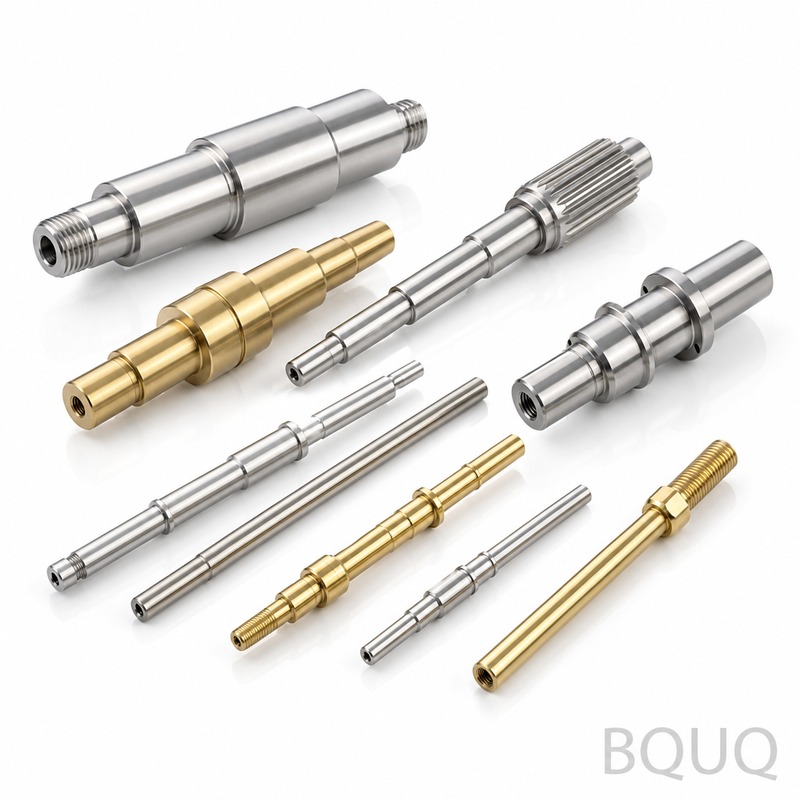
On a lathe, the bar stock rotates while a cutting tool moves in and out along the length. Everything the tool can touch is a surface of revolution: diameters, faces, grooves, chamfers, threads, tapers and radii. Because the workpiece spins continuously and the tool cuts in a controlled path, turning produces naturally round, concentric parts with excellent surface finish and tight roundness control.
The geometry that matters is axial symmetry. A plain shaft, a valve stem, a pneumatic fitting, a bearing spacer, an insert for a mold — these are turned parts, and they are turned for a reason. Producing the same features on a mill would mean indexing the part through multiple setups while fighting to hold concentricity between operations; the lathe holds it inherently because the part never leaves the spindle.
Modern CNC lathes also carry live tooling — driven rotary tools mounted on the turret — which lets a single machine mill flats, drill cross holes and cut off-axis features without a second setup. That blurs the old boundary: a fitting that is mostly round but has two wrench flats and a cross hole can still be a one-operation turning job.
What CNC Milling Actually Does
On a mill, the cutting tool rotates and the workpiece sits clamped on the table or in a vise. The tool approaches from any direction, so milling builds prismatic geometry: flat faces, pockets, slots, bosses, ribs, tapped holes, counterbores, and complex 3D contours across multiple faces. A 3-axis machine cuts the top face and, with repositioning, the sides; a 4- or 5-axis machine reaches undercuts and angled features in fewer setups.
Milling is the process for anything that is not a body of revolution: enclosures, brackets, housings, heat sinks, robot arms, camera mounts, valve blocks. It is also the only way to make features whose position matters relative to each other across different faces, because the tool can reference the same datum system across the whole part.
The Direct Comparison
| Factor | CNC turning (lathe) | CNC milling |
|---|---|---|
| Workpiece motion | Part rotates | Part clamped, tool rotates |
| Natural geometry | Round, axially symmetric | Prismatic, boxy, multi-face |
| Signature features | Diameters, tapers, threads, grooves, faces | Pockets, slots, holes, bosses, contours |
| Typical tolerance | ±0.005 mm on diameters | ±0.005 mm on machined features |
| Typical finish (Ra) | 0.8–1.6 µm standard | 1.6–3.2 µm standard |
| Material removal | Very efficient on bar stock | Efficient on blocks, slower on deep cavities |
| Setup per part | Minimal — one spindle axis | Often multiple faces and fixtures |
| Small-batch economics | Fast cycle, low per-part cost on rounds | Higher setup share, justified by complexity |
Takeaway: for the same material and quantity, turning almost always beats milling on cycle time for round parts, and milling wins outright for anything with flat faces or off-axis features. The process is decided by geometry first, then quantity and tolerance refine the choice.
When the Part Decides for You
The fastest way to choose is to ask what happens if you spin the part around its longest axis. If the outline stays the same as it rotates, turning is a candidate; if the part is asymmetric, has one dominant flat face, or carries features on several faces, milling is the route. The table below shows how common part shapes map to process:
| Part shape | Best process | Why |
|---|---|---|
| Shaft, pin, dowel, roller | Turning | Roundness and concentricity are inherent |
| Bushing, sleeve, spacer | Turning (bored) | ID and OD stay concentric in one setup |
| Threaded fitting, connector | Turning | Single-point threads, high finish |
| Bracket, plate, housing | Milling | Flat faces, pockets, hole patterns |
| Block with holes on 5 faces | Milling | Datum-based positioning across faces |
| Round part with flats/cross holes | Turn + mill (live tooling) | One machine, one setup, one datum |
| Valve body or manifold | Milling | Complex internal features, porting |
The middle row deserves attention because it trips up more buyers than any other: a part that is "mostly a cylinder but with a hex on one end" is not automatically a milling job. With live tooling on a lathe, both the cylinder and the hex are machined in a single clamping — and the price reflects that efficiency. Telling your supplier "it is a turned part with some milling" is more useful than "it is a complex part."
Tolerances, Finish and the Real Differences
Both processes hold the same production tolerance at BQUQ — ±0.005 mm on critical features, verified by CMM — because both use the same class of CNC control and feedback. The practical differences are in what is easy to hold. Turning holds roundness and concentricity almost for free; milling holds flatness and hole position across a large face with equal ease. Asking a mill to hold 0.005 mm roundness on a long shaft means many light passes and slow cycles; asking a lathe to hold a tight true-position between two holes on a flat face means fighting the setup. Specify tight tolerances only where the function demands them, and let the process do its natural job everywhere else.
Surface finish follows the same logic. A turned diameter finishes to 0.8 µm Ra without extra effort because the cutting edge travels a continuous helical path. A milled face reaches 1.6–3.2 µm Ra in a standard pass, and grinding or polishing is needed below that. None of this is a quality judgment — it is physics — and it is why comparing a turned finish to a milled finish apples-to-apples is usually a misunderstanding.
Cost Reality: Which One Costs Less?
For round parts, turning wins on cost per piece at almost every quantity because material is removed efficiently from bar stock and the cycle is short. For prismatic parts, milling is not an option, so the question disappears. Where the two genuinely compete — short, fat cylinders that could be faced and bored on a mill, or simple rounds that a mill could grind out — turning is typically 20–40% cheaper at the same tolerance, and the gap widens as diameter tolerance tightens.
Quantity changes the picture in a different way. At prototype volumes both processes carry a setup burden and per-part prices are high. From a few hundred pieces up, the per-piece cost converges on cycle time, which is where process choice matters most. If you are comparing quotes, ask the supplier for the estimated cycle time per part on each process; that number, more than any formula, tells you which route your geometry actually favors.
At BQUQ we run both CNC turning and CNC milling lines in the same ISO9001 factory, so the recommendation you get is based on your drawing, not on which machine is idle. Send the geometry — STEP or PDF with dimensions — to sc@bquq.com or WhatsApp +86 13713157787, and the quote will name the process we would actually run, with a cycle-time estimate you can check. For more on how materials change the economics of either process, see the CNC materials guide, and for the full cost structure behind the numbers, the CNC machining cost guide walks through every line item.
Email sc@bquq.com or WhatsApp +86 137 1315 7787 with your PDF/DXF/STEP file. An engineer reviews it and replies with price, lead time and DFM notes on working days.
Frequently Asked Questions
Q: Can a CNC lathe make non-round features?
Yes, with live tooling. Modern lathes mill flats, drill and tap cross holes, and cut slots without a second setup. The part must be fundamentally round, but it no longer has to be purely round.
Q: Which process is cheaper for small quantities?
For round parts, turning. Setup is minimal and bar stock is cheap, so even one-off shafts are economical. For prismatic parts, milling is the only option, and its setup cost is simply part of prototyping.
Q: Is turning or milling more accurate?
Both hold ±0.005 mm in production at BQUQ. Accuracy is not the differentiator — geometry is. Turning holds roundness and concentricity naturally; milling holds flatness and hole positions across faces naturally.
Q: When should a part use both processes?
When it is round but carries flats, cross holes or keyways. Live-tooling lathes do most of these in one setup; genuinely complex parts may go to a mill after turning, but that adds cost and a datum transfer.
Q: How do I tell the factory which process I need?
You do not have to. Send the drawing and describe the function; the shop picks the process. What helps is describing the part honestly — "round body with a hex end and two cross holes" — rather than prescribing a machine.
Related Articles
- cnc-machining-materials-guide — More from the BQUQ CNC Machining engineering series.
- cnc-304-vs-316-stainless-guide — More from the BQUQ CNC Machining engineering series.
- cnc-anodizing-finishes-guide — More from the BQUQ CNC Machining engineering series.
Data Sources and Verification
Tolerances, cycle times and price ranges in this guide come from BQUQ production records at our Dongguan plant, where CNC machining (±0.005 mm), stamping, custom springs and heat sinks run under one roof. BQUQ is an ISO 9001:2015 certified factory; the certificate and batch inspection reports are available on request with every quotation.
Related Resources
- About BQUQ: an ISO9001-certified source factory in Dongguan running four production lines under one roof.
- CNC products and services: turning, milling and precision components from the machining line — CNC turning parts, CNC milling parts, CNC precision components.
- Industry trends: manufacturing, material market, and sourcing analysis for buyers.
- Technical articles: engineering guides and process comparisons — more where this article came from.
- FAQ hub: quick answers on CNC, stamping, springs, and heat sinks.
- Case studies: real parts and real numbers from projects we engineered and delivered.
- Contact us: send your drawing and get a quote within 12 working hours.
Authored by the BQUQ Engineering Team. BQUQ is an ISO9001-certified source factory in Dongguan, China, running CNC machining, metal stamping, custom springs and heat sink lines under one roof. Send drawings to sc@bquq.com or WhatsApp +86 13713157787 for a quote within 12 working hours. www.bquq.com