Size LED heat sinks by junction temperature: lumen depreciation and lifetime math with real numbers. BQUQ (ISO9001, Dongguan) quotes in 12 hours.
LED Heat Sink Selection: Sizing for Lumen Output and Lifetime
Size an LED heat sink by junction temperature, not by watts alone. A white LED running at 85 °C junction keeps roughly 90% of its initial lumen output after 36,000-60,000 hours; push it to 120 °C and that same LED falls to 70% lumen maintenance in a fraction of the time. A 100 W LED module that is 30% efficient dumps about 70 W of heat — and the heat sink is what decides whether your luminaire lasts 5 years or 15 months.
LEDs are efficient compared with incandescent lamps, but they are still heaters first. Roughly two-thirds of the electrical input to a typical white LED never becomes light; it becomes heat that must leave the junction or the chip degrades. Lumen output, color stability, and lifetime all track junction temperature with frightening regularity, so heat sink selection is really a temperature-budgeting exercise. This guide walks the calculation with real numbers.
Why Heat Decides Lifetime: Lumen Depreciation Math
Every LED datasheet carries an LM-80 report: lumen maintenance measured at controlled case temperatures, extrapolated per TM-21 to an L70 or L90 lifetime — the hours until output drops to 70% or 90% of initial. The same chip at different temperatures gives very different lives. Typical values for mid-power white LEDs:
| Junction temperature | Typical L70 lifetime | Typical L90 lifetime |
|---|---|---|
| 70 °C | 80,000-100,000+ h | ~36,000-50,000 h |
| 85 °C | 50,000-70,000 h | ~25,000-36,000 h |
| 100 °C | 30,000-45,000 h | ~12,000-20,000 h |
| 120 °C | 15,000-25,000 h | ~6,000-10,000 h |
Takeaway: every 10-15 K of junction temperature you shave roughly doubles the useful life of the emitter. If your specification promises 50,000-hour luminaires, junction temperature around 85 °C or lower is where the design has to land — and that target flows straight into sink size.
Step 1: Convert Electrical Watts Into Heat Watts
Manufacturers quote LEDs in lumens and watts of input, which hides the real number the heat sink sees. Subtract the light from the power: a 150 lm/W module converts about 30% of input to light, so 70% becomes heat. Lower-efficacy or phosphor-heavy chips do worse.
| LED input power | Optical efficiency | Heat to sink |
|---|---|---|
| 50 W | 35% (high efficacy) | ~32 W |
| 100 W | 30% (typical mid-power) | ~70 W |
| 150 W | 25% (older/high-CRI) | ~112 W |
| 200 W (COB array) | 30% | ~140 W |
Takeaway: use the optical efficiency from the module datasheet, not the marketing lumen number, when you compute heat. Underestimating heat by assuming 50% optical efficiency is the most common sizing error in LED luminaire design — it silently halves your cooling margin.
Step 2: Budget the Full Thermal Chain to Hit Junction Target
Heat leaves the die through a series of resistances: junction to solder point inside the package, through the board, through the thermal interface material, into the sink base, and out to air. Decide the junction target first (85 °C for a long-life design), subtract maximum ambient, divide by heat watts, and you get the total budget. Typical shares of that budget:
| Resistance stage | Typical value (COB on MCPCB) |
|---|---|
| Junction to case (Rth j-c) | 0.3-0.6 K/W |
| Case to board + TIM | 0.1-0.3 K/W |
| Board to sink base | 0.1-0.2 K/W (good TIM) |
| Sink to ambient | the remainder, sized by fins |
Worked example: 100 W module, 70 W heat, 25 °C ambient, 85 °C junction allowed. Total budget is (85-25)/70 ≈ 0.86 K/W. Package and interface stages eat roughly 0.6-0.8 K/W of it, leaving only ~0.1-0.3 K/W for the heat sink — a large passive extrusion or a modest fan-cooled unit. This is why high-power COB fixtures are bulkier than they look: the sink must stay at roughly ambient-plus-20 while dumping 70 W.
Step 3: Sizing Rules of Thumb for Real Fixtures
For natural-convection aluminum sinks, two heuristics bracket most LED designs. A passive extruded sink needs roughly 50-80 cm² of exposed fin surface per heat watt to hold a reasonable temperature rise, or in mass terms about 60-100 g of aluminum per heat watt for a typical extruded profile. Forced air roughly halves both. Compact retrofit lamps that skip a real sink rely on the driver derating the current as temperature climbs — which is why their lumen output sags after an hour.
| Fixture type | Typical cooling approach | Sink scale (heat W basis) |
|---|---|---|
| 9-15 W GU10/retrofit | Cast or stamped body, passive | 30-50 g total body |
| 20-40 W downlight | Die-cast or extruded cup, passive | 40-80 g |
| 60-150 W street light | Large extruded or bonded-fin, passive | 60-100 g/W |
| 100-300 W high bay | Extruded + fan or remote driver | 40-60 g/W + fan |
Takeaway: if a 100 W passive street light head weighs under about 2.5-3 kg of aluminum, run the numbers again before trusting the glossy brochure. There is no trick alloy that cools with less metal — the physics of natural convection is unforgiving.
Material and Finish Choices That Add Real Margin
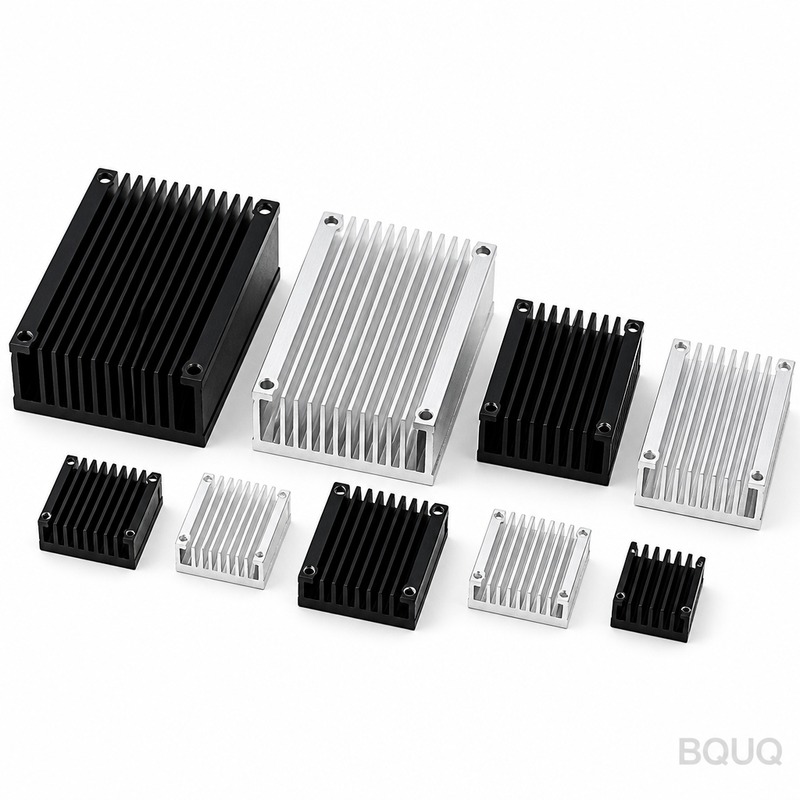
Alloy matters at the margins. 6063-T5 conducts roughly 200 W/m·K and is the standard for extruded heat sinks; 6061-T6 at 155-170 W/m·K is chosen when the housing must carry mechanical load — the detailed comparison is in our 6063 vs 6061 guide. Black anodizing adds a small radiation assist at high sink temperatures, but in most LED fixtures its bigger practical value is corrosion protection and uniform emissivity.
For high-volume luminaire bodies, stamped heat sinks and die-cast housings win on cost when the thermal requirement is modest and geometry suits the process. A stamped aluminum body can carry 10-20 W of heat adequately with a good thermal path to the board; beyond that, move to extrusion. The choice is volume-and-heat driven, and a source factory running both lines can tell you which is cheaper at your quantity.
What to Send Your Heat Sink Factory
Bring the real thermal data, not the lumen target. Send: LED module power and optical efficiency or measured heat watts, maximum junction or case temperature allowed, ambient range and IP enclosure details (a sealed housing blocks convection), required dimensions and mounting hole pattern, and whether airflow exists. A complete thermal spec lets the factory size the profile correctly the first time — and when the drawing is ambiguous, say so plainly rather than letting assumptions creep in. BQUQ runs extruded, CNC, and stamped heat sink lines under one ISO9001 roof and quotes within 12 working hours, but the accuracy of that quote starts with your thermal numbers.
Email sc@bquq.com or WhatsApp +86 137 1315 7787 with your PDF/DXF/STEP file. An engineer reviews it and replies with price, lead time and DFM notes on working days.
Frequently Asked Questions
Q: What junction temperature should I design an LED luminaire for?
A: For long-life products, target 85 °C or below at maximum ambient. At 85 °C typical white LEDs hold L70 for 50,000-70,000 hours; every 10-15 K above that roughly halves lifetime, which is why 100 °C-plus designs usually have short rated lives.
Q: How do I convert LED watts into the heat the sink must remove?
A: Subtract light from electrical input. A 100 W module at 30% optical efficiency produces about 70 W of heat. Use the module datasheet's optical efficiency — assuming 50% is the classic error that leaves luminaires under-sized by half.
Q: Why does a 100 W LED street light need such a heavy heat sink?
A: Because it dissipates roughly 70 W passively with only 10-20 K of allowable rise to stay near 85 °C junction. Natural convection needs about 50-80 cm² of fin surface per heat watt, so a large extrusion with 2.5 kg or more of aluminum is normal physics, not over-engineering.
Q: Can a stamped or die-cast housing replace an extruded heat sink for LEDs?
A: Yes, when heat is modest — roughly up to 15-25 W per body in free air. Above that, extruded fins earn their cost. The crossover depends on quantity and envelope; a factory running both stamped and extruded lines can cost both routes for your part.
Q: Does black anodizing really improve LED heat sink performance?
A: Slightly, by raising surface emissivity for radiation, which matters mainly at high sink temperatures and in confined spaces. For most LED fixtures its real value is corrosion resistance and a uniform, durable finish rather than a dramatic thermal gain.
Related Articles
- thermal-interface-materials-guide — More from the BQUQ Thermal Management engineering series.
- igbt-power-module-cooling-guide — More from the BQUQ Thermal Management engineering series.
- black-anodized-heat-sink-why — More from the BQUQ Thermal Management engineering series.
Data Sources and Verification
Tolerances, cycle times and price ranges in this guide come from BQUQ production records at our Dongguan plant, where CNC machining (±0.005 mm), stamping, custom springs and heat sinks run under one roof. BQUQ is an ISO 9001:2015 certified factory; the certificate and batch inspection reports are available on request with every quotation.
Related Resources
- About BQUQ: an ISO9001-certified source factory in Dongguan running four production lines under one roof.
- Heat sinks and thermal parts: extruded, CNC-machined and stamped options from the thermal line — extruded heat sinks, CNC-machined heat sinks, stamped heat sinks.
- Industry trends: manufacturing, material market, and sourcing analysis for buyers.
- Technical articles: engineering guides and process comparisons — more where this article came from.
- FAQ hub: quick answers on CNC, stamping, springs, and heat sinks.
- Case studies: real parts and real numbers from projects we engineered and delivered.
- Contact us: send your drawing and get a quote within 12 working hours.
Authored by the BQUQ Engineering Team. BQUQ is an ISO9001-certified source factory in Dongguan, China, running CNC machining, metal stamping, custom springs and heat sink lines under one roof. Send drawings to sc@bquq.com or WhatsApp +86 13713157787 for a quote within 12 working hours. www.bquq.com