Air cooling suits ~300 W per module; liquid past ~1 kW or high flux. Capacity, noise, cost compared. BQUQ (ISO9001, Dongguan) quotes in 12 hours.
Air vs Liquid Cooling for Electronics: A Practical Selection Guide
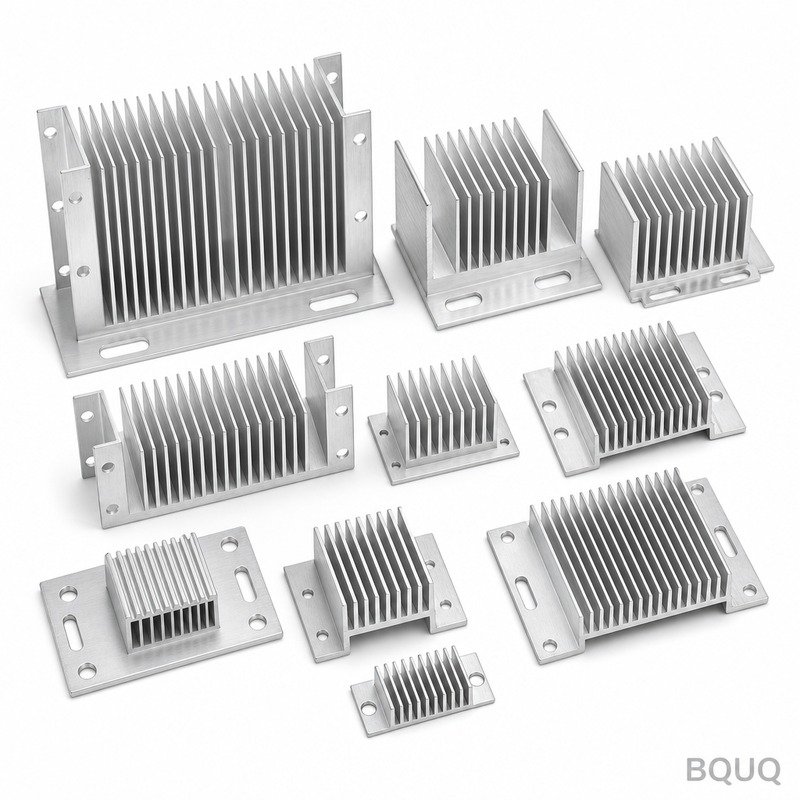
Air cooling is the right answer until the numbers say otherwise: roughly up to 200-300 W per module in a ventilated product, or heat fluxes around 5-15 W/cm² at the component surface. Beyond that — a 1 kW+ IGBT stack, a high-end server CPU in a dense chassis, a laser or traction inverter — liquid cooling takes over because a cold plate reaches 0.005-0.05 K/W while the best air sink struggles below 0.1 K/W. The crossover is a math problem, not a fashion statement.
Air is free, simple, and everywhere; liquid is dense, powerful, and complicated. Water carries about 3,500 times more heat per unit volume than air, which is why a thin cold plate can absorb what a warehouse of fins cannot. But liquid systems add a pump, tubing, fittings, a radiator, and a leak path — so the engineering question is where the crossover really sits for your watts, your heat flux, and your product's life in the field. This guide gives the decision numbers.
Where Air Runs Out of Headroom
Two limits define air cooling's ceiling. Total watts matter: a finned extruded heat sink with a good fan moves a few hundred watts before the block becomes absurdly large. Heat flux matters more: when hundreds of watts leave a chip the size of a postage stamp, the heat must spread before fins can touch it, and air-side spreading has hard limits. The practical envelope for air-cooled designs:
| Cooling challenge | Air-cooled practical limit |
|---|---|
| Total dissipation per assembly | ~200-400 W with ducted fan |
| Component heat flux | ~10-20 W/cm² with heat spreader |
| Junction-to-ambient resistance | ~0.1-0.3 K/W best case |
| Noise at high power | Rising fast past ~300 W |
Takeaway: when your calculation lands below these lines, air wins on cost, simplicity, and service life — every liquid system you avoid is a pump, a leak path, and a maintenance item you never have to think about.
What Liquid Actually Buys You
A liquid cold plate replaces the fin block at the heat source: coolant flows through channels in a copper or aluminum plate bolted to the module, and the heat rides away in the fluid to a radiator elsewhere. Because the coolant is dense, the plate stays small and its resistance low. The heat still must reach ambient air at the radiator — liquid does not break thermodynamics — but it moves the air-side problem to a location where space and noise are less critical.
| Performance axis | Air (best finned sink + fan) | Liquid cold plate |
|---|---|---|
| Typical thermal resistance | 0.1-0.3 K/W | 0.005-0.05 K/W |
| Practical heat flux | 10-20 W/cm² | 50-200+ W/cm² |
| Noise at source | Fan at the electronics | Quiet at the module |
| System volume at high watts | Very large fins | Compact at source |
| Moving parts | 1+ fans | Pump + fans at radiator |
Takeaway: liquid wins on concentrated heat — high flux, high total watts, tight enclosures. Its two real costs are system complexity and the radiator: at the radiator you are back to air, and that air-side rejection still needs finned surface and airflow, just somewhere more convenient.
The Middle Ground: Heat Pipes and Vapor Chambers
Before jumping to pumped liquid, check the heat-spreading middle ground. Heat pipes and vapor chambers move heat laterally with almost no temperature drop, letting you relocate heat from a small hot chip to a large remote fin area that air can cool efficiently. They are passive, sealed, and cheap compared with a pumped loop, which is why laptops, servers, and high-density LED fixtures use them heavily.
Heat pipes are the right tool when the problem is a hot spot on an otherwise cool board — the classic "spread then air-cool" architecture. They stop being enough when total watts are so high that no realistic air-side fin area exists, or when the heat must travel meters rather than centimeters. That is the moment pumped liquid stops being exotic and becomes the layout answer. Designers comparing approaches will find the heat sink types guide useful, since vapor-chamber and heat-pipe assemblies still terminate in extruded or bonded fin blocks.
When Liquid Cooling Is Justified
The clearest cases for liquid: traction inverters and motor drives above roughly 1-3 kW of module loss (where air ducts become tunnels), high-performance computing with multiple 300-500 W CPUs in one chassis, lasers and welding power stages, energy storage converters, and any sealed outdoor cabinet where fans cannot survive the environment. In each case the driver is the same — watts per cubic meter is too high for air, or the air path is unavailable.
| Application | Typical dissipation | Cooling answer |
|---|---|---|
| Small power supply | 50-150 W | Natural or fan air |
| Motor drive, 10-50 kW rating | 300-1500 W losses | Ducted forced air |
| Traction / large inverter | 2-10 kW losses | Liquid cold plate |
| Server chassis, dense CPUs | 1-4 kW per rack unit row | Air or liquid depending on density |
| Laser / welding head | 1-5 kW concentrated | Liquid, often with deionized water |
Takeaway: liquid wins above roughly 1 kW concentrated, in sealed enclosures, or where heat flux exceeds what air-side spreading can manage. Below that, the cost and reliability ledger favors air.
The System Costs Nobody Puts on the Slides
Liquid cooling shifts cost from the heat sink to the system. A cold plate needs a pump rated for the loop, a radiator sized for the full load, fans on that radiator, tubing and quick-connect fittings, coolant with corrosion inhibitor (or deionized water for direct electronics contact), and a leak and freeze strategy. Pump life is typically 30,000-70,000 hours — better than many fans, but it is still a wear item with a scheduled replacement. Field servicing means trained hands and spare coolant, which is why industrial users standardize one loop design across products.
The honest engineering view: if you can meet the thermal budget with air and the enclosure allows it, do that. If the calculation says no — and the thermal resistance guide shows exactly how to run it — liquid is a proven, mature answer, not a risk. When you go liquid, the metal side — precision CNC-machined heat sinks and cold plates with milled flow channels and flat mounting faces — is exactly the kind of work a machine shop does well; send the flow path, flatness, and pressure requirements with the drawing, and the quote comes back right the first time.
Email sc@bquq.com or WhatsApp +86 137 1315 7787 with your PDF/DXF/STEP file. An engineer reviews it and replies with price, lead time and DFM notes on working days.
Frequently Asked Questions
Q: At what power level should I switch from air to liquid cooling?
A: Generally above roughly 1 kW of concentrated dissipation, or when component heat flux exceeds what air-side spreading can handle — around 10-20 W/cm². Below that, a ducted fan and finned sink is cheaper, simpler, and more reliable.
Q: Does liquid cooling actually remove more heat, or just move it?
A: It moves heat far more efficiently from the component to a remote radiator — cold plates reach 0.005-0.05 K/W versus 0.1-0.3 K/W for air. The heat still reaches ambient air at the radiator, so total watts must still be rejected by finned surface and airflow somewhere.
Q: What are the main reliability risks of liquid cooling?
A: Pump wear, coolant leaks at fittings, corrosion or biological growth in the loop, and freezing in outdoor use. Mitigations are quality pumps, sealed quick-connects, corrosion-inhibited or deionized coolant, and scheduled maintenance — all real operating costs to budget.
Q: Can heat pipes replace pumped liquid cooling?
A: Often, when the problem is a hot spot needing lateral heat spreading to a remote fin area. Heat pipes are passive and sealed, but they stop being sufficient when total watts are too high for any realistic air-side surface or the heat must travel meters.
Q: Is a liquid-cooled system quieter than an air-cooled one?
A: Usually yes at the electronics, because the module has no fan — but the radiator still needs fans, and the pump adds noise. Total system noise depends on radiator fan sizing, not on the cold plate alone.
Related Articles
- heat-sink-mounting-methods-guide — More from the BQUQ Thermal Management engineering series.
- heat-sink-thermal-resistance-calculation — More from the BQUQ Thermal Management engineering series.
- thermal-interface-materials-guide — More from the BQUQ Thermal Management engineering series.
Data Sources and Verification
Tolerances, cycle times and price ranges in this guide come from BQUQ production records at our Dongguan plant, where CNC machining (±0.005 mm), stamping, custom springs and heat sinks run under one roof. BQUQ is an ISO 9001:2015 certified factory; the certificate and batch inspection reports are available on request with every quotation.
Related Resources
- About BQUQ: an ISO9001-certified source factory in Dongguan running four production lines under one roof.
- Heat sinks and thermal parts: extruded, CNC-machined and stamped options from the thermal line — extruded heat sinks, CNC-machined heat sinks, stamped heat sinks.
- Industry trends: manufacturing, material market, and sourcing analysis for buyers.
- Technical articles: engineering guides and process comparisons — more where this article came from.
- FAQ hub: quick answers on CNC, stamping, springs, and heat sinks.
- Case studies: real parts and real numbers from projects we engineered and delivered.
- Contact us: send your drawing and get a quote within 12 working hours.
Authored by the BQUQ Engineering Team. BQUQ is an ISO9001-certified source factory in Dongguan, China, running CNC machining, metal stamping, custom springs and heat sink lines under one roof. Send drawings to sc@bquq.com or WhatsApp +86 13713157787 for a quote within 12 working hours. www.bquq.com