CNC machined heat sinks win at low volume, tight base flatness, copper and shapes extrusion cannot make. BQUQ (ISO9001, Dongguan) quotes in 12 hours.
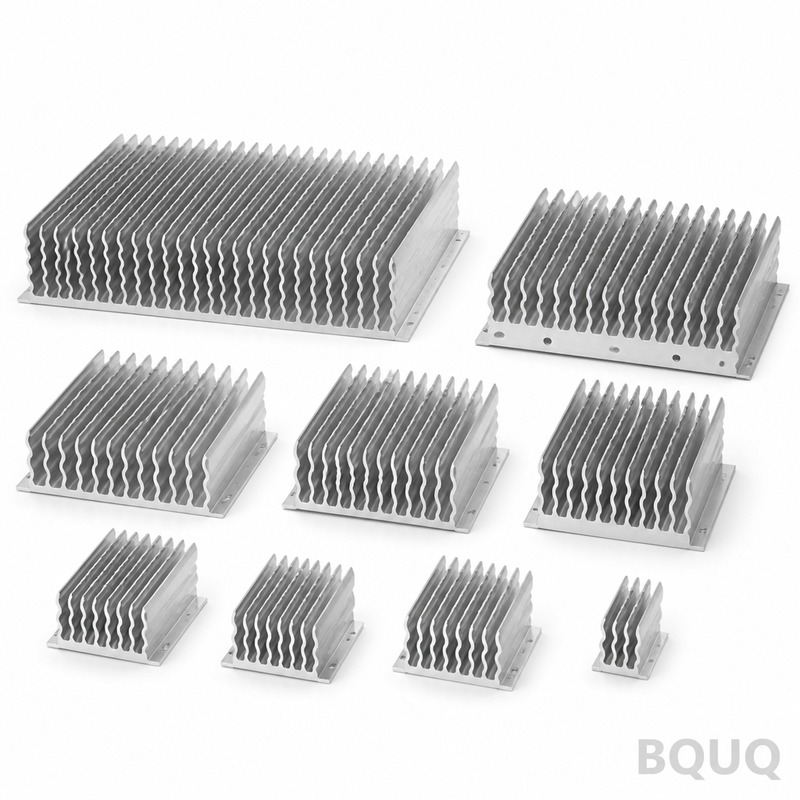
CNC Machined Heat Sinks: When Machining Beats Extrusion
CNC machining beats extrusion when quantity is low, the base needs real precision, the material is copper, or the geometry is impossible for a die — prototypes and short runs under a few hundred pieces, bases needing flatness and pockets, radial or crossed fins, and parts thicker or more complex than any profile. Above that, if an extrusion profile exists or a die is justified, extrusion wins on per-part cost; the crossover is a quantity and geometry question, not a quality one.
A machined heat sink starts as a solid block of aluminum or copper and gets its fins cut away with end mills. That sounds wasteful — and for simple shapes at volume it is. But machining buys three things extrusion cannot sell cheaply: no tooling commitment, precision on the features that touch the device, and geometric freedom. Each of those is worth real money on the right part.
When Machining Is the Right Call
Four situations point to machining before any die discussion starts. First, low quantity: with no extrusion die to amortize, a 50-piece run of machined sinks is often cheaper than the die alone for a custom profile. Second, precision: a base that must be flat to keep a thin TIM layer working, with mounting pockets and holes positioned relative to the device — machined features hold tolerances no extruded surface can. Third, copper: copper extrudes poorly and is almost always machined or skived instead. Fourth, geometry: fins in two directions, radial fins around a cylinder, crossed or pin fins, stepped bases, and enclosed channels are all machining territory.
| Situation | Extruded route | CNC machined route |
|---|---|---|
| 100 pcs, no existing profile | New die $1,000+ — uneconomic | No tooling; machining wins |
| 1,000 pcs, standard profile exists | Cut to length — cheapest | Machining loses on cost |
| 5,000 pcs, custom profile | Die amortizes to cents — wins | Machining only for complex bases |
| Copper part, any quantity | Not practical | Machining or skiving standard |
| Base flatness ≤ 0.1 mm + pockets | Needs machining anyway | Directly machined |
Takeaway: the decision tree is short. Existing profile or real volume — extrude. Otherwise — machine. And when the thermal interface demands a flat, pocketed, precisely drilled base, the answer is often a hybrid: an extruded fin section with a machined base, which combines cheap fins with machined precision.
The Geometry Extrusion Cannot Make
Extrusion pushes metal through a fixed cross-section, which means every fin runs the full length in one direction. Machining cuts with a tool that moves in three axes, so fins can run in two directions (cross-cut), radiate outward from a cylinder, taper, step, or stop short of the edges. Pin fins — arrays of small square or round pins — are a machined specialty that outperforms straight fins in compact forced-air designs because air can turn between the pins instead of channeling.
| Geometry | Extrusion | CNC machining |
|---|---|---|
| Straight parallel fins | Yes | Yes |
| Crossed or two-direction fins | No | Yes |
| Radial fins on a cylinder | No | Yes |
| Pin fin arrays | No | Yes |
| Stepped or tapered fins | Limited | Yes |
| Fins on two opposite faces | No (two dies) | Yes, one setup class |
| Enclosed channel or cavity in the base | No | Yes (pockets) |
Takeaway: if your envelope forces fins in more than one direction, the process decision is already made — no die can produce it, and machining (or bonding separate fin sections) is the only route. This is where a machined sink stops being a compromise and becomes the enabling technology for the whole thermal design.
Precision Where It Pays
The thermal interface lives on the base, and the base is where machined sinks justify their price. A machined base can be held flat to roughly 0.05 mm or better across 100 mm — an order of magnitude tighter than an as-extruded surface — which lets a thin grease or phase-change layer do its job instead of bridging air gaps. Hole patterns, counterbores, and pockets are positioned relative to the device footprint with normal machining tolerances of ±0.05 mm or tighter, so the assembly is repeatable from unit to unit.
| Feature | Typical machined capability | Why it matters thermally |
|---|---|---|
| Base flatness | ≤ 0.05 mm per 100 mm | Thin, even TIM layer |
| Mounting hole position | ±0.05 mm class | Repeatable clamp pressure |
| Pockets and counterbores | ±0.05 mm class | Component nests, captive hardware |
| Surface finish on base | Ra 0.8–1.6 µm typical | Consistent contact resistance |
| Fin thickness (milled) | ~0.8 mm and up | Dense arrays without die limits |
Takeaway: every 0.05 mm of base flatness error or waviness becomes an air gap under the device, and air is the worst thermal interface material in the building. Spec the base flatness on the drawing and the machining center delivers it; the same feature on an extrusion is a separate milling operation anyway, so paying for it once as a machined part is often cheaper than paying for it twice.
Cost Reality: When Machining Wins and Loses
Machined sinks carry no die cost, which makes them unbeatable at low volume, but they pay per cubic millimeter of metal removed and per minute of spindle time. A simple 100 × 100 × 40 mm aluminum block with straight fins might machine in a few minutes; a dense pin-fin array in copper can take an hour. As a planning guide, machined aluminum sinks typically land in a higher per-part band than equivalent extrusions until the extrusion die is amortized — the crossover usually sits somewhere in the low hundreds to low thousands of pieces depending on profile complexity.
| Route | Tooling | Per-part cost trend | Best fit |
|---|---|---|---|
| Extrusion, stock profile | None | Lowest at any volume | Standard shapes |
| Extrusion, new die | $900–2,500 | Falls fast after ~500 m | High volume custom |
| CNC machined, aluminum | None | Flat, machine-time-driven | Short runs, complex bases |
| CNC machined, copper | None | High (material + time) | High-flux local spreading |
| Hybrid: extruded fins + machined base | Die + machining | Middle | Precision interface at volume |
Takeaway: when the drawing needs a flat, pocketed, multi-feature base, compare the hybrid against full machining honestly — a stock extrusion with a machined base can capture both cheap fins and machined precision. For anything below the crossover, or any copper part, or any two-direction geometry, full CNC machining from solid is the pragmatic answer, and it is the route BQUQ runs on its CNC-machined heat sinks line — machining centers in the same Dongguan factory that also cuts extruded heat sinks, so the process recommendation follows the drawing rather than the available equipment. Send the part file with quantity and thermal requirements to sc@bquq.com for a quote within 12 working hours; the heat sink cost factors guide explains how the price layers stack if you want to see the math first.
Email sc@bquq.com or WhatsApp +86 137 1315 7787 with your PDF/DXF/STEP file. An engineer reviews it and replies with price, lead time and DFM notes on working days.
Frequently Asked Questions
Q: When should I choose a CNC machined heat sink over extruded?
A: For prototypes and short runs under a few hundred pieces (no die cost), copper parts, bases needing flatness under ~0.1 mm with pockets and precise holes, and any geometry extrusion cannot produce — crossed, radial, or pin fins. At volume with a suitable profile, extrusion wins on price.
Q: How much does CNC machining limit fin geometry?
A: Machined fins can go thinner than extrusion limits — roughly 0.8 mm and up with standard tooling — and can run in any direction the tool can reach. Deep narrow slots are limited by tool length and diameter; a slot deeper than about 10–15 times its width needs special tooling or EDM.
Q: Is a machined heat sink better thermally than an extruded one?
A: Not automatically — performance comes from fin area and airflow, not from how the fins were made. Machining wins thermally where it enables geometry extrusion cannot make (pin fins, two-direction fins) and where base flatness improves the interface between device and sink.
Q: Why are copper heat sinks usually machined rather than extruded?
A: Copper has poor extrudability — the press forces are high, die life is short, and profile sizes are limited. Most copper sinks are machined from plate, skived, or formed from copper sheet, which is why copper appears mainly where its conductivity earns the cost.
Q: Can I combine an extruded fin section with a machined base?
A: Yes, and it is often the smartest thermal value at moderate volume: extrusion makes the fins cheaply, then a machining pass flattens the base, drills the holes, and cuts any pockets. The joint between the two is the design question — brazing, epoxy, or mechanical assembly each have their own thermal penalty.
Related Articles
- heat-sink-cost-factors — More from the BQUQ Thermal Management engineering series.
- heat-sink-extrusion-design-guide — More from the BQUQ Thermal Management engineering series.
- heat-sink-selection-workflow — More from the BQUQ Thermal Management engineering series.
Data Sources and Verification
Tolerances, cycle times and price ranges in this guide come from BQUQ production records at our Dongguan plant, where CNC machining (±0.005 mm), stamping, custom springs and heat sinks run under one roof. BQUQ is an ISO 9001:2015 certified factory; the certificate and batch inspection reports are available on request with every quotation.
Related Resources
- About BQUQ: an ISO9001-certified source factory in Dongguan running four production lines under one roof.
- Heat sinks and thermal parts: extruded, CNC-machined and stamped options from the thermal line — extruded heat sinks, CNC-machined heat sinks, stamped heat sinks.
- Industry trends: manufacturing, material market, and sourcing analysis for buyers.
- Technical articles: engineering guides and process comparisons — more where this article came from.
- FAQ hub: quick answers on CNC, stamping, springs, and heat sinks.
- Case studies: real parts and real numbers from projects we engineered and delivered.
- Contact us: send your drawing and get a quote within 12 working hours.
Authored by the BQUQ Engineering Team. BQUQ is an ISO9001-certified source factory in Dongguan, China, running CNC machining, metal stamping, custom springs, heat sink and collet lines under one roof. Send drawings to sc@bquq.com or WhatsApp +86 13713157787 for a quote within 12 working hours. www.bquq.com