"Fixed vs sliding guide bushings on Swiss-type lathes: support, clearance, wear and fit. BQUQ machines Swiss collet bushing systems in Dongguan."
"Guide Bushings in Swiss Machining: Fixed vs Sliding"
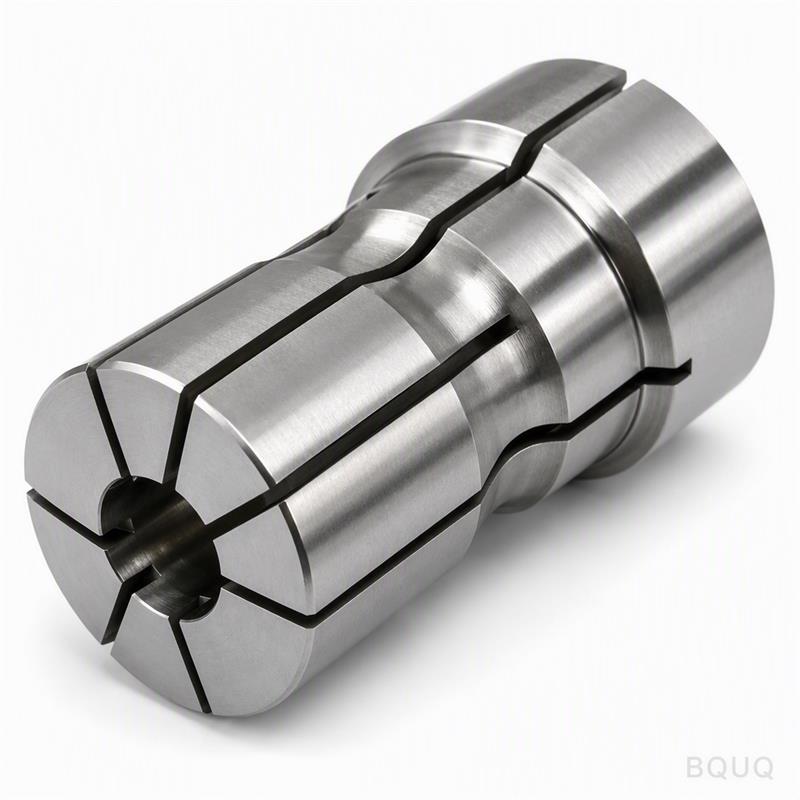
A guide bushing is the part that makes a Swiss-type lathe Swiss: a precision sleeve that supports the bar immediately behind the cutting tools so slender stock machines true instead of deflecting. The two architectures — fixed, where the bushing stays stationary and the bar slides through it, and sliding, where the bushing travels with the headstock — trade support stiffness against machining flexibility.
Every Swiss machine has one, and almost no two shops agree on which type to run. That is because the answer genuinely depends on the work. Long, thin, high-finish parts favor the rigid support of a fixed bushing; machines that need long main-spindle travel or heavier roughing often use a sliding bushing. This guide explains how each works, what the numbers say, and how to pick without guessing.
What the Bushing Actually Does
On a conventional lathe the chuck holds a short, stiff workpiece and the tool cuts near the grip. On a Swiss-type lathe the headstock slides, feeding bar stock past the tool zone, and the workpiece can be very long relative to its diameter. Without support at the cut, the bar would bend away from the tool and the part would come out tapered, oval or chattered.
The guide bushing closes that gap. It is mounted just behind the tools, its bore matches the bar within a few thousandths of a millimeter, and it holds the bar at the exact point where cutting forces act. The spindle collet feeds and rotates the bar; the bushing positions it. Both must be right — a Swiss-type collet chuck that feeds true and a bushing that supports true are the two halves of one system.
Fixed vs Sliding: The Two Architectures
In a fixed bushing machine the bushing is anchored to the machine frame near the tool zone, and the bar slides through it as the headstock feeds. This is the classic Swiss arrangement and the reason the process earned its reputation for long, slender precision parts: the support point never moves, so the bar is guided at the tools in every pass.
In a sliding bushing machine the bushing is carried by the headstock and travels with it. The support point therefore moves with the bar, which changes what the machine can do: the main spindle can machine over a longer travel while the bar stays supported, and heavier roughing becomes practical because the bar is held closer to where force is applied along the whole stroke. The cost is a more complex, more expensive headstock assembly and a bushing that must be aligned as it moves.
| Factor | Fixed bushing | Sliding bushing |
|---|---|---|
| Mounting | Anchored to machine frame | Carried by the headstock |
| Support point during feed | Stationary at tool zone | Travels with the bar |
| Typical bar clearance | Tight, ~0.003–0.008 mm typical | Looser, ~0.01–0.02 mm typical |
| Typical strengths | Slender parts, fine finish, roundness | Long travel, heavier cuts, flexibility |
| Typical weaknesses | Bushing wear at one zone | More parts to align, higher cost |
| Changeover | Size bushing to each bar | Size bushing and check travel alignment |
Clearance values are typical operating ranges for small-to-mid bars, not fixed specifications; larger bars and higher speeds push the numbers up. The architectural difference is the reliable part: fixed means one unmoving support, sliding means a support that follows the work.
Choosing by Part Geometry and Process
The practical selection rule starts with length-to-diameter ratio and cut severity. If the part is long and slender — say over 10× diameter unsupported — you want the support point as close to the tools as possible, which points to fixed bushing operation. If the job is dominated by main-spindle machining over a long stroke, or you are roughing aggressively and want the headstock and bushing to move as one rigid unit, sliding bushing machines earn their complexity.
Bushing material and construction matter as much as architecture. The bushing bore takes the wear, so production shops run carbide bushings or carbide with replaceable liners on long runs, and hardened steel for short runs and soft materials. The bushing must also be sized to the measured stock — a fixed bushing bore that is 0.005 mm too tight will seize on a warm bar, and one that is 0.02 mm loose will let the bar flex.
| Bushing material | Typical wear life | Typical role |
|---|---|---|
| Hardened tool steel | Moderate | Short runs, brass, aluminum, soft steel |
| Solid tungsten carbide | Long | High-volume runs, abrasive alloys |
| Carbide with replaceable liner | Long, cheap to renew | High-mix production, quick bushing changes |
| Split/adjustable | Depends on material | Fine clearance tuning on precision work |
The economics are simple: the bushing is cheap relative to the bar, the tooling and the spindle. Replace it before it scores stock or drifts size, and keep spares for every bar you run regularly.
Running and Maintaining Either Type
Whichever architecture your machine uses, three habits keep bushings honest. First, measure the actual bar diameter and order or grind the bushing bore to it — nominal sizes drift and so do bars. Second, keep the bushing and bar clean and well lubricated; swarf dragged through a tight bore scores both surfaces in seconds. Third, watch the telltales: a bright band on the bar, a sudden finish change, or drifting front-end diameters all point at bushing wear before they point at anything else. Our collet system guide covers the full bushing family and sizing logic, and the collet runout article explains how support errors become measured errors on the part.
When you spec bushings and collets together from one source, alignment responsibility is simpler: BQUQ machines guide bushing work alongside its Swiss collet chucks and auto-lathe collets with CNC capability in the 0.005 mm class, so bore, seat and taper are made against the same reference. Send stock sizes and bushing details to sc@bquq.com for a quotation within 12 working hours.
Email sc@bquq.com or WhatsApp +86 137 1315 7787 with your PDF/DXF/STEP file. An engineer reviews it and replies with price, lead time and DFM notes on working days.
Frequently Asked Questions
Q: Fixed or sliding bushing — which gives better surface finish?
A: Fixed bushings usually win on finish for slender parts because the support point never moves and clearance can be kept tightest. Sliding bushing machines can match it on the right jobs but carry more alignment variables. Finish is decided by setup either way.
Q: Do I need a different bushing for every bar size?
A: Yes. The bushing bore must be sized to the actual bar — typically within a few microns to about 0.02 mm depending on type and diameter. Running an oversized bushing to save changeover time guarantees flex and poor finish.
Q: Why does my bar have a shiny band in one spot?
A: That is contact wear where the bushing rides the bar, usually from a tight bore, dry running, or swarf trapped between bar and bushing. Stop and check the bore before the band becomes a score that marks every part.
Q: Can a fixed bushing machine do sliding-bushing work?
A: Not in the strict sense — the bushing mounting is built into the headstock and frame architecture. You can change bushing type (steel, carbide, liner) and clearance, but fixed and sliding are machine designs, not bushing options.
Q: How often should a guide bushing be replaced?
A: There is no universal interval; it depends on material, speed and lubrication. Inspect at every job change and replace when the bore shows a wear step, when finish degrades, or when front-end diameters drift — usually long before the bushing fails catastrophically.
Authored by the BQUQ Engineering Team. BQUQ is an ISO9001-certified source factory in Dongguan, China, running CNC machining, metal stamping, custom springs, heat sink and collet lines under one roof. Send drawings to sc@bquq.com or WhatsApp +86 13713157787 for a quote within 12 working hours. www.bquq.com