Guide bushings and collets as one Swiss system: the collet feeds the bar, the bushing supports the cut. Clearance logic from BQUQ ISO9001 Dongguan.
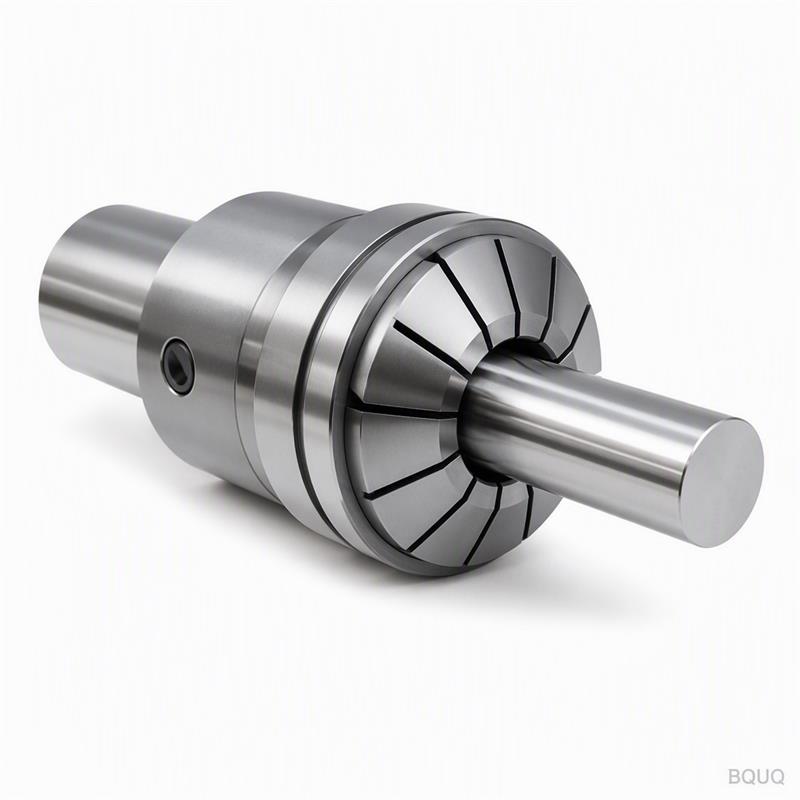
Guide Bushings and Collets: The Swiss Machining Pair
Short answer: on a guide-bushing Swiss lathe the collet grips and feeds the bar while the guide bushing supports the bar right at the cutting zone, keeping deflection under roughly 0.005–0.01 mm so long, slender parts machine true. The two components are a matched pair: bushing bore clearance typically runs 0.003–0.015 mm over stock diameter for ground bar, and if the collet is accurate but the bushing is worn, the part still drifts. Buy and maintain them as a system, not as spare parts. Replacing one half of the pair without the other is the most common way shops chase a drift that never goes away.
Swiss-type machining exists because of this pair. A sliding headstock machine feeds bar stock through a guide bushing, and the tools cut within a few millimeters of the bushing face. The work never overhangs far from support, which is why a Swiss lathe can turn a part 20 mm long out of 3 mm bar with a straightness a fixed-headstock lathe cannot match. But that geometry only works if the collet and bushing agree with each other.
What Each Component Actually Does
The collet, mounted in the headstock spindle, grips the bar and pushes it forward through the bushing on each feed cycle. It carries the axial feed force and the torque reaction from cutting, and it must release cleanly so the bar can advance. The guide bushing sits in the machine frame near the tool zone and supports the rotating bar against cutting forces, defining where the bar runs true.
Divide the jobs and the failure modes become obvious. Collet problems show as feed errors, grip marks, and the bar slipping or rotating in the headstock. Bushing problems show as taper, ovality, and chatter in the machined diameter — the classic symptoms of the bar flexing at the cut. When a Swiss part drifts out of roundness, most shops change the collet first and the bushing second, but statistically the bushing is the more common culprit because it runs against the full bar surface every revolution, all day.
The Feed Cycle: How the Pair Cooperates
During a feed cycle the headstock collet opens, the bar pusher or feeder advances stock through the guide bushing by the programmed length, and the collet re-clamps; then the spindle accelerates and the tools cut against bar supported by the bushing. Timing matters. If the collet closes while the bar is still moving, it grips off-center; if it opens too early near the end of the part, the bar can whip inside the bushing. Machine builders handle this with cam timing or servo coordination, but the workholding side must cooperate by releasing cleanly and re-clamping at the same axial position every cycle.
Two design details make the pair behave. First, the collet bore and the bushing bore must share the same nominal axis — which the machine guarantees only if both seats are clean and undamaged, so bore alignment is really a maintenance property rather than a manufacturing one. Second, the bushing carries an oil groove or lubrication feed because the bar-to-bushing interface is a plain bearing running at thousands of rpm; starving it turns a 0.005 mm clearance into galling within minutes. Most bushing failures are lubrication failures first and wear failures second.
The practical consequence: when a Swiss machine starts producing a repeating taper or a surface finish that degrades along the part length, examine the feed cycle and the lubrication before blaming either component. A bar that feeds 0.01 mm off-axis because the collet released late will cut a taper that no new bushing will cure.
Rotary vs Fixed Guide Bushings
Two bushing architectures exist, and they change how the whole front end behaves.
| Feature | Fixed (stationary) bushing | Rotary bushing |
|---|---|---|
| Bar rotation | Bar rotates inside stationary bushing | Bushing rotates with the bar on bearings |
| Speed range | Typical up to 8,000–10,000 rpm | Handles high spindle speeds |
| Wear driver | Sliding contact on bore | Bearing life, less bore wear |
| Lubrication | Critical, oil through the bushing | Oil mist or grease on bearings |
| Best for | Standard Swiss work, lower speeds | High-speed, long-run precision |
Fixed bushings are usually carbide or hardened steel with an oil groove, sized a few microns over the bar. Rotary bushings carry the bar in a rotating sleeve supported by ball bearings, which lets the stock spin at full speed without sliding wear. The fixed type is simpler and cheaper; the rotary type is the answer when speed or surface finish demands it. Material choice also matters — our guide to Swiss machining covers when carbide bushings pay back on abrasive materials.
Conversion kits exist for many Swiss machines, letting a shop switch a fixed-bushing headstock to rotary or back. The conversion is rarely neutral: it changes the lubrication system, the speed envelope and the bar preparation rules, so treat it as a machine re-commissioning rather than a parts swap. If most of your work is ground bar at moderate speed, a fixed bushing with a carbide insert is often the lowest-cost, lowest-maintenance answer.
Sizing the Pair: Clearance Is a Spec, Not an Accident
The bushing bore must be larger than the bar or it seizes; how much larger is the whole game. Too tight and the bar gall or the bushing overheats; too loose and the bar deflects under cut and the part goes tapered.
| Stock condition | Bushing bore over stock (typical) | Collet bore approach |
|---|---|---|
| Precision ground bar | 0.003–0.008 mm | Bore matched to actual bar diameter |
| Cold-drawn bar | 0.008–0.015 mm | Bore matched, allow for size bands |
| Centerless ground, tight band | 0.003–0.005 mm | Matched set with bushing |
| Plated or coated bar | 0.010–0.020 mm | Watch coating buildup in slots |
Collets on Swiss machines are normally made to the stock diameter with very little clearance, because the collet closes onto the bar and only needs to slide over it when open. The bushing, by contrast, never closes — it is a fixed hole the bar spins in — so its clearance is set purely by the lubrication film and thermal growth. When a shop orders a "matched set," it means the collet bore and bushing bore were made and ground against the same actual bar diameter, which is the only way to get the pair to 0.005 mm-class concentricity.
Why the Pair Fails Together and Should Be Maintained Together
The two parts share one failure loop. The collet feeds the bar forward; the bushing wears a slight taper or ovality; the bar no longer runs true at the cut; the machined diameter drifts; the operator opens the collet clearance to compensate; now the bar feeds off-center into a worn bushing and the collet itself starts wearing unevenly. Before long both parts are scrap and nobody can say which failed first.
The practical defense is a paired maintenance routine: check bushing bore against a new bar with a feeler or air gauge when runout drifts, replace or re-grind the bushing at the same time as the collet when a matched set is used, and record both in the same log. Runout measured at the bushing face versus 20 mm behind it tells you instantly which half of the pair has degraded — the same test-bar method detailed in our collet runout measurement guide applied to the bushing zone.
A practical paired-purchase habit: when you order a replacement collet for a machine whose bushing is mid-life, order the bushing at the same time and schedule the swap together. The two parts are cheap relative to the setup they share, and replacing them in pairs restores the matched clearances the machine was commissioned with, instead of mixing one fresh part with one worn part and guessing which one is drifting.
When the Bushing Disappears: Fixed-Headstock Swiss Machines
A growing share of Swiss-type machines run without a guide bushing — the "bushing-less" or fixed-headstock configuration, where the headstock itself becomes the support and the bar is fed through a long, precise collet or a bar guide. This removes bushing wear and lubrication entirely and is excellent for short, stiff parts. It also removes the stiffness advantage that defines Swiss machining, so long slender parts need reduced depth of cut and feed, and the collet alone must carry concentricity. If your part is longer than roughly 3–4× its diameter, a bushing machine is usually the better tool; if it is short and stubby, bushing-less saves setup and consumable cost. Our Swiss collet systems guide compares these architectures with the collet options each accepts.
For shops running both architectures, collet standardization softens the difference. The collet family a machine accepts — its taper, thread and pull length — is fixed by the spindle, but bore size and stock diameter are shared decisions, so a shop can run the same stock sizes through bushing and bushing-less machines with one collet inventory philosophy. Machine architecture then stays where it belongs: a decision driven by part geometry and volume, not by workholding availability.
Frequently Asked Questions
Q: What clearance should a Swiss guide bushing have over the bar?
A: For precision ground bar, 0.003–0.008 mm is typical; for cold-drawn bar, 0.008–0.015 mm. The bushing must clear the largest bar in your tolerance band and still leave room for an oil film. When in doubt, size to the measured bar diameter, not the nominal one.
Q: When should I use a rotary guide bushing instead of a fixed one?
A: When spindle speed or finish requirements push past what a fixed bushing tolerates — typically above roughly 8,000–10,000 rpm, or when bore wear from sliding contact shortens fixed bushing life unacceptably. Rotary bushings add bearing cost and maintenance but remove sliding wear at the bore.
Q: My parts are drifting out of round. Collet or bushing first?
A: Measure both with the same test bar. Indicate at the bushing face and 20 mm behind it: if the face reading is high, suspect the bushing; if both are high and the collet zone is clean, suspect the collet or spindle nose. On Swiss machines, bushing wear causes more roundness drift than collet wear, so check the bushing before you spend on a new collet.
Q: Should I order collet and bushing as a matched set?
A: For work holding tight concentricity — 0.005 mm class or better — yes. A matched set is made and ground against the same measured bar diameter, removing the accumulation of separate tolerances. For general work, individually correct sizes are usually fine.
Q: How long do guide bushings last?
A: It depends almost entirely on stock material and lubrication. Carbide fixed bushings on clean ground steel can run hundreds of thousands of parts; on abrasive cold-drawn or plated stock they may need replacement within weeks. Monitor bore wear with a feeler check against a new bar and replace when clearance has grown roughly double the initial value.
Related Resources
- Guide bushing machining guide: bushing types, carbide selection, and setup practice for Swiss cells.
- Swiss collet systems guide: how collet and bushing choices interact across machine architectures.
- Guide bushings: fixed and rotary bushings bored to your stock diameter.
- About BQUQ: ISO9001-certified source factory in Dongguan, Qiaotou, machining collets and bushings in-house.
- Contact us: send your machine model and stock spec for a quote within 12 working hours.
Authored by the BQUQ Engineering Team. BQUQ is an ISO9001-certified source factory in Dongguan, China, running CNC machining, metal stamping, custom springs, heat sink and collet lines under one roof. Send drawings to sc@bquq.com or WhatsApp +86 13713157787 for a quote within 12 working hours. www.bquq.com