Match collet bore shape to stock: round by diameter, hex, square and triangle by across-flats. BQUQ machines shaped bores to 0.005 mm class, ISO9001.
Round, Hex and Triangle Bore Collets: Matching Hole Shape to Stock
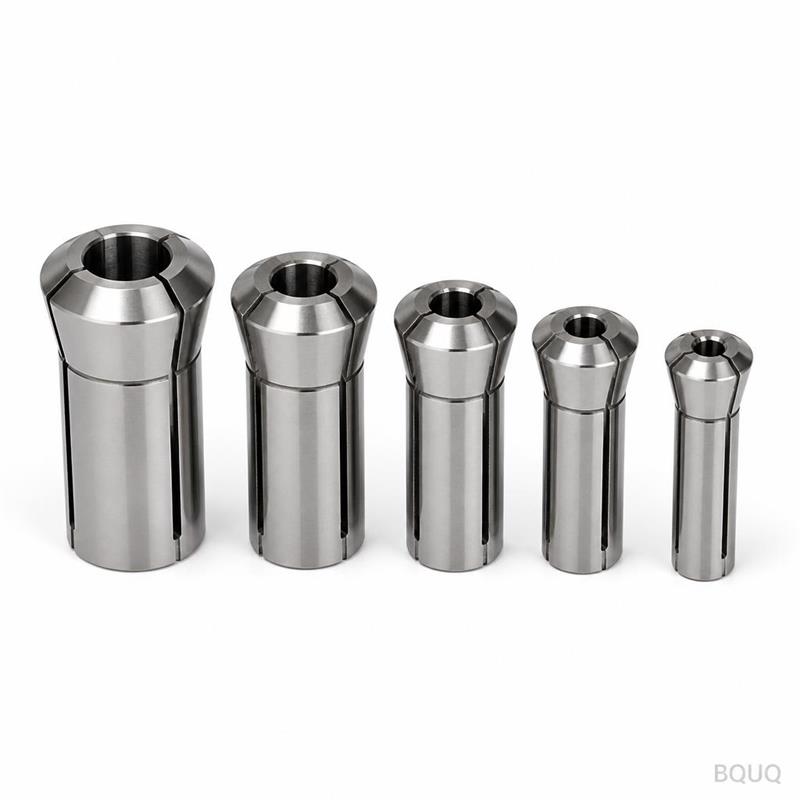
Collet bores are cut to match the cross-section of the stock: round for round bar, hex across-flats for hex bar, square across-flats for square bar, and triangle across-flats for triangular stock. A round bore cannot hold a hex bar straight, and a hex bore sized by corner distance will never touch the flats — the hole shape and its reference dimension must copy the stock.
Most bar work is round, which is why round-bore collets dominate catalogs. But automatic lathes routinely run hex and square stock to make terminals, fasteners and fittings without a secondary milling step, and triangle stock appears in specialized wire and profile work. Each shape changes the bore geometry, the slot layout and the reference dimension you order by. Get those three right and a shaped-bore collet grips as reliably as a round one.
Why Bore Shape Must Copy Stock Shape
A collet grips through surface contact and friction. Round stock offers a continuous surface, so a round bore distributes grip around the full circumference. Hex stock offers six flat faces; a round bore would touch only the corners — three narrow lines of contact that cannot transmit torque without crushing the edges or letting the bar rotate.
The bore therefore becomes the stock's cross-section, offset by a small working clearance. The collet maker cuts the profile in the hardened blank, then grinds or wire-cuts it so the gripping faces are true. Slotting is arranged around the profile so the fingers close radially without collapsing the corners.
| Stock shape | Bore reference dimension | Contact faces | Typical slot layout |
|---|---|---|---|
| Round | Diameter | Full circumference | 3 slots |
| Hex | Across-flats (AF) | 6 flats | 3 slots, corners land in support zones |
| Square | Across-flats (AF) | 4 flats | 4 slots typical |
| Triangle | Across-flats (AF) | 3 flats | 3 slots, corner-aligned |
The takeaway row is the second column: every non-round bore is ordered by across-flats, the distance between parallel sides — never by the corner-to-corner (circumscribed) diameter. Across-flats is what the stock drawing states, what a micrometer checks, and what the collet bore must reproduce.
Hex Bore Collets: The Most Common Shaped Bore
Hex collets hold hex bar for parts that need a hexagon feature machined, broached or just held rigidly while the other end is turned. They are standard in terminal, fitting and fastener production, and they are ordered constantly for the auto-lathe families (36, 46, 52, 60, 630, 643).
The critical detail is the across-flats dimension. Hex bar is specified as AF, for example 8 mm AF or 5/16 in AF (7.94 mm). Order the collet by that number. The bore is then cut as a hexagon of that AF with working clearance, and the collet grips on all six flats.
Slot placement matters on hex collets. The fingers must close radially, but a slot aligned with a hex corner would leave that corner unsupported or force the fingers to bend around it. Good hex collet designs place the three slots so each finger carries a full flat or a corner between support points, keeping the hex centered as it closes. That is machining detail, not marketing: wrong slot phasing shows up as bar lift-off on one flat and visible runout on the turned part.
Square and Triangle Bores: Niche but Real
Square bore collets serve square stock for parts like broached shafts, square shanks and tool blanks. Sizing is again across-flats, and slotting is usually four-way so each face is carried by one finger. Square corners are sharper than hex corners, so clearance at the corner radius matters: the bore corners must clear the stock's corner radius or the collet will not close fully.
Triangle bore collets are the specialist of the group, used where the stock itself is triangular in section — certain wire profiles, special fasteners and locking components. The bore is an equilateral triangle sized across the flats, with three slots phased to the faces. Triangle stock is rarely drawn to tight tolerance, so check the bar grade before ordering; a loose triangle bar in a tight bore will not seat.
| Bore shape | Typical stock sources | Common parts made |
|---|---|---|
| Round | Drawn, ground round bar | Shafts, pins, turned blanks |
| Hex | Drawn hex bar, cold headed hex | Terminals, fittings, hex-head blanks |
| Square | Drawn square bar | Broached blanks, square shanks |
| Triangle | Specialty drawn profiles | Locking hardware, special wire parts |
If your stock shape is not in a standard table, the bore is a custom cut — the profile follows your stock drawing exactly, and the same AF rules apply.
Ordering Rules That Prevent Bad Collets
Three ordering errors cause nearly every shaped-bore mismatch. First, giving the wrong reference dimension: a hex collet quoted from corner-to-corner diameter instead of AF will be oversized by about 15% and never touch the flats. Second, mixing units: 8 mm AF hex and 5/16 in (7.94 mm) AF hex are different bores — convert exactly. Third, assuming one bore covers a tolerance range: as with round collets, the shaped bore has only a few hundredths of a millimeter of closure, so the bar grade must be consistent.
Include the corner radius on the stock drawing if it is significant. On hex and square stock the drawn corners are never sharp; a bore with zero corner clearance will bind before the flats make contact. A good supplier asks for the stock profile or a sample when the corner geometry is unusual.
Also state what the stock is made of. Hardened or work-hardened bar (stainless, some alloys) resists the fingers differently than soft brass or aluminum, and the slot width and bore clearance can be adjusted so grip is secure without marking the surface. Soft stock in a bore cut for hard stock will show witness marks at the slot edges.
What the Factory Needs from You
A complete shaped-bore inquiry is: collet family (type number), machine and chuck reference, stock shape and material, the exact across-flats or diameter with unit, the bar tolerance grade, and the runout class required on the finished part.
This is the specification set BQUQ machines against every day for the 36/46/52/60/630/643 families. The bore profile is cut in the hardened blank and finished by precision grinding on the same line that holds ±0.005 mm across our CNC production, under ISO9001 control — shaped bores included, since a hex or triangle bore is held to the same geometry discipline as a round one. Browse the auto-lathe collet range, see a real example in our CNC-machined 52-type hex-bore collet, and when your size is off the standard ladder, our custom collet design guide lists the drawing details that get a shaped bore quoted fast. The chucks these families seat into come from the same line — see the Swiss and 2J collet chucks. Send the stock spec to sc@bquq.com and the quote comes back within 12 working hours.
Email sc@bquq.com or WhatsApp +86 137 1315 7787 with your PDF/DXF/STEP file. An engineer reviews it and replies with price, lead time and DFM notes on working days.
Frequently Asked Questions
Q: Can a round bore collet hold hex bar?
A: Poorly. Contact happens only at the three sharp corners, which cannot transmit torque without deforming the bar. Use a hex bore collet sized across-flats; the grip then covers all six faces.
Q: What dimension do I order for a hex collet?
A: The across-flats dimension of the hex bar, in millimeters or inches, exactly as the bar drawing states. Never order by the corner-to-corner diameter — that bore will be roughly 15% too large and will not grip.
Q: Do shaped-bore collets need different slot counts?
A: Usually yes. Hex collets commonly use three slots phased to the corners; square collets often use four. Slot phasing keeps the flats supported as the fingers close, which round collets do not have to consider.
Q: Why does my hex collet mark the bar at the slot edges?
A: Either the corner clearance is too small, so the corners bind before the flats seat, or the bar is harder than the bore was set up for. Send the stock profile and material so the bore clearance and slot edges can be matched.
Q: Is triangle bore stock common enough to be standard?
A: It is a specialty. Triangle stock comes from niche profile drawing, so most triangle-bore collets are custom orders sized across-flats with corner clearance. Confirm the bar grade and corner radius before quoting.
Authored by the BQUQ Engineering Team. BQUQ is an ISO9001-certified source factory in Dongguan, China, running CNC machining, metal stamping, custom springs, heat sink and collet lines under one roof. Send drawings to sc@bquq.com or WhatsApp +86 13713157787 for a quote within 12 working hours. www.bquq.com