How a spring collet converts drawbar pull into radial grip: taper wedges, slot geometry, force math and a worked torque example. BQUQ ISO9001 Dongguan.
Spring Collet Clamping Force: How Slots and Tapers Work
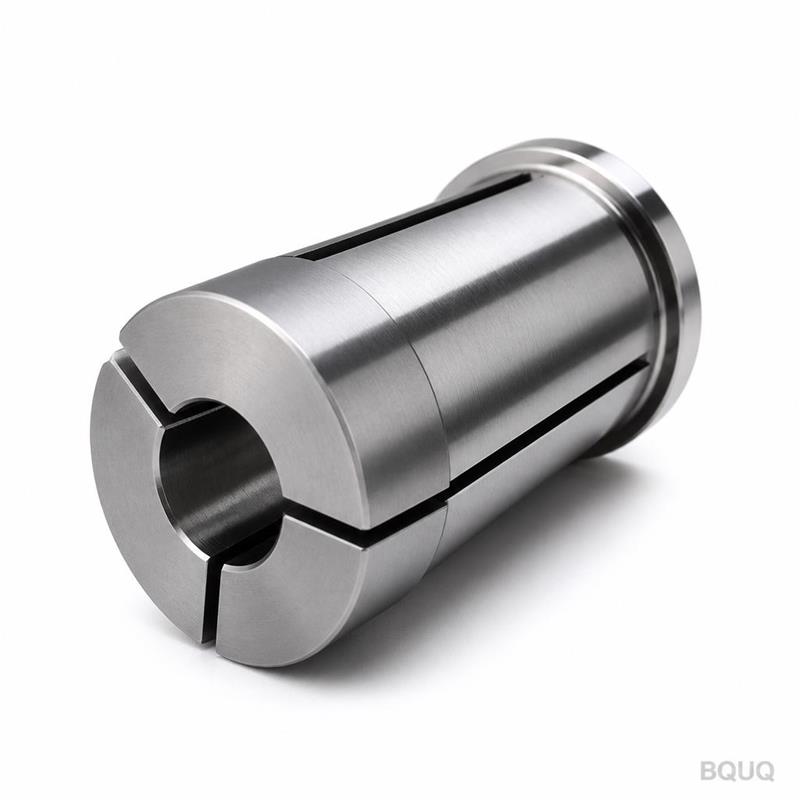
Short answer: a spring collet is a wedge. The drawbar pulls the collet into a matching taper, and the axial pull converts into radial grip through the taper angle — a 3–5 kN drawbar pull on a typical 15° half-angle collet produces several kN of grip spread around the full bore circumference. Slot count and width decide how evenly that force distributes and how much the collet can flex; taper angle decides how much grip you get per unit of pull and whether the collet releases cleanly.
Strip away the marketing and a spring collet is three parts doing one job: a slotted sleeve that flexes, a taper that multiplies force, and a drawbar that supplies it. Change any one and the grip changes. Grip is a force you can calculate, and the calculation tells you which collet, which bar preparation and which drawbar setting you actually need. This is why two collets that look identical can behave completely differently on the same machine.
The Taper Wedge: Force In, Force Out
When the drawbar pulls the collet backward into the spindle nose taper, each slotted segment is pushed radially inward by the wedge action. For small angles, the relationship is close to:
Radial grip ≈ Axial drawbar force ÷ tan(taper half-angle + friction angle)
A smaller included taper angle gives more radial grip per unit of axial pull — but it also approaches the self-locking condition. If the half-angle falls below the friction angle (roughly 6–9° for clean steel on steel), the wedge jams and the collet will not release without a positive opening force. That is why collet families sit at very different taper angles depending on how they open.
| Collet family | Included taper angle (typical) | Character |
|---|---|---|
| ER collets | 8° | High grip per pull; needs nut threads to open positively |
| R8 collets | ~16°51′ | Steeper, releases more freely |
| 5C / 2J collets | 20° | Standard drawbar collets, moderate grip ratio |
| Auto-lathe / Swiss collets | 30° | Steep, fast release, suited to rapid feed cycles |
The 30° included angle (15° half) common on auto-lathe and Swiss collets looks inefficient on paper, but those machines feed bar continuously and need positive, fast release between cycles — grip is cheap when the machine can simply pull harder.
Slots: The Part That Makes It a Spring
Slots are what let a solid ring become a gripping device. Cut a ring and it can flex inward when compressed into a taper; leave it solid and it cannot grip at all. The number, width and root geometry of the slots set three things: how evenly grip distributes, how much diameter range the collet covers, and how many cycles it survives.
Three-slot collets (120° apart) are the classic compromise: segments wide enough to be stiff, slots narrow enough to avoid trapping chips. Six-slot designs distribute force more evenly and close more roundly on out-of-round stock, at the cost of narrower segments that flex less and wear the slot edges faster. Every slot root is a stress concentration, which is why quality collets drill a small relief hole at the slot root — it spreads the bending stress and is the difference between a collet that lasts a season and one that lasts years.
| Slot arrangement | Grip distribution | Diameter range | Typical use |
|---|---|---|---|
| 3 slots / 120° | Good, stiff segments | 0.05–0.15 mm per collet | Auto-lathe and Swiss collets |
| 6 slots | More even, rounder closure | 0.10–0.30 mm per collet | General spring collets |
| Slots from both ends | Even flex along length | Moderate | Long-grip collets |
| Solid bore, no slots | No flex | None | Not a spring collet |
More flex range is not free: a collet gripping at the extreme of its range holds less firmly and less truly than one gripping near its neutral bore size. That is why collets are specified to a stock diameter rather than a range.
Slot width is also a compromise with chips. Narrow slots keep segments stiff and grip even, but they trap fine swarf — especially from aluminum and brass — and a slot packed with chips stops the collet closing fully, which reads as slip and out-of-round parts. Collets for soft, gummy materials often run slightly wider slots or a small internal relief so chips can escape, trading a little stiffness for reliability. If bright packed material shows in the slots during cleaning, slot geometry is part of the problem.
How Much Grip Do You Actually Need?
The grip must do two jobs: stop the bar from slipping axially under feed force, and stop it from rotating under cutting torque. For a given grip force F (spread around the circumference), the torque capacity is roughly:
Torque capacity ≈ F × μ × r
where μ is the friction coefficient between collet bore and stock (typically 0.10–0.18 clean steel) and r is the stock radius. A worked example: 10 mm bar (r = 5 mm), grip force 4 kN, μ = 0.15 gives about 4,000 × 0.15 × 0.005 = 3.0 N·m of torque capacity and 4 kN of axial holding force against the feed thrust. A light Swiss turning pass on a 10 mm bar rarely exceeds 1 N·m, which is why the system holds comfortably — and why chatter, not grip, is usually the limit.
Grip force and contact area are linked. A collet whose bore matches the stock over its full length spreads the grip across the whole bore and marks the bar far less than the same force applied by a collet that touches only at two narrow bands. That is why collet bores are specified to the actual stock diameter and why worn or out-of-round collets mark parts even at modest force — the effective contact area collapses. If marking is the problem, measure the contact pattern: a light coat of marking ink on the bar shows exactly where the collet touches.
| Bar dia | Grip force (typical) | Torque capacity at μ=0.15 | Typical cut demand |
|---|---|---|---|
| 3 mm | 1.5–3 kN | 0.3–0.7 N·m | Under 0.2 N·m |
| 10 mm | 3–5 kN | 2.3–3.8 N·m | Under 1 N·m |
| 20 mm | 6–10 kN | 9–15 N·m | 2–5 N·m finish work |
If parts slip or rotate, the fix is usually not more drawbar force — which distorts the collet and marks the stock — but a cleaner bore, matched stock diameter, or a collet with more contact area. Grip marks on the bar are the signature of over-force; slipped parts are the signature of under-force or a contaminated bore.
Pull-Back vs Dead-Length: What Clamping Moves
The same wedge that grips also moves the work. A pull-back collet retracts the bar axially as it clamps, typically 0.05–0.2 mm depending on taper and travel, which shifts the part relative to the tools. Dead-length collets hold the bar position fixed while clamping, using a separate sliding mechanism so the nose does not pull back. For parts where length control matters — shoulders, grooves, and features referenced from the bar end — dead-length behavior is worth the extra mechanism cost. Our pull-back vs dead-length guide works through when the axial shift matters and when it does not.
Why Clamping Force Drifts in Service
Every spring collet loses grip slowly and quietly. The bore wears and its effective diameter grows, so the collet must close further to reach the stock, pushing the grip toward the edge of its slot travel where force per unit of deflection drops. Slot roots work-harden and eventually micro-crack; contamination packs into the slots and holds the segments apart. The classic symptom is not sudden slip but a creeping need for more drawbar force, and operators usually notice it only when the first grip marks appear on the bar after months of clean running.
The drift is measurable before it is visible. A drawbar load cell, or a simple grip test — clamp a test bar, apply increasing torque with a wrench, and note where it slips — repeated monthly gives a trend line. A collet that slips at 3 N·m one quarter and at 2.2 N·m the next has lost roughly a quarter of its grip; recondition the bore or replace the collet before it slips mid-cut, because a part that rotates in the collet during a cut can ruin the tool, the part and sometimes the machine.
Lubrication sits on both sides of the force equation. A heavy film on the taper changes how the collet seats and releases, and inconsistent lubrication shows up as scatter in both grip and runout from one cycle to the next. The reliable practice is to lubricate the moving taper surfaces sparingly with the maker's recommended oil, keep the schedule consistent, and keep the bore and stock interface clean — grip is a friction phenomenon, and friction tolerates no surprises.
Frequently Asked Questions
Q: How much clamping force does a spring collet actually produce?
A: As a rule of thumb, a typical drawbar pull of 3–5 kN on a 15° half-angle collet produces several kN of radial grip spread around the full circumference. Exact numbers depend on taper angle, friction, and contact area; on 10 mm steel bar that typically translates to 2–4 N·m of torque capacity, far above light turning demand.
Q: Why does my collet leave grip marks on the bar?
A: Grip marks mean local pressure exceeds the stock's yield — usually from excessive drawbar force, a collet bore undersized for the actual bar, or grip concentrated on a narrow contact band. Reduce drawbar force to the minimum that holds the part, and check that the bore matches the measured bar diameter rather than the nominal one.
Q: Why do ER collets use such a shallow taper?
A: The ER system uses an 8° included taper to generate high radial grip from a modest thread force in a compact nut. The shallow angle approaches self-locking, which is why ER collets need the nut threads to push them open positively — tighten with the maker's torque spec and never force a release.
Q: Do more slots mean better clamping?
A: More slots distribute grip more evenly and close more roundly on out-of-round stock, but they make segments narrower, reduce flex range, and concentrate wear at slot edges. Three-slot designs remain standard for auto-lathe and Swiss collets because they balance stiffness, range, and life for round, tightly toleranced stock.
Q: When do I need a dead-length collet instead of a pull-back type?
A: When features are referenced from the bar end and axial position must repeat — typically for parts with tight length tolerances on shoulders or grooves. A pull-back collet shifts the bar 0.05–0.2 mm during clamping; if that shift breaks your length tolerance, go dead-length.
Related Resources
- Spring collets vs solid collets: when a flexing collet is the right workholding and when it is not.
- Dead-length vs pull-back collets: axial positioning behavior during clamping, compared with numbers.
- Auto lathe collet guide: choosing collet types and bores for cam and CNC auto lathes.
- About BQUQ: ISO9001-certified Dongguan factory machining collets, springs and precision parts in-house.
- Contact us: send your stock spec and machine model for a collet quote within 12 working hours.
Authored by the BQUQ Engineering Team. BQUQ is an ISO9001-certified source factory in Dongguan, China, running CNC machining, metal stamping, custom springs, heat sink and collet lines under one roof. Send drawings to sc@bquq.com or WhatsApp +86 13713157787 for a quote within 12 working hours. www.bquq.com