Free Length and Tolerances: What a Factory Holds
Short answer: Free length tolerance is the window a spring factory can actually hold on the unloaded length of a finished spring — typically ±0.5 mm on a 25 mm compression spring in standard production, tightening to ±0.15 mm or better when the drawing demands it. It is not a number you can pick freely; it is the sum of wire diameter variation, coiling machine resolution, stress-relief movement, and end-conditioning. At BQUQ in Dongguan, we quote compression, extension and torsion springs in 12 working hours and state the free length tolerance we will hold, rather than the one that looks good on a drawing.
What exactly is free length?
Free length is the overall axial length of a spring in its unloaded, unrestrained state. For a compression spring it is the distance from one ground end face to the other with nothing pushing on it. For an extension spring it is the length from the inside of one hook to the inside of the other. For a torsion spring it is usually replaced by the body length plus leg configuration, because the "free" dimension that matters is angular, not linear.
Free length is a reference dimension, not a performance dimension. What your assembly actually cares about is usually one of three things:
- Installed length — the length the spring sits at when the assembly is closed, which sets the preload.
- Loaded length — the length at working deflection, which sets the working force.
- Solid height — the length at full compression, which sets whether the spring bottoms out before the mechanism does.
Free length matters because it is the easiest dimension to measure on an incoming inspection bench, and because it is the dimension that shifts when anything upstream changes. A spring that is 1 mm long at free state may still hit its installed load perfectly — or it may not. The tolerance you write on free length is a proxy for how much load variation you are willing to accept.
Why free length drifts during manufacturing
Four things move free length after the wire has been cut:
1. Wire diameter variation. Spring wire is drawn to a tolerance, not an exact size. A ±0.02 mm swing on a 1.0 mm wire changes coil diameter and therefore the number of coils that fit in a given length.
2. Coiling tension and pitch setting. The machine sets pitch mechanically or via servo. Small changes in wire feed and cam timing change the as-coiled length before any heat treatment.
3. Stress relief. Low-temperature stress relief relaxes residual stresses from coiling and typically shortens a compression spring slightly. The amount depends on material, wire size and furnace cycle.
4. End grinding and setting. Grinding removes material from the end coils; a "set" or presetting operation deliberately compresses the spring past solid to stabilise length. Both change the final free length.
A factory that does not control all four will quote a wide tolerance and hope. A factory that controls them can hold a tight one repeatably.
What tolerance can a factory actually hold?
The table below is what we treat as standard production capability for cold-coiled springs in common materials (music wire, stainless steel, oil-tempered chrome-silicon). These are indicative figures for production planning, not a specification you can assume without a drawing review.
| Free length (mm) | Standard production | Tightened (drawing-specified) | Notes |
|---|---|---|---|
| Up to 10 | ±0.25 mm | ±0.10 mm | Small springs, fine wire, sensitive to end grinding |
| 10 – 25 | ±0.50 mm | ±0.15 mm | Most common range for electronics and appliances |
| 25 – 50 | ±0.75 mm | ±0.25 mm | Pitch control dominates; setting recommended |
| 50 – 100 | ±1.50 mm | ±0.50 mm | Long springs need presetting to stabilise |
| Over 100 | ±2.0 % of length | ±0.75 % of length | Length tolerance usually expressed as a percentage |
Two things to notice. First, tolerance scales with length — asking for ±0.1 mm on a 120 mm spring is asking for a different manufacturing route, not a tighter inspection. Second, the "tightened" column is achievable but costs more, because it implies 100% length sorting, presetting, or a slower coiling cycle.
How free length tolerance converts into load tolerance
This is the part most drawings get wrong. Free length tolerance and load tolerance are linked through the spring rate. If you specify a free length window and a load window independently, you may be specifying a physically impossible combination.
| Spring rate (N/mm) | Free length tolerance | Resulting load variation at fixed installed length |
|---|---|---|
| 1.0 | ±0.50 mm | ±0.50 N |
| 5.0 | ±0.50 mm | ±2.50 N |
| 20.0 | ±0.50 mm | ±10.0 N |
| 20.0 | ±0.15 mm | ±3.0 N |
Read the bottom two rows together. On a stiff spring, halving the length tolerance is the only practical way to halve the load variation — or you accept the load window and open the length window. There is no third option that does not involve changing the spring rate or the installed length.
If you are still sizing the spring, the relationships between rate, active coils and deflection are worked through in our guide to the compression spring design calculator.
Does free length tolerance differ by spring type?
Yes, and significantly. The end conditions change what is measurable and what is controllable.
Compression springs
Compression springs are the easiest to hold, because free length is a single axial dimension between two ground faces. Closed and ground ends give the best control; closed-not-ground ends are cheaper but the wire end geometry adds scatter. Open ends are for springs that never seat flat and should not carry a tight free length callout.
Extension springs
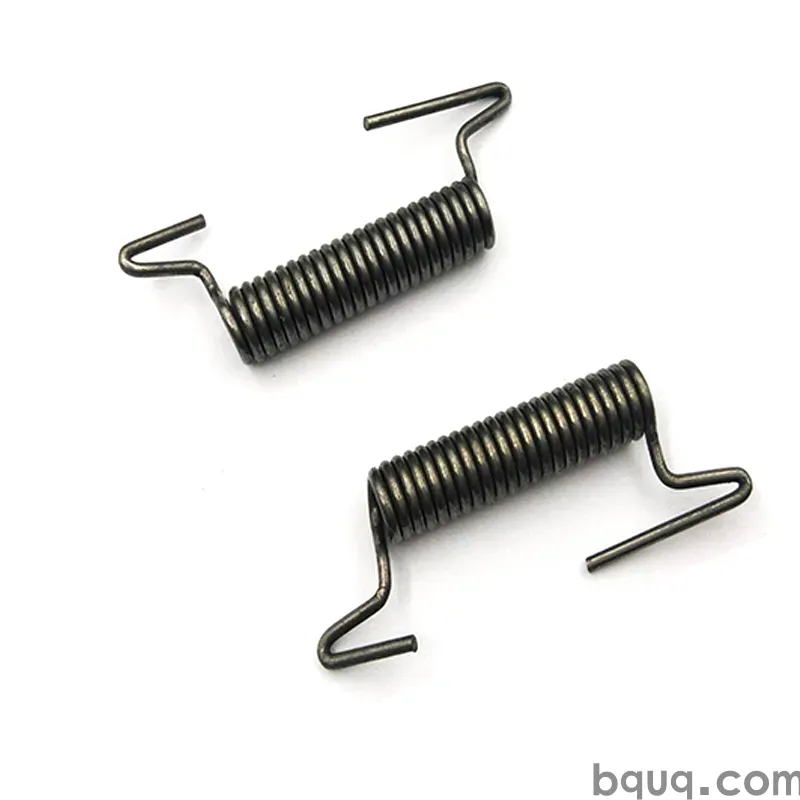
Extension springs are harder. Free length is measured inside the hooks, and hook geometry — loop position, bend radius, initial tension — adds variation that has nothing to do with the coil body. A practical approach is to tolerance the body length tightly and the overall length including hooks more loosely, then control the hook position with a gauge.
Torsion springs
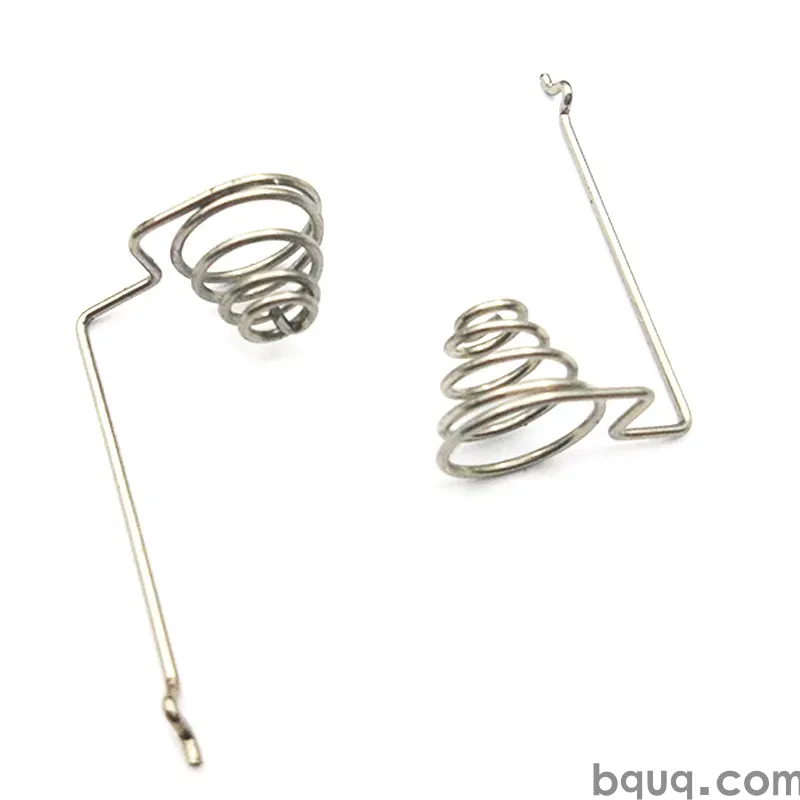
Torsion springs are the hardest to express as a length. The meaningful free-state dimensions are body length, inside diameter, leg angle and leg length. Body length tolerance behaves like compression spring free length; leg angle is usually toleranced in degrees and is the dimension that actually drives assembly fit. Our torsion spring production line handles both body length and leg angle callouts on the same drawing.
| Spring type | Primary free-state dimension | Typical standard tolerance | Main driver of variation |
|---|---|---|---|
| Compression | Overall free length | ±0.5 mm at 25 mm | Pitch control, grinding, stress relief |
| Extension | Body length + hook position | ±0.8 mm at 25 mm | Hook forming, initial tension |
| Torsion | Body length + leg angle | ±0.5 mm / ±3° | Leg forming, coil diameter |
Why tighter than necessary is a cost, not a virtue
Every step tighter on free length adds cost. Going from ±0.5 mm to ±0.15 mm on a mid-size compression spring typically means one or more of the following:
- Slower coiling with in-process length checks rather than batch sampling
- A presetting or "set" operation after stress relief
- 100% length gauging with manual or automated sorting
- Higher scrap rate on the coiling line, priced into the unit cost
None of that improves the assembly if the assembly does not need it. The right question is not "how tight can you hold?" but "how much load variation can my mechanism tolerate?" Work backwards from that.
Two practical rules we give buyers:
1. Tolerance free length only if the spring seats on a hard stop. If the installed length is set by the housing, free length variation converts directly into preload variation. If the spring is compressed by a screw or a variable gap, free length matters much less.
2. Tolerance load, not length, when load is what you feel. A load test at a specified deflection captures wire diameter, coil count and length in one measurement. It is often the cheaper control. See how we approach this in spring load testing.
What happens when a spring is over-compressed
Free length tolerance also interacts with how far the spring travels. Push a compression spring past its design deflection and it yields — the free length grows permanently, and every subsequent cycle starts from a different baseline. This is why presetting exists: it deliberately induces that yield once, under control, so the spring the customer receives is already stable. The mechanism is explained in our article on spring overload and yield.
If your assembly can over-travel in a fault condition, say so on the RFQ. It changes the material and the setting operation.
How to write free length on a drawing
A drawing that a factory can quote quickly and hold reliably usually contains:
- Free length as a basic dimension with an explicit tolerance, not a reference note
- Direction of measurement (overall, inside hooks, body only)
- End condition (closed and ground, closed not ground, open)
- Load at one or two specified deflected lengths, with tolerance
- Solid height maximum
- Material and surface finish
- Any presetting requirement
If you only know the free length and nothing else, we can still quote — but we will come back with questions, and that is a good sign. A factory that quotes a tight free length without asking about installed length, deflection and solid height is quoting a number, not a spring.
BQUQ runs four production lines in one Dongguan factory: CNC machining to ±0.005 mm, metal stamping, custom springs, and heat sink production. That matters here because spring ends often need a machined seat, a stamped retainer or a formed clip, and having all of it under one roof removes the tolerance stack you get when three suppliers each hold their own window. Send the drawing to sc@bquq.com and you get a quote, including the free length tolerance we will commit to, in 12 working hours. MOQ is flexible, so prototype and pilot quantities are welcome.
Frequently Asked Questions
Q: What is a normal free length tolerance for a compression spring?
A: For a cold-coiled compression spring around 25 mm long, ±0.5 mm is normal production capability in music wire or stainless steel. Tighter windows such as ±0.15 mm are achievable with presetting and 100% length gauging, but they add cost and cycle time. The right tolerance depends on how much load variation your assembly tolerates, not on what looks precise on the drawing.
Q: Does free length tolerance affect spring load?
A: Yes, directly. At a fixed installed length, load variation equals free length variation multiplied by spring rate. A ±0.5 mm window on a 20 N/mm spring produces ±10 N of load scatter. On a 1 N/mm spring the same window produces only ±0.5 N. This is why stiff springs usually need tighter length tolerances or a load-based acceptance criterion instead.
Q: Can you hold a tighter tolerance than the standard table?
A: Often yes, within limits. Below roughly ±0.1 mm on small springs, the measurement itself becomes the constraint, and we will discuss gauge repeatability with you. Very tight calls on long springs are usually better solved by changing the design — reducing length, adding a seat, or tolerancing load at deflection rather than free length.
Q: How is free length measured on an extension spring?
A: Free length on an extension spring is normally measured from the inside of one hook to the inside of the other, with the spring hanging free and no load applied. Because hook forming adds variation independent of the coil body, we recommend tolerancing body length tightly and overall hook-to-hook length more loosely, then gauging hook position separately.
Q: What information do you need to quote a spring with a free length callout?
A: Send the drawing if you have one. If not, give us wire diameter or desired load, outside or inside diameter, free length, installed length, working deflection, solid height limit, material preference, end condition and estimated annual quantity. With those we can quote in 12 working hours and flag any tolerance that is not physically achievable before you commit.
Related Resources
- About BQUQ and our Dongguan factory: /about/
- Compression springs: /compression-springs/
- Torsion springs: /torsion-springs/
- Custom extension springs: /extension-custom-springs/
- Industry trends: /industry-dynamics/
- Technical articles: /bquq-blog/
- FAQ and contact: /faq/ | /contact/
Authored by the BQUQ Engineering Team. BQUQ (Dongguan) runs CNC machining (±0.005 mm), metal stamping, custom springs, and heat sink production in one ISO9001 factory. Source-direct from Dongguan, China — quote in 12 hours: sc@bquq.com | WhatsApp +86 13713157787 | www.bquq.com