Wave Springs vs Belleville: Choosing for Preload
Short answer: choose a wave spring when you need preload with useful axial travel in a short stack height — typically 0.3–3 mm of deflection at 5–50% of free height, with force tolerances around ±10–15% on standard tooling. Choose a Belleville (disc) washer when you need very high force in a tiny envelope or a near-flat load curve, typically 0.05–0.5 mm of travel at 50–90% of free height. Wave springs are forgiving of stack-up variation and cheaper to tune; Bellevilles deliver far more force per millimeter of height and are the default for bolted joints and bearing preload. BQUQ machines and forms both in one ISO9001 Dongguan factory.
What problem is preload actually solving?
Preload is stored elastic energy. You add it to a joint, a bearing, a seal, or a connector so that the assembly stays tight and functional across its whole service life.
Without preload, three things go wrong. Fasteners relax under vibration and thermal cycling. Bearings skid instead of rolling, which destroys raceways. Seals leak because contact pressure drops below the sealing threshold. In electrical contacts, preload keeps contact resistance stable instead of letting it drift with oxidation and micro-motion.
The engineering question is never "should we preload?" It is "how much force, over how much travel, in how much space, and how tightly must that force be controlled?" Wave springs and Belleville washers answer those questions very differently.
How does a wave spring work?
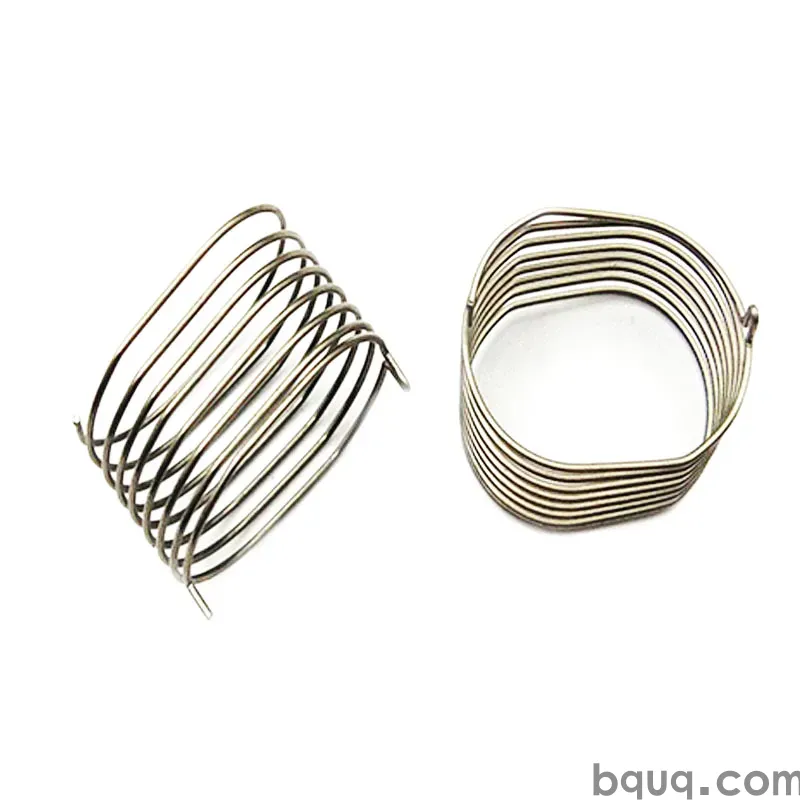
A wave spring is a flat wire or strip formed into a continuous wave around a circumference. The crests and valleys act as a series of small beams in series. When you compress it axially, each wave deflects, and the total travel is the sum of every wave's deflection.
Key traits:
- Low solid height. A single-turn wave spring can sit at 30–50% of the height of an equivalent-force coil spring.
- Large travel per unit height. Multi-turn wave springs stack waves in parallel or series to trade force against travel.
- Moderate force. Typical working ranges run from a few newtons up to roughly 2,000 N in standard sizes, higher in heavy-gauge custom designs.
- Gap-free circumference. Because the wave is continuous, force is distributed around 360°, which is ideal for bearing and seal preload.
Wave springs are made from flat wire — often 17-7PH, 302 stainless, or carbon spring steel — and the wave count, amplitude, wire thickness, and number of turns are all independently tunable. That gives a designer several knobs to hit a target load at a target height.
How does a Belleville washer work?
A Belleville washer, also called a disc spring, is a shallow conical washer. Load is applied at the inner and outer edges, and the cone flattens. Because the cone is stiff, a small axial deflection produces a large force.
Key traits:
- Very high force in a very small height. A 50 mm OD disc can carry several thousand newtons at under 2 mm of deflection.
- Non-linear load curve. Depending on the height-to-thickness ratio (h₀/t), the curve can be progressive, nearly flat, or even snap-through with a negative slope region.
- Stackable. Discs can be stacked in series (more travel, same force), in parallel (more force, same travel), or in combinations to build a custom curve.
- Sensitive to tolerances. Force varies strongly with disc thickness and free height, so load scatter of ±10–20% is normal unless you sort or specify tighter.
The flat region of a Belleville curve is the reason they dominate bolted-joint preload: over a wide band of compression, the force barely changes, so thermal expansion and gasket creep do not move the clamp load much.
Side-by-side comparison
| Property | Wave spring | Belleville washer |
|---|---|---|
| Typical travel | 0.3–3 mm (up to 10 mm+ multi-turn) | 0.05–0.5 mm per disc |
| Force range | ~1 N to ~2,000 N (standard) | ~50 N to 50,000 N+ |
| Solid height | Very low, 30–50% of coil equivalent | Extremely low |
| Load curve | Near-linear, slightly progressive | Non-linear; can be flat or snap-through |
| Force tolerance | Roughly ±10–15% | Roughly ±10–20%, tighter if sorted |
| Load distribution | 360° continuous | Edge contact, two rings |
| Stack-up tolerance | Forgiving | Demanding |
| Cost at low volume | Low to moderate | Very low (catalog parts) |
| Best fit | Bearing/seal preload, connectors, short stacks | Bolted joints, heavy clamp loads, overload stops |
The table hides one important nuance: the two parts are not always substitutes. In many assemblies they are complementary — a Belleville provides the heavy clamp load, and a wave spring provides the fine, low-force preload on a bearing or seal nearby.
Which one handles stack-up variation better?
This is where wave springs usually win, and it is often the deciding factor.
Real assemblies have tolerance stacks. A housing bore is ±0.05 mm, a cover plate is ±0.1 mm, a bearing is ±0.02 mm, and a gasket compresses unpredictably. If your preload element only has 0.15 mm of usable travel, that stack-up eats it entirely and the load swings wildly.
A wave spring with 1.5 mm of travel absorbs the same stack-up with roughly a tenth of the load variation. That is the practical argument for wave springs in high-volume consumer and industrial assemblies where nobody wants to sort shims.
Bellevilles handle stack-up differently: you deliberately design into the flat part of the curve. If the disc is operating where dF/dx ≈ 0, then a 0.1 mm stack-up error barely changes the force. This is elegant, but it requires the disc to be sized so that the nominal working point sits in that flat band — and it means you cannot also use that travel for anything else.
A quick numeric illustration
Take a joint that needs 400 N of preload and sees ±0.15 mm of stack-up variation.
| Approach | Travel available | Load at −0.15 mm | Load at +0.15 mm | Spread |
|---|---|---|---|---|
| Wave spring, 1.2 mm travel | 1.2 mm | ~350 N | ~450 N | ±12.5% |
| Belleville, 0.25 mm travel | 0.25 mm | ~160 N | ~640 N | ±60% |
The Belleville numbers are indicative for a disc operating on the steep part of its curve. Move the working point into the flat region and the spread collapses — but you must have the height budget and the analysis to do it.
When should you pick a wave spring?
Choose a wave spring when:
- You need preload with real travel — 0.5 mm or more — in a short axial space.
- The load is moderate, roughly under 2 kN.
- You need 360° load distribution, as with bearing preload, seal energizing, or a piston ring.
- Stack-up variation is significant and you do not want to sort shims.
- You want a near-linear spring rate so the assembly behaves predictably.
- The assembly is weight- or height-sensitive, such as a connector, a camera module, or a hand tool.
Typical applications include bearing preload in gearboxes and motors, seal energizing in valves and pumps, connector and contact preload, clutch and brake return elements, and vibration damping in small mechanisms. If your design also faces cyclic loading, it is worth reading our notes on spring overload and yield before you fix the working stress.
When should you pick a Belleville washer?
Choose a Belleville when:
- You need high force — hundreds to tens of thousands of newtons.
- Axial space is measured in fractions of a millimeter.
- You want a flat load curve for bolted-joint clamp load stability.
- You need overload protection or a snap-action element, using the negative-slope region.
- You are stacking discs to build a specific force-travel signature.
- Cost per part matters and a catalog disc will do.
Typical applications include bolted flange clamp load, bearing preload in high-stiffness spindles, die springs and punch retention, overload clutches, and valve spring packs.
One caution: Bellevilles concentrate stress at the inner and outer edges. Fatigue life is very sensitive to edge condition, so deburring and edge radius control matter more than they do on a wave spring.
Material and manufacturing considerations
Both parts are usually made from similar alloys, but the forming routes differ.
| Material | Wave spring | Belleville | Notes |
|---|---|---|---|
| Carbon spring steel (e.g. 65Mn, 1075) | Yes | Yes | Lowest cost, needs coating for corrosion |
| 301/302 stainless | Yes | Yes | Good general corrosion resistance |
| 17-7PH | Yes | Yes | High strength, good fatigue, precipitation hardened |
| 631 / 17-4PH | Less common | Yes | High strength, moderate corrosion resistance |
| Inconel / 718 | Custom | Custom | High temperature and aggressive environments |
Wave springs are normally wound or stamped from flat wire, then stress-relieved and, where required, shot-peened. Bellevilles are typically stamped or fine-blanked, then heat treated, tempered, and often pre-set (scragged) to stabilize the free height.
Two process details drive real-world performance:
- Edge quality. For Bellevilles, a sharp or burred edge is a fatigue crack initiation site. Specify edge radius and deburring.
- Set removal. Both types lose a little free height on first compression. Pre-setting at the factory removes that loss so the customer's first cycle matches the drawing.
For very short runs and prototypes, laser-cut or wire-formed wave springs can be produced without hard tooling, which keeps iteration cheap. Our prototype and short-run spring program covers how that works in practice.
How do you specify a preload spring correctly?
Give your supplier the following, and the design conversation gets much shorter:
1. Working load at the working height, with tolerance.
2. Installed height and free height, or the available cavity.
3. Travel required in service, including stack-up variation.
4. Maximum solid height you can tolerate.
5. Cycle life — number of cycles and whether it is static or dynamic.
6. Environment — temperature range, humidity, chemicals, wash-down.
7. Interface details — bore diameter, shaft diameter, flatness of the mating faces.
8. Volume — prototype, pilot, or production, and annual quantity.
If you cannot supply all of these, supply what you have. A load, a cavity, and a life target are usually enough to start. It also helps to state whether the spring is a wear part or a structural element, because that changes the safety factor you should apply. Our guide to the compression limit explains how to set a working stress ceiling for each case.
Where does BQUQ fit?
BQUQ is an ISO9001 precision manufacturing source factory in Dongguan, China, running four production lines under one roof: CNC machining, metal stamping, custom springs, and heat sinks. That combination matters for preload components because a wave spring or Belleville is rarely a standalone purchase — it usually sits inside a stamped retainer or a machined pocket that has to match it.
What that means for buyers:
- CNC machining to ±0.005 mm for the pockets, shoulders, and retainers that set the installed height.
- Metal stamping for retainers, spacers, and disc blanks in the same factory.
- Custom springs — wave, disc, compression, extension, torsion — quoted in 12 working hours.
- Flexible MOQ, so a 200-piece pilot build and a 200,000-piece production order both go through the same process controls.
- One shipment, one set of documents, instead of coordinating three suppliers.
Because the spring line and the machining line share a quality system, dimensional stack-up issues get solved at the drawing stage rather than after the first article. If your preload element interfaces with a machined bore, that is a meaningful advantage. You can see the range on our compression springs and custom extension springs pages, and we form wave and disc geometries to the same controls.
Frequently Asked Questions
Q: Can a wave spring replace a Belleville washer directly?
A: Only if the force and travel requirements overlap. Wave springs generally top out around 2 kN in standard sizes, while Bellevilles routinely exceed 10 kN. If your application needs high clamp load in under 0.5 mm of travel, a wave spring will be too soft and too tall. If it needs 1–2 mm of travel at moderate load, a wave spring is usually the better and cheaper answer.
Q: Which is better for bolted joint preload?
A: Belleville washers, in most cases. Their flat load region keeps clamp load stable as gaskets creep and thermal expansion changes the joint length. Wave springs can work in light bolted joints, but their more linear curve means clamp load tracks every dimensional change. For safety-critical or high-vibration joints, use a disc stack sized to operate in the flat band.
Q: How much travel can a wave spring provide?
A: A single-turn wave spring typically offers 0.3–1 mm of usable deflection. Multi-turn designs stack waves to reach 3–10 mm or more, at the cost of some height and a softer rate. The practical limit is set by solid height and by fatigue stress at the wave crests, so always confirm travel against cycle life rather than assuming the geometric maximum.
Q: Do Belleville washers lose load over time?
A: Slight relaxation is normal in the first hours of service, which is why reputable suppliers pre-set or scragg the discs at the factory. After pre-setting, load loss over years is small if the disc stays below roughly 80% of its rated deflection and the temperature stays within the material's limit. Above that, creep accelerates, especially in carbon steel at elevated temperature.
Q: What tolerances should I expect on spring force?
A: Standard production wave springs typically hold ±10–15% on load at the working height, and Bellevilles ±10–20% unless you specify tighter. Sorting, tighter thickness control, or 100% load testing can bring either part to ±5%, but it adds cost and lead time. For most preload applications, ±15% is acceptable because the joint is designed with margin.
Related Resources
- About BQUQ and our Dongguan factory: /about/
- Custom compression, wave, and disc springs: /compression-springs/
- Custom extension springs and wire forms: /extension-custom-springs/
- Industry trends in spring and stamping sourcing: /industry-dynamics/
- Technical articles and engineering guides: /bquq-blog/
- Frequently asked questions: /faq/
- Case studies: /case/
- Contact the engineering team: /contact/
Authored by the BQUQ Engineering Team. BQUQ (Dongguan) runs CNC machining (±0.005 mm), metal stamping, custom springs, and heat sink production in one ISO9001 factory. Source-direct from Dongguan, China — quote in 12 hours: sc@bquq.com | WhatsApp +86 13713157787 | www.bquq.com