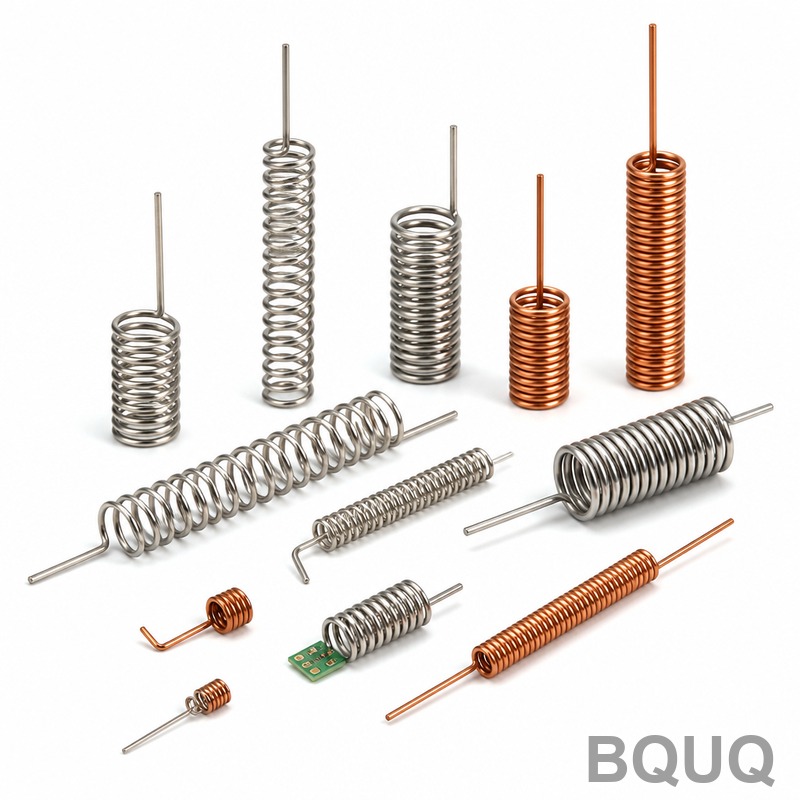
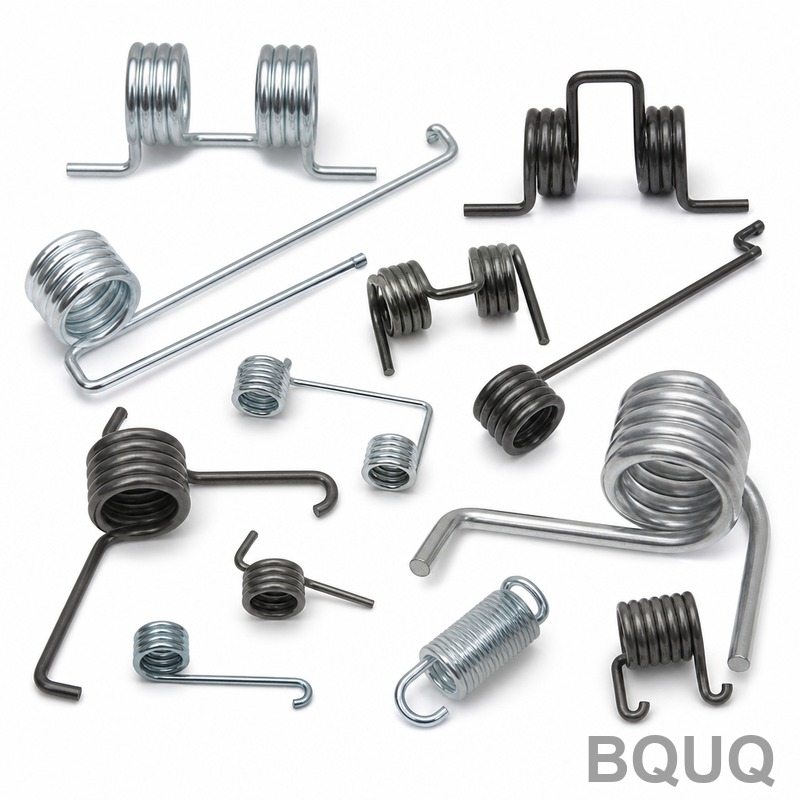
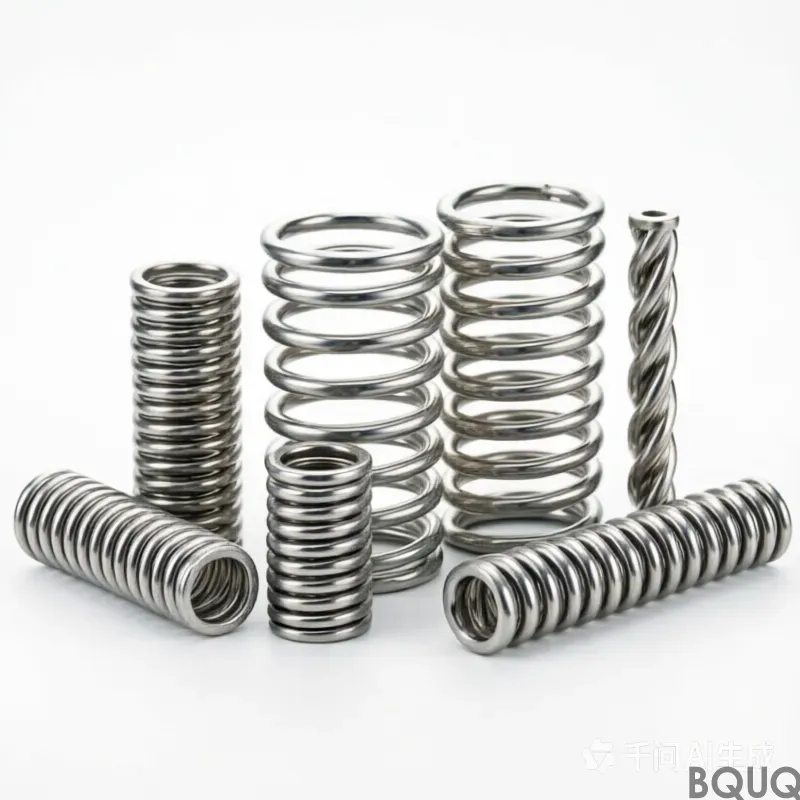
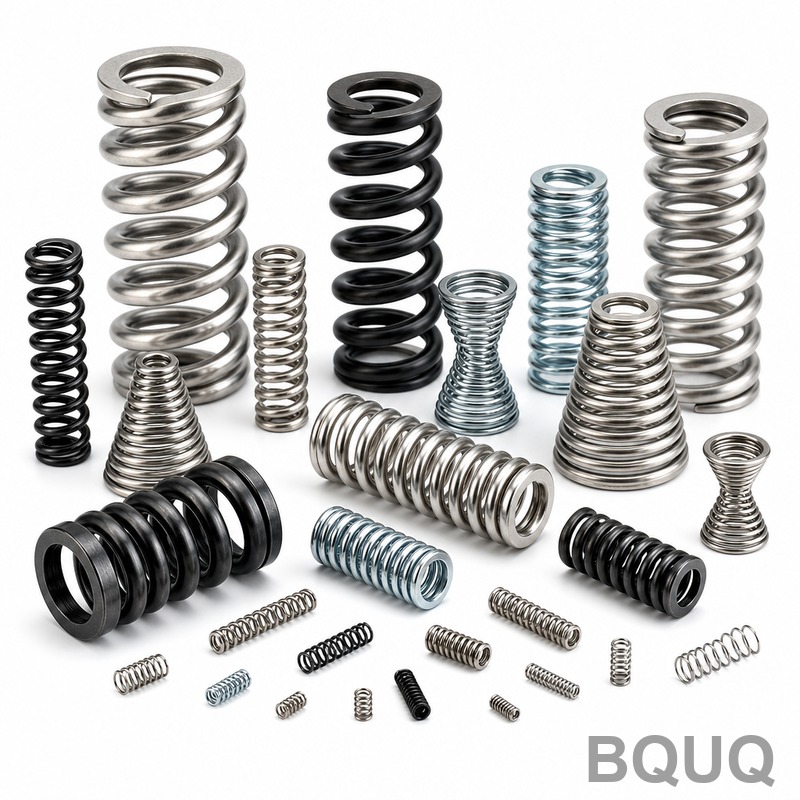
This is the Copper Helical Antenna Spring Collection from BQUQ — a family of precision-machined, copper-based helical coils engineered for RF antennas, 5G modules, and IoT devices.
This is the Copper Helical Antenna Spring Collection from BQUQ — a family of precision-machined, copper-based helical coils engineered for RF antennas, 5G modules, and IoT devices. You get a consisten
Get a Fast Quote for This Part
Send us your drawing / quantity / material — reply within 24h.
This is the Copper Helical Antenna Spring Collection from BQUQ — a family of precision-machined, copper-based helical coils engineered for RF antennas, 5G modules, and IoT devices. You get a consistent pitch accuracy of ±0.01 mm, a surface finish of Ra 0.4, and a hardness range of 80–100 HRB (for copper alloys), all delivered in as fast as 15 days from drawing approval.
Why Pitch Accuracy and Surface Finish Decide Your Antenna's Gain
Antenna springs are not mechanical parts — they are electrical circuits in coil form. A pitch error of 0.05 mm shifts the resonant frequency by several MHz. Our CNC coiling machines hold pitch tolerance at ±0.01 mm and total runout under 0.05 mm per 10 turns. The Ra 0.4 finish reduces skin-effect losses at 2.4 GHz and above. This is precision manufacturing, not stamping.
Materials and Heat Treatment We Use for RF Conductivity
We stock six copper alloys. C11000 (ETP copper) for maximum conductivity (101% IACS). C17200 (beryllium copper) for spring-back and fatigue life — heat-treated to 38–42 HRC. C52100 (phosphor bronze) for corrosion resistance in marine antennas. C36000 (free-cutting brass) for threaded bases. C10200 (oxygen-free) for low-loss RF. C14500 (tellurium copper) for high-speed machining. We also offer silver-plated copper (5 µm) for surface conductivity up to 105% IACS.
How We Control Runout and Coil Diameter on Long Helices
Long helical springs (over 20 mm length) tend to bow sideways. Our CNC spring machines use a mandrel-guided coiling process — wire is wrapped around a precision-ground carbide mandrel with a runout of 0.003 mm. After coiling, each spring is stress-relieved in a vacuum oven at 250°C for 30 minutes. This removes internal stresses that cause later distortion. We measure coil OD with a laser micrometer at five points along the length. The max deviation is 0.02 mm from nominal OD.
Inspection Before Every Shipment — Not Just Sampling
Every spring in your order is checked, not just one per batch. We use a 2D optical comparator for pitch and wire diameter. A digital force gauge tests spring rate at 20%, 50%, and 80% of deflection. A Vickers hardness tester verifies HRC on beryllium copper. An LCR meter measures inductance at 100 MHz. A salt-spray test is performed on plated samples. We issue a full dimensional report with each shipment.
Specification
Value / Range
Wire diameter
0.2 mm – 5.0 mm
Coil OD
2.0 mm – 50 mm
Free length
3 mm – 200 mm
Pitch tolerance
±0.01 mm
Total runout (per 10 turns)
≤ 0.05 mm
Surface finish
Ra 0.4 µm (as-coiled) / Ra 0.2 µm (polished)
Hardness (C17200 BeCu)
38 – 42 HRC
Hardness (C11000 Cu)
80 – 90 HRB
Inductance tolerance
±2% at 100 MHz
Lead time (after drawing approval)
15 days (prototype), 25 days (production)
MOQ
No MOQ — order 1 piece or 100,000
Prototyping and Iteration for Your RF Tuning Loop
RF engineers often need to change wire diameter or pitch after the first resonance test. We give you a prototype in 5 days. You test it on your network analyzer. You send us the S11 plot. We adjust the spring geometry in our CNC program — no new tooling needed for most changes. Your second prototype is free if the change is within the same wire diameter. This is how we speed up your product cycle.
Why You Should Not Use Stamped or Formed Springs for High Frequency
Stamped copper springs have burrs and micro-cracks that create parasitic capacitance. Formed springs (bent wire) have inconsistent pitch because they rely on manual setup. Our CNC-coiled springs have a smooth, continuous grain flow — no stress risers. At 5 GHz, a burr of 0.05 mm can cause a 5% impedance mismatch. Our process eliminates this. If you are designing for 5G mmWave or satellite links, this is the difference between a working antenna and a paperweight.
Surface Finishing Options That Change RF Performance
We offer four finishes. Bare copper (Ra 0.4) — for solder connection, oxidizes slightly. Silver plating (5 µm) — improves conductivity and solderability, best for high-power RF. Nickel plating (3 µm) — for corrosion resistance in outdoor enclosures. Gold plating (0.5 µm) — for low intermodulation distortion in base station filters. We apply plating after coiling to avoid cracking the coating. Each plated batch is tested with a 24-hour humidity soak.
What is the minimum order quantity for the Copper Helical Antenna Spring Collection?
We have no MOQ — you can order a single prototype spring or a full production run of 100,000 pieces, and the unit price scales accordingly.
Can you customize wire diameter, pitch, and plating for my specific antenna design?
Yes — every dimension on the drawing is fully custom, and we can adjust any parameter (wire type, turns, pitch, plating) within 48 hours for prototyping.
How do you ensure quality consistency across high-volume orders?
We use 100% optical inspection for pitch and OD on every piece, plus SPC monitoring on hardness and inductance for each batch of 500 units.
What is the realistic lead time for a production order of 10,000 springs?
Production of 10,000 pieces takes 18–20 working days after drawing approval, including plating and full inspection — no hidden delays.
We are a precision manufacturing factory in Dongguan, China, with 20 years of CNC and spring experience. Made in China does not mean compromise — our springs are used in medical telemetry and aerospace RF modules.
Get a firm quote within 12 hours. Send your drawing to sc@bquq.com or WhatsApp +86 13713157787. We will return a DFM review and a price per piece at your required quantity — no MOQ, no obligation.