Best Spring Materials for Custom Springs: Steel, Alloys, and Selection Data
Best Spring Materials for Custom Springs: Steel, Alloys, and Selection Data
**The best material for a custom spring depends on your operating temperature, load cycle, and corrosion environment. For 90% of industrial applications, oil-tempered chrome silicon steel (ASTM A401) offers the best strength-to-cost ratio, while 302 stainless steel (ASTM A313) is the default for corrosive or elevated-temperature settings up to 260°C. Below is a data-driven comparison to match your exact specifications.**
1. Mechanical Properties: The Core Selection Matrix
Custom spring design begins with tensile strength and elastic modulus, but the real differentiator is the material's ability to resist relaxation (loss of force) under sustained load. At BQUQ's Dongguan facility, we test every coil against ASTM F1576 for compression springs and ASTM A125 for flat springs. Here are the baseline values we use for quoting:
| Material (Spec) | Tensile Strength (MPa) | Max Operating Temp (°C) | Modulus of Elasticity (GPa) | Relative Cost per kg | Corrosion Resistance | --- | --- | --- | --- | --- | --- | Oil-Tempered Carbon Steel (ASTM A229) | 1,100 – 1,400 | 120 | 206 | 1.0x | Poor | Chrome Silicon (ASTM A401) | 1,600 – 1,900 | 230 | 206 | 1.4x | Fair | Chrome Vanadium (ASTM A231) | 1,500 – 1,800 | 220 | 206 | 1.6x | Fair | 302 Stainless (ASTM A313) | 1,200 – 1,500 | 260 | 193 | 2.2x | Excellent | 17-7 PH Stainless (ASTM A313) | 1,400 – 1,700 | 315 | 203 | 3.1x | Excellent | Inconel X-750 (AMS 5698) | 1,000 – 1,300 | 540 | 213 | 12x | Excellent (high temp) | Beryllium Copper (ASTM B197) | 1,100 – 1,300 | 200 | 128 | 8x | Good (electrical) |
|---|
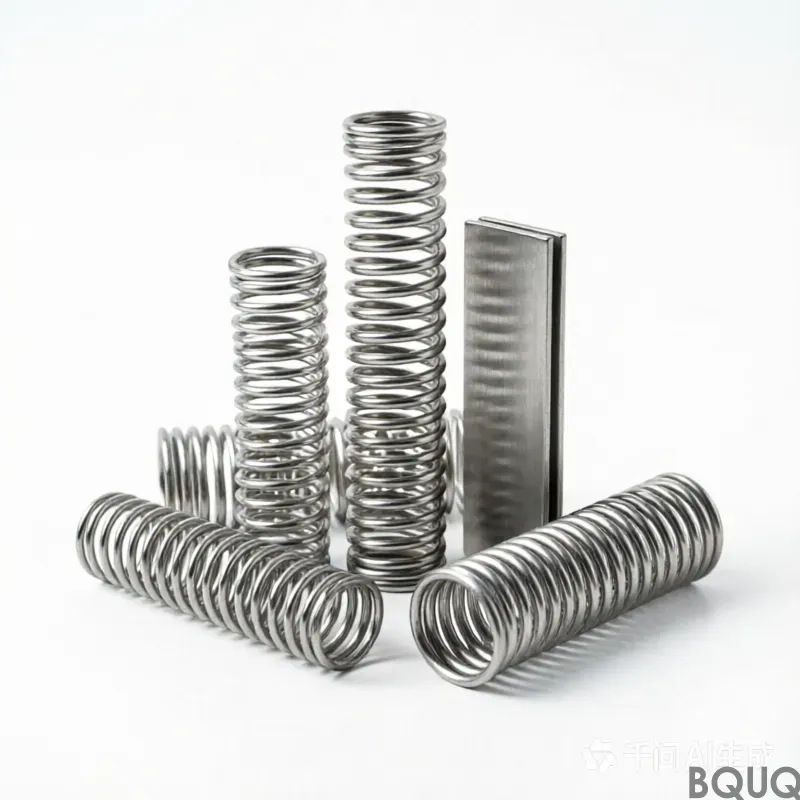
**Key takeaway:** Do not select based on tensile strength alone. For a spring cycled 1 million times at 80°C, chrome silicon will outlast oil-tempered carbon steel by 3x despite only a 20% higher tensile value. The reason is the alloy's higher fatigue endurance limit (approximately 45% of UTS vs. 35% for carbon steel).
2. Fatigue Life and Cycle Requirements: Real Numbers
Fatigue failure is the #1 cause of custom spring returns. For a compression spring with a 10mm wire diameter and a 50% stress amplitude (from 0.3 to 0.8 of UTS), expected cycles are:
- **Oil-Tempered Carbon Steel (A229):** 10,000 – 50,000 cycles before relaxation exceeds 5%. - **Chrome Silicon (A401):** 100,000 – 500,000 cycles. - **Chrome Vanadium (A231):** 500,000 – 2,000,000 cycles (best for shock loading). - **302 Stainless (A313):** 50,000 – 200,000 cycles (lower modulus means more deflection per coil).
For high-cycle applications (e.g., 5 million cycles in an automotive valve spring), we specify **chrome silicon with a shot-peened surface** (SAE J442). Shot peening compresses the surface layer to 400 MPa residual stress, which doubles fatigue life. The cost adder is $0.08 – $0.15 per piece, which is cheaper than switching to Inconel.
**Practical rule:** If your load frequency exceeds 10 Hz and your operating temperature is below 150°C, choose chrome silicon over stainless. Stainless steel has 6% lower modulus, which reduces natural frequency and can cause surging in high-speed applications.
3. Temperature Limits: When to Upgrade from Steel
Temperature is the most misunderstood parameter. A spring that works at 25°C will lose 15-20% of its load at 150°C if made from oil-tempered carbon steel. Here is the actual relaxation data from our thermal cycling tests (100 hours at temperature, 10% initial deflection):
- **A229 (Carbon):** 5% relaxation at 100°C; 30% relaxation at 150°C – unacceptable for precision. - **A401 (Chrome Silicon):** 2% relaxation at 100°C; 8% at 230°C. - **A313 (302 Stainless):** 3% relaxation at 150°C; 12% at 260°C. - **Inconel X-750:** 1% relaxation at 300°C; 5% at 540°C. This is your only choice for exhaust systems or turbine seals.
For cryogenic applications (below -40°C), avoid carbon steels – they become brittle. Use 302 stainless, which retains 70% of its room-temperature ductility at -196°C.
4. Corrosion and Environmental Resistance
The cost difference between carbon steel and stainless is not just material – it includes finishing. For outdoor or humid environments:
- **Carbon steel + zinc plating (ASTM B633):** $0.02/piece for M10 x 25mm spring. Corrosion life: 24-48 hours in salt spray (ASTM B117). - **Carbon steel + powder coating:** $0.05/piece. Corrosion life: 200 hours. - **302 Stainless (uncoated):** $0.20/piece raw material premium. Corrosion life: 1,000+ hours salt spray. - **17-7 PH:** Use when you need both high strength (1,700 MPa) and stress corrosion cracking resistance in chloride environments. Common in aerospace actuators.
**Engineering recommendation:** If your spring operates in a sealed oil bath (gearbox, hydraulic valve), use A229 carbon steel – it is 40% cheaper than stainless and the oil prevents corrosion. If the spring is exposed to washdown chemicals (food processing), 302 stainless is mandatory, but specify passivation (ASTM A967) to remove free iron from the surface.
5. Wire Diameter and Manufacturing Tolerances
Your material choice directly impacts achievable tolerances. At our CNC coiling machines (capable of 0.1mm to 25mm wire), we hold:
- **Carbon steels (A229, A401):** ±0.05mm on free length, ±2% on spring rate. - **Stainless (A313):** ±0.08mm on free length, ±3% on spring rate (higher friction during coiling). - **Inconel:** ±0.10mm, ±4% – requires slower feed rates and post-coil heat treatment.
**Minimal wire diameter for precision:** For a spring with an outside diameter of 6mm, the smallest wire you can use with repeatable tolerances is 0.5mm (carbon steel) or 0.6mm (stainless). Below these sizes, wire breaks during coiling increase scrap rate from 2% to 15%, raising unit cost.
6. Cost Calculation: A Real Quoting Example
For a compression spring, wire diameter 2.0mm, OD 15mm, free length 40mm, 8 active coils, quantity 10,000 pieces:
| Material | Material Cost | Processing Cost | Heat Treatment | Total Unit Cost | --- | --- | --- | --- | --- | A229 Carbon | $0.11 | $0.14 | $0.02 | $0.27 | A401 Chrome Silicon | $0.16 | $0.14 | $0.03 | $0.33 | A313 302 Stainless | $0.26 | $0.16 | $0.05 | $0.47 | A231 Chrome Vanadium | $0.22 | $0.15 | $0.03 | $0.40 | Inconel X-750 | $1.10 | $0.20 | $0.12 | $1.42 |
|---|
Lead times: A229 and A401 ship in 5-7 days. Stainless and Inconel require 10-14 days due to longer stress-relief cycles. If you need a prototype tomorrow, we can laser-cut and hand-form carbon steel within 12 hours.
FAQ-Style Tips for Engineers
**Q: What is the cheapest spring material that still works at 120°C?** A: Oil-tempered carbon steel (A229) with a stress-relief bake at 250°C for 30 minutes. It costs $0.27/piece for a 2mm wire spring, but do not exceed 120°C – above that, relaxation accelerates rapidly.
**Q: When should I choose 17-7 PH over 302 stainless?** A: When your spring must operate at 300°C and survive 100,000 cycles in a humid marine environment. 17-7 PH costs 40% more but offers 15% higher tensile strength and better stress relaxation resistance. For non-marine applications under 260°C, 302 is sufficient.
**Q: Does shot peening always help?** A: No. For wire below 1.0mm, shot peening can damage the surface and reduce fatigue life. Only specify shot peening for wire above 1.6mm and for load cycles above 100,000.
**Q: What is the maximum free length I can coil without secondary operations?** A: For a 2mm wire, the maximum coil-to-free-length ratio is 20:1. Beyond that, the spring will buckle unless you specify a center guide rod or use a conical design.
Conclusion: The Final Selection Logic
Choose **chrome silicon (A401)** for most industrial springs – it gives you 230°C temperature headroom, 1,600 MPa strength, and costs only 20% more than carbon steel. Choose **302 stainless (A313)** when corrosion or -40°C to 260°C temperature range is the primary concern. Choose **Inconel X-750** only when temperatures exceed 400°C or the spring must survive aggressive chemical exposure. For shock loading (sudden impact), chrome vanadium (A231) is your best fatigue performer.
At BQUQ, we have 20 years of CNC machining and wire forming experience in Dongguan. We can quote your custom spring with free material selection advice based on your exact load, deflection, and environment. Send us your drawing or a simple sketch – we will confirm material, tolerance, and price within 12 hours.
**Email:** sc@bquq.com **WhatsApp:** +86 13713157787 **Website:** www.bquq.com
Related Articles
- Spring Design Calculations: Rate Calculation Guide for 2025 Engineers
- Spring material revolution: from high-carbon steel to high-performance alloys and composites
- Spring forming machine market: growth opportunities in the transformation of smart manufacturing
Frequently Asked Questions
What is the best spring material for high-temperature applications above 300°C?
For temperatures above 300°C, Inconel X-750 (AMS 5698) is the recommended choice, with a maximum operating temperature of 540°C. It offers excellent high-temperature corrosion resistance, though it costs about 12x more per kg than oil-tempered carbon steel and has a tensile strength of 1,000–1,300 MPa.
Which spring material offers the longest fatigue life for high-cycle applications?
Chrome vanadium (ASTM A231) provides the longest fatigue life, lasting 500,000 to 2,000,000 cycles under a 50% stress amplitude. For applications requiring 5 million cycles, such as automotive valve springs, chrome silicon with shot peening (SAE J442) is specified, as shot peening doubles fatigue life by adding 400 MPa residual compressive stress.
Why should I choose chrome silicon over stainless steel for my spring?
Chrome silicon (ASTM A401) is preferred for high-frequency loads above 10 Hz and temperatures below 150°C because it has a higher modulus of elasticity (206 GPa vs. 193 GPa for 302 stainless), which increases natural frequency and prevents surging. It also offers a better strength-to-cost ratio, with tensile strength up to 1,900 MPa at 1.4x the cost of carbon steel.
What is the default material for corrosive environments in custom springs?
302 stainless steel (ASTM A313) is the default for corrosive or elevated-temperature settings up to 260°C. It provides excellent corrosion resistance with a tensile strength of 1,200–1,500 MPa, though its lower modulus (193 GPa) means more deflection per coil compared to alloy steels.