CNC Machining Surface Finishes in 2024: Anodizing, Bead Blasting, and Polishing Tolerances and Costs
CNC Machining Surface Finishes: A Complete Guide to Anodizing, Bead Blasting and Polishing
For over 20 years, BQUQ has manufactured precision components in Dongguan, China, serving industries from automotive to medical devices. In our experience, the difference between a functional part and a world-class part often comes down to surface finish. While the CNC spindle creates the geometry, the finish determines the performance, lifespan, and perceived quality of the component.

This guide provides a technical breakdown of the three most requested post-processing methods: anodizing, bead blasting, and mechanical polishing. We will cover real tolerances, cost implications, and design rules that we apply daily on our shop floor.
Why Surface Finish Matters in Precision Manufacturing
Surface finish is not purely cosmetic. It directly impacts:
- **Corrosion resistance:** A sealed anodized layer (2-25 microns) prevents oxidation on 6061-T6 aluminum, extending part life in saline environments by up to 4x compared to bare material. - **Fatigue strength:** Aggressive bead blasting can create micro-compressive stresses, improving fatigue life by 10-15%. Conversely, deep polishing that removes material can reduce wall thickness and weaken thin sections. - **Friction and wear:** For sliding components, a polished surface with Ra 0.2 microns reduces coefficient of friction by roughly 30% compared to a standard machined Ra 3.2 finish. - **Dimensional accuracy:** Every post-process adds or removes material. Anodizing adds thickness; polishing removes it. Ignoring this can scrap a tight-tolerance part.
At BQUQ, we classify finishes into three tiers: functional (Ra 3.2), refined (Ra 1.6), and aesthetic/precision (Ra 0.4 or better). The choice dictates cost and lead time.
Anodizing: The Workhorse for Aluminum and Titanium
Anodizing is an electrochemical process that converts the metal surface into a decorative, durable, corrosion-resistant anodic oxide finish. It is almost exclusively applied to aluminum (6061, 6063, 7075) and sometimes titanium.
Type II and Type III Comparison
We recommend Type II (sulfuric acid) for general wear and color, and Type III (hard coat) for extreme abrasion resistance.
| Property | Type II (Standard) | Type III (Hard Coat) | :--- | :--- | :--- | **Coating Thickness** | 5 - 18 microns | 25 - 75 microns | **Hardness (Vickers)** | 200 - 400 HV | 350 - 600 HV | **Color Options** | Clear, Black, Red, Blue, Gold | Mostly Black or Dark Gray | **Typical Tolerances** | Adds 0.05 mm per surface | Adds 0.10 mm per surface | **Temperature** | 68-72°F (20-22°C) | 50-55°F (10-13°C) | **Cost Factor (vs. Machining)** | +8% - 12% | +15% - 25% | **Typical Application** | Consumer electronics, heat sinks | Aerospace actuators, gears |
|---|
**Critical Design Rule:** Always specify the coating thickness to your machinist. For a hole with a nominal 10.00 mm diameter, a 25-micron hard coat will reduce the final inside diameter to approximately 9.95 mm. If you require a 10.00 mm final hole, we must machine it pre-anodize to 10.05 mm. At BQUQ, we request a "finished size" drawing to avoid this 0.1% dimensional error.
Heat Sink Efficiency
For our heat sink customers, black anodizing is not just aesthetic. A 12-micron black anodized coating increases the emissivity of aluminum from 0.09 (bare) to 0.85. This improves radiative heat dissipation by up to 40% in natural convection applications, a critical factor in LED lighting and power electronics.
Bead Blasting: Texture, Uniformity, and Cost-Efficiency
Bead blasting uses compressed air to propel fine glass beads or aluminum oxide at a surface to clean it or impart a uniform matte texture. It is the fastest and most cost-effective way to hide CNC machining marks.
Process Specifications
- **Media:** Glass beads (30-60 PSI) for a soft satin finish; aluminum oxide (60-90 PSI) for a more aggressive etch. - **Resulting Roughness:** Typically Ra 0.8 to 1.6 microns, depending on bead size (100-200 mesh). - **Coverage:** Uniform, but cannot reach deep internal corners or blind holes smaller than 2 mm in diameter.
**Price Impact:** Bead blasting adds approximately $15-$30 per part for a standard 100x100 mm component, depending on batch size. It is often combined with anodizing. The blasting profile can slightly increase the surface area, which helps the anodic layer adhere better.
The Masking Problem
If you need a critical sealing surface (e.g., a valve seat) kept smooth, it must be masked with silicone or tape before blasting. This adds labor cost (roughly 15 minutes per batch) and requires a tolerance of +/- 0.05 mm on the masked area. We advise designers to avoid blasted surfaces on press-fit diameters to prevent galling.
Case Study: Automotive Brackets
For a recent automotive bracket order (5000 pcs, 6061-T6), we used a 120-mesh glass bead blast at 45 PSI, followed by clear anodizing. The result was a consistent matte finish with a roughness of Ra 1.2 microns, masking minor tool marks from the 4th-axis machining. The total cost per part was reduced by 18% compared to a polished alternative.
Mechanical Polishing: Mirror Finishes and Precision Removal
Polishing is an abrasive process that reduces surface roughness to a mirror-like finish. It is used for molds, medical implants, and decorative trim. Unlike blasting, polishing is a material removal process.
Grit Progression and Results
We use a standard progression for aluminum:
1. **Sand with 400 grit** - Removes deep tool marks. Result: Ra 0.8 microns. 2. **Sand with 800 grit** - Refines scratches. Result: Ra 0.4 microns. 3. **Sand with 1500 grit** - Prepares for buffing. Result: Ra 0.2 microns. 4. **Cotton buff with diamond compound** - Achieves mirror finish. Result: Ra 0.05 to 0.1 microns.
**Tolerance Consideration:** Polishing can remove 0.02 to 0.05 mm of material from a surface. On a part with a +/- 0.01 mm tolerance, polishing is a high-risk operation. We only recommend it for non-critical surfaces or where the dimension is left "oversize" to compensate.
Cost and Lead Time
Polishing is the most labor-intensive finish. It is 3-5 times more expensive than bead blasting. For a 50x50 mm part, polishing adds $20-$50 per unit. Lead time increases by 2-3 business days because it is a manual process requiring skilled operators.
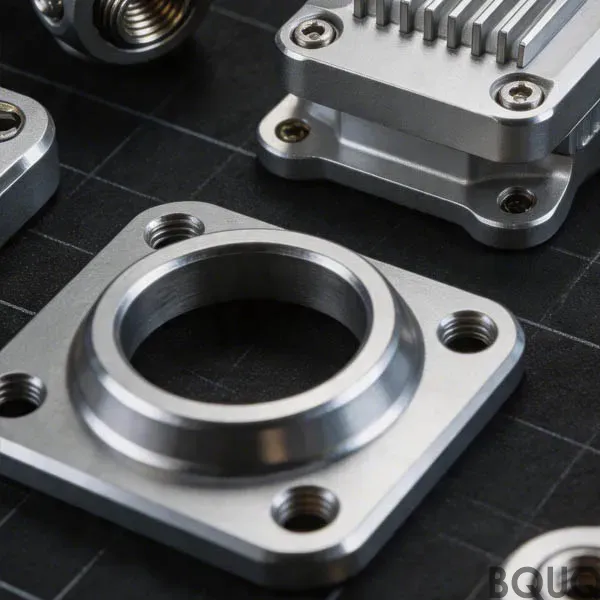
**Design Rule:** Avoid sharp external edges on polished parts. A sharp 90-degree edge will round over during buffing, creating a "soft" edge. Design a 0.5 mm chamfer or radius to keep the aesthetic consistent.
Surface Finish Comparison Table
The table below summarizes the key technical characteristics for engineering reference.
| Finish Type | Typical Ra (microns) | Material Removal | Corrosion Resistance | Cost Index (1 = Machining) | Lead Time Added | :--- | :--- | :--- | :--- | :--- | :--- | **As-Machined (32 RMS)** | 3.2 | None | Poor (Al) | 1.0 | 0 days | **Bead Blasted** | 1.2 | None - Slight Etch | Moderate (Better Adhesion) | 1.15 | 1 day | **Type II Anodized (Clear)** | 2.0 (under layer) | None (Adds 10 microns) | Excellent | 1.12 | 2 days | **Type III Anodized (Black)** | 2.0 (under layer) | None (Adds 50 microns) | Excellent (Hard) | 1.25 | 3 days | **Mechanical Polish (Mirror)** | 0.1 | 0.03 - 0.05 mm | Good (if sealed) | 1.50 - 2.00 | 3 days | **Polish + Anodize** | 0.1 | 0.05 mm + Coating | Excellent | 1.75 | 4 days |
|---|
*Note: Costs are relative to a standard 6061-T6 CNC machined part with a 100x100x20 mm envelope and standard +/- 0.05 mm tolerance. Prices vary with geometry and volume.*
FAQ-Style Tips for Design Engineers
**1. When should I specify bead blasting?** Use it for any aluminum part that will be anodized a color other than clear. The matte texture hides fingerprint smudges and provides a uniform base for the dye. Do not use it if your part has threads finer than M3, as media can clog them.
**2. Can I anodize after polishing?** Yes, but the polished surface will appear semi-bright, not a full mirror. The anodic layer (10 microns) is translucent and will slightly diffuse the light. For a true "mirror black" look, you need a specific process called "bright dipping" before anodizing, which adds a premium cost.
**3. What is the maximum temperature for anodized parts?** Type II anodize is stable up to 212°F (100°C) continuous. Type III can withstand intermittent exposure to 400°F (204°C) without cracking, but continuous operation above 250°F (121°C) will reduce hardness.
**4. How do I specify the finish on a drawing?** Use the ISO 1302 symbols. For example, "Ra 0.8" for a blasted finish, or "Anodize per MIL-A-8625 Type II Class 2 Black" for a specific military standard. Always add a note for the maximum coating thickness if it affects fit.
**5. Is polishing possible on stainless steel?** Yes, but it is more difficult. 304 and 316 stainless steel require a different compound (typically chromium oxide) and higher pressure. Expect a 20% cost increase over aluminum polishing.
Conclusion: Choosing the Right Finish for Your Next Run
Selecting a surface finish is a balance of three variables: performance, aesthetics, and budget. For functional durability, specify Type III hard coat anodizing. For cost-effective consistency, choose bead blasting. For high-end optical quality, invest in mechanical polishing.
At BQUQ, our engineers review your 3D model and 2D drawing to recommend the most economical finish that meets your Ra, hardness, and corrosion requirements. We understand that a 0.02 mm tolerance change can save you thousands of dollars in scrap.
We are ready to assist with your next project. Our team provides **12-hour rapid quoting** on all CNC machining and finishing inquiries. Send your CAD files to **sc@bquq.com** or reach us on WhatsApp at **+86 13713157787**. Visit our website at **www.bquq.com** to see our full range of capabilities.
Frequently Asked Questions
How much does anodizing affect the dimensions of my CNC machined part?
Anodizing adds material to the surface. Type II adds about 0.05 mm per surface, while Type III hard coat adds about 0.10 mm per surface. For example, a 10.00 mm hole with a 25-micron hard coat will finish at approximately 9.95 mm, so pre-machining must account for this.
What is the difference between Type II and Type III anodizing for aluminum parts?
Type II (sulfuric acid) provides a 5-18 micron coating with 200-400 HV hardness and offers clear, black, red, blue, or gold colors. Type III (hard coat) provides a thicker 25-75 micron coating with 350-600 HV hardness, but is mostly black or dark gray. Type III costs 15-25% more than machining, versus 8-12% for Type II.
Can bead blasting improve the fatigue life of my metal components?
Yes, aggressive bead blasting creates micro-compressive stresses on the surface, which can improve fatigue life by 10-15%. However, this is a functional benefit, not just cosmetic, and should be specified if fatigue resistance is critical for your application.
How does surface finish affect friction and wear for sliding parts?
A polished surface with Ra 0.2 microns reduces the coefficient of friction by roughly 30% compared to a standard machined finish of Ra 3.2. This can significantly improve performance for sliding components, but polishing removes material, so wall thickness must be checked for thin sections.