CNC Machining vs Injection Molding: Cost and Performance Comparison for Precision Parts
For production volumes under 1,000 units, CNC machining is the definitive economic and performance choice, while injection molding becomes cost-effective only above 5,000 to 10,000 units due to mold amortization. CNC delivers tighter tolerances (±0.005 mm vs ±0.05 mm) and wider material compatibility, but injection molding wins on per-part cost at scale and surface finish consistency. The crossover point where total cost equalizes typically falls between 500 and 2,000 parts depending on geometry, material, and finishing requirements.
Cost Breakdown: Where the Money Goes
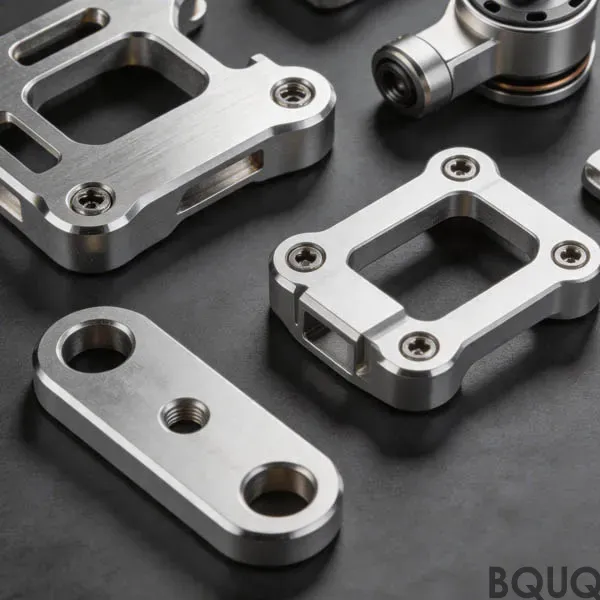
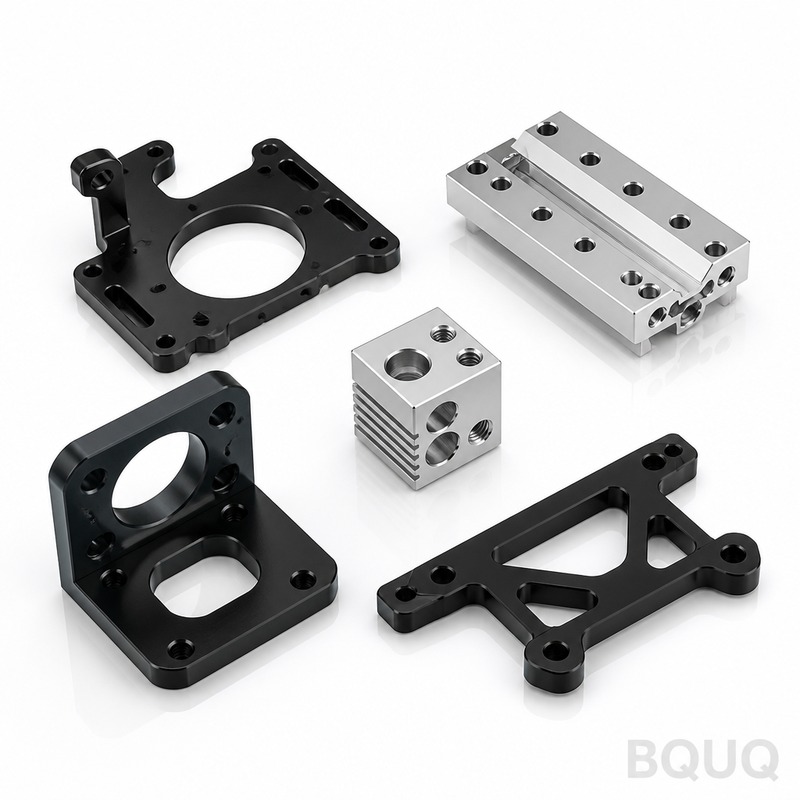
The fundamental cost driver in CNC machining is machine time, ranging from $35 to $120 per hour depending on the equipment class (3-axis vs 5-axis) and precision level. Material costs add 10-30% to the machining fee, while setup is minimal—typically $50 to $200 per job. For a standard aluminum 6061 bracket, CNC quoting at BQUQ shows $8.50 per part at 100 units, dropping to $4.20 at 500 units, and $2.80 at 1,000 units.
Injection molding shifts the cost structure entirely. The mold itself—a hardened P20 or H13 steel tool—costs $3,000 for a simple two-plate design, $12,000 for a medium-complexity slide-action mold, and $35,000 or more for multi-cavity tools with hot runners. Per-part price then drops dramatically: $1.20 at 5,000 units, $0.65 at 20,000 units, and $0.40 at 100,000 units for the same bracket geometry. Mold steel hardness ranges from 28 HRC for P20 to 52 HRC for H13, directly affecting tool life and maintenance intervals.
| Parameter | CNC Machining | Injection Molding |
| Typical tolerance | ±0.005 mm to ±0.012 mm | ±0.05 mm to ±0.125 mm |
| Minimum order quantity | 1 unit | 500 to 1,000 units |
| Tooling cost | $0 to $200 | $3,000 to $35,000+ |
| Per-part cost at 100 units | $8.50 (Al 6061) | Not viable |
| Per-part cost at 5,000 units | $3.20 | $1.20 |
| Per-part cost at 50,000 units | Not practical | $0.50 |
| Lead time for first article | 3 to 7 days | 15 to 30 days |
| Material waste | 10% to 20% | 1% to 3% |
| Surface finish (Ra) | 0.4 µm to 1.6 µm | 0.2 µm to 0.8 µm as-molded |
| Wall thickness limit | 0.5 mm minimum | 1.0 mm to 2.5 mm nominal |
| Material range | Unlimited (metals, plastics) | Thermoplastics only |
| Maximum part size | Up to 2000 mm | Limited by press tonnage |
Tolerance and Geometric Capability
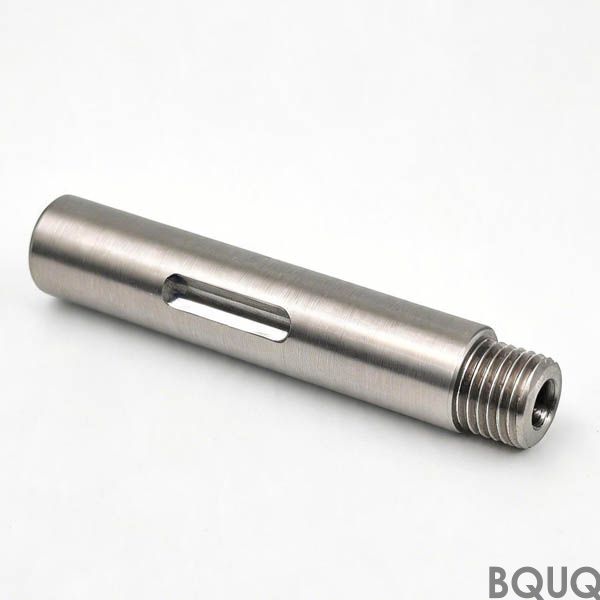
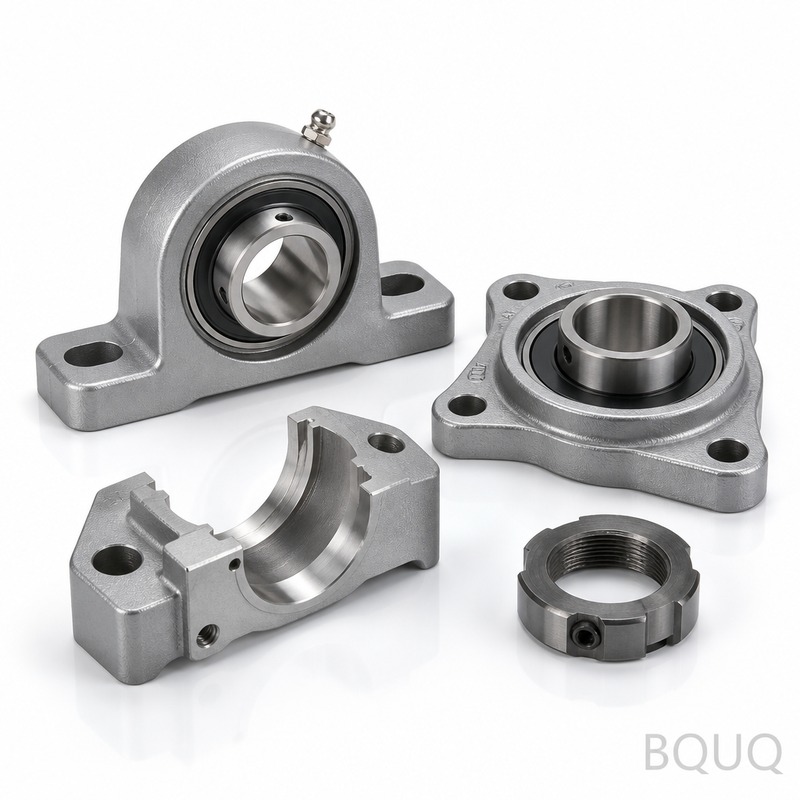
CNC machining holds positional accuracy of ±0.005 mm on standard features and ±0.010 mm on complex 3D contours, with surface finishes down to Ra 0.4 µm achievable through fine finishing passes. This makes CNC the only option for aerospace components, medical implants, and precision valve bodies where dimensional stability under thermal cycling is critical. Machined parts also retain residual compressive stress from cutting, which improves fatigue life by 10-15% compared to molded equivalents.
Injection molding delivers repeatable tolerances of ±0.05 mm for general features and ±0.02 mm for tightly controlled dimensions, but this comes with constraints. Draft angles of 0.5 to 2 degrees are mandatory for part ejection, wall thickness must stay between 1.0 mm and 4.0 mm to avoid sink marks, and weld lines form wherever polymer flow fronts meet—creating weak points that can fail under impact. Shrinkage varies by material: ABS shrinks 0.4-0.7%, nylon 6/6 shrinks 1.5-2.0%, and glass-filled PBT shrinks 0.2-0.5%, requiring mold compensation that adds 5-10% to tooling cost.
Material Selection and Thermal Performance
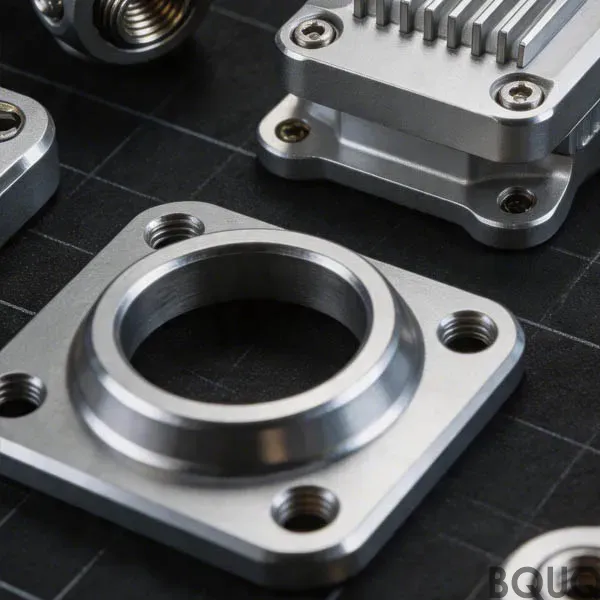
CNC machining offers unrestricted material choice, from aluminum 7075-T6 (yield strength 503 MPa) to stainless steel 17-4PH (yield 1,100 MPa after H900 aging) and engineering plastics like PEEK (continuous service at 260°C). For heat sinks—a BQUQ specialty—CNC allows complex fin geometries with aspect ratios of 10:1 and fin thickness down to 0.8 mm, achieving thermal conductivity of 167 W/m·K for aluminum 6063-T5. Skived or extruded heat sinks may cost less, but CNC-machined copper heat sinks (390 W/m·K) remain unmatched for high-density IGBT modules.
Injection molding is restricted to thermoplastics, with the highest continuous-use temperature around 150-180°C for PPS and LCP grades. Molded plastic heat sinks are possible with thermally conductive compounds (1-8 W/m·K), but they cannot match metal performance. For metal injection molding (MIM), the material range improves—17-4PH stainless and 316L are common—but MIM parts require sintering at 1,300°C and exhibit 1-3% shrinkage that is difficult to predict, limiting tolerances to ±0.3% of the part dimension.
Lead Time and Production Flexibility
CNC machining delivers prototype parts in 24 hours using local stock, with first articles typically ready in 3-5 business days. Design changes are free—simply update the CAM code and rerun. This makes CNC the preferred process for iterative development, where 3-5 design revisions are common before freezing the design. BQUQ's 5-axis CNC centers reduce setups from three to one for complex parts, cutting lead time by 40% compared to 3-axis machining.
Injection molding requires 15-30 days for tool fabrication, plus 3-5 days for mold tryout and process validation. Any design change after tool cutting incurs modification costs of $500 to $2,000 per change, with a 3-7 day delay. However, once validated, cycle times are fast: 30-60 seconds for small parts, 90-180 seconds for large housings. A single cavity produces 100-200 parts per hour, and multi-cavity tools (4, 8, or 16 cavities) multiply output proportionally.
Surface Finish and Post-Processing
CNC-machined surfaces show visible tool marks at 1.6 µm Ra; bead blasting improves this to 0.8 µm, and manual polishing reaches 0.2 µm. Anodizing (Type II or III) adds a hard coating of 25-50 µm that improves wear resistance and provides corrosion protection. For EMI shielding, CNC parts accept electroless nickel plating (3-5 µm) or conductive paint without adhesion issues.
Injection-molded parts replicate the mold surface exactly. A mirror-polished mold (SPI A-1 grade) yields glossy surfaces of 0.05 µm Ra, while textured molds (chemical etching, MT-11000) create leather or matte finishes. Molded parts require degating and flash removal, adding $0.05-0.20 per part. Painting or laser marking is common, but secondary operations like tapping or metal insert placement extend cycle time and cost.
Practical Recommendations for Engineers
Choose CNC machining when your part has thin walls under 1.0 mm, requires tolerances tighter than ±0.02 mm, involves metals, or needs rapid iteration. CNC is also the correct choice when your projected total volume is below 1,500 units—even at $8 per part, you will spend less than the $12,000 mold cost plus molded part price. For heatsinks with high fin density or custom baseplate geometries, CNC is the only practical method for volumes under 10,000 units.
Transition to injection molding when your design is frozen, your volume exceeds 5,000 units, and your geometry accommodates draft angles and uniform wall thickness. A good rule of thumb is to compare 2× the CNC per-part price at your target volume against the mold cost divided by volume plus the molded part price. If molded total cost is 40% lower, the switch is justified. For volumes between 1,000 and 5,000, consider hybrid approaches: CNC for prototypes and bridge tooling, then soft molds (aluminum, 5,000-10,000 shot life) for initial production runs.
FAQ-Style Tips for Decision Makers
For a 100-unit pilot run of an aluminum enclosure with 0.1 mm tolerances, plan on $900-1,200 total with CNC, delivered in 5 days. For a 50,000-unit plastic housing with 0.5 mm tolerances, injection molding total cost is $18,000-25,000 including a $15,000 mold, at a per-part price of $0.40-0.60. If your design is still changing weekly, always machine; a single mold modification costs more than three CNC prototype runs. For glass-filled materials, verify the mold is hardened to 48 HRC minimum to prevent abrasive wear. And never mold parts with internal threads—always use CNC or add metal inserts.
At BQUQ, we provide CNC machining and injection molding services from our Dongguan factory, with 20 years of experience in precision components for automotive, medical, and electronics industries. Our engineers will review your 3D model and recommend the most cost-effective process based on your volume, tolerance, and material requirements. Send your drawings for a free quotation within 12 hours. Email: sc@bquq.com, WhatsApp: +86 13713157787, or visit www.bquq.com for instant DFM feedback.
Related Articles
- Adaptive Control and AI Real-Time Optimization in CNC Machining: From Experience to Algorithm
- High-speed machining technology: principles, tool path optimization, and industrial applications
- Analysis of the core technology of five-axis linkage machining: from motion to high-precision curved surface manufacturing