Compression Spring vs Torsion Spring vs Extension Spring: Key Differences for Engineers
Compression Spring vs Torsion Spring vs Extension Spring: Key Differences for Engineers
**Direct Answer:** The fundamental difference lies in load direction and function. A compression spring is designed to resist axial compressive forces (pushing together), an extension spring resists axial tensile forces (pulling apart), and a torsion spring resists rotational or twisting forces around its axis. Each type has distinct wire diameters, end configurations, and stress profiles that dictate their specific applications in CNC machined assemblies, metal stampings, and precision mechanical systems.
H2: Defining the Three Spring Types: Function and Load Direction
### Compression Springs: The Workhorse of Axial Push Compression springs are open-coil helical springs designed to oppose axial compression. When you push the ends together, the spring stores mechanical energy and pushes back. They are the most common spring type, accounting for approximately 70% of all industrial spring applications. Typical wire diameters range from 0.1 mm (0.004 inch) for micro-electronics to 50 mm (2 inches) for heavy machinery. The critical design parameter is the free length versus solid height; a well-designed compression spring should have a solid height that is 20-30% less than the free length to prevent coil binding.
### Extension Springs: The Pull-Back Specialists Extension springs, also known as tension springs, are tightly wound coils (often with initial tension) that resist stretching. Unlike compression springs, their coils are usually in contact with each other in the free state. The initial tension is a critical specification, typically ranging from 5% to 15% of the maximum load. For precision applications, the spring rate (N/mm) must be calculated with the initial tension subtracted from the applied force. Hook ends, cross-over ends, or threaded plugs are common termination methods, each adding 0.50-2.00 mm to the overall length.
### Torsion Springs: Rotational Force and Torque Control Torsion springs exert torque (rotational force) when twisted or rotated. They are usually wound with a smaller pitch to allow coils to rub against each other, which reduces the effective free length. The primary specification is torque, measured in Newton-millimeters (N·mm) or pound-inches (lb-in). For example, a typical torsion spring in a door hinge mechanism might require 50 N·mm of torque at a 90-degree deflection, with a tolerance of ±10%. The legs (end configurations) can be straight, bent, or looped, and their position determines the wind direction (right-hand or left-hand).
H2: Material Selection and Temperature Performance
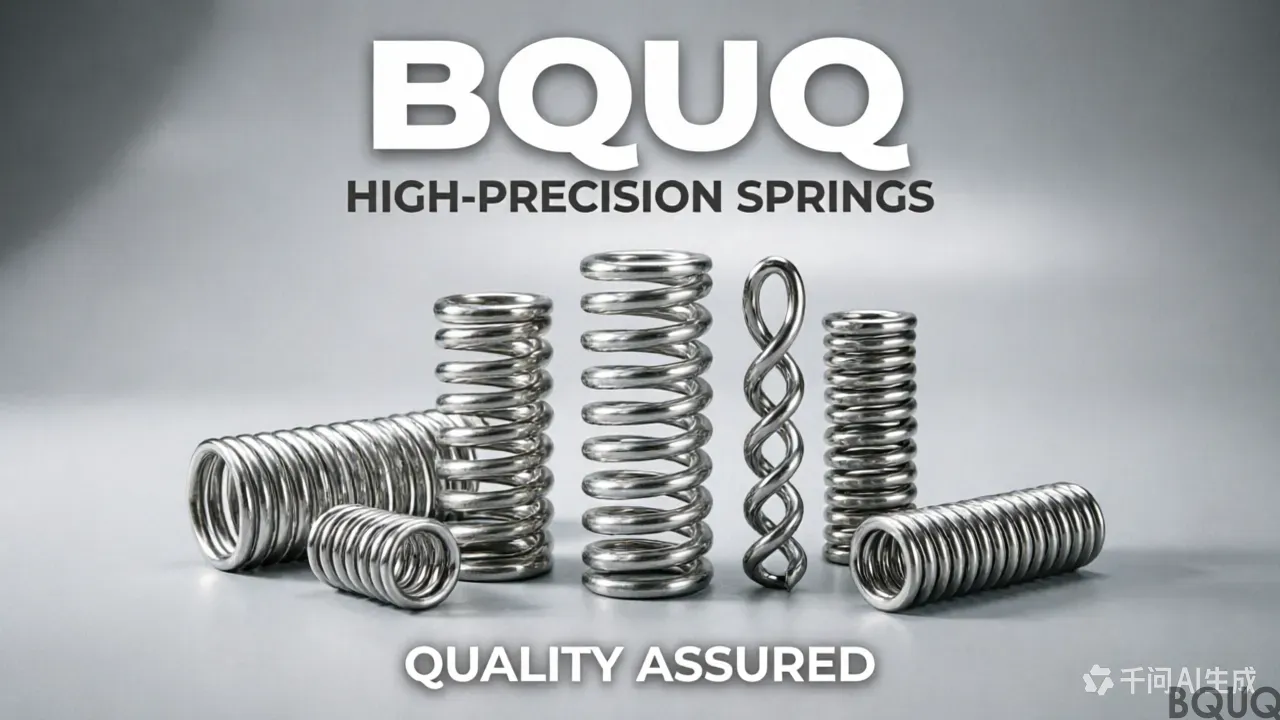
The choice of spring material directly impacts performance, cost, and lifespan. Below is a comparison of common materials used in our Dongguan facility for CNC machining and spring manufacturing.
| Material | Max Operating Temp | Tensile Strength (MPa) | Modulus of Elasticity (GPa) | Relative Cost | Best Application | ---------- | ------------------- | ------------------------ | ---------------------------- | --------------- | ------------------ | Music Wire (ASTM A228) | 120°C (250°F) | 2300 - 2600 | 197 | 1.0x | General purpose, high stress | Stainless Steel 302 (A313) | 290°C (550°F) | 1500 - 1800 | 193 | 2.5x | Corrosion resistance, medical | Chrome Silicon (A401) | 230°C (450°F) | 1900 - 2100 | 200 | 3.0x | Shock loading, high fatigue | Inconel X-750 | 650°C (1200°F) | 1000 - 1200 | 214 | 10x | Aerospace, high temperature | Phosphor Bronze (B159) | 100°C (210°F) | 700 - 900 | 96 | 4.0x | Electrical conductivity, corrosion |
|---|
For industrial applications in Guangdong's humid climate, we recommend 302 stainless steel for extension springs exposed to moisture, while music wire remains the cost-effective choice for compression springs in dry, controlled environments. Torsion springs subjected to cyclic loading above 10,000 cycles should use chrome silicon or a shot-peened surface treatment to improve fatigue life by up to 30%.
H2: Dimensional Tolerances and Manufacturing Precision
Precision is paramount in spring manufacturing. At BQUQ, our CNC coiling machines achieve the following standard tolerances (based on DIN 2095 and EN 15800):
| Parameter | Compression Spring | Extension Spring | Torsion Spring | ----------- | ------------------- | ------------------ | ---------------- | Outer Diameter (OD) | ±0.05 mm (up to 10 mm OD) | ±0.10 mm | ±0.15 mm | Free Length | ±1.0% or ±0.3 mm (whichever is greater) | ±1.5% | N/A (leg position ±1°) | Spring Rate | ±5% | ±5% | ±7% (torque) | Initial Tension | N/A | ±10% | N/A | Coil Diameter Ratio (D/d) | 4 to 16 | 4 to 12 | 4 to 20 |
|---|
For torsion springs, the angular tolerance of the legs is critical. A standard tolerance is ±2 degrees, but for precision robotics, we can achieve ±0.5 degrees with CNC grinding and laser measuring. The index (spring index = mean diameter / wire diameter) should be kept between 4 and 16 to avoid manufacturing difficulties; below 4 causes excessive tool wear, above 16 causes coil sagging and instability.
H2: Cost Comparison and Lead Times (2024 Pricing)
Understanding price differentials helps in design for manufacturability (DFM). Prices are for medium-volume runs (1,000-5,000 pieces) at a wire diameter of 1.5 mm (0.060 inch):
| Spring Type | Tooling Cost (USD) | Unit Price (USD/pc) | Lead Time (days) | Typical Failure Mode | ------------- | ------------------- | --------------------- | ------------------ | ---------------------- | Compression | $50 - $150 | $0.15 - $0.45 | 3-5 | Buckling, fatigue fracture | Extension | $80 - $200 | $0.25 - $0.65 | 5-7 | Hook failure, over-extension | Torsion | $100 - $300 | $0.35 - $0.85 | 5-8 | Leg bending, stress relaxation |
|---|
Compression springs are the cheapest because they require only simple end grinding. Extension springs need specialized hook-forming tools, increasing tooling cost by 40-60%. Torsion springs are the most complex due to leg forming and tight angular tolerances. For orders above 10,000 pieces, unit prices drop by 20-35% due to automated CNC coiling and in-line quality inspection.
H2: Design Formulas and Practical Engineering Rules
### Compression Spring Rate (k) k = (G × d⁴) / (8 × D³ × n) Where G = shear modulus (79.3 GPa for steel), d = wire diameter, D = mean diameter, n = active coils. Example: d=2mm, D=20mm, n=5 → k = (79,300 × 16) / (8 × 8000 × 5) = 3.97 N/mm.
### Extension Spring Initial Tension (Pi) Initial tension for music wire is approximately 10-15% of the maximum load. In practice, set Pi = 0.10 × P_max. If you need a spring that pulls with 100N, design for 10N initial tension and 90N spring rate contribution.
### Torsion Spring Torque (M) M = (E × d⁴ × θ) / (3670 × D × n) Where E = elastic modulus, θ = deflection in degrees. For a torsion spring with d=1.2mm, D=12mm, n=4, and 90° deflection: M = (197,000 × 2.07 × 90) / (3670 × 12 × 4) = 20.7 N·mm.
### Buckling Prevention (Compression) If the free length / mean diameter ratio exceeds 4:1, the spring may buckle. Add a guide rod or sleeve, or design a nested spring (dual concentric springs) to maintain stability. Buckling can reduce load capacity by 50% or more.
H2: Application Selection: Which Spring Should You Use?
The decision matrix below simplifies selection based on your mechanical requirements:
| Application Requirement | Recommended Spring | Reasoning | ------------------------- | ------------------- | ----------- | Push-back mechanism, valve return | Compression | Axial load, high spring rate, stable | Trigger reset, latch pull-back | Extension | Consistent pull force, compact length | Door hinge, clamp return | Torsion | Rotational torque, minimal space | Shock absorption (automotive) | Compression (chrome silicon) | High energy storage, fatigue resistance | Electrical contact pressure | Extension (phosphor bronze) | Conductive, corrosion resistant |
|---|
For example, in a CNC machined aluminum housing, if you need to return a sliding element to its home position, an extension spring with hooks is ideal. However, if space is constrained axially, a torsion spring around a pivot pin may be more compact. Always consider the working environment: extension springs are prone to tangling during handling, so use them only when the stroke is guided.
H2: FAQ-Style Tips for Engineers
**Q: Can I use a compression spring as an extension spring by flipping it?** A: No. Compression springs have open ends and no initial tension; they will not provide consistent pull force and may separate under load. Always use the correct type.
**Q: What is the maximum deflection for a torsion spring?** A: Generally, 30-50% of the free angle to prevent plastic deformation. Beyond 360 degrees, stress relaxation becomes a serious issue, especially above 150°C.
**Q: How do I specify a spring for a drawing?** A: Provide wire diameter (d), outer diameter (OD) or inner diameter (ID), free length (L), number of coils (n), end type, and load at a specific deflection or torque. Include tolerances based on DIN 2095.
**Q: Why is my extension spring failing at the hook?** A: Hook stress concentration is 30-50% higher than coil stress. Increase the hook radius (at least 2x wire diameter) or specify a cross-over hook design. For high-cycle applications (>1M cycles), use a threaded plug instead of a hook.
**Q: What is the cost difference for a custom spring versus a standard one?** A: Standard off-the-shelf springs cost 30-50% less, but may have looser tolerances (±5% spring rate) and limited material choices. Custom springs from BQUQ cost slightly more but offer exact fit and longer service life.
H2: Conclusion and Manufacturing Recommendation
The core difference is load direction: compression resists push, extension resists pull, and torsion resists twist. Material selection and tolerance control are equally important. For high-volume or precision applications, partner with a manufacturer that understands CNC machining and spring coiling integration. At BQUQ, we have 20 years of experience producing compression, extension, and torsion springs for automotive, medical, and consumer electronics clients in Dongguan, China. Our in-house CNC coiling and automated testing ensure consistent quality with a spring rate tolerance of ±3% for critical applications.
For your next project, we provide 12-hour quoting with DFM feedback. Send your drawings to **sc@bquq.com** or message us on WhatsApp at **+86 13713157787**. Visit **www.bquq.com** to download our spring design datasheet and tolerance charts. We help you select the right spring type, material, and surface treatment to reduce cost and improve reliability.
Related Articles
- Spring Design Calculations: Rate Calculation Guide for 2025 Engineers
- Aerospace and defense springs: Reliability engineering in extreme environments
- Spring forming machine market: growth opportunities in the transformation of smart manufacturing
Frequently Asked Questions
What is the main difference between compression, extension, and torsion springs?
The fundamental difference is load direction and function. Compression springs resist axial compressive forces (pushing together), extension springs resist axial tensile forces (pulling apart), and torsion springs resist rotational or twisting forces around their axis. Each type has distinct wire diameters, end configurations, and stress profiles for specific applications.
What are typical wire diameters and design parameters for compression springs?
Typical wire diameters range from 0.1 mm (0.004 inch) for micro-electronics to 50 mm (2 inches) for heavy machinery. A well-designed compression spring should have a solid height that is 20-30% less than the free length to prevent coil binding. They account for approximately 70% of all industrial spring applications.
How is initial tension specified for extension springs?
Initial tension typically ranges from 5% to 15% of the maximum load. For precision applications, the spring rate (N/mm) must be calculated with the initial tension subtracted from the applied force. Hook ends, cross-over ends, or threaded plugs are common termination methods, each adding 0.50-2.00 mm to the overall length.
What is the primary specification for torsion springs and how is torque measured?
The primary specification is torque, measured in Newton-millimeters (N·mm) or pound-inches (lb-in). For example, a typical torsion spring in a door hinge mechanism might require 50 N·mm of torque at a 90-degree deflection, with a tolerance of ±10%. Legs can be straight, bent, or looped, determining wind direction.