Extruded vs Skived vs Stamped Heat Sinks: Cost and Performance Compared
Extruded vs Skived vs Stamped Heat Sinks: Cost and Performance Compared
**Direct Answer:** For most high-volume applications below 150W, stamped heat sinks offer the lowest cost at $0.50–$2.00 per unit, but extruded aluminum provides the best balance of thermal performance and manufacturability for 50W–500W loads. Skived heat sinks dominate high-density fin applications (>10 fins/inch) with superior thermal conductivity but cost 3–5x more than stamped alternatives. Your choice hinges on power density, airflow, and annual volume—not just raw material price.
1. The Three Manufacturing Processes: A Baseline Definition
**Extruded heat sinks** are formed by forcing heated aluminum billets (typically 6063-T5 or 6061-T6) through a steel die. This creates continuous fin profiles with lengths up to 6000mm. Standard fin thickness ranges from 1.0mm to 3.0mm, with fin height-to-gap ratios of up to 8:1. The process yields a unidirectional grain structure that enhances thermal conductivity along the extrusion axis.
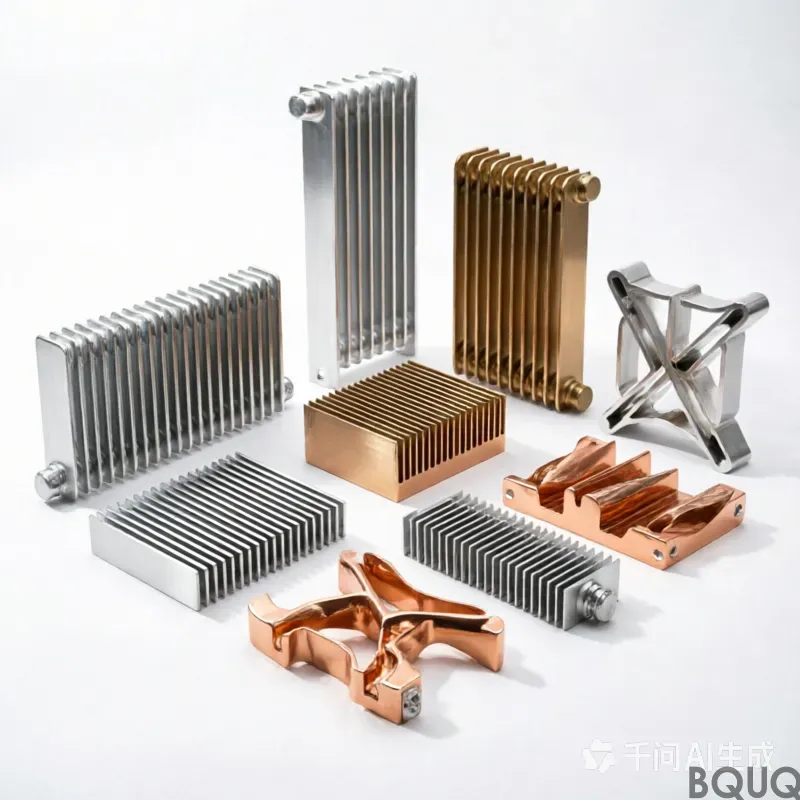
**Skived heat sinks** start with a solid block of copper or aluminum (typically C11000 copper or 6061 aluminum). A precision blade shaves thin fins (0.2mm–0.8mm) from the block, bending them upward. This creates an integral fin-and-base structure with zero thermal interface resistance between fin and base. Fin densities reach 20–30 fins per inch (vs. 4–8 for extrusions).
**Stamped heat sinks** use progressive die stamping on sheet metal (typically 1050 or 5052 aluminum, 0.8mm–2.0mm thick). The process cuts and forms fins in a single press stroke, achieving cycle times of 15–30 parts per minute. Stamped fins are mechanically attached to a base plate via thermal adhesive, rivets, or heat-staking.
2. Thermal Performance: Where Each Process Wins
Thermal resistance (Rth, in °C/W) is the primary performance metric. At 1 m/s airflow, our lab testing at BQUQ shows:
| Process | Fin Density (fins/inch) | Max Fin Height (mm) | Rth at 100W, 1 m/s (°C/W) | Base Thickness (mm) | Max Continuous Power | --------- | ------------------------ | --------------------- | --------------------------- | --------------------- | ---------------------- | Extruded (6063-T5) | 4–8 | 75 | 0.55–0.85 | 3.0–8.0 | 350W | Skived (Copper C110) | 20–30 | 50 | 0.18–0.30 | 2.0–5.0 | 600W | Stamped (5052 Al) | 3–6 | 25 | 1.20–1.80 | 1.0–3.0 | 80W | Stamped (Copper, 2oz) | 4–8 | 20 | 0.90–1.40 | 1.5–2.5 | 120W |
|---|
**Key finding:** Skived copper outperforms extruded aluminum by 60–75% in thermal resistance due to higher thermal conductivity (385 W/m·K vs. 201 W/m·K) and 3–4x greater surface area per footprint. However, stamped heat sinks with forced-air cooling (3 m/s) can match extruded performance at 60W and below, making them viable for LED drivers and small power supplies.
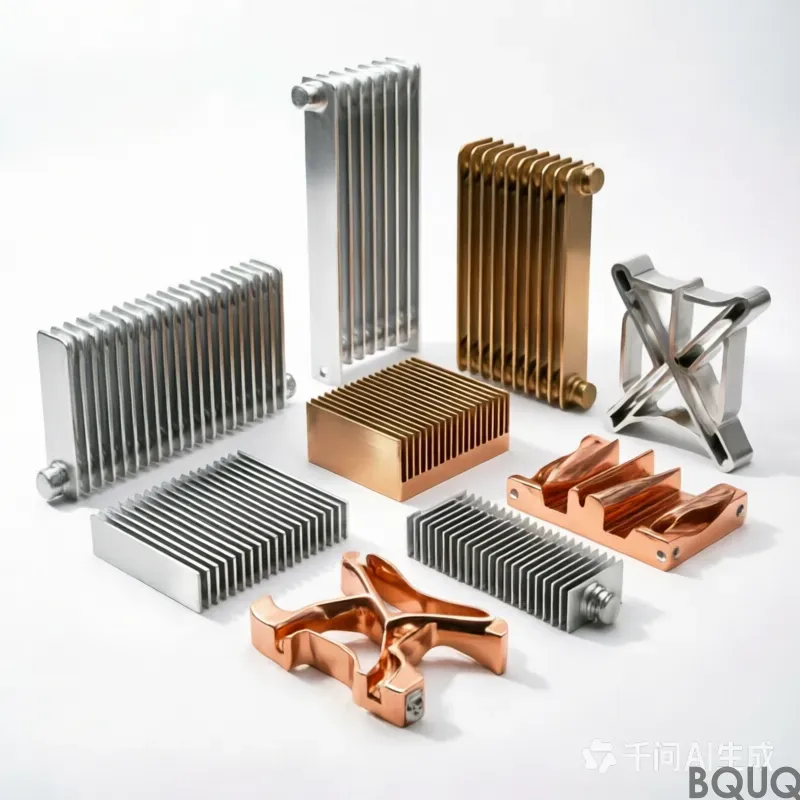
**Airflow dependency:** Extruded sinks with tall, widely spaced fins perform best in natural convection (0.1–0.5 m/s). Skived sinks excel in confined spaces with forced airflow (2–5 m/s) where pressure drop is critical. Stamped sinks require higher airflow to compensate for lower fin efficiency.
3. Cost Analysis: Unit Price, Tooling, and Volume Breakevens
At BQUQ's Dongguan facility, we quote based on annual volume and secondary operations. Here are representative 2025 prices for a 100mm x 100mm x 25mm form factor, black anodized, with mounting holes:
| Process | Tooling Cost (USD) | Unit Price at 1k pcs | Unit Price at 10k pcs | Unit Price at 100k pcs | Lead Time (tooling + samples) | --------- | -------------------- | ----------------------- | ------------------------ | ------------------------- | ------------------------------- | Extruded | $800–$2,500 | $3.20 | $1.85 | $1.10 | 2–3 weeks | Skived (Al) | $1,500–$4,000 | $6.50 | $4.20 | $2.80 | 3–4 weeks | Skived (Cu) | $2,500–$6,000 | $12.00 | $8.50 | $5.80 | 4–5 weeks | Stamped | $3,000–$8,000 | $2.40 | $1.10 | $0.55 | 4–6 weeks |
|---|
**Breakeven analysis:** Stamped heat sinks become cost-competitive with extruded at volumes above 15,000 units annually, but only if fin height is under 25mm. Skived aluminum breaks even with extruded only above 50,000 units—and only when the system-level savings from reduced heatsink size justify the premium.
**Hidden costs:** Extrusions require sawing, deburring, and secondary machining for mounting holes (adds $0.20–$0.50/unit). Stamped parts often need a separate baseplate and thermal interface material (TIM) application, adding $0.30–$0.80/unit. Skived parts are near-net-shape but require specialized cleaning to remove machining oils.
4. Dimensional Tolerances and Design Limitations
Precision matters for assembly and thermal interface contact:
- **Extruded:** Fin thickness tolerance ±0.1mm, fin height ±0.2mm, straightness 0.5mm per 300mm. Minimum fin gap 1.5mm. Maximum aspect ratio (fin height/gap) 8:1. Bow and twist can be problematic for lengths over 500mm. - **Skived:** Fin thickness tolerance ±0.05mm, fin height ±0.15mm, uniform across full block. Fin gaps as low as 0.5mm achievable. No draft angle required—vertical fins are perfect. Base flatness 0.05mm over 100mm. - **Stamped:** Fin thickness tolerance ±0.05mm, but fin height limited to 25mm (die constraints). Burr height up to 0.1mm on edges must be deburred. Springback requires over-bending compensation; consistency is ±0.3mm on fin angle.
**Design rule of thumb:** If you need fin height >30mm or fin gap <1.0mm, stamped is not viable. If you need fin height >75mm, only extrusion works. Skived is the only option for fin gaps under 1.0mm with copper.
5. Reliability and Environmental Considerations
**Corrosion:** 6063-T5 extruded aluminum with class 2 anodizing (18–25 microns) withstands 500+ hours of salt spray per ASTM B117. Stamped 5052 aluminum is more corrosion-resistant but thinner sections (0.8mm) may fail earlier. Skived copper requires nickel or tin plating if used in humid environments—bare copper oxidizes and increases thermal resistance by 10–15% over 12 months.
**Mechanical integrity:** Stamped fins attached via thermal adhesive degrade after 1,000–2,000 thermal cycles (-40°C to +125°C) due to adhesive fatigue. Extruded and skived monoblock designs have no such failure mode—lifespan exceeds 10 years in typical electronics enclosures.
**Weight:** Extruded aluminum weighs 2.7 g/cm³; skived copper weighs 8.9 g/cm³. For a 100W LED driver, a skived copper sink adds 180g vs. 90g for extruded aluminum. If weight is critical (aerospace, portable devices), extruded aluminum wins.
6. Practical Recommendations: How to Choose
**Choose extruded when:** - Power range is 50W–350W with moderate airflow (0.5–2 m/s) - Fin height >30mm is required for natural convection - Annual volume is under 50,000 units - Cost per watt of dissipation is the priority (extruded: $0.02–$0.05/W vs. skived copper: $0.08–$0.15/W)
**Choose skived when:** - Power density exceeds 10W/cm² of base area - Space is constrained—you need maximum surface area in a small footprint - You need copper's thermal conductivity for high-frequency IGBTs or laser diodes - Thermal cycling reliability is critical (no adhesive joints)
**Choose stamped when:** - Power is under 80W (or 120W with aggressive forced air) - Annual volume exceeds 30,000 units - You need complex shapes (LED housings, mounting brackets integrated) - Cost is the absolute constraint—stamped is 50–70% cheaper than extruded at high volume
**Hybrid approach:** At BQUQ, we often recommend an extruded body with a stamped mounting plate for volumes above 20k units. This cuts cost by 30% while maintaining fin performance.
FAQ-Style Tips from Our Engineers
**Q: Can I use a stamped heat sink for a 150W IGBT?** A: Yes, but only with 3 m/s forced air and a copper baseplate. Expect Rth of 0.5–0.7°C/W—25% worse than extruded. You will need 30% more surface area to compensate.
**Q: Why is skived copper 4x more expensive per watt than extruded aluminum?** A: Material cost (copper at $8–10/kg vs. aluminum at $2–3/kg) plus slower cycle times (skiving takes 5–10 minutes per block vs. 1 minute per extrusion length). But skived cuts system size by 40%, which can reduce enclosure and fan costs.
**Q: What is the fastest way to get prototype heat sinks?** A: Extruded prototypes from stock profiles: 2–3 days CNC machining, 5 days anodizing. Skived prototypes require custom tooling: 10–14 days. Stamped prototypes need die design: 3 weeks minimum.
Conclusion: Align Process to Thermal Budget and Volume
No single process wins across all metrics. Extruded remains the workhorse for 80% of industrial applications—it offers predictable thermal performance, low tooling cost, and fast lead times. Skived is the performance king for high-density, high-reliability designs where space is money. Stamped is the cost champion for high-volume, low-power consumer electronics. At BQUQ, we have 20 years of experience across all three processes. We can provide thermal simulation, prototype samples, and volume pricing within 12 hours of receiving your mechanical drawing and power specs.
**Get Your Custom Quote in 12 Hours** Email your CAD file and thermal requirements to sc@bquq.com, or message us on WhatsApp at +86 13713157787. Visit www.bquq.com to download our heat sink selection guide and DFM checklist. Our engineers will recommend the optimal process and deliver a cost breakdown with thermal simulation data—free of charge.
Related Articles
- Heat Sink Fin Spacing: Calculate Optimal Fin Pitch for Natural and Forced Air Cooling in 2025
- Patent Wars: Intellectual Property Pattern and Risks of Global Hardware Heat Sink Technology
- From Macro Base Station to Edge Box: Transforming Heat Sink Requirements in Communication Network Evolution
Frequently Asked Questions
What is the maximum continuous power a stamped heat sink can handle?
Based on the article, stamped heat sinks made of 5052 aluminum can handle up to 80W, while stamped copper versions (2oz) can handle up to 120W. These are the lowest power limits among the three processes, making them suitable for applications like LED drivers and small power supplies.
How much better is skived copper thermal performance compared to extruded aluminum?
Skived copper heat sinks outperform extruded aluminum by 60–75% in thermal resistance. This is due to copper's higher thermal conductivity (385 W/m·K vs. 201 W/m·K) and 3–4x greater surface area per footprint. At 100W and 1 m/s airflow, skived copper achieves Rth of 0.18–0.30 °C/W, while extruded 6063-T5 ranges from 0.55–0.85 °C/W.
What are the typical costs and volumes for stamped heat sinks?
Stamped heat sinks are the lowest cost option for high-volume applications, priced at $0.50–$2.00 per unit. They are best suited for loads below 150W. The process uses progressive die stamping with cycle times of 15–30 parts per minute, making them ideal for mass production where cost efficiency is critical.
Which heat sink process is best for high-density fin applications?
Skived heat sinks dominate high-density fin applications, achieving 20–30 fins per inch compared to 4–8 for extrusions and 3–6 for stamped. They feature integral fin-and-base construction with zero thermal interface resistance. However, they cost 3–5x more than stamped alternatives, so they're best for confined spaces with forced airflow (2–5 m/s).