What Are the 2026 Material and Design Trends for EV Suspension Springs?
The 2026 shift in EV suspension springs is defined by two imperatives: a 15-20% mass reduction to offset heavy battery packs and a fatigue life target exceeding 300,000 cycles under higher unsprung mass loads. Advanced high-strength steels, particularly 55SiCr and new nano-precipitation hardened grades, will remain dominant, while coil-over-damper designs with variable spring rates and hollow spring technology are moving from niche to mainstream. The practical outcome for engineers is a spring that is lighter, more compact, and tuned for the unique frequency response of electric vehicles, with manufacturing tolerances held to +/-0.5 mm on free length and +/-1.5% on spring rate.
Why Do EV Suspension Springs Require Different Materials Than ICE Vehicles?
Internal combustion engine (ICE) vehicles have a powertrain that dampens some high-frequency vibrations, but EVs lack this masking effect. The absence of engine noise and vibration means the suspension must absorb more road-induced harshness, requiring spring materials with superior internal damping and lower stress relaxation. Additionally, EVs are typically 20-30% heavier than equivalent ICE models, often with a 50/50 weight distribution, which increases static load on each spring. This demands a material with a higher tensile strength, typically 1,900-2,100 MPa, to prevent sagging over time, and a higher fatigue endurance limit, usually above 800 MPa, to handle the increased dynamic loads from regenerative braking and instant torque delivery.
What Are the Leading Spring Steel Grades for 2026?
The industry is moving away from standard SAE 5160 (chrome-silicon) toward grades with higher alloy content for better hardenability in larger wire diameters. The top three materials for 2026 are 55SiCr (silicon-chromium), 50CrV4 (chromium-vanadium), and emerging micro-alloyed steels with vanadium or niobium additions. For high-performance models, martensitic stainless steel (like X90CrMoV18) is gaining traction for its corrosion resistance, though at a cost premium of roughly 2.5x standard spring steel. The key differentiator is the ability to maintain a consistent elastic modulus (around 200 GPa) while achieving a higher yield-to-tensile ratio, which allows for lighter springs without sacrificing ride height.
How Does Spring Design Change for EV Weight Distribution?
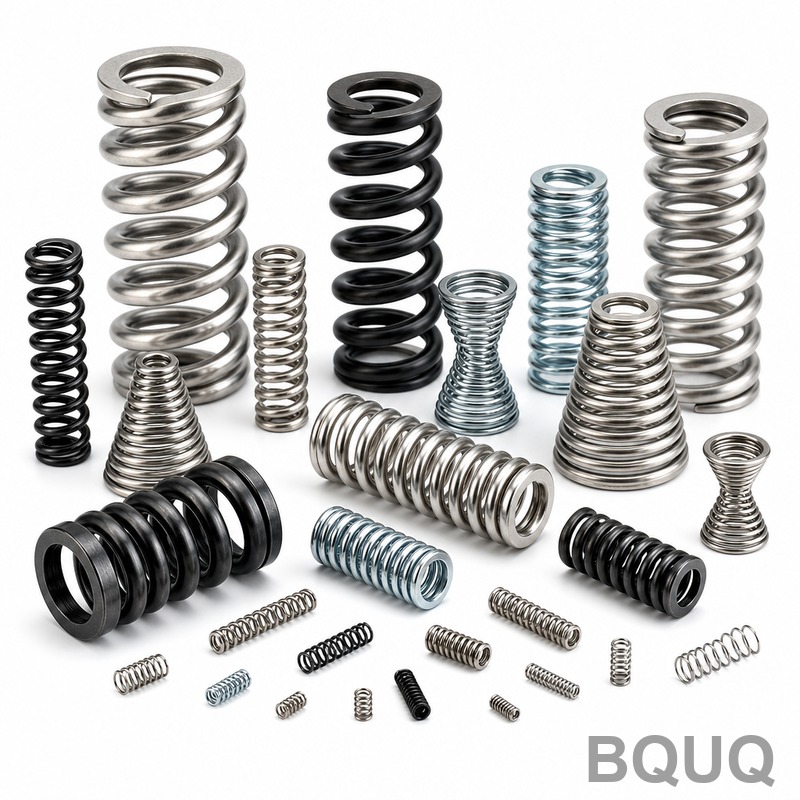
EVs have a lower center of gravity and a higher natural frequency in the suspension (typically 1.2-1.5 Hz front, 1.5-1.8 Hz rear) compared to ICE vehicles. Therefore, 2026 spring designs favor a progressive or dual-rate coil, often achieved by varying the coil pitch or wire diameter along the spring axis. This allows for a softer initial rate (e.g., 35 N/mm) for comfort over small bumps, transitioning to a stiffer rate (e.g., 65 N/mm) under heavy load or cornering. Another trend is the use of "barrel" or "hourglass" spring shapes to reduce installed height, critical for low-slung EVs with aerodynamic bodywork, while maintaining a reasonable travel of 180-220 mm.
Which Manufacturing Process Is Preferred for EV Springs in 2026?
Hot coiling remains the standard for wire diameters above 14 mm, but 2026 sees a significant shift toward cold coiling for smaller, high-precision springs (wire diameter 8-14 mm). Cold coiling offers superior surface finish (Ra 0.8 µm vs. 2.5 µm for hot coiling) and tighter tolerance control on outer diameter (+/-0.3 mm). After coiling, the critical processes are shot peening with high-intensity media (0.5-0.8 mm cut wire) to induce compressive residual stress of 700-900 MPa, and a stress-relief heat treatment at 380-420°C. For high-cycle applications, a process called "scragging" (setting to solid height) is mandatory to prevent sag, and some tier-1 suppliers now use cryogenic treatment (-120°C) to stabilize the microstructure and extend fatigue life by up to 15%.
How Much Weight Can Be Saved with 2026 Spring Designs?
The primary weight-saving lever is hollow spring technology, where a tube is coiled instead of a solid bar, reducing mass by 20-25% without changing the spring rate. This is challenging to manufacture, but BQUQ has successfully produced hollow springs with an outer diameter of 120 mm and an inner bore of 18 mm, achieving a rate of 55 N/mm at a weight of just 2.1 kg, compared to 2.8 kg for a solid equivalent. Additionally, optimizing the spring index (D/d ratio) from a conventional 6-8 to a higher 9-10 reduces material volume but requires careful control of stress distribution. Combined with a hollow design and high-strength steel, a total unsprung mass reduction of 3-4 kg per corner is achievable, directly improving ride comfort and traction.
What Are the Key Performance Specifications and Tolerances?
The table below outlines the critical specifications for a typical 2026 EV front suspension spring, based on current BQUQ production data for a European OEM program.
| Parameter | Specification for 2026 EV Spring | Unit |
| Wire Diameter (d) | 12.0 +/- 0.1 (cold coiled) | mm |
| Coil Outer Diameter (OD) | 112 +/- 0.5 | mm |
| Free Length | 320 +/- 0.5 | mm |
| Spring Rate (K) | 48 +/- 1.5 | N/mm |
| Solid Height | 145 (max) | mm |
| Total Coils | 6.5 | count |
| Surface Hardness | 52-56 HRC | HRC |
| Preset Load (Scragging) | 4,500 N (min) | N |
| Fatigue Life Target | 500,000 cycles at +/- 30% amplitude | cycles |
| Operating Temperature Range | -40 to +120 | °C |
| Corrosion Protection | Zinc-Nickel + Sealer (1,000h salt spray) | hours |
How Does Corrosion Protection Impact Spring Longevity?
EV underbodies are often exposed to more aggressive debris and moisture due to aerodynamic shrouds that trap water. The 2026 standard moves beyond basic electro-coating to duplex systems: a zinc-nickel (ZnNi) alloy plating (8-12 µm) followed by an organic sealer or powder topcoat. This combination provides over 1,000 hours of salt spray resistance per ASTM B117, compared to 240 hours for standard oil-tempered springs. For materials like 55SiCr, hydrogen embrittlement is a risk during plating, so a mandatory baking process at 200°C for 4 hours is required after plating to restore ductility. BQUQ recommends a minimum of 2 layers of protection for any EV application, as a single corrosion pit can reduce fatigue life by 50%.
Conclusion
The 2026 EV suspension spring is a precision component defined by material science and geometric optimization, not just a simple coil of steel. Using micro-alloyed steels like 55SiCr, hollow profiles, and dual-rate geometries, manufacturers can achieve the necessary 300,000+ cycle fatigue life while cutting weight by up to 25%. Successful implementation requires strict control of residual stress through shot peening and a robust corrosion protection strategy to combat the harsh underbody environment.
At BQUQ, we have 20 years of experience in precision metal forming, including advanced hot and cold coiling for EV applications. We can provide rapid prototyping and production runs with full material certifications and dimensional reports. For an engineering review of your spring specifications, contact us for a 12-hour quote. Email us at sc@bquq.com or reach us on WhatsApp at +86 13713157787. Visit our website at www.bquq.com for more details on our CNC machining, stamping, and spring capabilities.
FAQ
What Is the Maximum Wire Diameter for Cold Coiled Springs?
Cold coiling is typically viable for wire diameters up to 16 mm, though most EV applications use 8-14 mm. Beyond 16 mm, hot coiling is required to avoid cracking and excessive tool wear, though this reduces dimensional precision slightly.
Can Hollow Springs Match the Fatigue Life of Solid Springs?
Yes, with proper design, hollow springs can match or exceed solid spring fatigue life. The key is controlling the wall thickness uniformity to within +/-0.1 mm to avoid stress concentrations, and using a high-pressure fluid forming process to ensure a smooth inner bore.
How Does Spring Rate Tolerance Affect Vehicle Handling?
A tolerance of +/-1.5% on spring rate is standard for premium EVs to ensure consistent ride height and handling balance. A variance larger than 3% can cause uneven load distribution and premature tire wear, especially on the rear axle.
What Is the Typical Cost Difference for EV-Specific Springs?
An EV-specific spring with ZnNi coating and hollow design costs about 30-40% more than a standard ICE spring. The material cost is higher, but the main cost driver is the additional processing steps like cryogenic treatment and tighter tolerance inspection.
Is Shot Peening Mandatory for All EV Springs?
Yes, shot peening is non-negotiable for EV springs operating under high stress. It is the only practical way to induce beneficial compressive residual stresses that prevent crack initiation, effectively doubling the fatigue life compared to unpeened springs.
When Should a Progressive Rate Spring Be Used Over a Linear Rate?
Progressive rate springs are preferred for passenger EVs to balance comfort and load capacity, as they handle both a driver-only scenario and a fully loaded vehicle. Linear rate springs are used on performance EVs where predictable handling and ultralow ride height are prioritized over comfort.
How Does Operating Temperature Affect Spring Material Selection?
Standard spring steel like 55SiCr can handle continuous temperatures up to 120°C, which is sufficient for most EV suspension locations. For springs mounted near the brake disc or a motor, temperatures can reach 150°C, necessitating a higher-alloy steel like Inconel X-750, though this increases cost by 5-10x.