What Are the Heat Sink Demands for EV Inverter Cooling?
Direct answer: The primary heat sink demand for EV inverters is the efficient dissipation of 300W to 1500W of continuous heat from IGBT or SiC power modules, requiring thermal resistance values below 0.2°C/W and coolant flow rates of 8 to 15 liters per minute. This demand translates into aluminum cold plates with flatness tolerances of 0.05 mm and surface roughness of Ra 0.8 µm, machined from 6063-T5 aluminum alloy. As electrification scales, the market requires liquid-cooled heat sinks capable of maintaining junction temperatures below 150°C for SiC devices and 125°C for IGBTs, while surviving 10,000+ thermal cycles.
What Is the Typical Power Density That an EV Inverter Heat Sink Must Handle?
Modern EV inverters operate at power densities of 25 to 45 kW per liter of inverter volume, which directly translates to heat fluxes of 50 to 150 W/cm² on the heat sink surface. For example, a 200 kW traction inverter using SiC MOSFETs generates approximately 800W of waste heat during continuous highway driving, but peak acceleration can push this to 1500W for 30-second bursts. The heat sink must therefore be designed for a thermal resistance of 0.05 to 0.15°C/W from the module baseplate to the coolant, depending on whether the system uses direct cooling (pin-fin arrays) or indirect cooling (cold plate with serpentine channels).
How Does the Choice Between IGBT and SiC Modules Change Heat Sink Requirements?
The transition from silicon IGBTs to silicon carbide (SiC) MOSFETs fundamentally changes the cooling strategy because SiC devices tolerate higher junction temperatures (175°C vs 150°C) but have smaller die areas, concentrating heat flux. A typical 750V/600A IGBT module dissipates 1200W with a heat flux of 80 W/cm², while an equivalent SiC module dissipates only 900W but at a heat flux of 140 W/cm² due to its 30% smaller footprint. This concentration requires heat sinks with enhanced micro-channel geometries, where channel widths of 0.5 to 1.0 mm and fin densities of 15 to 25 fins per inch are necessary, compared to 8 to 12 fins per inch for IGBT applications.
What Are the Specific Thermal and Mechanical Tolerances for EV Inverter Heat Sinks?
The thermal interface between the power module and heat sink demands precise mechanical specifications to minimize contact resistance. The mounting surface must have a flatness of 0.05 mm over the entire 200mm x 150mm footprint, with a surface roughness of Ra 0.8 µm to ensure proper thermal interface material (TIM) wetting at 50 µm thickness. The hole-to-hole positional tolerance for M6 mounting threads is ±0.1 mm, and the overall heat sink thickness must be held to ±0.2 mm to maintain consistent clamp pressure of 10 to 15 N·m per screw. Leakage tests must confirm zero leakage at 8 bar pressure for liquid-cooled designs, with burst pressure resistance up to 25 bar.
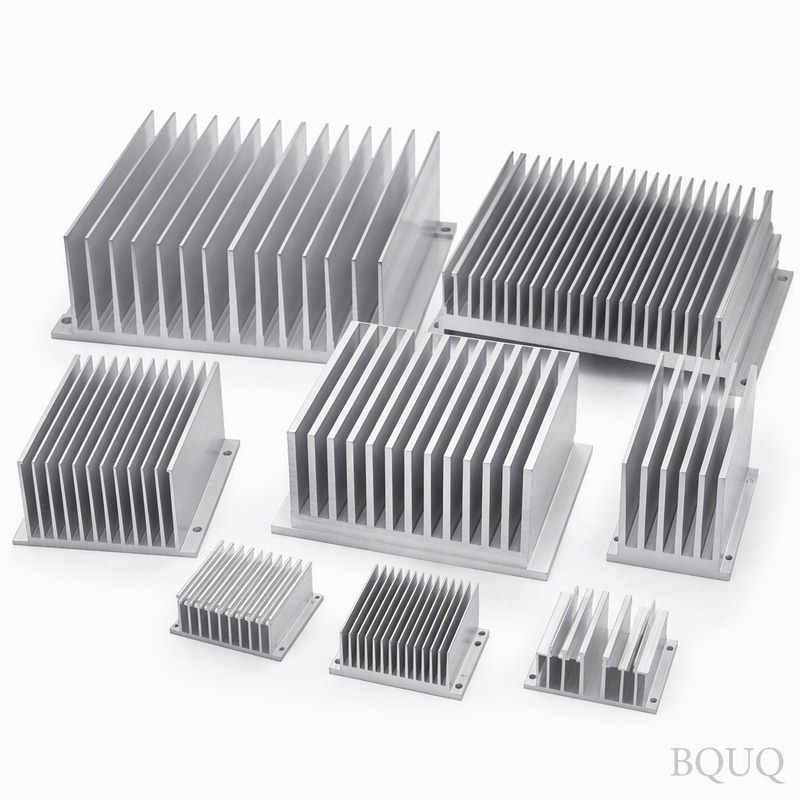
Why Is Liquid Cooling Becoming the Standard Over Air Cooling for EV Inverters?
Air-cooled heat sinks are physically incapable of meeting the heat flux requirements of modern EV inverters, as natural convection achieves only 0.005 to 0.02 W/cm²·°C, while forced air with high-speed fans reaches only 0.05 to 0.15 W/cm²·°C. Liquid cooling with a 50/50 ethylene-glycol water mixture achieves 1 to 5 W/cm²·°C, which is 20 to 50 times more effective. For a 150 kW inverter, an air-cooled solution would require a heat sink weighing 15 kg with a fan consuming 500W of parasitic power, whereas a liquid-cooled cold plate weighs only 3.5 kg and requires just 50W of pump power, making liquid cooling mandatory for any inverter above 50 kW continuous rating.
Which Manufacturing Processes Produce the Most Cost-Effective EV Inverter Heat Sinks?
For production volumes below 10,000 units per year, CNC machining of 6063-T5 aluminum blocks offers the best balance of thermal performance and cost, with prices ranging from $45 to $90 per piece depending on pin-fin complexity. For volumes between 10,000 and 100,000 units, vacuum brazing of stamped aluminum plates reduces unit cost to $25 to $50, though tooling investment runs $30,000 to $80,000. Above 100,000 units, friction stir welding or extruded profiles with CNC-machined channels become economical at $18 to $35 per unit, but require 12 to 16 week tooling lead times. The table below summarizes the trade-offs.
| Manufacturing Process | Production Volume | Unit Cost (USD) | Tooling Cost (USD) | Thermal Performance (W/cm²·°C) | Lead Time (weeks) |
| CNC Machined Solid Block | 1 – 10,000 | $45 – $90 | $2,000 – $5,000 | 3.5 – 5.0 | 2 – 4 |
| Vacuum Brazed Stamped Plates | 10,000 – 100,000 | $25 – $50 | $30,000 – $80,000 | 2.5 – 4.0 | 8 – 12 |
| Friction Stir Welded Assembly | 10,000 – 50,000 | $30 – $55 | $25,000 – $60,000 | 3.0 – 4.5 | 10 – 14 |
| Extruded Profile with CNC Channels | 50,000 – 500,000 | $18 – $35 | $15,000 – $40,000 | 2.0 – 3.5 | 12 – 16 |
| Cast Aluminum with Pin Fins | 100,000+ | $15 – $28 | $50,000 – $120,000 | 1.5 – 3.0 | 14 – 20 |
How Does Coolant Flow Rate and Pressure Drop Affect Heat Sink Design?
The coolant flow rate directly determines the convective heat transfer coefficient, but it must be balanced against pump power consumption and pressure drop. For a typical 150 kW inverter cold plate, the optimal flow rate is 10 L/min at a pressure drop of 30 to 50 kPa, achieving a heat transfer coefficient of 10,000 to 15,000 W/m²·K. Increasing flow to 15 L/min improves heat transfer by only 15% but doubles the pressure drop to 100 kPa, requiring a larger pump that consumes 200W instead of 50W. The channel geometry must therefore be optimized using computational fluid dynamics, with typical channel dimensions of 8mm width x 4mm depth and a serpentine path length of 1.5 to 2.0 meters to achieve turbulent flow (Reynolds number above 4000) without excessive pumping losses.
What Testing Standards Apply to EV Inverter Heat Sinks?
Automotive-grade heat sinks must pass stringent validation tests per USCAR-2 and LV124 standards, including thermal shock testing from -40°C to +125°C for 1000 cycles. Pressure cycling tests require 100,000 cycles from 0 to 3 bar at 90°C without leakage or deformation. Vibration testing per ISO 16750-3 demands random vibration at 27.8 m/s² RMS for 32 hours in each axis, while the heat sink must maintain structural integrity. Corrosion testing per ASTM B117 requires 500 hours of salt spray exposure with no pitting deeper than 0.1 mm, which is why 6063-T5 aluminum with a chromate conversion coating or anodizing to 18-20 µm thickness is the standard specification.
Can Additive Manufacturing Produce Viable EV Inverter Heat Sinks?
Additive manufacturing (selective laser melting) can produce heat sinks with conformal cooling channels that achieve thermal resistance 20-30% lower than conventionally machined designs, but the cost is currently prohibitive for mass production. A 200mm x 150mm aluminum heat sink printed in AlSi10Mg costs $250 to $450 per unit with a 3-week lead time, compared to $60 for a machined equivalent. However, for prototype validation and low-volume performance vehicles (under 500 units/year), additive manufacturing is viable because it eliminates tooling costs entirely and allows design iteration within days, making it the preferred choice for Formula E and high-performance EV prototypes.
What Are the Most Common Failure Modes for EV Inverter Heat Sinks?
The most frequent failure mode is thermal fatigue cracking at the interface between the aluminum baseplate and copper cooling tubes in brazed assemblies, caused by the coefficient of thermal expansion mismatch (23 ppm/°C for aluminum vs 17 ppm/°C for copper). This manifests as micro-cracks after 5,000 to 8,000 thermal cycles, leading to coolant leakage and catastrophic inverter failure. The second most common issue is galvanic corrosion when aluminum heat sinks contact stainless steel fittings, which is mitigated by using anodized surfaces and dielectric coolant additives. The third failure mode is fouling of micro-channels (below 1mm width) by debris or corrosion products, which reduces flow rate by 30-50% within 5 years, necessitating channel widths above 1.5mm for any coolant loop not using a 40-micron filter.
How Should Engineers Specify a Heat Sink for Their EV Inverter Program?
Engineers should specify the heat sink based on the worst-case thermal scenario: peak power dissipation at maximum ambient coolant temperature of 65°C, while maintaining a junction temperature margin of at least 25°C below the device limit. Specify the thermal resistance budget (junction-to-coolant) as the primary metric, then break it down into junction-to-case (device datasheet), case-to-sink (TIM), and sink-to-coolant (heat sink performance). Always request a prototype with the exact power module and TIM assembly for thermal impedance testing, as datasheet values from heat sink suppliers often assume ideal mounting conditions that are not achievable in production. Finally, require a DFMEA and process control plan from the manufacturer, particularly for brazed joints and weld seams, as these are the highest-risk features for field failures.
FAQ
What Is the Maximum Junction Temperature for SiC MOSFETs in EV Inverters?
Silicon carbide MOSFETs in automotive traction inverters are rated for a maximum junction temperature of 175°C, compared to 150°C for silicon IGBTs. However, operating continuously at temperatures above 150°C reduces device lifetime by approximately 50% for every 10°C increase due to accelerated solder fatigue. Most OEMs therefore design cooling systems to maintain junction temperatures below 150°C for SiC and below 125°C for IGBT devices.
How Much Does a Production-Ready EV Inverter Heat Sink Cost?
A production-ready liquid-cooled aluminum heat sink for a 150 kW inverter costs between $25 and $60 per unit at volumes of 50,000 units per year, depending on the manufacturing process and surface treatment. CNC-machined versions cost $45 to $90, while brazed assemblies fall in the $25 to $50 range. The cost includes the cold plate, inlet/outlet fittings, and anodizing to 18-20 µm thickness.
What Coolant Is Used in EV Inverter Cooling Systems?
The standard coolant is a 50/50 mixture of ethylene glycol and deionized water, with a specific heat capacity of 3.3 kJ/kg·K and a freezing point of -37°C. Some newer vehicles use propylene glycol-based coolants for lower toxicity, though these have 5% lower thermal conductivity. The coolant must have low electrical conductivity (below 100 µS/cm) to prevent galvanic corrosion and electrical leakage in the inverter.
Can a Heat Sink Be Shared Between the Inverter and the Electric Motor?
Yes, a common thermal management system can cool both the inverter and motor using the same coolant loop, but the inverter typically requires lower coolant temperatures (below 65°C) than the motor (which can tolerate up to 90°C). This is achieved by placing the inverter heat sink upstream in the coolant flow path, or by using a dedicated parallel branch with a flow control valve. The combined heat load of 2.5 to 4 kW requires a total flow rate of 15 to 20 L/min.
What Is the Typical Lead Time for Custom EV Inverter Heat Sink Prototypes?
CNC-machined prototypes of EV inverter heat sinks can be delivered in 2 to 4 weeks, including design review, material procurement, machining, and leak testing. Vacuum-brazed prototypes take 6 to 8 weeks because the brazing furnace cycle and fixture fabrication require additional time. For production tooling, cast or extruded designs require 12 to 20 weeks for tool making and process qualification.
How Do Thermal Interface Materials Affect Heat Sink Performance?
Thermal interface materials (TIM) account for 10-30% of the total thermal resistance from junction to coolant, with typical thermal resistances of 0.05 to 0.15°C·cm²/W for phase-change materials and 0.02 to 0.05°C·cm²/W for liquid metal (gallium-based) TIMs. The TIM thickness must be controlled to 25-75 µm, which requires the heat sink mounting surface to have a flatness of 0.05 mm and roughness of Ra 0.8 µm. Using a high-performance TIM can reduce junction temperature by 5-10°C compared to standard silicone-based pads.
Which Aluminum Alloy Is Best for EV Inverter Heat Sinks?
Aluminum alloy 6063-T5 is the industry standard for EV inverter heat sinks because it offers a thermal conductivity of 200 W/m·K, excellent extrudability, and good corrosion resistance when anodized. Alloy 6061-T6 has slightly higher strength (yield strength of 276 MPa vs 145 MPa) but lower thermal conductivity (167 W/m·K), making it suitable for structural heat sinks. Copper is not used in production because it is 3 times heavier and 4 times more expensive, despite having 2 times the thermal conductivity.
For your EV inverter heat sink program, BQUQ provides CNC machining and vacuum brazing services with 20 years of precision manufacturing experience in Dongguan, China. We deliver prototypes in 2 weeks with full thermal testing reports, and production parts with PPAP documentation for automotive compliance. Our engineering team can optimize your cold plate design for thermal resistance below 0.10°C/W while reducing manufacturing cost by up to 20% through design-for-manufacturing analysis. Submit your CAD file for a free design review and quotation within 12 hours. Contact us at sc@bquq.com or WhatsApp +86 13713157787, or visit www.bquq.com for more information.
Related Articles
- Regional Market Competition: Differences and Opportunities in Asia Pacific, North America, and Europe's Heat Sink Ecology
- Smaller Is Harder: The Technical Limits and Innovations of Ultra-Thin Heat Sinks in Consumer Electronics
- Automotive Thermal Management Track: How Hardware Heat Sinks Conquered 800V with Smart Cockpit