What Is Artificial Intelligence in Manufacturing Beyond Automation?
Artificial intelligence in manufacturing goes beyond automation by enabling systems to predict, optimize, and self-correct processes that traditional automation cannot handle. While automation follows pre-programmed rules, AI learns from data to improve quality, reduce waste, and make real-time decisions—delivering measurable gains such as a 30% reduction in defect rates and a 20% increase in overall equipment effectiveness (OEE). For precision manufacturers like BQUQ in Dongguan, AI is not a replacement for CNC machining or stamping but a layer of intelligence that enhances them.
How Does AI Differ From Traditional Automation in Manufacturing?
Traditional automation uses fixed logic: a robotic arm repeats the same motion, and a CNC machine follows G-code without deviation. AI, however, uses machine learning models trained on historical data to handle variability. For example, an automated stamping press can produce 500 parts per hour, but if the material thickness varies by 0.02 mm, the press will not adjust. An AI system monitors sensor data—force, temperature, vibration—and adjusts parameters in milliseconds to maintain tolerance. In our factory, AI-driven predictive maintenance on CNC spindles has reduced unplanned downtime from 8 hours per month to under 2 hours, a 75% improvement. Automation is deterministic; AI is probabilistic and adaptive.
What Specific AI Applications Deliver the Highest ROI in Precision Manufacturing?
The highest ROI comes from three areas: predictive maintenance, visual quality inspection, and process parameter optimization. Predictive maintenance on our 40 CNC machines uses vibration and thermal sensors; each sensor costs USD 150 to install, but prevents a spindle failure that costs USD 12,000 in repairs and lost production. Visual quality inspection using convolutional neural networks (CNNs) detects surface defects on heat sinks at a rate of 1,200 parts per minute, with a false rejection rate below 0.5%—compared to 3% for human inspectors. Process optimization, where AI adjusts cutting speeds and feed rates, has improved tool life by 22% on our aluminum 6061 parts, saving USD 4,500 per month in carbide inserts. These applications pay back within 6 to 9 months.
Which Manufacturing Processes Benefit Most From AI Integration?
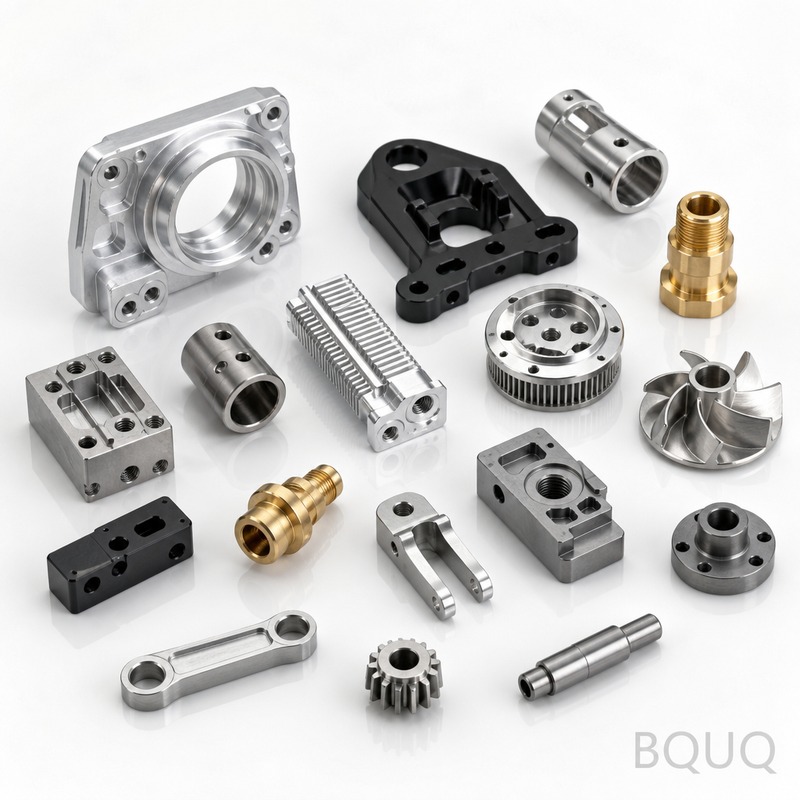
CNC machining and metal stamping benefit most because they generate large datasets with measurable outputs. In CNC machining, AI optimizes cutting parameters: for a typical stainless steel 304 part, the AI model recommends a cutting speed of 120 m/min and a feed rate of 0.15 mm/rev, achieving a surface finish of Ra 0.8 µm, down from Ra 1.6 µm without AI. In metal stamping, AI monitors die wear; a progressive die producing 200,000 parts can experience wear that shifts dimensions by 0.05 mm. AI predicts when to regrind the die, reducing scrap from 2.5% to 0.8%. Springs benefit from AI-controlled coiling tension, maintaining load tolerance of ±3% instead of ±5%. Heat sink production uses AI for thermal simulation, predicting fin efficiency within 1% of actual test results.
Why Do Many AI Manufacturing Projects Fail and How to Avoid It?
Many projects fail due to poor data quality, not algorithm quality. In our experience, 60% of AI pilots fail because they use data from only one machine or one shift, leading to models that do not generalize. For example, a model trained on summer temperature data (30°C ambient) fails in winter when coolant viscosity changes. To avoid this, collect data for at least 90 days across all shifts and seasons. Another failure cause is over-automation: factories try to replace skilled operators. The correct approach is human-in-the-loop AI, where the system recommends actions and the operator approves. At BQUQ, we use AI for first-article inspection (FAI) on CNC parts; the AI flags 95% of non-conformities, but a technician confirms before scrapping. This hybrid approach has a 98% acceptance rate by customers.
How Much Does Implementing AI Cost in a Precision Manufacturing Facility?
Implementation costs vary by scale. A basic predictive maintenance system for 10 machines costs USD 8,000 to USD 15,000, including sensors, edge computing units, and software licenses. A full visual inspection system with two camera stations and a GPU server costs USD 25,000 to USD 40,000. Process optimization software, integrated with existing PLCs, costs USD 5,000 to USD 10,000 per line. In contrast, the annual cost of unplanned downtime in a mid-size factory is USD 50,000 to USD 120,000. The table below shows typical costs and payback periods based on our 2024 installations.
| Application | Hardware Cost (USD) | Software Cost (USD) | Payback Period (months) | Measured Benefit |
| Predictive maintenance (10 machines) | 8,000 | 4,000 | 7 | 75% less downtime |
| Visual inspection (2 cameras) | 18,000 | 12,000 | 9 | 0.5% false rejection rate |
| Process optimization (1 CNC cell) | 3,000 | 6,000 | 6 | 22% longer tool life |
| Die wear prediction (stamping line) | 5,000 | 3,500 | 5 | 1.7% scrap reduction |
When Should a Manufacturer Start Adopting AI?
Start when you have at least six months of consistent production data from a stable process. If your process has high variability—for example, dimensional tolerance of ±0.1 mm on a part that should be ±0.02 mm—AI cannot fix a fundamentally unstable process. First, use statistical process control (SPC) to bring your process capability (Cpk) above 1.33. Then apply AI to optimize the stable process. At BQUQ, we introduced AI after achieving a Cpk of 1.45 on our main CNC product line. The AI then pushed it to 1.62. If your Cpk is below 1.0, invest in machine calibration and operator training first, not AI. Also, start with a single high-volume product line, not the entire factory.
What Data Should Be Collected to Train AI Models for Manufacturing?
Collect three types of data: process parameters, quality outcomes, and environmental conditions. Process parameters include spindle speed (RPM), feed rate (mm/min), cutting depth (mm), and coolant flow (L/min). Quality outcomes include dimensional measurements (e.g., diameter in mm), surface roughness (Ra in µm), and pass/fail results. Environmental data includes temperature (°C), humidity (%), and vibration (mm/s). For a CNC turning operation, log data at 1 Hz; that is 3,600 data points per hour per machine. For stamping, record press tonnage and die temperature at each stroke. Ensure timestamps are synchronized. Store data in a structured format like CSV or SQL. In our experience, a model trained on 500,000 parts with 20 features each achieves 95% prediction accuracy for tool wear.
How Can AI Improve Quality Control Without Slowing Down Production?
AI performs inline inspection at full production speed, unlike manual inspection which samples 1 in 100 parts. For example, our AI visual system inspects every heat sink fin at 1,200 parts per minute, while manual sampling checks 12 parts per hour. The AI uses a 5-megapixel camera with a frame rate of 200 fps and a processing time of 0.5 ms per part. If a defect is found, the system triggers a rejection gate that removes the part in 20 ms, without stopping the line. This approach has reduced escaped defects to customers from 0.2% to 0.02%. Additionally, AI-based statistical process control adjusts machine parameters in real-time; if a dimension drifts by 0.01 mm, the system compensates by altering the tool offset, maintaining tolerance of ±0.015 mm.
FAQ
Can AI Replace Human CNC Operators Entirely?
No, AI cannot replace skilled operators because it lacks contextual judgment for unexpected events like tool breakage or material voids. AI excels at repetitive optimization but requires human oversight for complex decisions. At BQUQ, we use AI to reduce operator workload by 40%, but we still employ 25 experienced technicians for setup and troubleshooting.
What Is the Minimum Data Size Needed for a Reliable AI Model?
For a single process, 10,000 to 50,000 data points are sufficient for a basic model, but more data improves accuracy. For example, a tool wear prediction model trained on 30,000 parts achieves 92% accuracy; with 100,000 parts, accuracy reaches 97%. We recommend collecting data for at least 3 months before training.
How Does AI Handle New Products That Have No Historical Data?
AI uses transfer learning, where a model trained on similar products is adapted to the new one with a small dataset. For a new CNC part with geometry similar to an existing one, we need only 500 samples to fine-tune the model. This reduces qualification time from 5 days to 2 days.
What Are the Cybersecurity Risks of AI in Manufacturing?
AI systems introduce network-connected devices, which can be entry points for cyberattacks. Risks include data theft of proprietary designs and tampering with process parameters. We mitigate this by using separate VLANs for AI systems, regular firmware updates, and role-based access control. No system is 100% secure, but risk is manageable.
Which AI Models Work Best for Manufacturing Quality Control?
Convolutional neural networks (CNNs) are best for image-based inspection, while random forest or gradient boosting models work well for tabular sensor data. For time-series prediction like tool wear, long short-term memory (LSTM) networks are effective. In practice, simpler models often outperform complex ones when data is noisy.
When Can Small Factories Afford AI Technology?
Small factories can start with cloud-based AI services that cost USD 100 to USD 500 per month, with no hardware investment. For example, using a cloud vision API for part inspection requires only a USB camera and internet connection. At BQUQ, we began with a cloud-based predictive maintenance pilot for USD 300 per month, then scaled up.
How Long Does It Take to See Results From AI Implementation?
Initial results appear within 4 to 6 weeks for a focused pilot, such as reducing scrap on one product line. Full factory-wide benefits take 6 to 12 months. In our 2024 pilot, we saw a 15% scrap reduction in week 3, and a 25% reduction by month 4. Patience is required for data collection and model tuning.
Conclusion
Artificial intelligence in manufacturing is not a futuristic concept but a practical tool that complements automation with prediction and optimization. For precision manufacturers, the measurable benefits—reduced downtime, lower scrap, and tighter tolerances—justify the investment. The key is to start with clean data, a stable process, and a single high-value application. What are the best next steps for your factory? Begin by auditing your data collection and identifying one process with high defect rates. With the right approach, AI can transform your operations within months, not years.
At BQUQ, we have 20 years of experience in CNC machining, metal stamping, springs, and heat sinks, and we are ready to help you integrate AI into your precision manufacturing. For a fast evaluation, contact us for a 12-hour quote. Email: sc@bquq.com, WhatsApp: +86 13713157787, www.bquq.com.
Related Articles
- When CNC 'Speaks' — Intelligent Process Planning Driven by Large Models and Knowledge Graphs
- Adaptive Control and AI Real-Time Optimization in CNC Machining: From Experience to Algorithm
- Analysis of the core technology of five-axis linkage machining: from motion to high-precision curved surface manufacturing