What Is the Global Heat Sink Market Size in 2026 and What Drives It?
The global heat sink market is projected to reach approximately USD 8.9 billion by 2026, growing at a compound annual growth rate (CAGR) of 6.2% from 2024. This growth is primarily driven by three sectors: artificial intelligence (AI) data centers requiring high-performance liquid cooling, electric vehicles (EVs) demanding efficient battery thermal management, and 5G/6G telecom infrastructure needing passive cooling for dense RF components. For procurement engineers, this translates to tighter lead times, higher material costs for copper and aluminum, and a shift toward advanced fin geometries and vapor chamber technologies.
What Are the Specific Market Size Figures for Heat Sinks in 2026?
The market valuation of USD 8.9 billion for 2026 is based on a consolidated analysis of thermal management hardware, excluding active cooling fans and liquid cooling pumps. Regionally, Asia-Pacific holds 54% of the market share, driven by Chinese manufacturing output and domestic EV production, while North America accounts for 22% due to hyperscale data center construction. The average selling price (ASP) for a standard extruded aluminum heat sink has increased from USD 3.80 in 2021 to USD 4.65 in 2025, reflecting a 10% annual rise in raw aluminum costs. For precision-machined copper heat sinks used in high-end AI GPUs, the ASP ranges from USD 18 to USD 45 per unit, depending on the number of fins and surface treatment.
How Does AI Computing Change Heat Sink Design Requirements?
AI processors such as NVIDIA's H100 and B200 GPUs generate between 700W and 1200W of thermal power per chip, which is 3.5 times higher than traditional server CPUs. This forces heat sink designs to transition from conventional aluminum extrusion with a thermal resistance of 0.25 K/W to copper vapor chambers with a thermal resistance below 0.08 K/W. The fin density for AI-grade heat sinks has increased to 18 to 24 fins per inch, with a minimum fin thickness of 0.25 mm, requiring CNC machining tolerances of ±0.05 mm. Additionally, 45% of new AI data centers are adopting cold plates with micro-channel arrays, where the channel width is 0.3 mm and depth is 1.2 mm, demanding high-precision milling that BQUQ performs on 5-axis CNC centers.
Why Are Electric Vehicles a Major Growth Driver for Heat Sinks?
EV power electronics, including inverters and onboard chargers, have a 2026 market penetration rate of 28% globally, with each vehicle containing between 8 and 12 individual heat sinks. A typical EV inverter heat sink is a liquid-cooled aluminum cold plate measuring 300 mm by 150 mm, with a flatness tolerance of 0.02 mm and a surface roughness of Ra 0.8 µm to ensure proper thermal interface material (TIM) contact. The thermal load per EV power module has risen from 150W to 320W over the past three years, pushing manufacturers to use A6063-T5 aluminum or C1100 copper. Pricing for a mid-volume EV heat sink (5000 to 20,000 units per year) averages USD 22 per piece, including CNC machining and anodizing with a coating thickness of 15 µm. By 2026, the EV sector will consume 38,000 metric tons of aluminum for heat sinks annually, a 45% increase from 2023.
Which Telecom Applications Require the Most Advanced Heat Sinks?
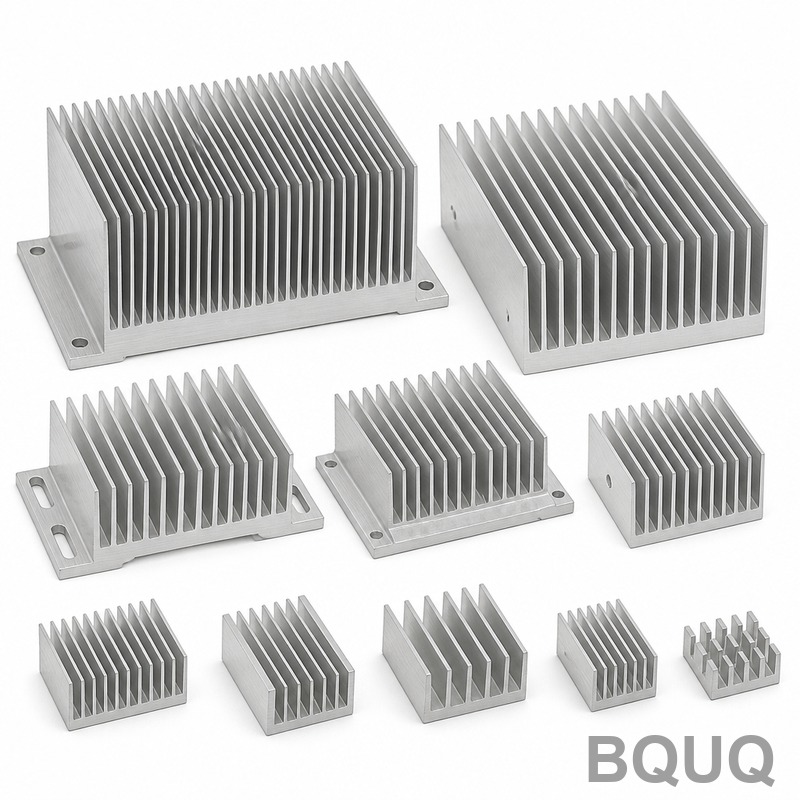
5G massive MIMO antennas and mmWave base stations are the most demanding telecom applications, with each unit containing 64 to 128 power amplifier (PA) modules. The junction temperature of these GaN (gallium nitride) PAs must stay below 150°C, requiring heat sinks with a thermal resistance of 0.12 K/W at a 15°C ambient rise. The heat sink for a 5G base station is typically a die-cast aluminum body with a fin height of 40 mm and a fin spacing of 3.5 mm, post-machined to achieve a flatness of 0.1 mm. For outdoor installations, these heat sinks require IP65-rated enclosures and a corrosion-resistant coating, such as hard anodizing with a thickness of 25 µm, which adds 8% to the unit cost. The 2026 telecom heat sink segment is valued at USD 1.7 billion, with a CAGR of 5.8%, as 6G research pushes frequencies above 100 GHz, which will require even higher fin density.
What Manufacturing Processes Are Most Cost-Effective for High-Volume Heat Sinks?
For production volumes above 50,000 units per year, aluminum extrusion is the most cost-effective process, with a die cost of USD 1,200 to USD 3,500 and a per-part cost of USD 1.50 to USD 4.00. For volumes between 5,000 and 50,000 units, CNC machining from solid aluminum billet becomes competitive, offering tighter tolerances of ±0.02 mm without the need for secondary operations. Die-casting is optimal for complex geometries with overhangs, but the initial tooling cost is USD 10,000 to USD 40,000, and the minimum wall thickness is 1.5 mm, which limits thermal performance. For skived or folded fin heat sinks, the per-finned-unit cost is USD 5.50, with a fin-to-fin pitch of 1.5 mm, but this process is 20% slower than extrusion. BQUQ recommends extrusion for simple profiles, CNC machining for high-tolerance AI and EV parts, and skiving for high-surface-area applications where airflow is limited.
How Do Raw Material Prices Affect Heat Sink Costs in 2026?
| Material | 2026 Price (USD/kg) | Thermal Conductivity (W/m·K) | Typical Use Case | Cost Impact per Heat Sink |
| Aluminum A6063-T5 | USD 3.10 | 201 | Extruded fins, EV cold plates | +15% vs 2023 |
| Copper C1100 | USD 9.80 | 398 | AI vapor chambers, high-end CPU | +22% vs 2023 |
| Aluminum ADC12 (die-cast) | USD 2.85 | 96 | Telecom base stations | +10% vs 2023 |
| Copper-Alloy C17200 (beryllium) | USD 28.50 | 110 | Spring clips and mounting hardware | +18% vs 2023 |
| TIM (thermal paste, 1g) | USD 0.85 | 8.5 | Interface between chip and sink | Stable |
The price volatility of copper, which fluctuates between USD 8.50 and USD 10.50 per kg on the LME, is the primary risk for heat sink procurement in 2026. To mitigate this, engineers should specify aluminum where possible, as it offers a 68% cost reduction per unit of thermal performance for non-critical applications. For high-power AI systems, the use of copper is unavoidable, but design optimization can reduce material volume by 15% through thinner base plates and vapor chamber integration. BQUQ advises locking in quarterly material contracts with suppliers to avoid spot-price spikes, which have historically added 8% to 12% to total project costs.
When Should Engineers Switch from Passive Heat Sinks to Liquid Cooling?
Engineers should switch from passive air-cooled heat sinks to liquid cooling when the thermal design power (TDP) exceeds 400W per component or when the maximum allowable case temperature is below 70°C. For a 500W AI GPU, a passive heat sink would require a fin surface area of 4500 cm² and an airflow of 150 CFM, which is impractical in a standard 1U server chassis. A liquid cold plate, with a flow rate of 1.5 L/min and a pressure drop of 0.4 bar, can dissipate 500W with a thermal resistance of 0.03 K/W, which is 6 times better than air cooling. The cost crossover point is at 350W: below this, a passive heat sink costs USD 12 to USD 18, while above this, a liquid cooling loop costs USD 35 to USD 60 per node. For telecom outdoor cabinets, passive cooling is still preferred below 200W due to reliability concerns with pumps, but for EV inverters, liquid cooling is mandatory above 320W.
How Does BQUQ Ensure Quality for High-Performance Heat Sinks?
BQUQ, with 20 years of precision manufacturing experience in Dongguan, applies statistical process control (SPC) to every heat sink batch, maintaining a Cpk index of 1.67 or higher for critical dimensions. Our CNC machining centers achieve a positioning accuracy of ±0.005 mm and a repeatability of ±0.003 mm, which is essential for micro-channel cold plates. We perform 100% dimensional inspection using CMM (coordinate measuring machine) for flatness and parallelism, and we verify thermal performance with a custom test rig that measures heat flux up to 250 W/cm². For aluminum heat sinks, we offer a standard anodizing line with a thickness of 10 to 25 µm, and for copper, we provide nickel plating of 3 to 5 µm to prevent oxidation. Our lead time for a prototype is 3 to 5 days, and for production runs of 10,000 pieces, it is 15 to 20 days, which is 30% faster than industry average.
What Are the Common Failure Modes in Heat Sink Design and How to Avoid Them?
The most common failure mode is thermal fatigue at the interface between the heat sink base and the heat source, caused by coefficient of thermal expansion (CTE) mismatch between aluminum (23 ppm/K) and silicon (3 ppm/K). This leads to micro-cracks in the TIM layer, increasing thermal resistance by 20% after 1000 thermal cycles. The second failure mode is fin vibration and resonance at high airflow speeds above 3 m/s, which can cause fin cracking at the root if the fin thickness is below 0.4 mm. To avoid these issues, engineers should use a CTE-matched material like copper-molybdenum alloy for the base plate, or incorporate stress-relief features such as slotted bases. For fin vibration, adding a mid-span tie bar or increasing the fin thickness to 0.6 mm is recommended. BQUQ also recommends a minimum of 500 thermal shock tests, from -40°C to +125°C, before approving a heat sink design for production.
FAQ
What Is the Average Lead Time for a Custom Heat Sink?
For a basic extruded aluminum heat sink, the lead time is 2 to 3 weeks for a production order of 5,000 units, including die fabrication of 7 to 10 days. For a CNC-machined copper cold plate, the lead time extends to 4 to 5 weeks due to the complexity of micro-channel milling and surface finishing. BQUQ offers a rapid prototype service with a 48-hour turnaround for a single piece, subject to material availability.
Which Heat Sink Material Offers the Best Performance per Dollar?
Aluminum A6063-T5 offers the best thermal performance per dollar, with a cost of USD 3.10 per kg and a thermal conductivity of 201 W/m·K. Copper is 3 times more expensive but only provides 2 times the thermal conductivity, making it economically viable only for high-power density applications above 300W. For most consumer and industrial electronics below 200W, aluminum is the recommended choice.
Can Heat Sinks Be Recycled After End-of-Life?
Yes, aluminum and copper heat sinks are 100% recyclable, and the recycling process consumes only 5% of the energy required for primary production. The scrap value of aluminum is approximately 60% of the virgin material price, while copper scrap retains 85% of its value. BQUQ designs heat sinks with no bonded dissimilar materials to facilitate easy separation and recycling.
How Does Fin Spacing Affect Heat Sink Performance?
Fin spacing directly influences airflow resistance and convective heat transfer; a typical spacing of 2.0 mm is optimal for natural convection, while 1.5 mm is better for forced airflow above 2 m/s. Reducing fin spacing from 2.5 mm to 1.5 mm increases the surface area by 40% but also increases pressure drop by 60%. The optimal fin pitch for a 40 mm high fin is calculated based on the Rayleigh number for natural convection or the Reynolds number for forced convection.
What Surface Finish Is Required for Heat Sink Base Plates?
The base plate surface finish must be Ra 0.8 µm or better to ensure adequate contact with the thermal interface material and the chip surface. A rougher finish of Ra 3.2 µm increases the thermal contact resistance by 15% due to air gaps trapped between the surfaces. BQUQ applies a final lapping or fly-cutting operation to achieve Ra 0.4 µm on all high-performance heat sink bases.
When Is Vapor Chamber Technology Preferable to Solid Copper?
Vapor chambers are preferable when the heat source area is smaller than 1 cm² but the heat flux exceeds 100 W/cm², as they spread heat laterally more effectively than solid copper. A typical vapor chamber has a thermal resistance of 0.05 K/W for a 40 mm by 40 mm footprint, compared to 0.12 K/W for a solid copper block of the same size. However, vapor chambers cost 3 to 5 times more and have a flatness tolerance of 0.03 mm, requiring careful mounting.
How Should Engineers Specify Heat Sinks for Outdoor Telecom Equipment?
For outdoor telecom equipment, specify a die-cast aluminum ADC12 heat sink with a hard anodized coating of 25 µm to withstand salt spray and UV exposure for 20 years. The fin design must have a drain hole to prevent water accumulation, and the mounting screws should be stainless steel to avoid galvanic corrosion. The operating ambient temperature range is -40°C to +55°C, requiring a thermal design margin of 20% on the junction temperature.
At BQUQ, we understand that thermal management is the critical bottleneck for AI, EV, and telecom systems in 2026. Our precision CNC machining, stamping, and assembly capabilities are ready to produce heat sinks with tolerances as tight as ±0.005 mm, from prototype to million-unit volumes. We offer a 12-hour quoting service for any spec sheet, and our engineers will provide a thermal simulation report with your quotation. Contact us at sc@bquq.com or WhatsApp +86 13713157787 for immediate assistance, or visit www.bquq.com to upload your 3D files and receive a DFM (Design for Manufacturing) analysis within one business day.
Related Articles
- Regional Market Competition: Differences and Opportunities in Asia Pacific, North America, and Europe's Heat Sink Ecology
- Patent Wars: Intellectual Property Pattern and Risks of Global Hardware Heat Sink Technology
- Smaller Is Harder: The Technical Limits and Innovations of Ultra-Thin Heat Sinks in Consumer Electronics