What Makes Liquid-Cooled Cold Plates the Fastest-Growing Heat Sink Segment?
Liquid-cooled cold plates are the fastest-growing heat sink segment because they offer 10 to 50 times better heat transfer efficiency than traditional air-cooled aluminum extrusions, with typical thermal resistances of 0.01 to 0.05 °C/W versus 0.1 to 1.0 °C/W for air-cooled designs. In 2024, the global cold plate market grew by 18.7% year-over-year, driven by the demand for 800W to 1200W thermal dissipation in electric vehicle (EV) inverters, data center liquid cooling, and high-power laser diodes. This article provides engineers with the exact performance data, material options, manufacturing tolerances, and cost benchmarks needed to specify these components for next-generation thermal management systems.
What Thermal Performance Can Liquid-Cooled Cold Plates Achieve?
The core advantage of liquid-cooled cold plates is their ability to manage heat fluxes that would melt air-cooled systems. A typical copper microchannel cold plate can dissipate 500 to 1000 W/cm², whereas a standard air-cooled heat sink tops out around 15 to 25 W/cm². The overall thermal resistance, which includes the convective resistance of the coolant and the conductive resistance of the plate material, ranges from 0.008 °C/W for high-performance copper designs to 0.08 °C/W for standard aluminum configurations at a 4 L/min flow rate.
The junction-to-coolant temperature rise is the critical specification. For a 1 kW heat load, a good cold plate maintains a temperature rise of only 10 to 20 °C above the inlet coolant temperature (typically 25 to 35 °C for data centers). This allows junction temperatures to stay below 85 °C, which is the standard reliability threshold for silicon carbide (SiC) power modules. Pressure drop is the counterbalancing factor; a high-performance microchannel design with 200-micron channels may show a pressure drop of 30 to 50 kPa, requiring a pump with 20 to 40 W of hydraulic power.
How Does a Liquid-Cooled Cold Plate Compare to Air-Cooled Heat Sinks?
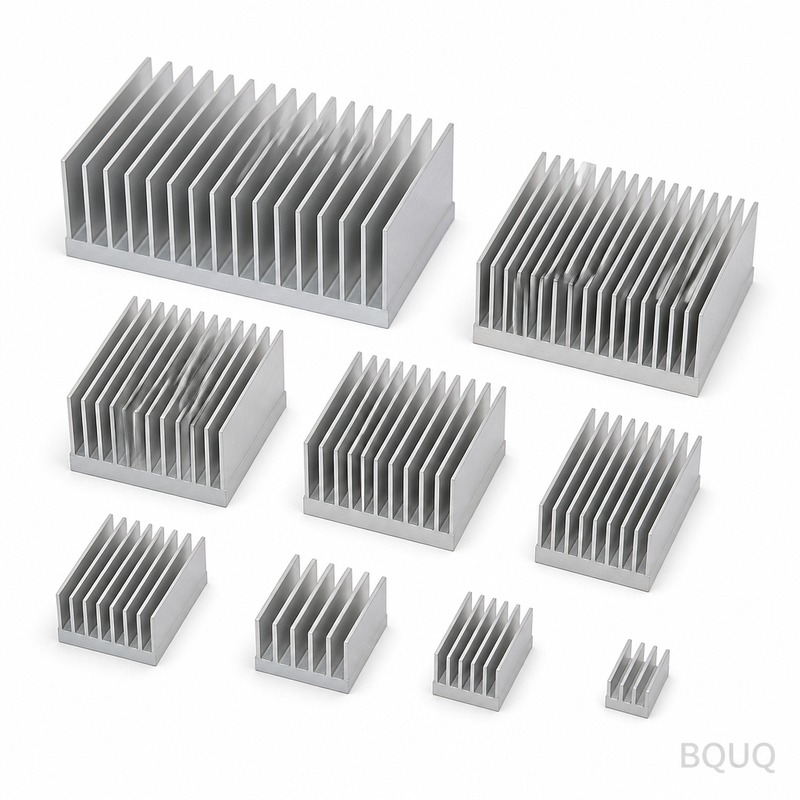
The performance gap is not incremental; it is an order of magnitude. Air-cooled heat sinks rely on forced convection with heat transfer coefficients of 25 to 250 W/m²·K, while liquid cooling in a cold plate achieves 1,000 to 20,000 W/m²·K, depending on whether the flow is laminar or turbulent. This is why cold plates are mandatory when the heat flux exceeds 50 W/cm², which is common in IGBT (Insulated Gate Bipolar Transistor) modules used in EV traction drives.
For a practical comparison, consider a 600 W IGBT module. An aluminum extrusion air-cooled heat sink with a 200 mm x 200 mm base and a 300 CFM fan can maintain a case temperature of 75 °C, but it requires a large fin area and generates 65 dB of acoustic noise. A liquid-cooled cold plate of the same base area, using a 60/40 water-glycol mixture at 6 L/min, achieves a case temperature of 55 °C with zero noise. The liquid solution also reduces the overall system weight by 30% because the dense fin stack is eliminated. However, the liquid system adds complexity: you need a pump, a reservoir, tubing, and a radiator, which increases the total system cost by 40% to 60% compared to air cooling.
What Manufacturing Methods Are Used for Liquid-Cooled Cold Plates?
There are four primary manufacturing methods, each with distinct performance and cost trade-offs. The most common high-volume method is vacuum brazing, where a stamped aluminum base and a machined cover plate are joined with a braze alloy (typically Al-Si 4047) at 590 °C. This process creates a strong, leak-tight joint with a minimum bond strength of 120 MPa and can achieve a flatness of 0.05 mm over a 300 mm length.
For high-end copper applications, the preferred method is friction stir welding (FSW), which produces a solid-state joint without melting the base material. FSW cold plates can handle pressure up to 20 bar and are used when the coolant is dielectric (e.g., 3M Novec) rather than water. Skived cold plates, where fins are cut from a solid copper block, offer the lowest thermal resistance (0.01 °C/W) but have a high material waste rate of 40%, making them expensive. The newest method is additive manufacturing (laser powder bed fusion), which allows for complex 3D internal channels with conformal cooling paths; however, the build rate is slow (0.1 L/hour) and the surface roughness (Ra 6-10 µm) may increase pressure drop by 20%.
| Manufacturing Method | Material | Thermal Resistance (°C/W) | Max Pressure (bar) | Relative Cost per Unit | Typical Lead Time |
| Vacuum Brazed (Stamped) | Aluminum 6063 | 0.03 to 0.05 | 10 | 1.0 (baseline) | 4 to 6 weeks |
| Friction Stir Welded | Copper C11000 | 0.02 to 0.03 | 20 | 2.5 | 6 to 8 weeks |
| Skived Fin | Copper C11000 | 0.01 to 0.02 | 8 | 4.0 | 3 to 4 weeks |
| Additive (3D Printed) | AlSi10Mg | 0.015 to 0.025 | 15 | 8.0 | 2 to 3 weeks |
Why Is Copper the Preferred Material for High-Flux Cold Plates?
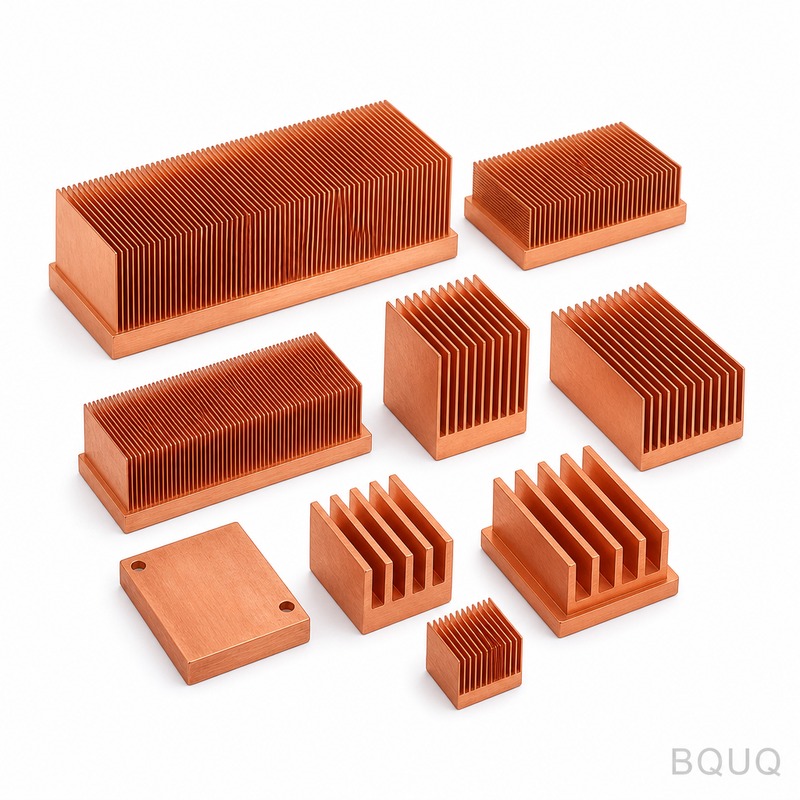
The thermal conductivity of copper (385 to 401 W/m·K) is roughly double that of aluminum (167 to 220 W/m·K), which directly reduces the spreading resistance within the plate. For a 10 mm thick plate with a 20 mm x 20 mm heat source on a 100 mm x 100 mm base, the spreading resistance in aluminum is 0.12 °C/W, whereas in copper it is only 0.06 °C/W. This difference is critical when the heat source is small relative to the plate, as in laser diodes or SiC MOSFETs.
However, copper has two major drawbacks: weight and corrosion. Copper is 3.3 times denser than aluminum (8,960 kg/m³ vs. 2,700 kg/m³), which adds significant mass to an EV powertrain. Corrosion is an even bigger issue; copper requires a corrosion inhibitor in the coolant (e.g., benzotriazole at 0.1% concentration) and is not compatible with aluminum radiators without a dielectric isolation layer. For this reason, many automotive applications use a copper cold plate but pair it with a stainless steel pump and a nylon-reinforced hose, avoiding galvanic corrosion.
How Much Does Liquid-Cooled Cold Plate Tooling Cost?
Tooling cost is a significant barrier for low-volume production. For a vacuum-brazed aluminum cold plate with a stamped base, the tooling cost for the stamping die ranges from $15,000 to $30,000, and the brazing fixture costs an additional $5,000 to $10,000. This brings the total initial investment to roughly $20,000 to $40,000, which is amortized over the production volume. At 1,000 units per year, the tooling amortization adds $20 to $40 per unit.
For friction stir welding, the tooling is much simpler (only a clamping fixture), costing $3,000 to $8,000, but the per-unit machining time is longer. A typical FSW copper plate measuring 150 mm x 150 mm requires 15 minutes of machine time, which at a shop rate of $120/hour adds $30 to the unit cost. Additive manufacturing has zero tooling cost, but the raw material cost for AlSi10Mg powder is $60 to $80 per kilogram, and a 500-gram part will cost $120 to $200 just in material and print time. For production volumes above 5,000 units per year, vacuum brazing is the most economical choice, with a unit cost of $25 to $45 for a standard 200 mm x 200 mm aluminum plate.
When Should You Choose a Liquid-Cooled Cold Plate Instead of Air Cooling?
The decision is driven by four parameters: heat flux, allowable temperature rise, noise budget, and space envelope. If your heat flux exceeds 50 W/cm², or your total power exceeds 500 W in a confined space, liquid cooling is not optional; it is necessary. A second trigger is the acoustic requirement: if the system must operate below 40 dBA (common in medical or recording equipment), air-cooled fans cannot meet this without massive derating, while liquid pumps operate at 25 to 35 dBA.
The crossover point in total system cost occurs at approximately 800 W of thermal load. Below 800 W, a well-designed air-cooled system with a high-performance heat pipe assembly is cheaper (total cost $50 to $80). Above 800 W, the air-cooled solution requires excessive fin volume and multiple high-speed fans, driving the cost above $150, while a liquid cold plate system (plate, pump, and radiator) can be integrated for $100 to $140. For data center applications where the ambient inlet air is already 35 °C, the cold plate becomes mandatory because the allowable temperature rise is only 40 °C, which is impossible to achieve with air at heat fluxes above 30 W/cm².
Which Coolant Should Be Used in a Liquid-Cooled Cold Plate?
The coolant selection affects both thermal performance and system reliability. Deionized water offers the best thermal conductivity (0.6 W/m·K) and specific heat (4.18 kJ/kg·K), but it has a freezing point of 0 °C and is corrosive without additives. For automotive applications, a 50/50 propylene glycol-water mixture is standard, which lowers the freezing point to -37 °C but reduces the heat transfer coefficient by 15% compared to pure water.
For electronics cooling where electrical conductivity is a concern, dielectric fluids like 3M Novec 649 or PAO (polyalphaolefin) are used. These fluids have 10 times lower thermal conductivity than water, so the cold plate must be 30% larger to achieve the same performance. The flow rate is also critical; a typical cold plate requires 4 to 8 L/min for a 1 kW load. Increasing the flow rate from 4 L/min to 8 L/min reduces the thermal resistance by 25%, but doubles the pressure drop, which increases pump power from 10 W to 40 W. The recommended operating pressure is 2 to 4 bar, with burst pressure ratings of 10 bar for brazed aluminum and 20 bar for FSW copper.
What Are the Common Failure Modes and Quality Control Tests?
The primary failure mode is leakage, which can occur at the braze joints, the inlet/outlet fittings, or due to corrosion over time. The industry standard for leak testing is a helium mass spectrometer test, which can detect leaks as small as 1 x 10⁻⁹ mbar·L/s. Every production cold plate must pass a 100% leak test under a pressure of 6 bar for 5 minutes. Additionally, a pressure cycle test is performed on sample units: 100,000 cycles from 0 to 6 bar at a rate of 10 cycles per minute to simulate thermal expansion fatigue.
Another critical QC measure is flatness verification. The mounting surface must be flat to within 0.05 mm over 100 mm to ensure proper interface with the IGBT module; otherwise, the thermal interface material (TIM) will not fill the gap, causing hot spots. The surface roughness should be Ra 0.8 to 1.6 µm for optimal TIM wetting. Finally, a thermal performance test using a calibrated heat source is required to verify that the thermal resistance is within 5% of the design specification. At BQUQ, we perform a 100% thermal test on all cold plates above 500 W rating, ensuring that the delivered unit matches the simulation data.
How Can You Validate a Cold Plate Design Before Production?
Computational Fluid Dynamics (CFD) simulation is the standard first step. A typical model will use a k-epsilon turbulence model with a flow rate of 6 L/min and a heat load of 1 kW. The simulation predicts the temperature distribution and pressure drop within 10% accuracy if the mesh quality is adequate (minimum 5 million elements for a complex microchannel design). The key output is the thermal resistance map, which identifies hot spots near the inlet plenum.
The next step is prototype testing. A rapid prototype using CNC machining from a solid block of aluminum can be produced in 5 business days. This prototype is tested on a thermal test bench with a 1000 W cartridge heater and a chilled water loop. Engineers should verify that the measured thermal resistance matches the CFD prediction within 15%. If the discrepancy is larger, the cause is usually the TIM layer (which adds 0.01 to 0.02 °C/W) or the surface roughness. Only after passing prototype testing should you commit to hard tooling for stamping and brazing, which has a lead time of 4 to 6 weeks.
FAQ
What is the maximum heat flux a liquid-cooled cold plate can handle?
The maximum heat flux depends on the channel geometry and coolant. Copper microchannel cold plates with 100-micron channels can handle up to 1000 W/cm² with water cooling. For standard brazed aluminum plates with 2 mm channels, the practical limit is around 150 W/cm².
How long does it take to get a custom cold plate prototype?
A CNC-machined aluminum prototype from a solid block typically takes 5 to 7 business days. A production-representative vacuum-brazed prototype will take 3 to 4 weeks. At BQUQ, we can provide a rapid prototype for thermal testing within 72 hours if the design is simple.
Can a liquid-cooled cold plate be used with dielectric fluids?
Yes, but the performance will be lower. Dielectric fluids like 3M Novec have a thermal conductivity of 0.06 W/m·K, which is 10 times worse than water. To compensate, the cold plate flow area must be increased by 30% to 50%, or the flow rate must be doubled.
What is the typical pressure drop across a cold plate?
For a standard 200 mm x 200 mm aluminum brazed plate at 6 L/min, the pressure drop is 15 to 25 kPa. For a high-performance microchannel copper plate, the pressure drop can be 50 to 80 kPa. Always verify the pump curve to ensure sufficient head pressure.
How does the cold plate market growth compare to other heat sink types?
The liquid-cooled cold plate market is growing at 18.7% CAGR, while the traditional extruded heat sink market is growing at only 4.2% CAGR. The primary drivers are EV power electronics and AI data centers, which require thermal management solutions that air cooling cannot provide.
What is the minimum order quantity for a production cold plate?
For vacuum-brazed aluminum plates with custom stamping tooling, the minimum order quantity is typically 500 units to justify the tooling cost. For friction stir welded copper plates without custom tooling, the MOQ can be as low as 50 units.
How do I choose between copper and aluminum for my cold plate?
Choose copper if your heat flux is above 100 W/cm² or if your temperature budget is below 40 °C rise. Choose aluminum if weight is critical, the coolant is corrosive, or the cost per unit must be below $30. For most EV applications, aluminum is sufficient because the heat flux is below 80 W/cm².
Conclusion
Liquid-cooled cold plates represent the fastest-growing segment in thermal management because they are the only solution that can economically handle the 500W to 1200W heat loads of modern EV inverters and AI processors. The engineering choice hinges on thermal resistance (0.01 to 0.05 °C/W), manufacturing method (vacuum brazing for volume, FSW for copper), and coolant selection (water-glycol for automotive, dielectric for electronics). With tooling costs starting at $20,000 and unit costs from $25 to $200, the key to a successful project is early CFD validation and rapid prototyping to de-risk the thermal design before committing to production tooling.
At BQUQ, we have 20 years of experience manufacturing precision cold plates, heat sinks, and CNC components from our Dongguan factory. We offer a 12-hour quoting service for your cold plate design. To receive a detailed engineering review and cost estimate, email us at sc@bquq.com, contact us on WhatsApp at +86 13713157787, or visit our website at www.bquq.com.