What Precision Engineering Demands Are Driving Electric Vehicle Manufacturing?
Electric vehicle (EV) manufacturing demands precision engineering at unprecedented levels, specifically requiring tolerances of ±0.005 mm for motor components and ±0.01 mm for battery enclosure sealing surfaces to ensure efficiency and safety. This surge is driven by the need for high-voltage component reliability, thermal management accuracy, and the lightweight structural integrity that directly impacts vehicle range and crashworthiness. Unlike internal combustion engine (ICE) vehicles, EVs require tighter control over material properties and geometric consistency across aluminum, copper, and advanced steel alloys to manage thermal expansion and electromagnetic interference.
What Tolerances Are Required for EV Motor and Battery Components?
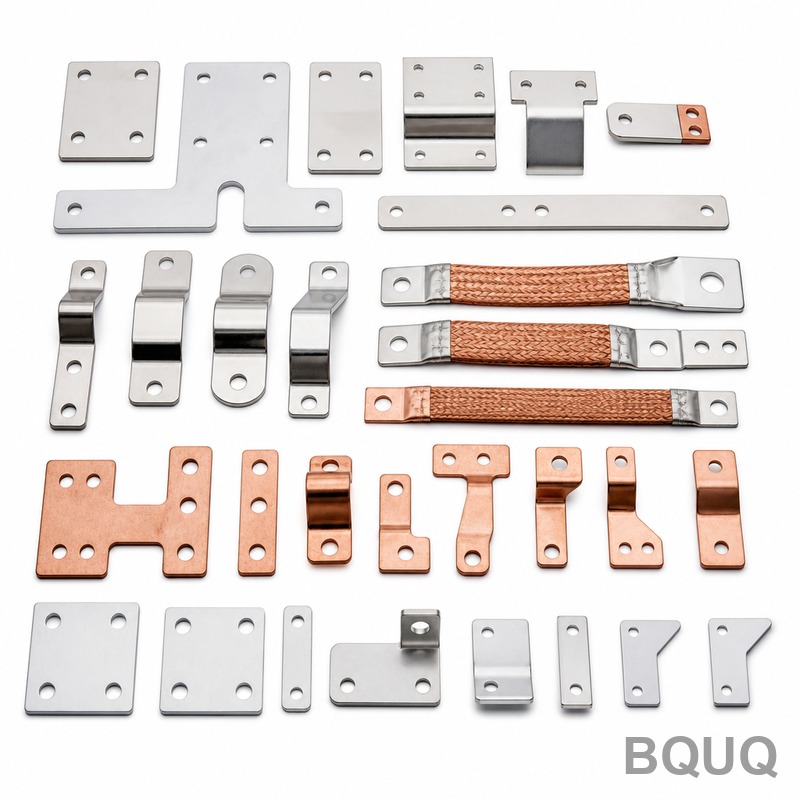
The shift to electric powertrains has reset tolerance standards. For EV drive motors, the stator and rotor laminations require stamping tolerances of ±0.02 mm to minimize air gap variation, which directly affects motor efficiency and torque ripple. Battery enclosures, typically machined from 6061-T6 aluminum, demand flatness tolerances of ±0.05 mm across 500 mm lengths to ensure a proper seal against coolant ingress and to prevent stress fractures on welded seams. CNC machined busbars and connector terminals for high-voltage systems require hole positioning accuracy within ±0.01 mm to prevent arcing and ensure consistent current flow at 800 V architectures.
How Does Thermal Management Precision Affect Battery Performance?
Lithium-ion battery performance degrades rapidly outside the 20°C to 35°C operating window, making thermal management a primary precision driver. Liquid cooling plates, CNC machined with micro-channel widths of 0.4 mm ±0.05 mm, are critical for heat dissipation. The machining of these channels requires a surface finish of Ra 0.8 µm to prevent turbulence and pressure drops that would starve the upper cells of coolant. In our experience, a 5% variation in channel cross-section can lead to a 15% reduction in cooling efficiency, which causes uneven cell aging and a 10% loss in usable range within 500 charge cycles. Precision machining of the cold plate interface to the battery module must achieve a coplanarity of 0.03 mm to ensure uniform thermal contact resistance.
Why Is Material Selection Critical for EV Structural Components?
Material selection in EV manufacturing is a precision engineering challenge because the materials must satisfy conflicting requirements: high strength, low weight, and excellent thermal conductivity. For battery housings, we commonly machine 6000-series aluminum alloys due to their weldability and corrosion resistance, but the material requires precise heat treatment to achieve a yield strength of 240 MPa without warping during machining. High-voltage busbars are increasingly switching from copper to aluminum-clad copper to save weight, but this requires precision cladding thickness control of ±0.02 mm to prevent hot spots. Additionally, the use of advanced high-strength steel (AHSS) in the chassis, stamped at tolerances of ±0.1 mm, is essential for maintaining crash energy absorption pathways that protect the battery pack in a side-impact collision.
What Are the Cost Implications of Tighter EV Tolerances?
Tighter EV tolerances directly increase manufacturing cost, but the trade-off is necessary for safety and warranty reduction. A standard CNC machined part for an ICE vehicle might hold a tolerance of ±0.1 mm, costing roughly $15 per unit; the same part for an EV battery busbar requires ±0.01 mm, increasing the cost to $28 per unit due to additional inspection and slower spindle speeds. Tooling costs for EV-specific metal stampings are 20-30% higher because they require D2 tool steel hardened to 60-62 HRC to maintain edge quality over 500,000 hits without burr formation exceeding 0.03 mm. The following table outlines typical price and lead time differences we observe at BQUQ for EV versus traditional automotive components:
| Component Type | Tolerance Requirement | Unit Price (USD) | Tooling Cost (USD) | Lead Time (Weeks) |
| Stamped Motor Lamination | ±0.02 mm | $0.85 | $18,500 | 4 |
| CNC Machined Battery Enclosure | ±0.05 mm | $145.00 | $6,200 | 3 |
| Stamped Chassis Bracket | ±0.15 mm | $2.40 | $9,800 | 5 |
| CNC Machined Cooling Plate | ±0.04 mm | $78.00 | $4,500 | 2 |
| Stamped Copper Busbar | ±0.01 mm | $5.60 | $12,000 | 4 |
| CNC Machined Motor Housing | ±0.02 mm | $210.00 | $8,900 | 6 |
How Is Quality Inspection Evolving to Verify EV Precision?
Traditional statistical process control is insufficient for EV safety-critical components; we now employ 100% inspection for dimensions affecting high-voltage isolation. Coordinate measuring machines (CMM) are used to verify datums, but for high-volume stampings, inline optical scanners with 0.005 mm resolution are required to check for micro-burrs that could puncture battery separators. For hermetic seals on battery lids, we utilize helium leak testing with a rejection threshold of 1 x 10⁻⁶ mbar·L/s, which is 100 times stricter than standard automotive fuel system testing. Furthermore, surface roughness profilometers are used to verify Ra values on machined sealing surfaces, as a deviation from Ra 0.4 µm to Ra 0.8 µm can cause micro-leakage paths under vibration.
Which Manufacturing Processes Are Seeing the Highest Demand Surge?
CNC machining and precision metal stamping are experiencing the highest demand surge, driven by distinct EV needs. CNC machining is essential for low-volume, high-complexity parts like inverter housings and gearbox components, where we see a 40% year-over-year increase in orders for 5-axis machining to handle complex undercuts. Metal stamping is surging for high-volume motor cores and structural brackets, with a 35% increase in demand for high-speed stamping presses capable of 800 strokes per minute while maintaining die protection systems. Additionally, precision spring manufacturing is critical for contactors and battery disconnect switches, requiring force tolerances of ±3% to ensure reliable engagement at high DC voltages.
Can Precision Engineering Overcome EV Thermal Runaway Risks?
Precision engineering is the primary defense against thermal runaway, which occurs when a cell temperature exceeds 150°C and triggers exothermic decomposition. CNC machined venting channels in the battery pack must have a cross-sectional accuracy of ±0.02 mm to guarantee that hot gases are directed away from adjacent cells within 50 milliseconds of a pressure spike. The precision fit of the ceramic-to-metal seals in battery current interrupt devices requires machining tolerances of ±0.005 mm to contain internal pressures up to 10 bar without cracking. Furthermore, the thermal interface material applied between the cell and cooling plate must be controlled in thickness to a variance of ±0.05 mm; this is achieved through precision shim machining, ensuring that hot spots are eliminated and the pack stays below the 60°C limit even during fast charging.
What Lead Times Are Realistic for EV Precision Components?
Realistic lead times for EV precision components at BQUQ range from 2 to 6 weeks depending on complexity and material availability. Prototype CNC machined parts for inverter housings can be delivered in 5-7 business days using 7075 aluminum, but production tooling for stamping motor laminations requires 4-5 weeks due to the wire EDM and grinding processes needed for die fabrication. For production runs exceeding 10,000 units, we recommend initiating tooling early, as the first article inspection report (FAIR) process alone can take 3 days to validate critical dimensions against the CAD model. We suggest adding a 15% buffer to the quoted lead time for the first production batch to accommodate process validation and supplier material certifications.
Frequently Asked Questions
What Is the Difference Between EV and ICE Machining Tolerances?
EV components generally require tolerances twice as tight as ICE components, especially for sealing surfaces and electrical connections. While an ICE cylinder head might require a flatness of 0.05 mm, an EV battery cold plate requires 0.02 mm to prevent coolant leaks. This shift requires more expensive machine tools and more frequent probing cycles.
How Do I Choose Between CNC Machining and Stamping for EV Parts?
Choose CNC machining for quantities under 5,000 units or when the part has complex 3D geometry and tight corner radii. Choose metal stamping for quantities above 20,000 units where the part is 2D or has simple bends, as the per-unit cost drops significantly after tooling amortization. For medium volumes, we often recommend a hybrid approach using CNC machining for prototyping and stamping for final production.
Are There Specific Certifications Required for EV Suppliers?
Yes, most tier-1 EV manufacturers require IATF 16949 certification for quality management systems. Additionally, you should expect requirements for CQI-9 (heat treating) and CQI-11 (plating) if your parts undergo those processes. BQUQ maintains these certifications and regularly audits our processes for high-voltage safety standards like ISO 6469.
How Does High-Volume Production Affect Precision Consistency?
High-volume production introduces tool wear, which can cause drift in critical dimensions. We combat this by integrating in-die sensors for stamping and on-machine probing for CNC that automatically compensate for tool wear every 100 cycles. This ensures that the 100,000th part is as precise as the first, maintaining a CpK value above 1.67 for all safety-critical features.
What Is the Typical Cost of a Precision Die for EV Stamping?
A precision progressive die for an EV motor lamination costs between $18,000 and $45,000, depending on the number of stations and the required tolerance. A simpler die for a chassis bracket costs around $9,000. The higher cost reflects the use of powder metallurgy steel and the precision grinding required to achieve a punch-to-die clearance of 5% of material thickness.
When Should I Use Aluminum Versus Copper for EV Busbars?
Use aluminum busbars for weight reduction when the current density is low and the operating temperature is below 100°C. Use copper busbars when you need higher conductivity or when the connection point is in a high-heat zone, such as near the inverter. Precision machining of aluminum requires chip-breaking features to prevent burrs that can cause short circuits.
How Can I Reduce Machining Distortion in Thin-Walled EV Housings?
Thin-walled aluminum housings are prone to distortion due to residual stress release. We recommend using stress-relieved 6061-T6 material and machining in multiple roughing passes, leaving 0.5 mm stock, followed by a finishing pass that removes only 0.1 mm per side. Using vacuum fixturing instead of mechanical clamps also reduces distortion by spreading the holding force evenly across the part surface.
Conclusion
The surge in EV manufacturing is fundamentally a precision engineering challenge, shifting the industry from the relaxed tolerances of ICE components to the rigorous demands of high-voltage and thermal management systems. At BQUQ, our 20 years of experience in CNC machining and metal stamping has enabled us to adapt quickly, investing in 5-axis machines and high-speed stamping presses to meet these stringent requirements. As EV architectures evolve toward 800V systems and solid-state batteries, the demand for tighter tolerances and more exotic materials will only increase, making precision engineering the primary competitive differentiator in this market.
To discuss your specific EV component requirements, our engineering team is available to provide a comprehensive quote within 12 hours. Contact us at Email: sc@bquq.com, WhatsApp: +86 13713157787, or visit www.bquq.com for more information.