Soft Jaws and Custom Workholding: Second Operations
Short answer: Soft jaws are sacrificial, machined-in-place jaw sets that grip a part on an already-finished surface without marking it, and they are the standard way to hold a part for a second operation. Because the jaw profile is cut on the machine that will run the job, concentricity typically holds within 0.01–0.02 mm and flatness within 0.01 mm on a well-prepared setup. That is usually enough to hit ±0.005 mm on the second-op features themselves, provided the first-op datum is clean and the jaw material is matched to the part. BQUQ machines soft jaws and custom fixtures in the same Dongguan factory as the parts, so the first op and second op never drift apart between suppliers.
What Is a Second Operation, and Why Is It Hard?
A second operation is any machining step performed after the part has already lost the stock material that originally held it. The classic example is a turned shaft: you face and turn the outside diameter in op one while gripping raw bar stock, then flip the part to bore, thread, or cross-drill the back face. The raw bar is gone. What remains is a finished surface you must not damage.
That creates a specific set of problems that do not exist in first-op work:
- No safe gripping surface. Hard jaws bite into finished diameters. On aluminum, brass, or a polished stainless part, the witness marks are scrap.
- Datum shift. Every time a part is re-chucked, the relationship between op-one features and op-two features is re-established. Errors here show up as runout, not as size errors, so they are easy to miss at the machine.
- Distortion. Thin walls, rings, and heat sink fins deflect under clamping load. The part measures fine in the chuck and springs out of tolerance once released.
- Cycle-time tax. If the operator has to indicate every part in a four-jaw chuck, you have converted a 90-second cycle into a 6-minute cycle.
Soft jaws address all four. They are the cheapest, fastest workholding answer for the majority of second operations, and they are almost always worth machining even for relatively short runs.
How Soft Jaws Actually Work
A soft jaw is a blank jaw — usually 6061 aluminum, sometimes mild steel, brass, or engineering plastic — that is bolted to the chuck or vise in the position it will run, then bored or milled to the exact profile of the part. Because the cut is made with the jaws under the same clamping load they will see in production, the resulting pocket is concentric to the spindle to within the machine's own accuracy.
The key principle: you are not making a jaw that fits the part, you are making a jaw that fits the part in this chuck, on this machine, at this clamping pressure. That is why soft jaws should never be transferred between machines without re-cutting.
Material selection for soft jaws
| Jaw material | Best for | Grip strength | Typical life | Notes |
|---|---|---|---|---|
| 6061 aluminum | Aluminum, brass, plastic parts; most second ops | Moderate | 500–5,000 cycles | Default choice; fast to machine, will not scratch most alloys |
| Mild steel (1018) | Steel and stainless parts, higher torque | High | 5,000–20,000 cycles | Machine with carbide; can mark soft materials |
| Brass | Polished or cosmetic surfaces | Low–moderate | 1,000–5,000 cycles | Excellent for watch parts and optical mounts |
| POM / nylon | Delicate finishes, thin walls | Low | 200–2,000 cycles | Use for light finishing passes only |
| Cast urethane pads | Very thin walls, high cosmetic demand | Very low | Varies | Often combined with aluminum jaws |
For most jobs coming through a Dongguan precision shop, 6061 soft jaws are the right starting point. They are cheap, they machine in minutes, and they are forgiving of small part-to-part variation.
Boring versus milling the jaw profile
Round parts get bored jaws. Prismatic parts get milled jaws. A bored jaw gives full circumferential contact, which distributes clamping load and minimizes ovality on thin-wall rings. A milled jaw gives you locating features — a pocket, a shoulder, a dowel pin hole — that repeat the part's angular position from cycle to cycle.
For parts with an asymmetric second-op feature, milled jaws with a hard stop are almost always faster than bored jaws plus an indicator. The stop does the locating; the jaw does the holding.
Designing a Second-Op Setup That Holds Tolerance
Start from the datum, not from the feature
The most common second-op failure is designing the fixture around the feature you want to machine instead of the surface you actually have. Ask: which op-one surface is the most reliable, most accessible, and most geometrically stable? That becomes the primary datum. Everything else — stops, clamps, jaw pockets — is built from it.
If op one produced a turned diameter and a faced shoulder, the shoulder is usually the better axial datum because it is flat and large. The diameter is the better radial datum because it is ground or turned concentric.
Control clamping pressure
Aluminum soft jaws at full chuck pressure will collapse a 1.5 mm wall. Two fixes:
1. Reduce hydraulic or pneumatic clamping pressure at the chuck or vise. Most power chucks allow this; note the setting on the setup sheet.
2. Increase contact area. A bored jaw with 180° of contact at low pressure distorts far less than three-point contact at high pressure.
For very thin parts, consider a expanding mandrel or a pot chuck that supports the bore rather than squeezing the outside.
Machine the jaws in place, every time
Never pre-machine soft jaws offline and bolt them on. Bore or mill them with the chuck at the same pressure and the same jaw position used in production. This is a five-minute operation that eliminates the single largest source of second-op runout.
Plan for chip evacuation
Soft jaw pockets trap chips. A trapped chip becomes a 0.05 mm locating error on the next part. Blow-off ports, relief grooves at the pocket floor, and a chip-clear routine in the program are cheap insurance.
Soft Jaws vs. Dedicated Fixtures vs. Collet Chucks
| Approach | Setup time | Repeatability | Unit cost at 500 pcs | Best fit |
|---|---|---|---|---|
| Machined soft jaws | 30–90 min | 0.01–0.02 mm | Low | Round and near-round parts, medium runs |
| Dedicated milled fixture | 2–8 hours | 0.005–0.01 mm | Moderate | Prismatic parts, tight angular tolerance |
| 5-axis vise + custom jaws | 1–3 hours | 0.01 mm | Low–moderate | Multi-face parts in one setup |
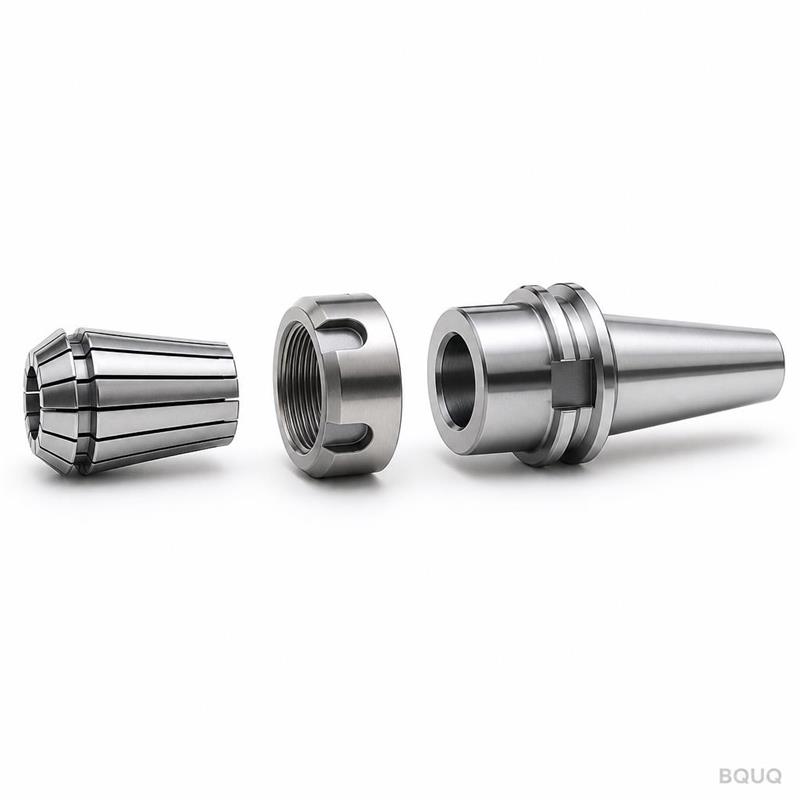
| Collet chuck + custom collet | 15–45 min | 0.005–0.01 mm | Low | Small diameters, high-volume turning |
| Expanding mandrel | 1–2 hours | 0.005–0.01 mm | Moderate | Thin-wall rings, bore-referenced parts |
| Vacuum plate | 1–4 hours | 0.01 mm | Moderate | Thin plates, heat sinks, no-clamp surfaces |
The right answer depends on volume, tolerance, and part geometry. For a 200-piece run of a turned aluminum fitting, bored soft jaws win on every axis. For a 5,000-piece run of a prismatic bracket with a tight hole pattern, a dedicated fixture pays for itself in the first week.
If your part needs multi-face access, our notes on 5-axis fixturing strategies cover how to combine soft jaws with tombstone setups.
Workholding for Common Part Families
Turned parts and shafts
Bored soft jaws on a 3-jaw power chuck, with a hard axial stop set to the op-one shoulder. For shafts under 20 mm diameter, a collet chuck with a custom collet is faster and more accurate. For long, slender parts, a subspindle or a Swiss-type setup removes the second op entirely by machining both ends in one cycle.
Prismatic brackets and housings
Milled soft jaws with a pocket that matches the op-one profile, plus a dowel pin or shoulder for angular location. If the part has a flat back face, a vacuum plate or a magnetic chuck can eliminate clamp-induced distortion completely.
Thin-wall rings and heat sinks
This is where workholding makes or breaks the job. Options, in order of preference:
1. Expanding mandrel on the bore
2. Pot chuck supporting the full outer diameter
3. Soft jaws with urethane pads at reduced pressure
Never grip a thin-wall ring on the outside with hard jaws and expect roundness. The part will measure round in the chuck and oval on the CMM.
Small precision parts
For parts under 10 mm, custom collets and soft jaws with fine-pitch adjustment are the practical answer. The holding force needed is small; the locating accuracy needed is large.
Cost, Lead Time, and When Soft Jaws Pay Off
Soft jaws are usually quoted as a one-time tooling charge. In a Dongguan precision shop, a simple bored jaw set is typically a few tens of USD and a few hours of machine time. A dedicated milled fixture with dowel location and clamps is typically several hundred USD and one to three days.
The break-even math is straightforward. If soft jaws add 20 seconds to the cycle but save 4 minutes of indicating per part, they pay back on the second part. If a dedicated fixture costs 400 USD but cuts cycle time by 30 seconds across 5,000 parts, it pays back in roughly 40 hours of machine time.
Where soft jaws consistently save money beyond the obvious:
- Scrap reduction. Marked or out-of-round parts are the most common second-op defect. Soft jaws eliminate the cause.
- Operator independence. A soft-jaw setup with a hard stop runs the same on every shift. Indicating does not.
- Faster quoting. When workholding is standard practice rather than a custom engineering project, quotes come back faster. Our cost-reduction breakdown covers where tooling sits in the total part cost.
Documenting the setup — jaw material, clamping pressure, stop position, jaw part number — is what makes the second run as fast as the first. Our guide to machining documentation covers what belongs on a setup sheet.
How BQUQ Handles Second Operations
BQUQ runs four production lines in one Dongguan factory: CNC machining, metal stamping, custom springs, and heat sink production. That matters for workholding because the fixture and the part are made by the same team, on the same floor, under one ISO9001 quality system.
Practically, that means:
- Soft jaws and fixtures are machined in-house, not outsourced to a tool shop
- First op and second op run on the same machines, so datums do not drift between suppliers
- CNC machining holds ±0.005 mm on critical features, with typical second-op concentricity of 0.01–0.02 mm depending on part geometry
- Flexible MOQ, so a 100-piece second-op run gets the same workholding attention as a 10,000-piece run
- Quotes returned within 12 working hours
Send a drawing or a 3D file and we will tell you whether soft jaws, a dedicated fixture, or a collet setup is the right answer for your part — and what it costs.
Frequently Asked Questions
Q: What is the difference between soft jaws and hard jaws?
A: Hard jaws are hardened steel, usually serrated, and are designed to grip raw stock with maximum force. Soft jaws are unhardened — typically 6061 aluminum — and are machined to the exact profile of the finished part. Soft jaws grip finished surfaces without marking them and can be re-cut many times as the job evolves. Hard jaws are for first operations on raw material.
Q: How accurate are soft jaws for a second operation?
A: With jaws bored in place at production clamping pressure, concentricity typically lands within 0.01–0.02 mm and flatness within 0.01 mm. That is usually sufficient to hold ±0.005 mm on the second-op features themselves, since the error is a locating error rather than a cutting error. Tighter results require a dedicated fixture or an expanding mandrel.
Q: Can soft jaws hold thin-wall parts without distortion?
A: Only with reduced clamping pressure and increased contact area. A bored jaw giving 180° of circumferential contact at low pressure distorts far less than three-point contact at high pressure. For walls under about 1.5 mm, an expanding mandrel or pot chuck that supports the bore or the full outer diameter is usually the better choice.
Q: When should I use a dedicated fixture instead of soft jaws?
A: When the part is prismatic with a tight angular tolerance, when annual volume justifies the tooling, or when the geometry cannot be gripped reliably by a jaw pocket. Dedicated fixtures typically achieve 0.005–0.01 mm repeatability and often reduce cycle time by allowing better tool access. Below roughly 1,000 pieces, soft jaws usually win on total cost.
Q: Does BQUQ make custom workholding for customer parts?
A: Yes. Soft jaws, milled fixtures, expanding mandrels, and custom collets are designed and machined in-house at our Dongguan factory alongside the production parts. Because the same team makes the fixture and the part, first-op and second-op datums stay consistent. Send your drawing and we will quote the workholding and the parts together within 12 working hours.
Related Resources
- About BQUQ and our four Dongguan production lines: /about/
- CNC machining services, including second-op workholding: /cnc-machining/
- CNC milling parts for prismatic and bracket-type components: /cnc-milling-parts/
- CNC turning parts for shafts, fittings, and rings: /cnc-turning-parts/
- Industry trends in precision manufacturing: /industry-dynamics/
- Technical articles and engineering guides: /bquq-blog/
- Frequently asked questions about quoting and tolerances: /faq/
- Case studies from production runs: /case/
- Contact the engineering team: /contact/
Authored by the BQUQ Engineering Team. BQUQ (Dongguan) runs CNC machining (±0.005 mm), metal stamping, custom springs, and heat sink production in one ISO9001 factory. Source-direct from Dongguan, China — quote in 12 hours: sc@bquq.com | WhatsApp +86 13713157787 | www.bquq.com