CNC Machining Inconel and Superalloys: A Reality Check
Short answer: Inconel and other nickel superalloys are machinable, but expect roughly 20–40% of the cutting speed you would use on 304 stainless, tool life measured in minutes rather than hours, and a machined cost 3–8× that of the same geometry in stainless steel. Inconel 718 in annealed condition cuts at a typical 25–35 m/min with carbide, needs high-pressure coolant, rigid tooling and light radial engagement. BQUQ machines these alloys in Dongguan on four production lines to ±0.005 mm, with quotes back in 12 working hours.
Superalloys earn their reputation honestly. They keep their strength at 700 °C, resist oxidation and creep, and hold tolerance when everything around them has softened. That is exactly why they are hard to cut — the same properties that make a turbine disc survive also make the chip stick to the insert, the tool rub instead of shear, and the workpiece work-harden the moment your feed drops.
This article is a reality check for buyers and engineers. It covers which alloys actually reach a CNC shop, what cutting data is realistic, where the money goes, and how to design parts that do not triple in price because of one undercut.
Which superalloys actually get machined on a CNC?
Not every heat-resistant alloy behaves the same way. The families below cover the overwhelming majority of RFQs we see.
Nickel-based alloys (Inconel, Hastelloy, Waspaloy)
Inconel 718 is the workhorse: aerospace, oil and gas, cryogenic hardware, fasteners. Inconel 625 is softer and more forgiving, popular for marine and chemical service. Hastelloy C-276 resists chlorides but galls badly. Waspaloy is stronger at temperature and harder still to cut. All share the same problems — low thermal conductivity, high work-hardening rate, abrasive carbides.
Cobalt-based alloys (Stellite)
Stellite 6 and similar grades are used for valve seats, wear pads and hardfacing. They are extremely abrasion-resistant and typically machined with carbide at very low speed, or ground. Expect heavy tool wear and a strong case for near-net shapes.
Titanium alloys (Ti-6Al-4V and friends)
Technically not a superalloy, but it lives in the same conversation. Ti-6Al-4V is roughly twice as hard to machine as 304 stainless, with notorious chip welding and heat concentration at the cutting edge.
Iron-nickel and refractory-adjacent grades
A286, Incoloy 800/825 and similar iron-nickel grades sit between stainless and true superalloys. They are noticeably easier — often 40–60% of stainless speeds rather than 25%.
Why is Inconel so difficult to machine?
Four physical properties do most of the damage.
Low thermal conductivity. Inconel 718 conducts heat at roughly 11 W/m·K, against about 16 for 304 stainless and 200+ for aluminium. Almost all the heat generated at the cutting edge stays in the tool and the workpiece instead of leaving with the chip. Edge temperatures climb fast, and carbide softens.
Work hardening. The surface hardens as it is deformed. If the tool rubs rather than cuts — because the feed is too light, the edge is dull, or the tool deflects — the next pass meets a harder skin. This is why "sneaking up on it" with tiny depths of cut makes things worse, not better.
Abrasive carbides and a gummy chip. The chip is continuous, strong and tends to weld to the rake face, producing built-up edge that chips away the coating.
High strength at temperature. The material does not get easier as it heats up. It stays tough right through the cutting zone.
The practical consequence: you need a rigid setup, a sharp edge, a real feed per tooth, and enough coolant pressure to reach the interface.
Realistic cutting parameters for Inconel 718
The table below is indicative, not a guarantee. Every machine, holder, insert grade and workpiece condition shifts these numbers. Treat them as a starting point for trials.
| Operation | Tool | Cutting speed | Feed per tooth | Radial / axial DOC |
|---|---|---|---|---|
| Rough milling (side) | 12 mm solid carbide, AlTiN | 25–35 m/min | 0.05–0.08 mm | 6–8% D / 1.0 D |
| Finish milling | 10 mm 5-flute, PVD | 35–45 m/min | 0.04–0.06 mm | 3–5% D / 0.5 D |
| Drilling (HSS-E) | Cobalt drill, 118° | 6–9 m/min | 0.05–0.10 mm/rev | Peck 1×D |
| Drilling (carbide) | Internal coolant | 18–25 m/min | 0.06–0.12 mm/rev | Through coolant |
| Turning (rough) | CNMG, negative | 30–45 m/min | 0.15–0.25 mm/rev | 1.5–2.5 mm |
| Turning (finish) | VNMG, positive | 45–60 m/min | 0.08–0.12 mm/rev | 0.3–0.6 mm |
| Tapping | HSS-E, spiral flute | 3–6 m/min | — | Form or cut, oil |
For comparison, the same operations on 304 stainless run at roughly 120–180 m/min milling and 180–220 m/min turning. That factor of four to five is the core reason Inconel parts cost what they cost.
What about tool life?
Expect 15–45 minutes of cutting time per edge on a good roughing setup, and considerably less on finishing where the edge is doing delicate work. In practice, a shop running Inconel 718 all day will consume tooling at a rate that would be unthinkable on aluminium. Some shops budget tool cost as 15–30% of the part price for complex Inconel work.
Coolant is not optional
High-pressure through-tool coolant (50–70 bar or more) is the single biggest productivity lever in superalloy machining. It breaks the chip, cools the edge, and stops the built-up edge from forming. Flood coolant at 10 bar is a compromise; dry machining Inconel is not a serious option.
How much more does Inconel cost than stainless?
Buyers often ask for a straight multiplier. The honest answer depends on geometry, but the table below shows typical relative machining cost for the same part, same tolerances, same quantity.
| Material | Relative machinability | Typical relative machining cost | Notes |
|---|---|---|---|
| Aluminium 6061 | Very easy | 1.0 (baseline) | High speed, long tool life |
| 303 / 304 stainless | Moderate | 2.0–3.0 | Good chip control |
| Ti-6Al-4V | Difficult | 4.0–6.0 | Chip welding, low speeds |
| Inconel 625 | Difficult | 5.0–7.0 | Softer than 718, still slow |
| Inconel 718 (annealed) | Very difficult | 6.0–9.0 | Baseline superalloy |
| Inconel 718 (aged) | Severe | 9.0–14.0 | Machine before ageing if possible |
| Stellite 6 | Severe | 10.0+ | Consider grinding instead |
Two caveats. First, material cost itself is significant — Inconel bar stock can be 10–20× the price of 6061 by weight, so the multiplier on the total part price is often lower than the machining multiplier above. Second, aged or precipitation-hardened material is dramatically worse to cut. If your design allows it, machine Inconel 718 in the annealed condition and age it afterwards. That single decision can cut machining cost by a third.
Design rules that keep superalloy parts affordable
Most of the cost in a superalloy part is decided at the drawing stage. These rules matter more here than in any other material.
Keep the material where it is needed
Inconel is chosen for temperature, corrosion or strength. Features that do not need those properties — brackets, standoffs, mounting flanges — can often be a different alloy, fastened on. A hybrid assembly is frequently cheaper than a monolithic Inconel block.
Avoid deep pockets and long slender tools
Tool deflection is fatal in superalloys. A pocket deeper than 3× the tool diameter forces a small, flexible cutter into a work-hardening material. If you must have depth, expect to pay for it, or design the pocket with a corner radius of at least 0.5× depth.
Specify tolerances you actually need
±0.005 mm is achievable on critical features in Inconel on a good machine, but it is expensive to hold across a whole part. Reserve tight tolerances for fits and sealing surfaces. General dimensions at ±0.1 mm cost a fraction of the same part held at ±0.01 mm.
Thin walls are a trap
A 0.8 mm wall in Inconel will move, chatter and spring. Below about 1.5 mm, expect to add support material, multiple finishing passes and possibly a stress-relief step. If the wall is not structural, thicken it.
Threads and holes
Roll-forming is not practical in Inconel at small sizes; cut threads with a spiral-flute tap and plenty of oil. Deep holes need through-coolant carbide drills and peck cycles. Thread milling is often more reliable than tapping for sizes above M6.
Where does a China source factory fit?
Superalloy work is a niche, and not every Chinese machine shop is set up for it. The differentiators are unglamorous: rigid machines with good thermal stability, high-pressure coolant plumbed to the spindle, a tool crib stocked with the right grades, and programmers who have run the material before.
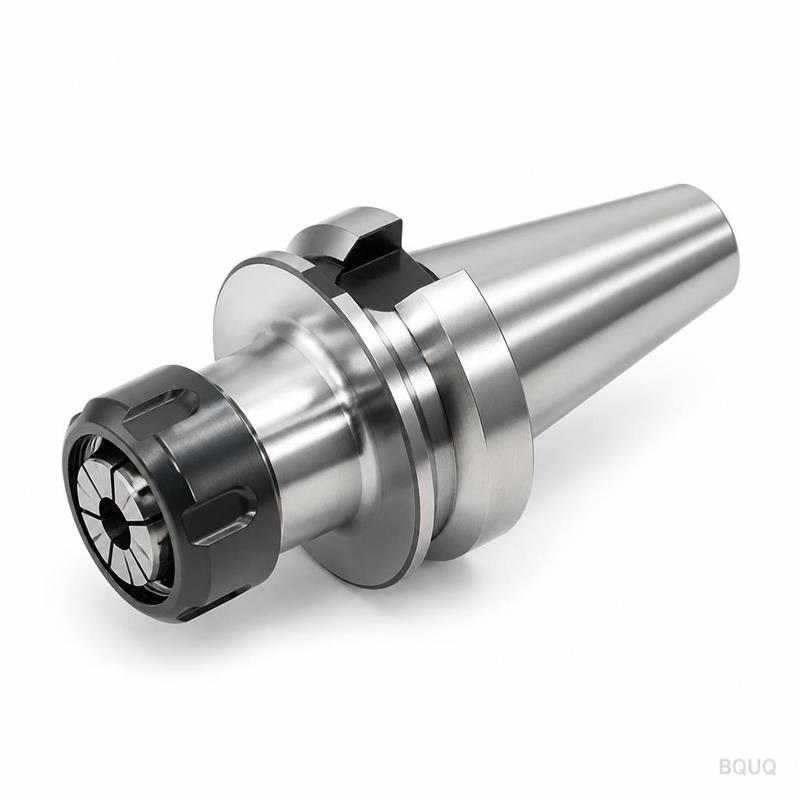
BQUQ runs four production lines in one Dongguan factory covering CNC machining, metal stamping, custom springs and heat sink production, under ISO9001. We hold ±0.005 mm on CNC work and quote in 12 working hours, with flexible MOQ — which matters when you need three Inconel prototypes before committing to a hundred. For a broader look at how we approach hard materials, see our guide to hard turning and our notes on tool holder selection, both of which apply directly to superalloy work.
If you are weighing a redesign, our DFM redesign examples show how small geometry changes translate into real cost reduction.
Frequently Asked Questions
Q: Can Inconel 718 be machined with standard carbide tooling?
A: Yes, but not the general-purpose grades. You need a tough, fine-grain carbide substrate with a PVD coating such as AlTiN or AlCrN, and a sharp, positive edge geometry. Standard stainless inserts will fail within minutes. Expect to run at 25–35 m/min for milling, with high-pressure coolant and a rigid holder. Tool life is short by any normal standard.
Q: Is it better to machine Inconel before or after ageing?
A: Before, almost always. Inconel 718 in the annealed condition machines at roughly two to three times the speed of aged material, with far better tool life. Machine to near-final dimensions, leaving allowance for distortion, then age and finish. If your part is already supplied in aged condition, expect a significant cost increase and plan for more finishing passes.
Q: What surface finish can I expect on CNC machined Inconel?
A: A typical as-machined finish is Ra 1.6 µm, and Ra 0.8 µm is achievable on finishing passes with a sharp edge and stable setup. Below Ra 0.4 µm becomes difficult because the material tends to smear and tear rather than cut cleanly. If you need a mirror finish, plan for polishing or a secondary operation rather than chasing it on the machine.
Q: Why does my Inconel part cost so much more than the stainless version?
A: Three reasons: cutting speed is roughly a quarter of stainless, tool consumption is far higher, and the raw material itself costs many times more per kilogram. On top of that, cycle times are long, so machine hours dominate the quote. Reducing the number of features that must be machined, rather than cast or left as stock, is the fastest route to a lower price.
Q: Does BQUQ machine superalloys, and what is the minimum order?
A: Yes. We machine nickel and titanium alloys on our CNC lines alongside aluminium, stainless and copper work, holding ±0.005 mm where the drawing requires it. MOQ is flexible — prototype quantities are welcome. Send a drawing and material spec to sc@bquq.com and you will have an indicative quote within 12 working hours.
Related Resources
- About BQUQ and our four Dongguan production lines: /about/
- CNC machining services, including superalloy work: /cnc-machining/
- CNC milling parts: /cnc-milling-parts/
- CNC turning parts: /cnc-turning-parts/
- Industry trends across machining and sourcing: /industry-dynamics/
- Technical articles and engineering guides: /bquq-blog/
- Frequently asked questions on quoting and tolerances: /faq/
- Case studies from production: /case/
- Contact the engineering team: /contact/
Authored by the BQUQ Engineering Team. BQUQ (Dongguan) runs CNC machining (±0.005 mm), metal stamping, custom springs, and heat sink production in one ISO9001 factory. Source-direct from Dongguan, China — quote in 12 hours: sc@bquq.com | WhatsApp +86 13713157787 | www.bquq.com