Tool Holder Selection for CNC: Torque, Runout and Access
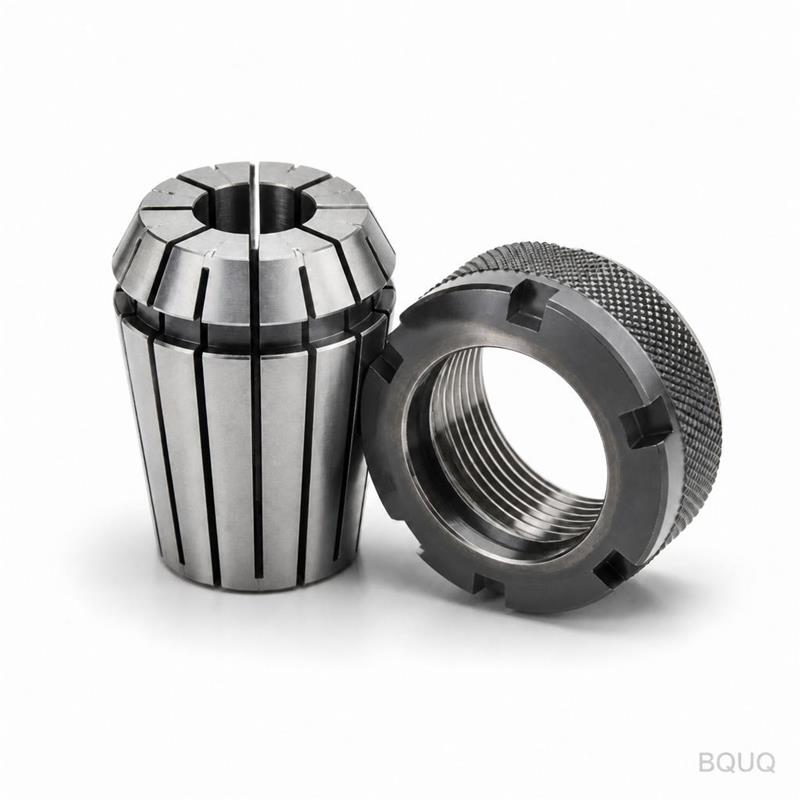
Short answer: Match the holder to the three constraints that actually break parts — torque, runout and access. For a 12 mm carbide end mill in aluminum at 1.5×D, an ER32 collet chuck holds 0.008–0.015 mm TIR and transmits roughly 40–60 N·m, which is fine. Move to a 20 mm cutter at 4×D in steel and you need a hydraulic or shrink-fit holder at 0.003 mm TIR and 150 N·m+; a collet chuck will chatter and pull. Reach decides the rest: if the holder body hits the wall before the cutter reaches depth, no amount of accuracy helps. BQUQ quotes holder-and-fixture recommendations with every CNC machining RFQ inside 12 working hours.
Why the tool holder decides your tolerance before the machine does
A CNC machine's positioning accuracy is a specification on paper. What actually reaches the workpiece is the sum of spindle, holder, collet and cutter. The holder is the weakest link in that chain because it is the only element that is repeatedly clamped and unclamped, and the only one whose stiffness you choose at the moment of setup.
Three failure modes account for most holder-related scrap:
Runout — radial eccentricity at the cutter tip. Every 0.01 mm of runout roughly doubles the chip load on one flute. In a 4-flute cutter that means one edge doing 40% of the work, wearing first, and pushing the bore off-centre. For a reamed hole held to H7, runout above 0.01 mm is usually enough to lose the tolerance.
Torque loss — the holder's ability to resist cutter pull-out and torsional slip. This matters most in heavy roughing and in high-helix cutters that generate strong axial pull. A holder that slips mid-cut does not just ruin the part; it scraps the cutter and can damage the spindle taper.
Access interference — the holder body, nut or wrench flats colliding with a wall, a boss or a fixture. This is geometry, not accuracy, and it is the reason shops own five holder families instead of one.
On the BQUQ floor in Dongguan, all four production lines — CNC machining, metal stamping, custom springs and heat sinks — share the same tool crib logic. A holder that is right for a heat sink fin profile is wrong for a hardened spring mandrel, and the selection rules below are how we decide.
What runout can you actually expect from each holder type?
Runout figures below are typical values measured at 3×D from the gauge line with a clean, new collet and a good-quality cutter shank. Treat them as indicative, not guaranteed — spindle condition and collet wear dominate in practice.
| Holder type | Typical TIR at 3×D | Max realistic speed | Best fit |
|---|---|---|---|
| ER collet chuck (ER16/ER20/ER32) | 0.008–0.015 mm | 20,000–25,000 rpm | General milling, drilling, tapping |
| Drill chuck (keyless) | 0.03–0.08 mm | 6,000 rpm | Non-critical drilling only |
| Hydraulic expansion | 0.003–0.005 mm | 30,000–40,000 rpm | Finishing, reaming, small-diameter tools |
| Shrink fit (induction) | 0.002–0.004 mm | 40,000 rpm+ | High-speed finishing, deep pockets |
| Side-lock / Weldon | 0.02–0.05 mm | 15,000 rpm | Heavy roughing, high torque |
| Mechanical milling chuck | 0.005–0.010 mm | 25,000 rpm | Heavy roughing with good accuracy |
Two practical notes. First, TIR is measured on a clean taper — a single chip or a smear of grease on the spindle taper can add 0.02 mm instantly. Second, collet quality matters more than holder brand at the ER level: a worn ER32 collet can double the runout of a new one, and collets should be retired on a schedule, not on failure.
For work where runout directly sets the tolerance — reamed bores, bearing seats, optical mounts — the holder is not a place to economise. Our article on reaming hole tolerance walks through how runout, reamer geometry and feed interact on a real H7 callout.
How much torque does your cut actually demand?
Torque demand scales with material, cutter diameter, radial engagement and axial depth. The holder must transmit more than the cutter generates, with margin for the interrupted cuts and hard spots that always show up in real stock.
| Operation | Cutter | Typical torque demand | Minimum holder class |
|---|---|---|---|
| Aluminum roughing, 1.5×D axial | 12 mm 3-flute | 15–25 N·m | ER32 |
| Aluminum roughing, 3×D axial | 16 mm 3-flute | 40–60 N·m | ER32 / mechanical chuck |
| Steel roughing, 1×D axial | 16 mm 4-flute | 60–90 N·m | Mechanical chuck / side-lock |
| Steel roughing, 2×D axial | 20 mm 4-flute | 120–180 N·m | Side-lock / heavy mechanical chuck |
| Stainless finishing | 8 mm 4-flute | 8–15 N·m | Hydraulic / shrink fit |
| Tapping M10 in steel | — | 25–40 N·m | Tension-compression tap holder |
The pattern: torque is rarely the limiting factor in aluminium, and almost always the limiting factor in steel and stainless roughing. That is why a shop running mixed work keeps both a collet set and a side-lock or mechanical chuck set.
There is a second torque issue that tables miss — pull-out. High-helix cutters in a deep axial cut generate a screw-like axial force that can drag the cutter shank out of a collet. The symptoms are a sudden change in depth, a squeal, and a scrapped pocket floor. If you see it, the fix is not more clamping force on the nut; it is a holder with a positive mechanical lock (side-lock, or a hydraulic holder with a shank that has a proper h6 ground surface).
When does reach and access override accuracy?
Constantly. A holder with perfect 0.002 mm runout is useless if the nut hits the workpiece wall at 30 mm depth. Access problems show up in three shapes:
- Deep cavities — the holder body diameter must be smaller than the cavity opening, and the neck must be long enough to reach the floor. Slim-neck shrink-fit holders exist precisely for this.
- Close-to-wall features — a nut that is 10 mm larger than the cutter shank limits how close you can machine to a shoulder. Slim-nut ER holders or a shrink-fit body solve it.
- Undercuts and back features — no straight holder reaches them. This is where a right-angle head, or a different process entirely (turning with live tooling), becomes the correct answer.
For 5-axis work the constraint shifts again: the holder must clear the part through the whole tilt range, not just at one orientation. This is a fixture-and-holder problem at the same time, and it is covered in more depth in 5-axis fixturing.
A useful rule from our own setup sheets: choose the holder that lets you machine the feature in one orientation, then check whether it can survive the cut. Accuracy is negotiable; access is not.
Which holder for which material and feature?
The matrix below is the one we use when quoting. It assumes a modern VMC or turning centre with a clean taper and reasonable spindle condition.
| Material / feature | First choice | Fallback | Avoid |
|---|---|---|---|
| Aluminium, high-MRR roughing | ER32 or mechanical chuck | Side-lock | Drill chuck |
| Aluminium, thin-wall finishing | Shrink fit or hydraulic | ER with new collet | Side-lock |
| Steel, general milling | Mechanical chuck | ER32 | Hydraulic (torque limit) |
| Stainless, finishing | Hydraulic | Shrink fit | Side-lock (runout) |
| Titanium, low-speed roughing | Side-lock | Mechanical chuck | Hydraulic |
| Brass, small features | ER16 / ER20 | Hydraulic | Side-lock |
| Deep pockets, small cutter | Slim-neck shrink fit | Slim-nut ER | Standard ER |
| Reaming to H7 | Hydraulic | Shrink fit | ER collet |
| Tapping | Tension-compression holder | Rigid tap holder (sync) | Drill chuck |
Two entries deserve comment. Hydraulic holders are not roughing tools — the internal pressure chamber that gives them their accuracy also limits how much torque they can transmit, and overloading them permanently damages the membrane. Side-lock holders trade runout for grip, so they belong on roughing passes where you will leave 0.3–0.5 mm for a finishing pass in a better holder.
That two-holder strategy — rough in a side-lock, finish in a hydraulic or shrink-fit — is standard practice in precision work and is one of the cheapest quality improvements available. It costs one extra tool change per feature.
Collet chucks: the workhorse, and where it fails
The ER collet chuck is the default for a reason: cheap, flexible, available in every taper, and good enough for the majority of milling and drilling. It fails in three predictable situations.
1. Torque saturation. Above roughly 60 N·m the collet starts to slip on the shank. The nut feels tight, but the grip is friction only.
2. Runout drift. ER collets are only as round as the nut that compresses them. A worn nut, or one tightened without the collet seated in the eccentric ring, adds runout immediately.
3. Reach. Standard ER nuts are bulky. If your feature is within 15 mm of a wall, you need a slim-nut variant or a different holder.
Tightening torque matters more than most operators think. An ER32 nut torqued to 80 N·m instead of the specified 100–136 N·m (depending on manufacturer) loses a meaningful fraction of its grip. A torque wrench on the bench is a cheap way to remove a whole class of problems.
For turning work, the equivalent decision is between a collet chuck, a 3-jaw and soft jaws. Soft jaws bored in situ give the best concentricity for a specific diameter and are covered in soft jaws and workholding.
What this means for your RFQ
When you send a part to BQUQ, the holder decision is part of the process plan, not an afterthought. Three things in your drawing or model change the answer:
- Tolerance callouts — a ±0.005 mm bore or a tight true-position callout pushes us toward hydraulic or shrink-fit holders, which affects cycle time and price.
- Feature depth-to-diameter ratio — anything beyond 4×D needs a long-reach holder, reduced feed, or a different process.
- Material — steel and stainless roughing consume holder torque budget; aluminium rarely does.
We run CNC machining to ±0.005 mm, turning and milling across four production lines in one Dongguan factory, with flexible MOQ from prototype quantities upward. Quotes go out within 12 working hours, and the quote includes the tooling and workholding assumptions we used — so you can see where the cost sits. If a design change would let us use a cheaper holder and a shorter cycle, we will say so.
Send drawings to sc@bquq.com or WhatsApp +86 13713157787 for a holder-aware quote.
Frequently Asked Questions
Q: What runout should I specify for a CNC tool holder?
A: Specify runout at the cutter tip, not at the holder gauge line, and state the distance. For general milling, 0.010 mm TIR at 3×D is a reasonable target. For reaming, boring or bearing seats, 0.005 mm or better is realistic with a hydraulic or shrink-fit holder. Remember that collet wear and spindle taper condition can add 0.01 mm or more on their own.
Q: Is a hydraulic tool holder better than a shrink-fit holder?
A: They solve overlapping problems differently. Hydraulic holders give 0.003–0.005 mm runout, damp vibration well and release with a set screw, but they are torque-limited and unsuited to heavy roughing. Shrink-fit holders give 0.002–0.004 mm runout and excellent rigidity with no moving parts, but need an induction unit and are slower to change. Many shops run both, choosing per operation.
Q: Why does my end mill pull out of the collet during roughing?
A: High-helix cutters generate strong axial pull, and a collet grips by friction alone. The usual causes are under-torqued nuts, a worn or contaminated collet, an oily cutter shank, or a cut that exceeds the holder's torque capacity. Fix the setup rather than over-tightening: clean the shank, replace the collet, torque to spec, or move the roughing pass to a side-lock or mechanical chuck.
Q: Can I use one tool holder family for aluminium and steel?
A: Not optimally. Aluminium rewards high speed and good runout, so ER collet chucks and shrink-fit holders work well. Steel roughing demands torque, which points to side-lock or mechanical chucks. A practical compromise is an ER32 set for aluminium and finishing, plus one mechanical chuck for steel roughing. That covers most mixed-work shops without a large holder inventory.
Q: How does holder choice affect the price of a CNC machined part?
A: Indirectly but clearly. A holder that forces a second finishing operation, a slower feed, or a longer reach adds cycle time. Conversely, specifying a tolerance that genuinely needs a hydraulic holder adds tooling cost per setup. On small batches the holder and fixture setup can dominate the price, which is why we list our workholding assumptions in every quote.
Related Resources
- About BQUQ and our four Dongguan production lines: /about/
- CNC machining services, tolerances and materials: /cnc-machining/
- CNC milling parts with holder-aware process planning: /cnc-milling-parts/
- CNC turning parts and collet/soft-jaw workholding: /cnc-turning-parts/
- Industry trends in precision manufacturing: /industry-dynamics/
- Technical articles and engineering guides: /bquq-blog/
- Frequently asked questions on sourcing from China: /faq/
- Case studies and DFM redesign examples: /case/
- Contact the engineering team: /contact/
Authored by the BQUQ Engineering Team. BQUQ (Dongguan) runs CNC machining (±0.005 mm), metal stamping, custom springs, and heat sink production in one ISO9001 factory. Source-direct from Dongguan, China — quote in 12 hours: sc@bquq.com | WhatsApp +86 13713157787 | www.bquq.com