Collets for Multi-Spindle and Cam Lathes
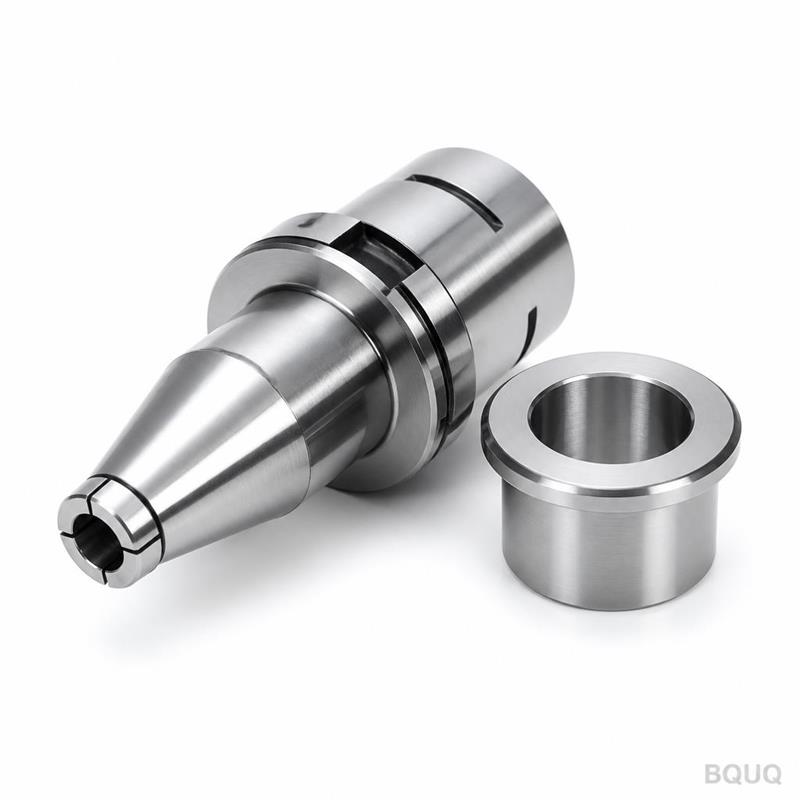
Short answer: For multi-spindle and cam (auto) lathes, specify spring collets matched to your machine's spindle nose series — typically 15-type, 25-type, or 36/46-type — with a bore form (round, hex, square, or special) cut to the bar stock, not to the finished part. Order the bore 0.02–0.05 mm above nominal bar diameter, hold TIR within 0.01–0.02 mm on the seating taper, and choose quenched or mirror-polished grades for high-cycle cam work. BQUQ manufactures these collets in Dongguan to ISO9001 with ±0.005 mm CNC capability and quotes custom profiles in 12 working hours.
Multi-spindle automatics and cam-operated lathes live or die by their collets. On a single-spindle CNC you can often compensate for a weak workholding setup with a slow feed and a light pass. On a six-spindle cam machine running 40 parts per minute, there is no time to compensate for anything. The collet either grips the bar concentrically on every index, or the machine produces scrap at a rate no operator can keep up with.
This article covers what actually matters when you specify collets for this class of machine: the collet families involved, how bore geometry is chosen, what tolerances to write on a drawing, and how material and heat treatment affect service life.
What makes multi-spindle and cam lathe collets different?
A cam lathe — often called an auto lathe or automatic screw machine — sequences its operations mechanically. Cams drive the cross slides, the turret, and the collet open/close mechanism. There is no servo feedback loop correcting the collet's grip force or concentricity. Everything the collet does, it does by geometry and spring force alone.
That produces three requirements that differ from general CNC workholding:
- Repeatability over millions of cycles. A cam machine may open and close its collets several million times per year. The collet must return to the same gripping diameter every cycle without losing spring memory.
- Fast, positive release. The bar must advance freely the instant the collet opens. A collet that drags on the bar wears the bar surface and can cause feed-length errors.
- Compact outside profile. Multi-spindle machines pack spindles tightly. There is no room for a bulky chuck body, which is why spring collets dominate this application.
On a multi-spindle machine the constraint is even tighter. Six or eight spindles sit on a common drum, each with its own collet, each indexed to a different station. If one collet in the set grips differently from the others, that spindle produces a different part. Sets matter as much as individual collets.
Which collet series fit which machine?
The naming convention for auto-lathe collets usually references the spindle nose or the machine family rather than a tooling standard like ER or 5C. The table below summarizes the common groupings and where they are used. Treat the bar capacity figures as typical/indicative — always confirm against your machine's spindle drawing.
| Series group | Typical bar capacity | Common machine context | Bore forms available |
|---|---|---|---|
| 15-type | ~4–15 mm | Small cam automatics, second-operation lathes | Round, hex, square, special |
| 25-type | ~10–25 mm | Mid-size single- and multi-spindle autos | Round, hex, square, slot |
| 36/46-type | ~20–46 mm | Larger multi-spindle and cam lathes | Round, hex, square, custom |
| Swiss-type guide bushing collets | ~1–32 mm | Sliding-headstock Swiss lathes | Round, carbide-lined |
| C-style / external-thread collets | Varies by spindle | Legacy cam and turret lathes | Round, hex, special |
Two practical notes. First, "15-type" and "25-type" are family labels, not universal dimensions — two machines from different builders can share the label and differ in taper angle or overall length. Second, the same machine may accept collets from more than one supplier family, so the safest specification document is a dimensioned drawing of the existing collet plus a note on the spindle nose.
If you are also working with sliding-head machines, the guide bushing and the collet must be treated as a matched pair; the principles in our collet system selection guide apply directly.
How do you choose the bore form and grip range?
The bore is where most specification errors happen. Three rules cover the majority of cases.
Cut the bore to the bar, not the part
For bar-fed cam work, the collet grips the raw bar stock. If you are running 12.00 mm ground bar, the collet bore should be sized for 12.00 mm bar — not for the 11.85 mm finished diameter. Specifying the finished size produces a collet that never grips properly and marks the bar.
Size the bore slightly above nominal bar diameter
A spring collet needs to close onto the bar. If the bore equals the bar diameter exactly, the collet has no closure travel and grip force collapses. A typical starting point is a bore 0.02–0.05 mm above nominal bar diameter for ground bar, and wider for hot-rolled or drawn stock with more diameter variation. Our collet grip range guide covers the arithmetic in detail.
Match the bore form to the bar cross-section
Round bar is the default, but cam machines frequently run hex, square, or profiled stock. A hex collet cut to the correct across-flats dimension grips on all six faces and indexes the bar angularly as a side benefit. Square and hex forms must be cut with the corners relieved slightly so the collet contacts the flats, not the corners.
| Bar form | Bore form | Key dimension to specify | Typical clearance |
|---|---|---|---|
| Round, ground | Round | Bore diameter | +0.02 to +0.05 mm |
| Round, drawn | Round | Bore diameter | +0.05 to +0.10 mm |
| Hex | Hex | Across-flats | +0.02 to +0.05 mm |
| Square | Square | Across-flats | +0.02 to +0.05 mm |
| Profiled / splined | Special | Full profile drawing | Per drawing |
For mixed-production shops, a collet with a slightly wider grip range reduces changeover time. The trade-off between range and concentricity is the subject of collet precision vs productivity.
What tolerances should you write on a cam lathe collet drawing?
Vague drawings produce collets that fit but do not perform. The following tolerance set is a workable starting point for auto-lathe and multi-spindle collets. Values are typical/indicative and should be tightened or relaxed based on part tolerance.
| Feature | Typical tolerance | Why it matters |
|---|---|---|
| Seating taper angle | ±5 arc-minutes | Controls axial position and radial centering |
| Taper surface TIR | 0.01–0.02 mm | Directly transfers to part runout |
| Bore diameter | +0.02 / −0.00 mm | Sets grip and bar feed clearance |
| Bore-to-taper concentricity | 0.01 mm | Prevents wall-thickness variation |
| Overall length | ±0.10 mm | Affects drawbar/closing travel |
| Slot width and count | Per drawing, ±0.05 mm | Governs spring rate and grip force |
| Hardness after quench | 58–62 HRC (typical) | Wear life on the taper and bore |
Two of these deserve emphasis. The taper angle is the single most influential dimension: a taper that is a few arc-minutes off will seat at the wrong depth, and the collet will either grip weakly or jam. And hardness is not a vanity spec — on a cam machine running millions of cycles, an unhardened or under-hardened collet will bell-mouth at the bore within weeks.
Material and heat treatment: where service life is won
Auto-lathe collets are almost always made from alloy spring steel, then hardened and tempered, then ground. The differences between a collet that lasts six months and one that lasts three years come down to three things:
1. Steel cleanliness and consistency. Inclusions and banding in the raw bar create weak points that become cracks at the slot roots.
2. Heat treatment control. Quenching to a controlled hardness range with proper tempering gives the combination of spring memory and wear resistance the application needs. Under-tempering makes the collet brittle; over-tempering makes it soft and short-lived.
3. Grinding after hardening. The taper and bore must be ground after heat treatment, not before. Any collet ground before hardening will distort during quench.
For high-cycle cam work, mirror-polished bores and tapers reduce friction, cut wear, and improve release. For abrasive bar stock or heavy grip loads, a quenched grade with a slightly harder taper surface is usually the better trade. Discuss the specific combination with your supplier rather than accepting a generic grade.
BQUQ produces these collets on dedicated lines in a single Dongguan factory, alongside CNC machining, metal stamping, custom springs, and heat sink production. That means the heat treatment and grinding steps are controlled in-house rather than subcontracted, which is what makes ±0.005 mm CNC capability meaningful on a hardened, slotted part.
How do you keep a multi-spindle set matched?
On a multi-spindle machine, buying six collets from three different batches is a recipe for one spindle producing out-of-tolerance parts.
- Order as a matched set. Specify that all collets in the set come from the same heat lot and are ground as a set.
- Record the as-built taper and bore dimensions. A set sheet with actual measured values lets you track wear spindle by spindle.
- Replace as a set. If one collet wears out, the others are close behind. Replacing one at a time creates a permanent mismatch.
- Store on a taper-protected rack. Taper damage from careless storage is a common cause of premature replacement. See our notes on collet storage and handling practice.
For shops that also run power chucks on the same floor, the workholding comparison in our product range for power chucks and Swiss-type workholding is a useful cross-reference when deciding which spindle gets which holding method.
Frequently Asked Questions
Q: Can I use a standard ER collet on a cam lathe?
A: Generally no. ER collets are designed for tool holding with a nut-driven closure and a specific taper interface. Cam lathes use drawbar- or cam-actuated spring collets with a machine-specific taper and outside profile. An ER collet will not seat correctly or deliver the required grip force, and the machine's closing mechanism will not engage it properly.
Q: How much grip range does an auto lathe collet have?
A: A typical spring collet grips over roughly 0.1–0.3 mm of diameter variation, depending on slot geometry and wall thickness. Wider range costs concentricity. For ground bar with tight diameter control, specify a narrow range for best TIR. For drawn or hot-rolled stock, accept a wider range and verify runout on the part.
Q: What runout can I expect from a good cam lathe collet?
A: A well-made collet on a clean, undamaged spindle taper typically holds 0.01–0.02 mm TIR at the bar. Achieving that requires a ground taper, correct hardness, and a spindle nose in good condition. If runout exceeds 0.03 mm, check the taper for wear or debris before blaming the collet.
Q: How long should a hardened auto lathe collet last?
A: On a cam machine running normal brass or mild steel bar, a properly hardened and ground collet commonly lasts hundreds of thousands to millions of cycles. Abrasive materials, excessive grip force, or a worn spindle taper shorten life significantly. Track bore wear with a plug gauge and replace when it exceeds your part tolerance budget.
Q: Do you make custom bore profiles for multi-spindle lathes?
A: Yes. BQUQ produces round, hex, square, slot, and fully custom profiled bores to drawing, plus matched sets from a single heat lot. Send the bar cross-section, spindle nose dimensions, and part tolerance, and we return a quotation within 12 working hours. Flexible MOQ applies, so trial sets are practical.
Related Resources
- About BQUQ and our Dongguan factory: /about/
- Auto lathe collets and spring collet range: /auto-lathe-collets/
- Power chucks and Swiss-type workholding: /power-chucks-swiss/
- Tool holder and collet chuck systems: /tool-holder-collet-chucks/
- Industry trends in precision manufacturing: /industry-dynamics/
- Technical articles and engineering guides: /bquq-blog/
- Frequently asked questions: /faq/
- Contact the engineering team: /contact/
Authored by the BQUQ Engineering Team. BQUQ (Dongguan) runs CNC machining (±0.005 mm), metal stamping, custom springs, and heat sink production in one ISO9001 factory. Source-direct from Dongguan, China — quote in 12 hours: sc@bquq.com | WhatsApp +86 13713157787 | www.bquq.com