How stamping quotes work: tooling $3,000–$50,000 (indicative) plus per-part price, what drives both, and when stamping beats CNC machining on cost.
Progressive Die Stamping Cost: How Tooling and Part Price Work
Short answer: every stamping quote has two numbers — the die, typically $3,000–$50,000 (indicative, set by complexity), and the per-part price, which after tooling exists can drop to pennies. A $15,000 die spread over 100,000 pieces adds only $0.15 per part, which is why stamping beats CNC machining as volume climbs — the crossover usually lands somewhere between 2,000 and 10,000 pieces depending on part complexity. When a quote looks too cheap, check what it assumes about the die steel, tolerance, and plating; when it looks too expensive, check the amortization period, not the sticker.
Stamping confuses buyers because the pricing is back-to-front compared to machining. CNC quotes are mostly per-part with small setup fees. Stamping quotes lead with a big tooling number that feels like a down payment on a car — then the per-part price looks almost insultingly low. Both numbers are honest; the trick is understanding what drives each and how they trade against each other as your volume grows.
Why Do You Always Get Two Numbers in a Stamping Quote?
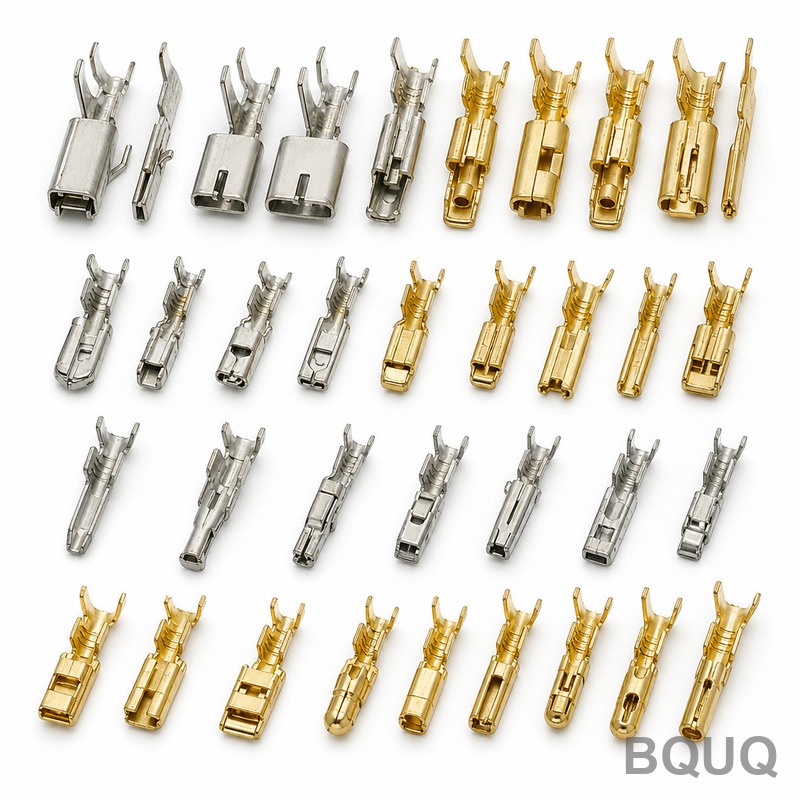
Because stamping has two cost structures with completely different rules. The die is a one-time engineering project: design, steel, cutting, tryout, adjustment. The per-part price is production: material, press time, plating, packaging. You pay the die once, no matter if you run 1,000 parts or 10 million. You pay the per-part price every time the press strokes. Every stamped family we make — terminals and contacts, brackets and mounts, enclosures — quotes the same two-number way.
The economics only make sense when you spread the die over the total run. A $20,000 die over 100,000 pieces is $0.20 per part — noise. The same die over 500 pieces is $40 per part — a disaster. That is why the first question in any stamping discussion is not "how much?" but "how many, and for how long?" The annual volume and the expected product life decide whether stamping is even the right process, and a factory that asks those questions before quoting is doing its job.
What Drives Progressive Die Tooling Cost?
Die cost scales with complexity, not part size. A simple flat blank with a couple of holes is a few thousand dollars. Add bends, forming, tight tolerances, thin material, or 20 stations of progressive work and the price climbs toward the high end. The material of the die itself matters: tool steel dies handle ordinary runs; carbide inserts extend die life for millions-of-strokes production but cost more up front.
| Die complexity | Typical tooling cost (indicative) | What it buys you |
|---|---|---|
| Simple blanking die, few features | $3,000–$8,000 | Flat parts, basic holes and notches |
| Progressive die, bends and forms | $8,000–$20,000 | Terminals, brackets, parts needing several operations |
| Complex precision progressive die | $20,000–$50,000+ | Fine-pitch terminals, tight tolerances, high station count |
| Carbide or insert tooling | Premium on any of the above | Die life in the tens of millions of strokes |
Three sneaky cost drivers hide in that table. Tight tolerances force precision die machining and slower, more careful tryout. Thin or hard materials need tighter clearances and better steel. And the number of forming stations multiplies everything — each bend is another station, another set of precision-ground components, another thing to adjust during tryout. When our engineers review a drawing before quoting, these are the features we flag first, because changing them on screen is free and changing them after steel is cut is not.
What Drives the Per-Part Price in Stamping?
Once the die exists, the per-part price is mostly material and press time. Material is the biggest line: coil stock cost times the part's footprint, plus the scrap skeleton left in the strip — a good layout keeps scrap under 30–40%, and a great die nests parts to share the strip. Press time is the second: a progressive die running 300–800 strokes per minute makes parts so fast that machine cost per part is tiny; a slow, complex die with frequent stops costs more per part.
| Cost driver | Typical impact |
|---|---|
| Material grade and thickness | Copper alloys and thick stock dominate material cost |
| Strip layout efficiency | Scrap ratio decides how much material you pay for |
| Plating | Selective plating costs less than full plating; gold costs real money |
| Tolerance and inspection | Tight features mean slower dies, more frequent checking |
| Packaging | Reel packaging for automated assembly beats loose parts |
Plating deserves a special mention because it is where stamped part quotes diverge wildly. A terminal that needs selective gold only at the contact tip costs a fraction of one plated all over. Tin, nickel, and silver plate at different rates too. If your quote seems high, ask whether the plating spec matches the actual contact duty — our stamped spring contact materials guide shows when gold is necessary and when tin or bare beryllium copper does the job.
When Does Stamping Beat CNC Machining?
The crossover depends on part complexity, and complexity cuts both ways. A simple flat bracket machined from plate is fast even on a CNC mill, so stamping needs high volume to win. A complex terminal that takes minutes of machining per piece is defeated by stamping at much lower volumes. As a rough guide, in the 2,000–10,000 piece range stamping usually starts winning, and past 50,000 pieces there is rarely a contest.
| Scenario | CNC machining | Progressive stamping |
|---|---|---|
| Simple bracket, 100 pcs | Clearly cheaper | Die cost kills it |
| Simple bracket, 5,000 pcs | Comparable, no tooling risk | Usually wins per part |
| Terminal with bends, 500 pcs | Cheaper, prototypes fast | Die cost too high |
| Terminal with bends, 20,000 pcs | Loses badly | Wins by 3–10× on unit cost |
| Any part, 100,000+ pcs | Only for final machining | The only sensible process |
Our precision metal stamping guide goes deeper into what kinds of parts suit each side of the line. The practical habit: when annual volume is uncertain, machine the first batches — you pay more per part but own no tooling — then move to stamping once the product proves itself. That sequence is exactly what a factory with both CNC and stamping lines, like ours, can execute without you changing suppliers.
What Should a Stamping Quote Actually Include?
A usable stamping quote lists the die cost, the per-part price, and the assumptions under both. Check that it states the die steel and expected die life with maintenance — a tool steel die may be quoted cheaper but need rebuilds sooner than carbide. Check what inspection is included: first-article report, yes; per-batch CMM sampling, at what frequency. Check the plating spec against the drawing. Check the packaging: reel packaging for SMT terminals costs more than boxes but saves your line time. And check the payment and tooling-ownership terms — who owns the die when the program ends matters more than people think.
The single most useful question to ask any stamping supplier: "show me the total cost at my real volume." That means die divided by expected lifetime quantity, plus per-part price, plus tooling maintenance spread over the program. A factory that answers with a clear number is thinking about your product's economics; one that quotes a per-part price and hopes you ignore the die is not. Send the drawing with annual volume to sc@bquq.com or WhatsApp +86 13713157787, and we will send back the full picture — die, per-part, crossover advice — within 12 hours on working days, from our ISO9001 stamping line in Dongguan.
Email sc@bquq.com or WhatsApp +86 137 1315 7787 with your PDF/DXF/STEP file. An engineer reviews it and replies with price, lead time and DFM notes on working days.
Stamped or machined? (Decision tree)
| If the part... | Choose | Why |
|---|---|---|
| Is thin, flat or formed from strip, at 1,000+ pcs | Stamping | Tooling pays back at volume |
| Is a prototype or under a few hundred pcs | Laser cut + form, or CNC | Avoids die cost |
| Is thick or has complex 3D form | CNC machining | Stamping is limited by strip thickness |
| Needs smooth edges and a tight profile | Fine blanking | Better sheared-edge quality |
| Is a contact or terminal with spring property | Stamped + heat treat/plating | Material and finish decide performance |
Frequently Asked Questions
How much does a progressive stamping die cost?
A: Typically $3,000–$50,000 (indicative). Simple blanking dies start around $3,000; complex precision dies for fine-pitch terminals run $20,000 and up. Part size matters less than feature count, tolerance, and stations.
Why is stamping so expensive at low volume?
A: Because the die cost is spread over the order. A $15,000 die over 1,000 pieces adds $15 per part. Over 100,000 pieces it adds $0.15. Below a few thousand pieces, machining without tooling is usually cheaper.
At what quantity does stamping become cheaper than CNC machining?
A: Roughly 2,000–10,000 pieces for most parts, depending on complexity. Complex formed parts cross over sooner; simple flat parts need higher volume. Above 50,000 pieces, stamping almost always wins.
Why are stamping quotes from China so much lower?
A: Vertically integrated factories control coil supply, toolmaking, and plating in-house, and die-making labor costs less. A direct source factory quotes without trader markup. Verify by first article before volume — the die is your commitment.
Do I pay for the die separately from the parts?
A: Usually yes — die cost is quoted separately and paid once, per-part price covers production. Confirm who owns the tooling when the program ends, and get expected die life and maintenance costs in writing.
Related Articles
- Precision Metal Stamping: Terminals, Contacts & Enclosures from a China Source Factory — Progressive die stamping from a Dongguan source factory: terminals, contacts, brackets, enclosures, materials and plating, and die development.
- Stamped Spring Contacts: Phosphor Bronze vs Beryllium Copper vs Steel — Phosphor bronze C5210, beryllium copper C17200, and 301 stainless for stamped spring contacts: conductivity, strength, fatigue, cost, and selection.
Data Sources and Verification
Tolerances, cycle times and price ranges in this guide come from BQUQ production records at our Dongguan plant, where CNC machining (±0.005 mm), stamping, custom springs and heat sinks run under one roof. BQUQ is an ISO 9001:2015 certified factory; the certificate and batch inspection reports are available on request with every quotation.
Related Resources
- About BQUQ: an ISO9001-certified source factory in Dongguan running four production lines under one roof.
- Stamping products: explore stamped terminals and contacts, stamping brackets and mounts, and sheet metal enclosures.
- Industry trends: manufacturing, material market, and sourcing analysis for buyers.
- Technical articles: engineering guides on CNC, heat sinks, springs, and stamping — more where this one came from.
- FAQ hub: quick answers on CNC, stamping, springs, and heat sinks.
- Case studies: real parts and real numbers from projects we engineered and delivered.
- Contact us: send your drawing and get a quote within 12 working hours.
Authored by the BQUQ Engineering Team. BQUQ (Dongguan) runs CNC machining (±0.005 mm), metal stamping, custom springs, and heat sink production in one ISO9001 factory. Source-direct from Dongguan, China — quote in 12 hours: sc@bquq.com | WhatsApp +86 13713157787 | www.bquq.com