Progressive die stamping from a Dongguan source factory: terminals, contacts, brackets, enclosures, materials and plating, and die development.
Precision Metal Stamping: Terminals, Contacts & Enclosures from a China Source Factory
Short answer: precision metal stamping turns coil stock into finished parts at press speed — terminals and contacts from 0.05–1.0 mm strip held to ±0.02–0.05 mm on critical features, brackets up to ~3 mm thick, and folded sheet metal enclosures, all in one progressive die. Tooling typically runs $5,000–$40,000 (indicative, varies with part complexity), which is why stamping pays off at volume while prototypes start life as CNC parts. Our Dongguan plant runs stamping beside CNC, spring, and heat sink lines, quotes in 12 hours on working days, and treats 1,000-piece first orders as normal.
Stamping is the process behind the parts you never see: the terminal inside a connector, the contact finger behind a button, the bracket holding a board, the shield can around a radio module. When a design reaches a few thousand pieces a year, stamping usually beats machining on price by a factor of three or more. This guide explains what a progressive die actually does, what materials and platings stamped parts use, and how to buy stamping from a source factory without surprises.
What Does Precision Metal Stamping Actually Cover?
Stamping starts with metal in coil form — thin strip, from a few hundredths of a millimeter up to several millimeters thick — and feeds it through a press with a die that cuts, bends, and forms the part in one stroke sequence. The word "progressive" means the strip moves through stations: station one pierces a pilot hole, station two cuts the outline, station three bends a tab, and the final station parts the finished piece from the strip. One stroke of the press, one finished part, hundreds of strokes per minute.
That is the whole economic trick of stamping: after the die exists, the machine makes parts faster than any other metal process. Per-part cost collapses because cycle time is a fraction of a second and the operator is mostly watching. The cost is concentrated up front, in the die — which is why stamping decisions are really tooling decisions, and tooling economics gets its own deep dive in our progressive die stamping cost guide.
| Capability | Typical range |
|---|---|
| Strip thickness | 0.05–3.0 mm (terminals usually 0.05–1.0 mm) |
| Part size | Small — a few mm up to ~300 mm |
| Critical tolerances | ±0.02–0.05 mm typical, verified with optical/CMM |
| Features per die | 10–40+ stations in a progressive die |
| Secondary operations | Coining, selective plating, forming, tapping |
| Typical annual volumes | 10,000–100,000,000 pieces |
What Kinds of Parts Come Out of a Progressive Die?
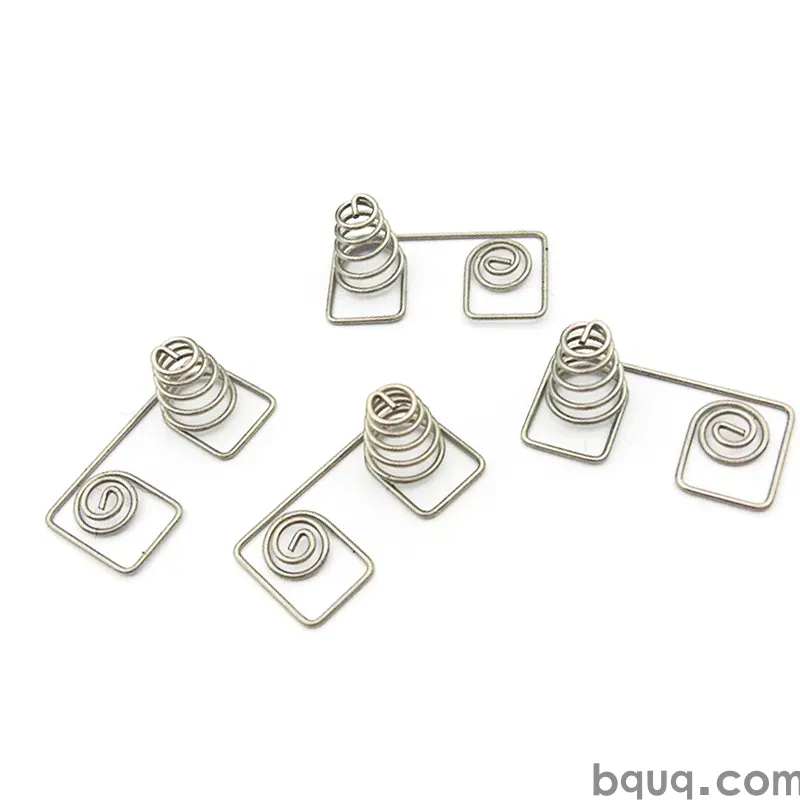
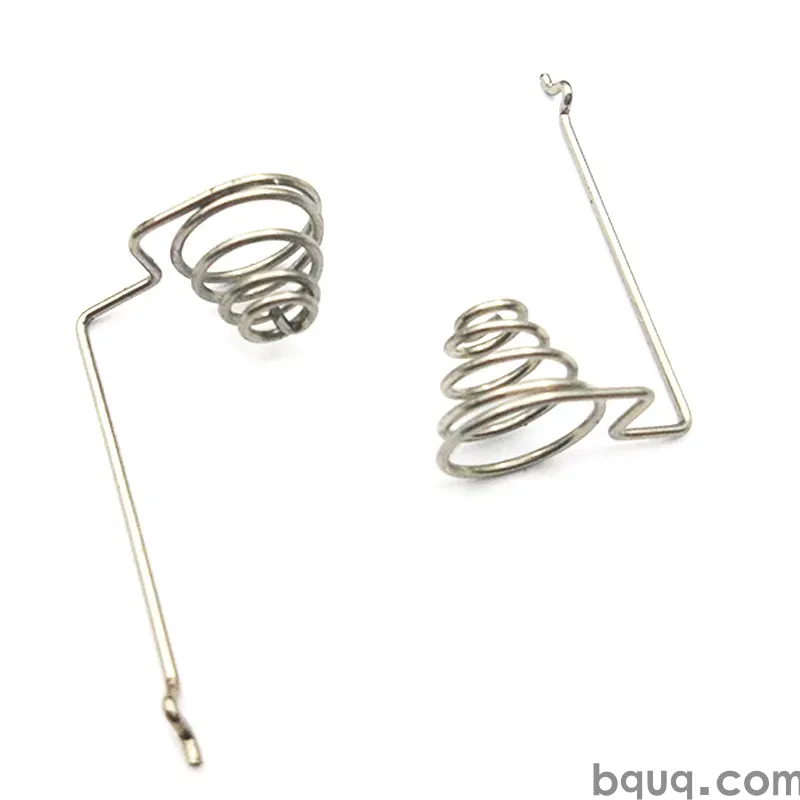
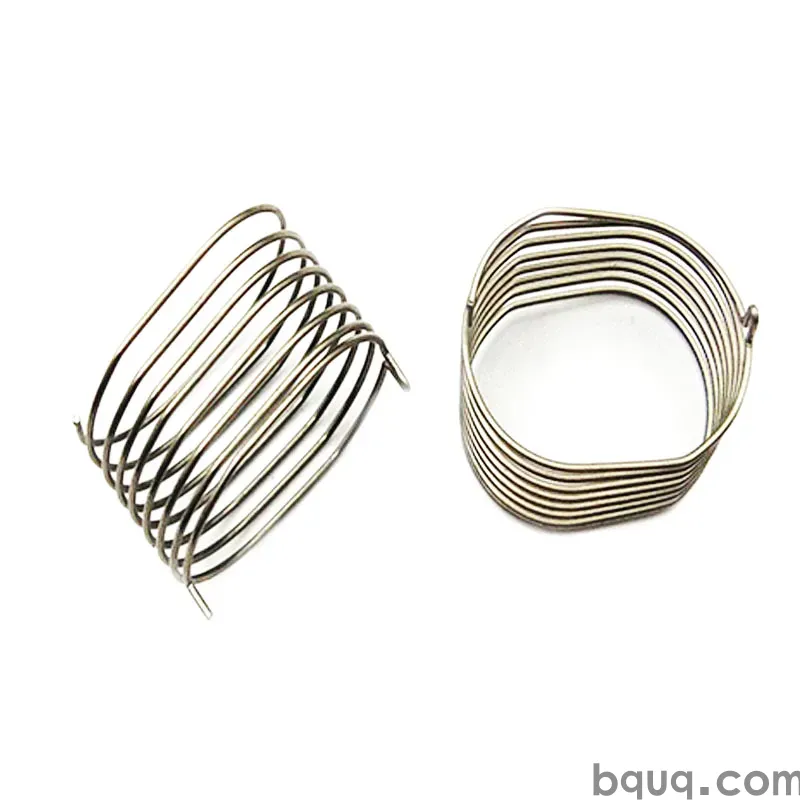
Three families cover most of what a stamping line produces, and they differ in material, tolerance, and finish rather than in the machine. Stamped terminals and contacts are the precision end: connector pins, crimp terminals, socket contacts, and the spring contacts inside switches and battery holders. They need exact pitch dimensions, controlled spring force after forming, and plating that survives thousands of insertions. Stamped brackets and mounts are the structural end: board retainers, chassis brackets, heat sink clips, shielding frames — thicker material, coarser tolerances, strength and flatness that matter more than micron-level features.
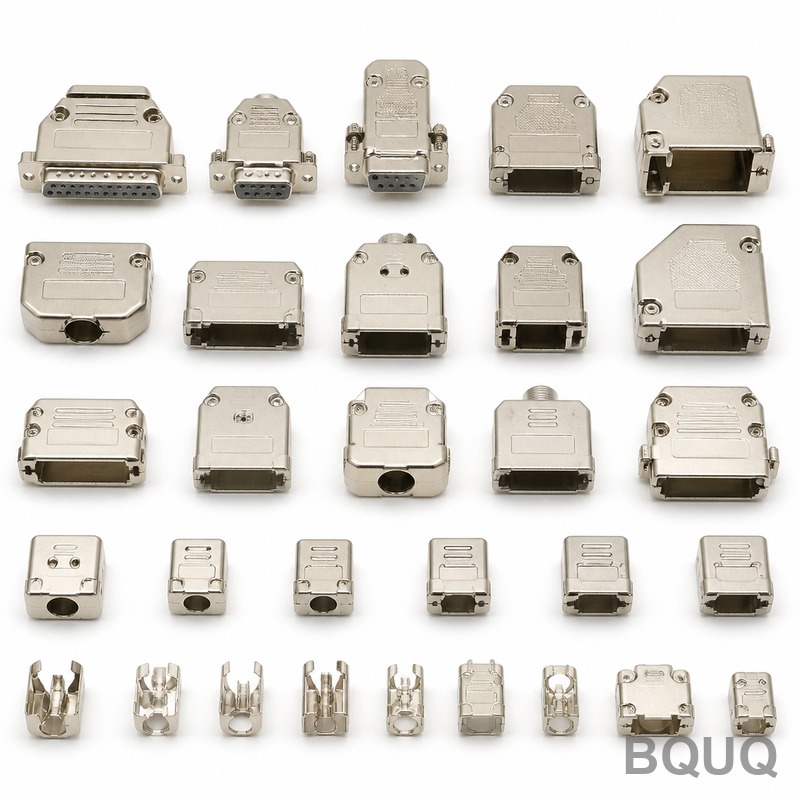
Sheet metal enclosures are the third family: shield cans, RF covers, chassis panels, and small boxes formed from sheet, often with a progressive or a line die that cuts, bends, and sometimes welds. Enclosures blur the line between stamping and sheet metal fabrication; the giveaway is volume — when you need tens of thousands of identical shield cans, they are stamped, not laser-cut one at a time.
Which Materials and Platings Do Stamped Parts Use?
Stamped parts inherit their material from function. Terminals and contacts need conductivity, springiness, and solderability, so the menu is copper alloys — brass for cheap terminals, and phosphor bronze or beryllium copper for spring contacts — the alloys compared in our stamped spring contact materials guide. Brackets and enclosures need strength and cheapness — steel, stainless, and aluminum. Then plating adds the surface function: low contact resistance, corrosion protection, solderability, or cosmetic finish.
| Material | Typical use | Typical plating |
|---|---|---|
| Brass C2600/C2680 | Terminals, pins, sockets | Tin (1–8 µm), gold flash on contact area |
| Phosphor bronze C5191/C5210 | Spring contacts, terminals needing flex | Tin, gold, silver |
| Beryllium copper C17200 | High-cycle spring contacts, touch springs | Gold flash, silver, or none |
| Stainless 301/304 | Spring clips, corrosion-resistant parts | Usually none, or selective gold |
| Steel (SPCC/SECC) | Brackets, frames, shields | Zinc, nickel, tin |
| Aluminum 5052/6061 | Lightweight brackets, heat sink clips | Chromate, anodize (on aluminum) |
Plating thickness values are typical and vary by spec — a connector rated for 500 insertions carries more gold at the contact zone than a part that gets assembled once. Note the pattern: gold and silver plate where the electrical contact happens; tin and nickel plate for solderability and corrosion; steel parts get zinc or nickel because bare steel rusts. The material-versus-plating logic is covered in depth on our stamped terminals and contacts page.
How Does Stamping Tooling Development Actually Work?
Die development is a project, not a purchase order, and it follows a standard sequence. First, design review: the factory's engineers study the part drawing for stampability — bend radii that crack, features that need two dies, tolerances that fight the process. Changes made here cost nothing; changes made after steel is cut cost everything. Second, die design and steel cutting, usually wire EDM and CNC machining of the die blocks. Third, tryout: the die goes in the press, sample parts come out, and the toolmaker adjusts clearances, bend angles, and strip feed until parts hit the drawing.
Fourth, first-article inspection: samples get measured against every critical dimension, often with optical comparators and CMM, and the report goes to you with the samples. Only after you approve does production run. A good stamping supplier will tell you during design review what the die will really cost and what tolerance the process can hold — because a die is a sunk cost you cannot revise by editing a file. Our stamping line follows exactly this flow, and we usually cut the first prototype samples by CNC while the die is being built, so you are testing real parts in your product weeks before the die finishes.
Why Buy Stamping From a Factory That Also Machines and Springs?
The answer is the parts that sit between processes. A connector terminal is stamped; the spring that tensions it may be coiled; the housing it mounts into may be machined or die cast; the heat it generates may need a stamped heat sink. When those parts come from one factory with one quality system, the assembly fits together the first time and one vendor owns the outcome. We run stamping beside CNC machining, custom springs, and heat sinks in one ISO9001 plant in Dongguan — a stamped terminal can ship in the same carton as its mating machined component, inspected against the same standards.
There is a second advantage that shows up on the quote: honesty about process choice. At low volume, machining a prototype costs a few hundred dollars and no tooling. At high volume, stamping wins by a wide margin. A single-process shop sells you its process; a four-line factory sells you the cheapest process that still meets the drawing, because it can still win the business either way. Send the part drawing to sc@bquq.com or WhatsApp +86 13713157787, and within 12 hours on a working day you will know which process your part deserves and what it costs — tooling number included.
Email sc@bquq.com or WhatsApp +86 137 1315 7787 with your PDF/DXF/STEP file. An engineer reviews it and replies with price, lead time and DFM notes on working days.
Stamped or machined? (Decision tree)
| If the part... | Choose | Why |
|---|---|---|
| Is thin, flat or formed from strip, at 1,000+ pcs | Stamping | Tooling pays back at volume |
| Is a prototype or under a few hundred pcs | Laser cut + form, or CNC | Avoids die cost |
| Is thick or has complex 3D form | CNC machining | Stamping is limited by strip thickness |
| Needs smooth edges and a tight profile | Fine blanking | Better sheared-edge quality |
| Is a contact or terminal with spring property | Stamped + heat treat/plating | Material and finish decide performance |
Frequently Asked Questions
What is the minimum order quantity for stamped parts?
A: Stamping economics are driven by the die, not the order size, so small first orders are normal while tooling is validated. After the die exists, the factory can run 1,000 pieces or 10 million. Prototypes before the die are usually CNC-machined — no tooling required.
How much does a progressive stamping die cost?
A: Typically $5,000–$40,000 (indicative), depending on part size, material thickness, feature count, and precision. The die is the real investment in stamping — which is why design review before cutting steel matters so much.
What tolerances can progressive die stamping hold?
A: ±0.02–0.05 mm on critical features like terminal pitch and contact geometry is typical, verified with optical measurement and CMM. General dimensions run looser. Ask for the first-article report and judge by data, not promises.
What is the difference between stamping and sheet metal fabrication?
A: Stamping uses a die in a press for high-volume identical parts. Sheet metal fabrication — laser cutting, bending, welding — makes low volumes without tooling. Above roughly 5,000–10,000 pieces of one design, stamping usually wins on unit cost.
Can I get prototype stamped parts before paying for the die?
A: Yes. We machine prototype parts by CNC from the same drawing so you can test fit and function while the die is in development. The prototype validates the design; the die trial validates the process.
Related Articles
- Progressive Die Stamping Cost: How Tooling and Part Price Work — How stamping quotes work: tooling $3,000–$50,000 (indicative) plus per-part price, what drives both, and when stamping beats CNC machining on cost.
- Stamped Spring Contacts: Phosphor Bronze vs Beryllium Copper vs Steel — Phosphor bronze C5210, beryllium copper C17200, and 301 stainless for stamped spring contacts: conductivity, strength, fatigue, cost, and selection.
Data Sources and Verification
Tolerances, cycle times and price ranges in this guide come from BQUQ production records at our Dongguan plant, where CNC machining (±0.005 mm), stamping, custom springs and heat sinks run under one roof. BQUQ is an ISO 9001:2015 certified factory; the certificate and batch inspection reports are available on request with every quotation.
Related Resources
- About BQUQ: an ISO9001-certified source factory in Dongguan running four production lines under one roof.
- Stamping products: explore stamped terminals and contacts, stamping brackets and mounts, and sheet metal enclosures.
- Industry trends: manufacturing, material market, and sourcing analysis for buyers.
- Technical articles: engineering guides on CNC, heat sinks, springs, and stamping — more where this one came from.
- FAQ hub: quick answers on CNC, stamping, springs, and heat sinks.
- Case studies: real parts and real numbers from projects we engineered and delivered.
- Contact us: send your drawing and get a quote within 12 working hours.
Authored by the BQUQ Engineering Team. BQUQ (Dongguan) runs CNC machining (±0.005 mm), metal stamping, custom springs, and heat sink production in one ISO9001 factory. Source-direct from Dongguan, China — quote in 12 hours: sc@bquq.com | WhatsApp +86 13713157787 | www.bquq.com