BQUQ, a Dongguan source factory, explains hardware stamping parts: what terminals, clips, brackets and contacts cost, tolerances and how to buy them.
Hardware Stamping Parts: A Source-Factory Guide to Terminals, Clips, Brackets and Contacts
Short answer: hardware stamping parts — terminals, clips, brackets, contacts — are blanks cut and formed from metal strip by progressive dies at 200–800 strokes per minute, with typical production tolerances of ±0.05 mm on formed features and ±0.02–0.05 mm on flat blanked ones. Tooling runs from roughly $2,000 for a simple terminal die to $20,000+ for a complex bracket tool, and per-part prices at volume usually land below $0.10. Stamping becomes the economic choice over CNC machining once annual volume passes roughly 10,000–50,000 pieces, depending on part size. That crossover logic, and how to spec the parts, is what this guide covers.
Buyers see stamped hardware everywhere: the terminals inside a connector, the clip that holds a battery, the bracket under an LED driver, the contact in a relay. They look similar but they are engineered differently — one demands conductivity, one spring force, one flatness, one corrosion resistance. This guide is written from the die shop floor in Dongguan, where we run progressive stamping every day alongside CNC, spring, and heat sink lines, and it is aimed at engineers and buyers who need to source these parts without guessing.
What Counts as a Hardware Stamping Part?
Hardware stamping parts share one thing: they start as coil strip and get punched and formed without removing material. Beyond that, the four families buyers name most — terminals, clips, brackets, contacts — have different design drivers.
| Part family | Typical materials | Strip thickness | Formed tolerance | Design driver |
|---|---|---|---|---|
| Terminals and pins | Phosphor bronze C5191/C5210, brass C2680, CuNiSi alloy | 0.1–0.6 mm | ±0.02–0.05 mm | Conductivity, plating adhesion, coplanarity |
| Clips and springs | Stainless 301, spring steel SK5/C75, beryllium copper | 0.1–0.8 mm | ±0.05 mm | Elastic force, fatigue life, snap behavior |
| Brackets and mounting plates | SPCC/galvanized steel, 5052 aluminum, 304 stainless | 0.5–3.0 mm | ±0.1–0.2 mm | Stiffness, hole pattern accuracy, finish |
| Electrical contacts | Silver-tin-oxide clad or riveted copper alloys | 0.3–1.0 mm | ±0.05 mm | Contact resistance, wear, weld resistance |
A terminal is a current path, so base metal and plating dominate the spec. A clip is a spring you stamp instead of wind, so temper and grain direction matter more than conductivity. A bracket is structure, so gauge, bend radius, and hole-to-hole accuracy decide whether it assembles. A contact is an electrical switch interface, so material at the mating surface carries the requirement. Trying to buy all four with one generic "stamped metal part" spec is how projects end up with clips that take a set or terminals that overheat.
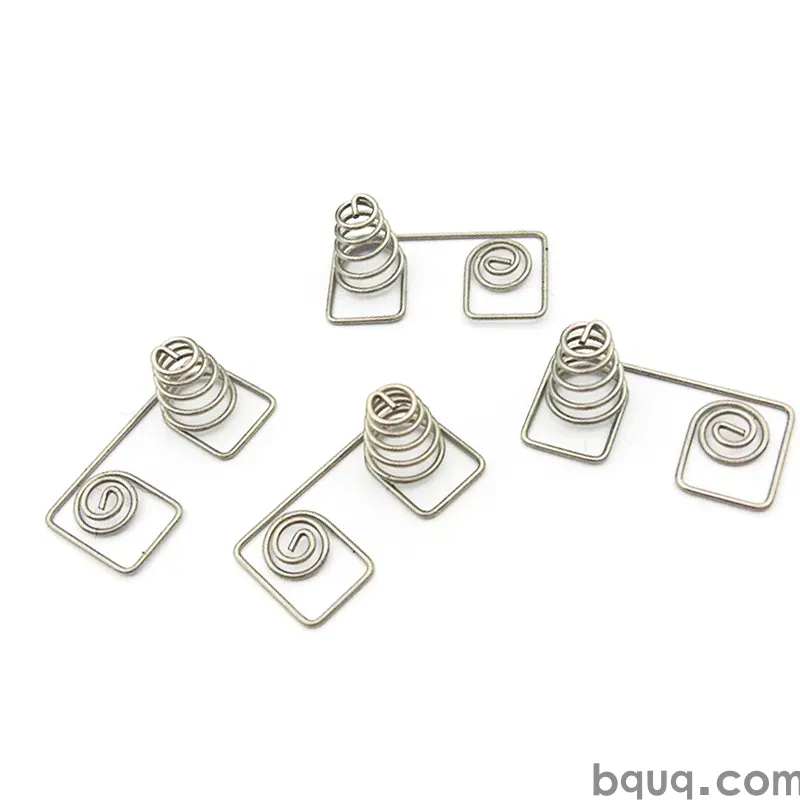
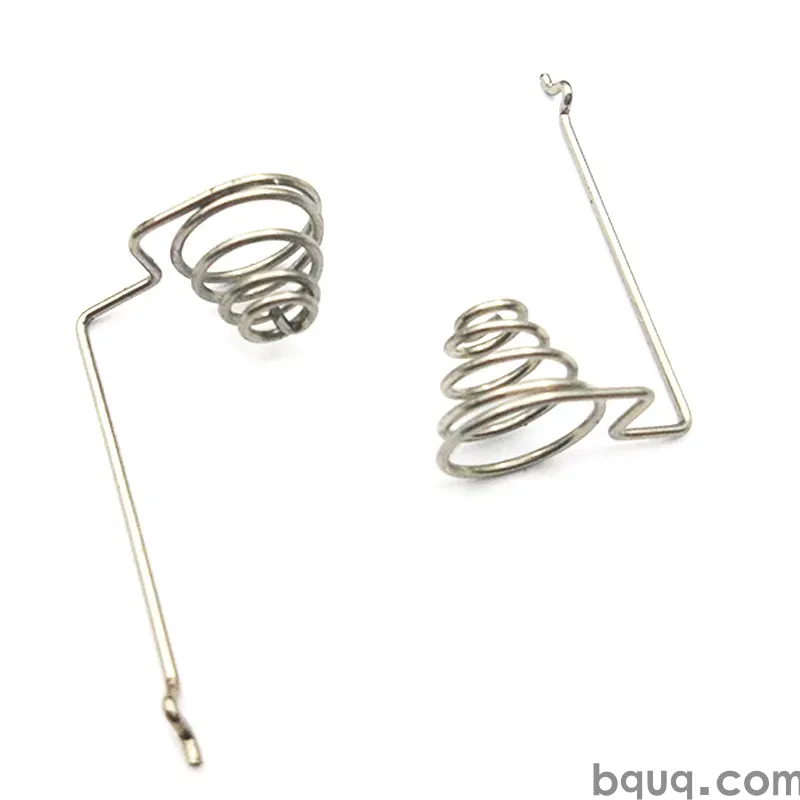
Real products mix the families in one assembly. A battery holder contains a stamped contact beam, a stamped retention clip, and often a wound coil spring for the side contact; a connector contains terminals, a shield can, and a stamped latch. That is why a factory that stamps and also winds springs and machines housings can be easier to work with than four specialized shops: one engineering conversation settles the material and tolerance logic across all the metal in the product, one set of samples validates the whole assembly, and you avoid the classic handoff problem where each supplier blames the other's tolerance stack.
Why Stamping Wins Above a Volume Threshold
Stamping is the cheapest way to make a metal part only when the tooling cost can be spread. The rule of thumb we give customers: if the part is small (under roughly 100 × 100 mm), flat or lightly formed, and you need more than about 10,000–50,000 pieces a year, a progressive die almost always beats CNC machining on unit cost. Below that volume, the die is a bad investment and CNC or laser cutting is the honest recommendation.
What changes at volume is unit economics. A progressive die makes one part every press stroke — 200 to 800 strokes per minute on high-speed presses for thin strip — with no per-part setup, no operator measuring every feature, and scrap held down by careful strip nesting. Material utilization on a well-nested terminal part runs 50–70%; a badly nested blank can waste half the coil. When we quote a stamped part we are really quoting three numbers: material utilization, strokes per minute, and die life between maintenance. Those three decide your per-part price more than anything the press operator does.
Two more levers sit upstream of the press. Multi-out tooling — cutting two, four, or eight identical parts per stroke — divides press time per part by the cavity count and is standard for small terminals and clips. And the strip itself is negotiable: buying coil in the exact width the die needs, instead of slitting from a standard width, cuts scrap and per-kilo cost. Tell the factory your honest annual volume; it changes whether we build a single-out or multi-out die, and that decision is nearly impossible to reverse economically after the tool is cut.
What Drives the Price of a Stamped Part
Cost structure flips versus machining. CNC cost is mostly cycle time and material. Stamping cost is mostly the die, then material, then press time. The table below gives indicative numbers to plan against; actual quotes come from your drawing.
| Part type | Progressive tooling, indicative | Typical press speed | Die life before major service | Per-part price at 100k pcs, indicative |
|---|---|---|---|---|
| Simple flat terminal, 0.2 mm strip | $2,000–$8,000 | 400–800 spm | 5–20 million strokes with re-sharps | $0.005–$0.03 |
| Formed clip with spring bend, 0.4 mm | $5,000–$12,000 | 300–600 spm | 3–10 million strokes | $0.01–$0.05 |
| Multi-bend bracket, 1.5 mm steel | $10,000–$25,000 | 100–300 spm | 1–5 million strokes | $0.05–$0.30 |
| Precision contact with coined surface | $8,000–$20,000 | 300–600 spm | 2–8 million strokes | $0.02–$0.08 |
Two consequences follow from these numbers. First, tooling is where you negotiate — the die design (progressive stages, carbide inserts, coatings) sets both the tool price and how long it runs before wear shows up. Second, unit price collapses between 10k and 100k pieces because the tooling cost per part drops tenfold, then flattens — so annual forecasts matter more than any single order size when we design the tool. For deep background on how the die itself is built and priced, our progressive die stamping cost guide walks through stage count and maintenance.
Tolerances: What a Die Can Actually Hold
Buyers routinely over-specify stamping tolerances, and over-specification costs real money because it forces extra die stages, coining operations, and slower presses. What a well-built progressive die holds in production:
| Feature type | Realistic production tolerance | What improves it |
|---|---|---|
| Blanked profile, flat part | ±0.02–0.05 mm | Carbide die, tight guide, material gauge control |
| Hole position across a flat part | ±0.05 mm | Pilot holes, consistent feed pitch |
| Formed bend angle | ±0.5–1.0° | Coining or bottoming stations, springback compensation |
| Formed dimension across bends | ±0.05–0.10 mm | Material temper consistency, overbend correction |
| Flatness of large blank | 0.1 mm over 100 mm typical | Stress-relief leveling, strip tension control |
Hold ±0.05 mm as your planning number for formed features and you will not be disappointed. Call ±0.02 mm only on flat blanked features that genuinely need it, and expect the die to be more expensive and the press slower to keep it. Verification matters as much as the tolerance itself: a serious die shop runs a first-article inspection at tool tryout, measures critical features in-process during the run, and ships a dimensional report with each batch. Ask what the supplier measures and with what — optical measurement and CMM for formed geometry, micrometers and pin gauges for holes — because a tolerance no one verifies is a tolerance no one holds. The full picture — including how ISO 2768-style general tolerances interact with stamped parts — is in our stamping tolerance guide. When you send us a drawing we will tell you which callouts drive cost and which are free, before you pay for a die that fights your own print.
Buying Stamped Hardware Parts From a Source Factory
Sourcing from a direct factory rather than a trader changes what you can ask for: die ownership, material certificates, plating done in-house or by a trusted partner, and inspection reports per batch. Practical checklist: send the drawing with material grade (not just "steel" or "copper"), temper if it matters, surface finish, plating spec with thickness, burr side, and annual volume. State whether the part carries current, must spring, or must survive salt and humidity — that changes the metal recommendation. Ask for a stamped sample from tryout tooling before production tooling if volume is uncertain; prototype and low-volume approaches let you validate without committing to a full die. And confirm you own the tool after the tooling charge is paid — at a source factory that is standard practice, documented in the quotation. Send the drawing to sc@bquq.com or WhatsApp +86 13713157787 and you will have a quotation within 12 working hours, including our recommendation on whether stamping is even the right process for your volume. Lead-time planning is straightforward once the die exists: prototype samples from tryout tooling typically arrive within 3–5 weeks of drawing approval, production tooling a few weeks more depending on stage count, and then parts ship as fast as the press runs. Tooling payment is normally split — part on order, balance at tool approval — which keeps both sides honest, and die ownership transfers to you once the tool is paid in full.
Frequently Asked Questions
Q: What is the minimum order quantity for stamped hardware parts?
A: Stamping has no hard MOQ — the real question is volume per year, because the die cost is amortized across it. A $6,000 tool spread over 10,000 pieces adds $0.60 per part; spread over a million it is negligible. For low volumes we suggest prototyping via soft tooling or CNC first.
Q: When should I choose stamping instead of CNC machining?
A: Roughly above 10,000–50,000 pieces a year for small flat or lightly formed parts, stamping wins on unit cost. Below that, CNC avoids the tooling investment entirely. The crossover depends on part size and complexity, so ask the factory to quote both when you are near the line.
Q: What tolerances can a progressive die hold on production parts?
A: Plan on ±0.05 mm for formed features and ±0.02–0.05 mm for flat blanked profiles and hole positions. Tighter work is possible with coining and carbide tooling but raises die cost and slows the press — call out only the dimensions that need it.
Q: Do I own the stamping die after paying the tooling charge?
A: Yes, that is standard practice at a direct source factory. The tooling cost is quoted separately, you own the die, and it is stored and maintained for your repeat orders. Confirm die ownership and storage terms in writing before paying.
Q: How do I get a quote for a stamped hardware part?
A: Send the 2D drawing with material grade, temper, plating, quantity, and annual volume to sc@bquq.com or WhatsApp +86 13713157787. We return a quotation within 12 working hours and will flag it if your volume suits a different process better.
Related Resources
- Stamped terminals and contacts: progressive-die production of precision stamped parts in Dongguan.
- Metal stamping process guide: how the process works and where it fits in your part strategy.
- About BQUQ: an ISO9001-certified source factory running stamping, CNC, spring and heat sink lines under one roof.
- Contact us: send the drawing for a quote within 12 working hours.
Authored by the BQUQ Engineering Team. BQUQ is an ISO9001-certified source factory in Dongguan, China, running CNC machining, metal stamping, custom springs, heat sink and collet lines under one roof. Send drawings to sc@bquq.com or WhatsApp +86 13713157787 for a quote within 12 working hours. www.bquq.com