Metal stamping tolerances by feature type: what normal production holds at no extra cost, and which tighter tolerance callouts raise die and part price.
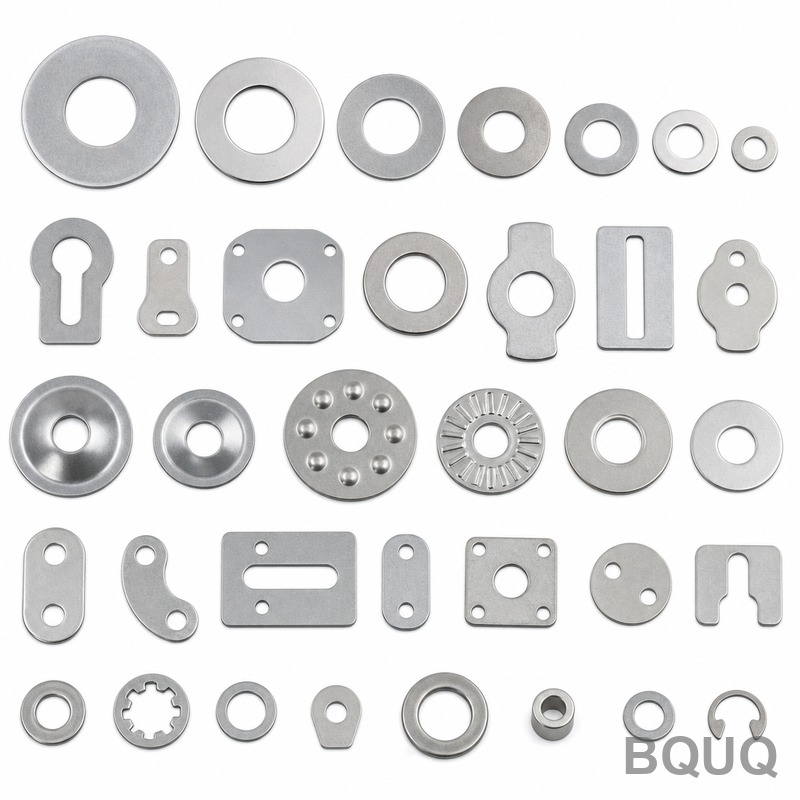
Metal Stamping Tolerances: What's Normal and What Costs Extra
In normal progressive die production, cut features hold ±0.02–0.05 mm, hole positions relative to each other hold about ±0.05 mm, and bend angles run ±0.5–1° — all at no extra cost. Calling tighter tolerances than that, especially on formed features, is where stamping quotes jump, because the fix is not better measuring but better tooling: coining stations, tighter die construction, or secondary operations.
Tolerance on a stamped part behaves differently than on a machined one. A CNC machine can hold a range of tolerances on the same part with program changes; a stamping die is built once and every part from it inherits the same capability. That means tolerance decisions in stamping are made at the die-design stage and paid for in tooling, not per part. Understanding which tolerances are free and which cost money is the fastest way to control both your die budget and your part price.
What a Normal Stamping Tolerance Looks Like
A well-built progressive die produces remarkably consistent parts, but the consistency is not uniform across feature types. Cut features — widths, slots, hole diameters — are controlled by the punch and die opening, so they repeat extremely well. Positions between features are controlled by strip piloting. Formed features — bends, curls, drawn heights — carry the tolerance of the metal's springback behavior, which is why they are the loosest of the lot.
| Feature type | Normal production tolerance | Notes |
|---|---|---|
| Blanked width, slots | ±0.02–0.05 mm | Directly set by punch/die size |
| Hole diameter (pierced) | ±0.02–0.05 mm | Watch burr direction |
| Hole-to-hole / hole-to-edge position | ±0.03–0.08 mm | Set by strip piloting |
| Bend angle | ±0.5–1° | Springback variation |
| Formed height / drawn depth | ±0.05–0.15 mm | Material thickness variation |
| Flatness over 25 mm | 0.05–0.15 mm typical | Improves with coining/leveling |
The takeaway: hold your tightest requirements on cut features and give formed features room. Designers who call ±0.05 mm on a bend height are paying for a capability the process does not naturally own.
Material Thickness Drives Everything
Stamped parts inherit variation from the coil itself. Rolled strip has a thickness tolerance — for example ±0.03–0.05 mm on a 1.0 mm steel strip is not unusual — and that variation flows straight into formed dimensions, bend strength, and part weight. You cannot die your way around coil variation; the die can only be built for one nominal thickness.
| Strip thickness (nominal) | Typical mill tolerance | Effect on formed parts |
|---|---|---|
| 0.2 mm | ±0.01–0.02 mm | Minimal |
| 0.5 mm | ±0.02–0.03 mm | Small but measurable |
| 1.0 mm | ±0.03–0.05 mm | Visible in bend and form dimensions |
| 2.0 mm | ±0.05–0.08 mm | Significant on formed features |
If your critical dimension is a formed height, tighter coil specification is sometimes the cheapest tolerance fix — better to specify a closer-thickness strip than to build a coining station. This is a standard review point when a supplier like ours reviews a stamped part drawing before quoting.
What Actually Costs Extra
Tolerances beyond normal capability cost money in one of three ways: extra die features, extra production steps, or extra inspection. Coining stations flatten and size critical surfaces and can push flatness and thickness tolerances down, but each station adds die cost. Fineblanking replaces the sheared edge with a smooth, full-shear edge and holds ±0.01–0.02 mm, but it needs a dedicated fineblanking press and heavier tooling. Secondary operations like grinding, sizing, or straightening add handling cost per part.
| Tolerance upgrade | How it is achieved | Typical cost effect |
|---|---|---|
| ±0.01–0.02 mm cut features | Fineblanking or EDM-finished die details | Die +50–100%+ |
| Tight flatness | Coining / leveling station | Extra station in die |
| Bend angle under ±0.5° | Springback compensation + tighter control | Higher scrap, slower runs |
| Formed height under ±0.05 mm | Coining + close-tolerance coil | Die + material cost |
| 100% dimensional inspection | Optical sorting or CMM per part | Per-part cost up |
The pattern is worth stating plainly: in stamping, tolerance is bought once in the die, not per part — but die cost is amortized over your full run, so a tolerance upgrade that doubles die cost may add only pennies per part at high volume. The progressive die cost guide shows how to judge that trade-off with your own volume.
Statistical Tolerancing Works Better on Stamped Parts
Because stamping is a stable, repeating process, its output is close to normally distributed around the die's nominal — drift happens slowly with die wear rather than randomly. That makes statistical process control genuinely useful: the factory measures a few parts at intervals, plots the trend, and sharpens or adjusts the die when dimensions walk toward a limit. Parts are effectively the same until the trend says otherwise.
This is why a capable stamping supplier quotes inspection differently than a machine shop. Instead of inspecting every critical part, the shop runs SPC charts, first-article inspection, and in-process checks, and keeps a capability record per feature. Ask for the process capability (Cpk) on your critical features — a supplier that tracks it can tell you your real risk of out-of-spec parts, which matters more than the tolerance on the drawing. Quality expectations like these belong in the review conversation before tooling is cut.
Email sc@bquq.com or WhatsApp +86 137 1315 7787 with your PDF/DXF/STEP file. An engineer reviews it and replies with price, lead time and DFM notes on working days.
Frequently Asked Questions
Q: What tolerance can metal stamping hold as standard?
Cut features such as widths, slots, and hole diameters hold ±0.02–0.05 mm in normal production; positions between features run ±0.03–0.08 mm; bend angles ±0.5–1°. These are achievable without special tooling at no extra cost.
Q: Why are my stamped parts' formed dimensions drifting?
Usually material thickness variation from the coil, or die wear over the run. Formed heights inherit strip thickness tolerance directly. Check coil tolerance first, then track die wear with SPC rather than inspecting every part.
Q: How much does a tighter tolerance cost?
If it needs a coining station or fineblanking, expect die cost to rise substantially — often 50–100% or more for fineblanking capability. At high volume the per-part impact is small; at low volume it can dominate the economics.
Q: Can stamping hold the same tolerances as CNC machining?
Not in general. CNC holds ±0.005 mm routinely, while stamping's economical range is ±0.02–0.05 mm for cut features. If a stamped design truly needs machined-level tolerance on a feature, the practical answer is often a post-stamping CNC operation on that feature only.
Q: What should I put in my drawing to avoid tolerance cost?
Tolerance only the features that interact with other parts — mating widths, hole patterns, critical bend angles. Leave cosmetic and non-functional features at general tolerances, and give formed features realistic ranges so the die does not need extra stations.
Related Articles
- precision-metal-stamping-services-china — More from the BQUQ Metal Stamping engineering series.
- metal-stamping-process-guide — More from the BQUQ Metal Stamping engineering series.
- progressive-die-stamping-cost-guide — More from the BQUQ Metal Stamping engineering series.
Data Sources and Verification
Tolerances, cycle times and price ranges in this guide come from BQUQ production records at our Dongguan plant, where CNC machining (±0.005 mm), stamping, custom springs and heat sinks run under one roof. BQUQ is an ISO 9001:2015 certified factory; the certificate and batch inspection reports are available on request with every quotation.
Related Resources
- About BQUQ: an ISO9001-certified source factory in Dongguan running four production lines under one roof.
- Stamping and sheet metal: terminals, brackets and enclosures from the press line — stamped terminals and contacts, stamping brackets and mounts, sheet metal enclosures.
- Industry trends: manufacturing, material market, and sourcing analysis for buyers.
- Technical articles: engineering guides and process comparisons — more where this article came from.
- FAQ hub: quick answers on CNC, stamping, springs, and heat sinks.
- Case studies: real parts and real numbers from projects we engineered and delivered.
- Contact us: send your drawing and get a quote within 12 working hours.
Authored by the BQUQ Engineering Team. BQUQ is an ISO9001-certified source factory in Dongguan, China, running CNC machining, metal stamping, custom springs and heat sink lines under one roof. Send drawings to sc@bquq.com or WhatsApp +86 13713157787 for a quote within 12 working hours. www.bquq.com