Metal stamping process explained: coil feed, progressive die stations, tolerances and thickness. ISO9001 Dongguan factory, 12-hour quotes.
Metal Stamping Process: How a Coil Becomes a Finished Part
Metal stamping feeds coiled metal strip through a press and a die, and with every stroke the die cuts, bends, and forms the strip into a finished part — hundreds of parts per minute for small components, with critical dimensions typically held to ±0.02–0.05 mm. It is the cheapest way to make metal parts once volume passes a few thousand pieces a year, because the cost is concentrated in the die, not in each part. Everything else — the coil, the press, the stations — exists to pay that die back as fast as possible.
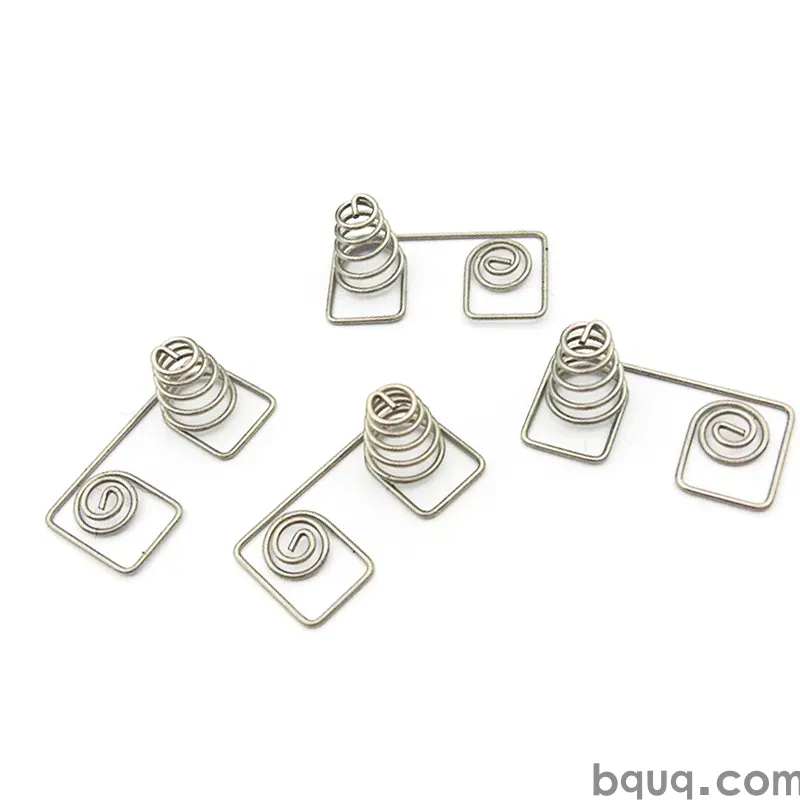
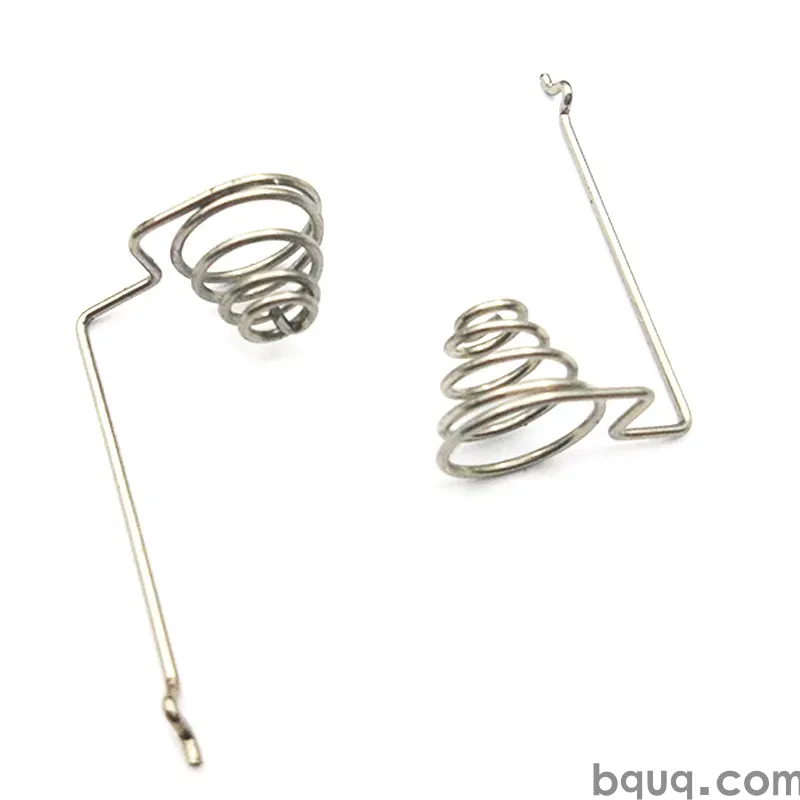
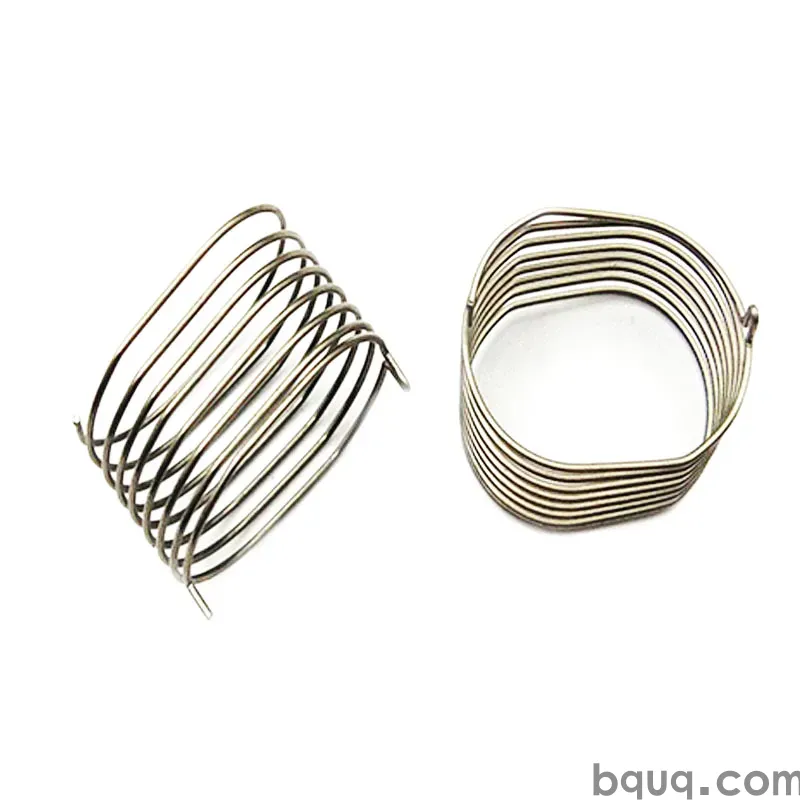
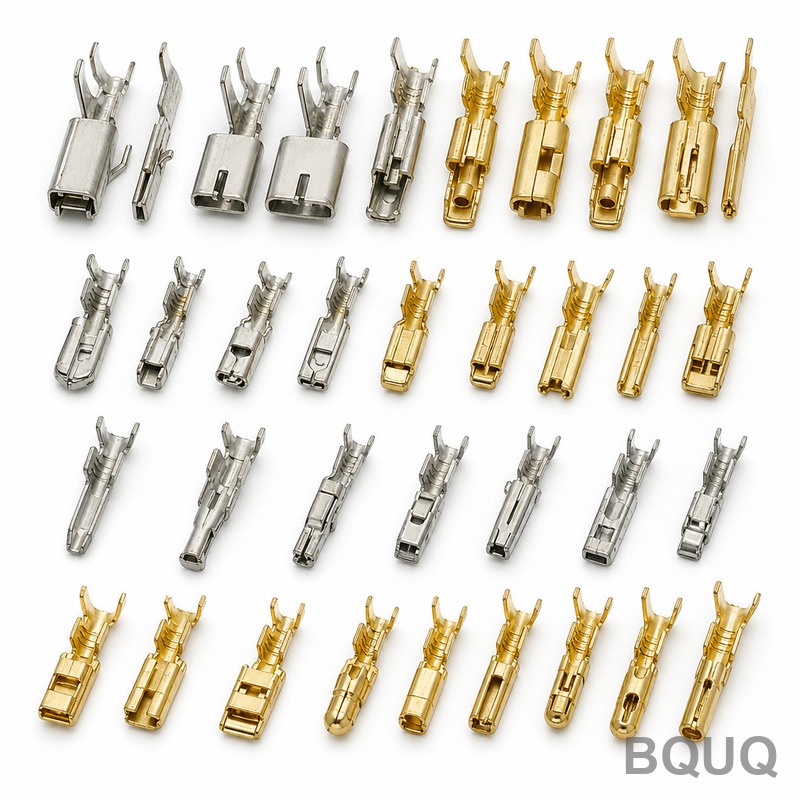
Stamping is how the metal parts you never notice get made: the terminal inside a connector, the spring contact behind a switch button, the bracket holding a PCB, the shield can around a radio module. Understanding the process helps you design parts that stamp cleanly, and helps you judge whether a factory quoting your job knows what it is doing. This guide walks the full route from coil to finished part and shows where cost, speed, and tolerance actually come from.
The Stamping Line: Coil, Straightener, Press, Die
A stamping line starts with metal in coil form, not sheets. Coil stock is cheaper per kilogram than cut sheets and lets the press run continuously without reloading. Before the strip enters the die it passes through a straightener that flattens coil curvature, then a feeder that advances an exact distance per stroke — the pitch. Pitch accuracy decides whether every feature lands where the drawing says, which is why feed error shows up immediately as rejected parts.
The press provides the force. Small precision parts run on presses from a few tons up to a couple hundred tons; larger formed parts and heavier material need bigger machines. What matters more than tonnage is the die, the hardened tool that shapes the metal. A stamping die is a pair of matched steel (or carbide) halves: the punch on top, the die button or cavity below. Strip moves between them, and each stroke is one complete work cycle.
| Line element | Job it does | Typical values |
|---|---|---|
| Coil + straightener | Supply flat strip continuously | Thickness 0.05–3.0 mm common for stamping |
| Feeder | Advance strip by exact pitch per stroke | Pitch error kept under ~±0.03 mm |
| Press | Deliver force per stroke | Small parts: 10–200 tons; speeds to several hundred SPM |
| Die | Cut, form, and separate the part | Progressive dies: 10–40+ stations |
| Scrap chopper | Cut skeleton strip for recycling | Steel/brass scrap has resale value |
The takeaway from that table: stamping output is measured in strokes per minute (SPM), and the die converts each stroke into profit. That is why tooling quality, not press size, is the real asset in a stamping shop.
How a Progressive Die Builds the Part in Stages
In a progressive die the strip moves through a sequence of stations, and each station does one small job. Station one pierces pilot holes used for alignment; later stations cut the outline, bend a tab, form a curl, coin a flat, and the last station parts the finished piece from the strip. Because the strip is always registered against pilot holes, every feature keeps its position relative to the others regardless of the order they were made.
| Station | Operation | What it produces |
|---|---|---|
| 1–2 | Pierce pilot holes, trim edges | Registration points for later stations |
| 3–5 | Blank outline, pierce holes/slots | Internal features and part profile |
| 6–8 | Bend, form, curl, coin | 3D shape, angles, and flatness control |
| 9+ | Optional: tap, mark, or assemble inserts | Features added before part-off |
| Final | Cut the part free from the strip | Finished part + scrap skeleton |
A connector terminal with four bends might pass through fifteen stations before it is parted off. One stroke of the press makes one complete terminal — that is the entire economic secret of progressive die stamping: after the die exists, the machine makes parts faster and cheaper than any other metal-forming route.
The Core Operations: Blanking, Bending, Forming, Drawing
Underneath the station list sit four basic operations, and most stamped parts are combinations of them. Blanking and piercing cut metal: blanking cuts the part outline out of the strip, piercing cuts holes into the part. Both are shearing actions — the punch pushes the metal through the die opening, and the gap between punch and die (clearance) decides the quality of the cut edge. Too little clearance gives torn edges and heavy punch wear; too much gives a rounded edge and a large burr. Typical cutting clearances run 5–10% of material thickness per side for most alloys.
Bending forms angles along a straight line and is governed by the inside radius rule: a sharp bend radius below about one material thickness concentrates strain and risks cracking on the outside of the bend. Forming is a looser term for shaping that is not a straight bend — curls, offsets, ribs, and drawn features. Drawing pulls flat sheet into a cup or shell and is limited by how much the material can stretch before it tears.
| Operation | What it does | Typical limits |
|---|---|---|
| Blanking / piercing | Shear the outline and holes | Edge quality set by die clearance |
| Bending | Fold along a straight line | Inside radius ≥ 1× thickness preferred |
| Forming | Offset, curl, rib, emboss | Springback must be compensated |
| Drawing | Stretch sheet into a cup/shell | First-draw ratio ~2.0 max on common alloys |
Not every part needs all four. A simple mounting bracket may be blank, pierce, and bend. A battery contact adds forming and coining. The mix of operations decides die complexity, and die complexity decides your tooling quote.
Materials, Speed, and Where Stamping Wins
The material menu for stamping follows function. Terminals and contacts need conductivity and springiness, so copper alloys dominate: brass for cost, phosphor bronze for repeated flexing, beryllium copper for high-cycle contacts. Brackets and structural parts use steel and stainless; lightweight parts use aluminum. Plating then adds the surface function — tin for solderability, gold at contact zones, zinc or nickel for corrosion.
| Material family | Typical strip thickness | Typical parts |
|---|---|---|
| Brass C2600/C2680 | 0.1–1.0 mm | Terminals, pins, sockets |
| Phosphor bronze C5191 | 0.05–0.8 mm | Spring contacts, fuse clips |
| Beryllium copper C17200 | 0.05–0.5 mm | High-cycle contacts, touch springs |
| Stainless 301/304 | 0.1–1.5 mm | Spring clips, corrosion-resistant parts |
| Steel SPCC/SECC | 0.3–3.0 mm | Brackets, frames, shields |
| Aluminum 5052 | 0.3–3.0 mm | Lightweight brackets, heat sink clips |
Stamping earns its place against machining when three conditions hold: volume is high enough to amortize the die, the part is small enough to feed through a die economically, and tolerances stay inside what stamping holds without extra operations. If you are below those volumes, CNC or prototype stamping routes make more sense; if the part exceeds them, stamping typically beats machining by a factor of three or more per part. Families like stamped terminals and contacts, brackets and mounts, and sheet metal enclosures are where the process earns its keep every day.
After the Press: Secondary Operations
The press rarely delivers the finished product by itself. Most stamped parts need at least one secondary step: deburring or tumbling to clean the cut edges, plating for solderability or corrosion, heat treatment if the part must act as a spring, or a light forming operation done off the press. Some parts go back into the die as a coining station instead — doing the work in the die costs less per part but more in tooling, which is the trade-off behind every die design decision.
Quality control runs alongside production, not after it. Dimensional checks on critical features happen at intervals during the run, and the first article is inspected before the press runs at speed. A serious supplier ships every batch with an inspection report, and we do at BQUQ because we run stamping beside CNC, spring, and heat sink lines in one ISO9001 factory in Dongguan — the same drawing review that applies to a machined part applies to a stamped one.
Email sc@bquq.com or WhatsApp +86 137 1315 7787 with your PDF/DXF/STEP file. An engineer reviews it and replies with price, lead time and DFM notes on working days.
Frequently Asked Questions
Q: How fast does a stamping press actually produce parts?
Small precision parts run at several hundred strokes per minute; large or heavily formed parts drop to 20–60 SPM. Even at the slow end, that is thousands of parts per hour, which is why per-part cost collapses once the die is paid for.
Q: What thickness range can metal stamping handle?
Most progressive stamping runs between 0.05 and 3.0 mm of strip. Terminals and contacts live at the thin end, 0.05–1.0 mm; brackets and enclosures use the thicker range. Above roughly 3 mm, cutting forces and bend radii make other processes more practical.
Q: What tolerance can a stamped part hold?
Critical features hold ±0.02–0.05 mm in normal production, verified with optical measurement or CMM. Bend angles run about ±0.5–1°. Holding tighter than that pushes you toward coining stations, extra operations, and higher tooling cost.
Q: Why is stamping tooling so expensive?
A progressive die is a precision machine tool built from hardened steel or carbide, often with twenty or more stations, each machined and fitted by hand. Typical tooling runs $5,000–$40,000 depending on part complexity, which is why stamping only pays off at volume.
Q: When should I machine a part instead of stamping it?
Below roughly a few thousand pieces per year, or when the part has deep pockets, undercuts, or features that cannot be formed from strip, CNC machining is usually the cheaper route. Send the drawing and quantity; a factory that runs both processes can quote both and tell you which wins.
Related Articles
- stamped-spring-contact-materials — More from the BQUQ Metal Stamping engineering series.
- stamping-vs-deep-drawing-guide — More from the BQUQ Metal Stamping engineering series.
- stamped-terminal-design-guide — More from the BQUQ Metal Stamping engineering series.
Data Sources and Verification
Tolerances, cycle times and price ranges in this guide come from BQUQ production records at our Dongguan plant, where CNC machining (±0.005 mm), stamping, custom springs and heat sinks run under one roof. BQUQ is an ISO 9001:2015 certified factory; the certificate and batch inspection reports are available on request with every quotation.
Related Resources
- About BQUQ: an ISO9001-certified source factory in Dongguan running four production lines under one roof.
- Stamping and sheet metal: terminals, brackets and enclosures from the press line — stamped terminals and contacts, stamping brackets and mounts, sheet metal enclosures.
- Industry trends: manufacturing, material market, and sourcing analysis for buyers.
- Technical articles: engineering guides and process comparisons — more where this article came from.
- FAQ hub: quick answers on CNC, stamping, springs, and heat sinks.
- Case studies: real parts and real numbers from projects we engineered and delivered.
- Contact us: send your drawing and get a quote within 12 working hours.
Authored by the BQUQ Engineering Team. BQUQ is an ISO9001-certified source factory in Dongguan, China, running CNC machining, metal stamping, custom springs and heat sink lines under one roof. Send drawings to sc@bquq.com or WhatsApp +86 13713157787 for a quote within 12 working hours. www.bquq.com