Stamping vs deep drawing: what geometry each process makes, draw ratio limits, wall thinning and tooling cost — and how to choose between them.
Stamping vs Deep Drawing: Process Limits and Part Geometry
Stamping bends and shears flat strip into parts that stay close to their original sheet thickness, while deep drawing stretches and pulls the metal into hollow shapes — cups, shells, cans — that can be several times deeper than their width. The practical dividing line is geometry: if your part is a bracket, terminal, or cover with bends, it is stamped; if it is a seamless hollow body, it is drawn. Trying to stamp a deep cup or draw a sharp-cornered bracket is how tooling budgets die.
The two processes share presses and dies but behave like different technologies because the metal does different things. In stamping, thickness barely changes and failure shows up as cracks at sharp bends or excessive burrs. In deep drawing, the material is deliberately thinned and stretched, and failure appears as tears in the wall or wrinkles in the flange. Choosing between them starts with reading your part geometry, not comparing machine specs.
What Each Process Can Actually Make
Stamping — blanking, piercing, bending, and forming from strip — produces parts whose form is built from the flat sheet by folding and small local stretches. Wall thickness stays close to the original material, corners stay sharp-ish, and the part generally has an open, folded structure. Brackets, terminals, clips, shields, and enclosures with flanged edges are stamping territory.
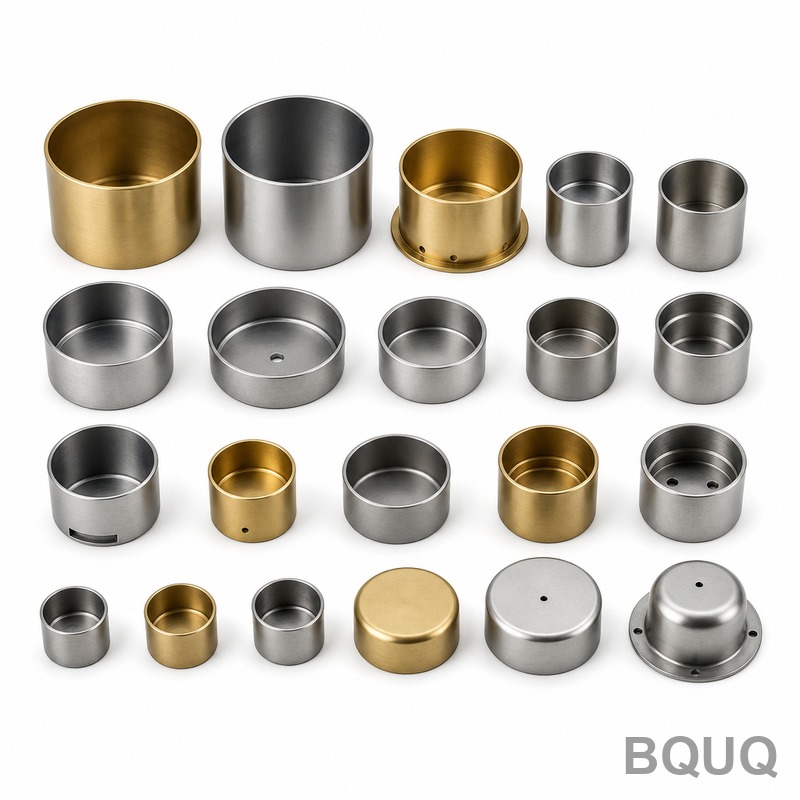
Deep drawing produces seamless hollow parts by pushing a flat blank through a die with a punch, so the bottom and walls are one continuous piece of metal with no joints. Cups, battery cans, motor housings, and drawn connector shells are the classic outputs. The geometry is closed — a bottom with walls rising from it — and the depth-to-width ratio is the number that decides difficulty.
| Geometry question | Stamping | Deep drawing |
|---|---|---|
| Part structure | Open, folded, flanged | Hollow, seamless, closed-end |
| Wall thickness | ~Original sheet thickness | Thins in walls (can vary 10–20%+) |
| Corners | Relatively sharp bends possible | Needs generous radii on punch/die |
| Depth | Shallow forms, bends | Multiple times part width, staged |
| Material flow | Mostly bending, little stretch | Heavy stretching and compression |
The takeaway from the comparison: if you can unfold the part in your head and refold it from a flat blank, it is stamping. If it is a container-like body that cannot be unfolded without tearing, it is deep drawing.
Draw Ratio: The Number That Sets Difficulty
The first deep drawing operation is limited by how much a flat blank of diameter D can be pulled into a cup of diameter d without tearing the bottom out of the wall. That ratio, D/d, is the limiting draw ratio (LDR). For most common alloys in a single draw, the practical limit is about 1.8–2.0 — meaning a first-draw cup diameter cannot be much less than half the blank diameter.
| Material | Typical limiting draw ratio (first draw) | Typical after annealing / redraws |
|---|---|---|
| Low-carbon steel (SPCC/DC01) | 1.9–2.1 | 3.0+ with intermediate anneals |
| Stainless 304 | 1.8–2.0 | 2.8+ with anneals |
| Aluminum (soft 1100/5052-O) | 1.8–1.9 | 2.5–3.0 with anneals |
| Brass (soft) | 1.9–2.1 | 3.0+ with anneals |
Deeper parts are made by redrawing: each subsequent operation reduces the diameter a little more, and if the metal work-hardens too far, the part is annealed between draws to restore ductility. Every redraw is another station or another press, which is exactly why deep drawn parts get progressively more expensive as depth-to-diameter rises. A ratio under about 0.75 depth-to-diameter is a single draw; going to 2:1 or 3:1 depth means staged tooling.
Thickness Behavior: Where Drawing Differs From Stamping
Stamped bends thin the metal slightly at the bend line and thicken nothing else; a drawn wall is a different story. As the punch pulls the blank into the die, the wall is stretched and thins, while the flange area is compressed circumferentially and tries to wrinkle. A drawn cup that starts as 1.0 mm sheet commonly comes out with walls around 0.85–0.95 mm and a bottom near original thickness, and the top edge of the wall is wavy (earing) because rolled sheet is not perfectly uniform in all directions.
| Process | Thickness change | Dominant failure modes |
|---|---|---|
| Stamping (bend/form) | Negligible except at bend line | Cracking at sharp bends, springback, burrs |
| Deep drawing | Walls thin 10–20%+ typical | Wall tearing, flange wrinkling, earing |
| Ironing (draw + thin) | Deliberate, controlled thinning | Galling, tool wear on the wall |
For the designer this means two rules: never specify drawn parts with the assumption that wall thickness equals sheet thickness everywhere, and never use a drawn cup where a stamped-and-assembled part works. Plenty of "can" shapes are actually two stamped halves joined, because that avoids the draw entirely — the classic decision point on enclosures and housings.
Cost and Volume: Drawing Is Specialized Tooling
Deep drawing is not a different price tier of the same tool — it is heavier, more specialized tooling with more development risk. Draw dies need exact radii control, blank holders to suppress wrinkling, and often multiple stages. A simple bracket die might run a few thousand dollars; a multi-stage draw die for a deep shell runs far more, and each stage is a separate precision tool. That cost is only sensible when the part genuinely needs to be seamless.
| Cost factor | Stamping (bend/blank) | Deep drawing |
|---|---|---|
| Typical tooling complexity | 1 tool, moderate stations | Blank holder + punch + die, staged |
| Development iterations | Lower risk | Higher risk (wrinkle/tear tuning) |
| Material utilization | Good, nesting in strip | Lower, round blank from square sheet |
| Secondary needs | Deburr, plating | Trim, anneal between stages, sometimes ironing |
The engineering conclusion: choose stamping unless the application demands a seamless hollow body — pressure containment, leak-free battery cans, minimum material, or the drawn look itself. When volume is high enough, progressive or transfer dies make even complex drawn parts economical, and parts like brackets and mounts or terminals and contacts prove the stamping side of the line every day. Send the drawing with annual quantity, and the process that fits both geometry and volume is the one worth quoting.
Email sc@bquq.com or WhatsApp +86 137 1315 7787 with your PDF/DXF/STEP file. An engineer reviews it and replies with price, lead time and DFM notes on working days.
Frequently Asked Questions
Q: What is the difference between stamping and deep drawing?
Stamping bends and shears sheet metal into open, folded shapes with little thickness change. Deep drawing pulls a flat blank through a die into a seamless hollow part — a cup or shell — stretching and thinning the walls in the process.
Q: How deep can a part be deep drawn in one operation?
In one draw, depth is limited by the draw ratio, and practical first draws reach roughly 0.5–0.75 times the cup diameter for common alloys. Deeper parts need staged redraws, sometimes with annealing between stages.
Q: Can a stamped part be converted to deep drawing later?
If the design allows seams, a two-piece stamped and joined construction often replaces a draw at lower tooling cost. If the part must be seamless, it was never stamping — it was drawing, and the tooling should have been planned that way from the start.
Q: Why do drawn parts have thinner walls than the sheet I specified?
Because the wall is stretched as the punch pulls material into the die, walls commonly end up 10–20% thinner than the starting sheet while the bottom stays near original thickness. Specify the minimum wall you need, not just the starting gauge.
Q: Which process is cheaper for a cylindrical shell?
If the shell must be seamless and volume is high, deep drawing with staged tooling is the standard route. At low volume, a drawn shape is rarely economical — machined, spun, or stamped-and-welded constructions usually win until volume justifies the draw tooling.
Related Articles
- metal-stamping-defects-guide — More from the BQUQ Metal Stamping engineering series.
- precision-metal-stamping-services-china — More from the BQUQ Metal Stamping engineering series.
- sheet-metal-bending-allowance-guide — More from the BQUQ Metal Stamping engineering series.
Data Sources and Verification
Tolerances, cycle times and price ranges in this guide come from BQUQ production records at our Dongguan plant, where CNC machining (±0.005 mm), stamping, custom springs and heat sinks run under one roof. BQUQ is an ISO 9001:2015 certified factory; the certificate and batch inspection reports are available on request with every quotation.
Related Resources
- About BQUQ: an ISO9001-certified source factory in Dongguan running four production lines under one roof.
- Stamping and sheet metal: terminals, brackets and enclosures from the press line — stamped terminals and contacts, stamping brackets and mounts, sheet metal enclosures.
- Industry trends: manufacturing, material market, and sourcing analysis for buyers.
- Technical articles: engineering guides and process comparisons — more where this article came from.
- FAQ hub: quick answers on CNC, stamping, springs, and heat sinks.
- Case studies: real parts and real numbers from projects we engineered and delivered.
- Contact us: send your drawing and get a quote within 12 working hours.
Authored by the BQUQ Engineering Team. BQUQ is an ISO9001-certified source factory in Dongguan, China, running CNC machining, metal stamping, custom springs and heat sink lines under one roof. Send drawings to sc@bquq.com or WhatsApp +86 13713157787 for a quote within 12 working hours. www.bquq.com