Progressive, transfer and compound dies compared: tooling cost, speed, part size and volume breakpoints. Dongguan ISO9001 stamping factory.
Progressive vs Transfer vs Compound Dies: Matching Die Type to Volume
Compound dies are the cheapest to build and best for simple flat parts, progressive dies dominate medium-to-high volumes of small parts because one press stroke finishes the part, and transfer dies take over when parts are large, thick, or need deep draws that a coil strip cannot feed. There is no universally best die — the right choice follows part geometry first and annual volume second, and the tooling cost difference between types can be a factor of five or more.
Buying stamping is really buying a die that will make your part for the next several years. Pick the wrong die type and you either pay for capability you never use, or you lock a part geometry into a die that cannot hold its tolerances. This guide compares the three mainstream die types — compound, progressive, and transfer — with the volume ranges, part sizes, and cost structures where each one wins.
Compound Dies: One Stroke, One Operation, Flat Parts
A compound die performs several cutting operations in a single stroke but all at one station: the part is blanked and pierced at the same time, and the finished flat part drops out complete. Because there is no strip movement between operations, a compound die holds the best positional accuracy of the three types — hole patterns relative to the part outline stay extremely consistent.
Compound dies build flat parts only. Anything requiring a bend, a curl, or a draw needs either extra die stations elsewhere or a different die type. Tooling cost is the lowest of the three, typically a few thousand to low tens of thousands of dollars, and setup is simple. The catch is output: one stroke makes one part, and with the die open and close cycle plus strip indexing, real production usually lands between 30 and 80 strokes per minute.
| Die type | Best part geometry | Typical tooling cost (indicative) | Typical output |
|---|---|---|---|
| Compound | Flat parts, washers, shims, simple blanks | $2,000–$10,000 | 30–80 SPM |
| Progressive | Small-to-mid parts, formed from strip | $5,000–$40,000 | 150–800+ SPM |
| Transfer | Large, thick, or deeply drawn parts | $40,000–$200,000+ | 15–60 SPM |
The practical takeaway: if your part is flat and your volume is under about 100,000 pieces a year, a compound die is often the most economical tool you can buy. It is the standard route for precision washers, shims, and spacers-type components where flatness and hole position matter more than speed.
Progressive Dies: Small Parts at Press Speed
A progressive die spreads the work across many stations along the strip: each stroke advances the strip one pitch, and every station works on a different part simultaneously. The result is one finished part per stroke at several hundred strokes per minute, and that is why progressive tooling dominates connector terminals, contacts, and small brackets.
The trade-off is in the die itself. With ten to forty stations to machine, fit, and align, progressive tooling costs more and takes longer to develop. Tolerance stacks across stations are still excellent because pilot holes keep the strip registered, but the die is more sensitive to material thickness variation, lubrication, and feed accuracy than a compound die. It also only works on parts that can be made while attached to a strip — deep cups, fully enclosed shapes, and parts with severe three-dimensional form usually cannot be fed that way.
| Factor | Compound die | Progressive die |
|---|---|---|
| Stations | One | 10–40+ |
| Part form | Flat only | Flat + bends + forms from strip |
| Positional accuracy | Excellent (single station) | Excellent (piloted strip) |
| Tooling development time | Shortest | Longest |
| Per-part cost at volume | Moderate | Lowest for small parts |
Volumes above roughly 50,000–100,000 pieces per year for small parts justify progressive tooling. Below that, the extra die cost rarely pays back. Our progressive die stamping cost guide walks through the arithmetic of that breakpoint with real numbers, because the decision is financial as much as technical.
Transfer Dies: When the Part Must Leave the Strip
Transfer dies take a different approach: the part is blanked from the strip and then mechanically carried station to station by fingers or grippers through separate forming and drawing stations. Because the workpiece is no longer attached to strip material, transfer tooling can handle parts a progressive die cannot — deep drawn shells, large enclosures, thick brackets, and parts whose final shape would tear strip material between stations.
The price is speed and tooling cost. Transfer presses run slower, typically 15–60 strokes per minute, and the dies are the most expensive of the three types because each station is effectively its own tool. They earn that cost on parts that simply cannot be made progressively: an automotive-style bracket drawn several times its own depth, or a part that needs material from both sides formed inward.
| Die type | Typical part size | Handles deep draws? | Best annual volume |
|---|---|---|---|
| Compound | Small–medium | No | Under ~100,000 |
| Progressive | Small (mm–300 mm) | Shallow only | 50,000–100,000,000 |
| Transfer | Medium–large | Yes | 100,000+ for large parts |
The rule worth remembering: if a part can hang on a strip through all its forming, progressive wins on cost per part; if it must come off the strip to be formed, transfer tooling is the engineering answer even at lower speed.
Volume Is Only Half the Decision
Die type selection is often drawn as a volume chart, but geometry vetoes volume. A tiny flat connector shell might be progressive even at only 30,000 pieces a year because the part cannot be handled efficiently any other way. A large, thick enclosure part might need transfer tooling regardless of whether volume is 50,000 or 500,000, because no other die type can form it.
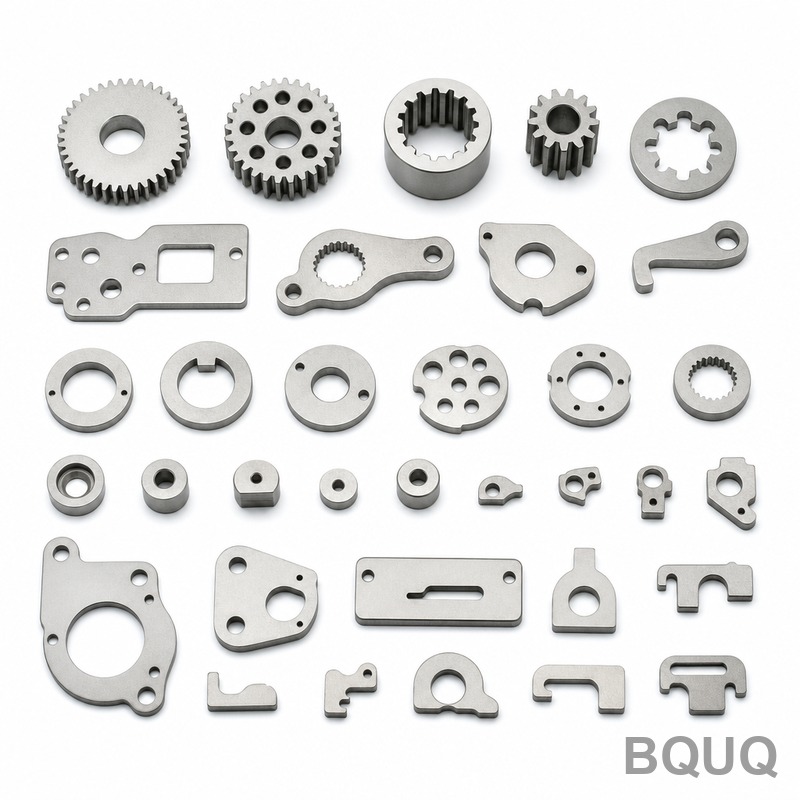
Work through the decision in this order: first define the part's forming needs (flat, strip-formable, or must-leave-strip), then estimate annual volume, then compare tooling cost against the per-part saving of the faster process. If your part is a candidate for the small-precision end, the parts we run daily at BQUQ — terminals and contacts, brackets and mounts — are almost all progressive-tooled, and we will tell you honestly when your volume does not justify that tooling yet.
Email sc@bquq.com or WhatsApp +86 137 1315 7787 with your PDF/DXF/STEP file. An engineer reviews it and replies with price, lead time and DFM notes on working days.
Frequently Asked Questions
Q: What is the difference between a compound die and a progressive die?
A compound die does all its cutting in one stroke at one station and makes flat parts only. A progressive die spreads operations across many stations along a moving strip, so one stroke finishes one part and bends and forms are possible. Progressive tooling costs more but runs far faster.
Q: When is a transfer die better than a progressive die?
When the part must leave the strip to be formed — deep drawn cups, large enclosures, thick heavy brackets. Transfer dies carry each blank between stations mechanically, which allows forming from all sides but cuts speed to 15–60 strokes per minute and raises tooling cost.
Q: Which die type gives the tightest tolerance?
A compound die, because the part is cut at one station with no strip movement between operations. Progressive dies come close thanks to pilot registration, typically ±0.02–0.05 mm on critical features, but the part is still being moved through stations.
Q: How much does each die type cost?
Indicative ranges: compound $2,000–$10,000, progressive $5,000–$40,000, transfer $40,000–$200,000+, depending on part size and station count. Cost varies heavily with geometry, which is why quotes are always drawing-specific.
Q: Can I start with a compound die and upgrade to progressive later?
Yes, and it is a common route for growing products. Start compound or with prototype tooling at low volume, then commission a progressive die once annual volume justifies it. The earlier die development usually carries over as process knowledge.
Related Articles
- stamped-terminal-design-guide — More from the BQUQ Metal Stamping engineering series.
- metal-stamping-defects-guide — More from the BQUQ Metal Stamping engineering series.
- precision-metal-stamping-services-china — More from the BQUQ Metal Stamping engineering series.
Data Sources and Verification
Tolerances, cycle times and price ranges in this guide come from BQUQ production records at our Dongguan plant, where CNC machining (±0.005 mm), stamping, custom springs and heat sinks run under one roof. BQUQ is an ISO 9001:2015 certified factory; the certificate and batch inspection reports are available on request with every quotation.
Related Resources
- About BQUQ: an ISO9001-certified source factory in Dongguan running four production lines under one roof.
- Stamping and sheet metal: terminals, brackets and enclosures from the press line — stamped terminals and contacts, stamping brackets and mounts, sheet metal enclosures.
- Industry trends: manufacturing, material market, and sourcing analysis for buyers.
- Technical articles: engineering guides and process comparisons — more where this article came from.
- FAQ hub: quick answers on CNC, stamping, springs, and heat sinks.
- Case studies: real parts and real numbers from projects we engineered and delivered.
- Contact us: send your drawing and get a quote within 12 working hours.
Authored by the BQUQ Engineering Team. BQUQ is an ISO9001-certified source factory in Dongguan, China, running CNC machining, metal stamping, custom springs and heat sink lines under one roof. Send drawings to sc@bquq.com or WhatsApp +86 13713157787 for a quote within 12 working hours. www.bquq.com