Compare 301, 304 and 430 stainless strip for stamped parts. BQUQ runs progressive dies in Dongguan and stamps corrosion-resistant parts with real tolerance control.
Stamping Stainless Steel Strip: 301, 304 and 430 for Corrosion-Resistant Parts
Short answer: use 301 strip when the part has to spring — clips, contacts, latches — because cold work takes it to roughly 1,270 MPa minimum tensile without heat treatment; use 304 when the part faces chlorides, moisture, or needs deep drawing; use 430 when the part is indoor, cosmetic, and cost-sensitive, at about 70–85% of 304 strip cost. Plan for 2–5° of springback on bends, tooling clearance roughly double what mild steel needs, and passivation after stamping to restore the oxide film on sheared edges. In production, BQUQ holds ±0.05 mm on formed stainless features and ships with dimensional reports.
Stainless is not one material and stamping it is not one process. The grade and temper you pick decide whether your part snaps like a spring, draws into a shell without cracking, or simply sits outdoors for a decade without red rust. This guide maps the three grades buyers actually specify — 301, 304 and 430 — to the stamped parts they suit, and tells you where the die shop has to change its habits.
Why Choose Stainless Strip Over Plated Carbon Steel?
Plated carbon steel fails in predictable places: the sheared edge. When a progressive die cuts a blank, the plating does not wrap around the cut edge, so bare steel is exposed at every trim line and punched hole. Scratch the surface in handling and you have a second rust site. Stainless sidesteps the whole problem because corrosion resistance comes from a self-healing chromium oxide film, not from a coating that can be cut, scratched, or chipped.
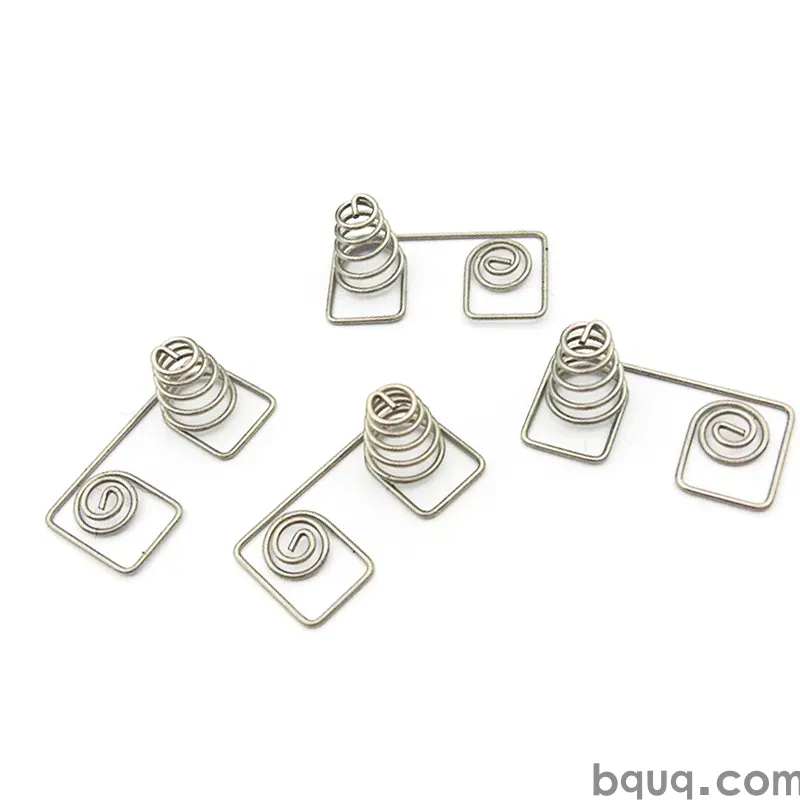
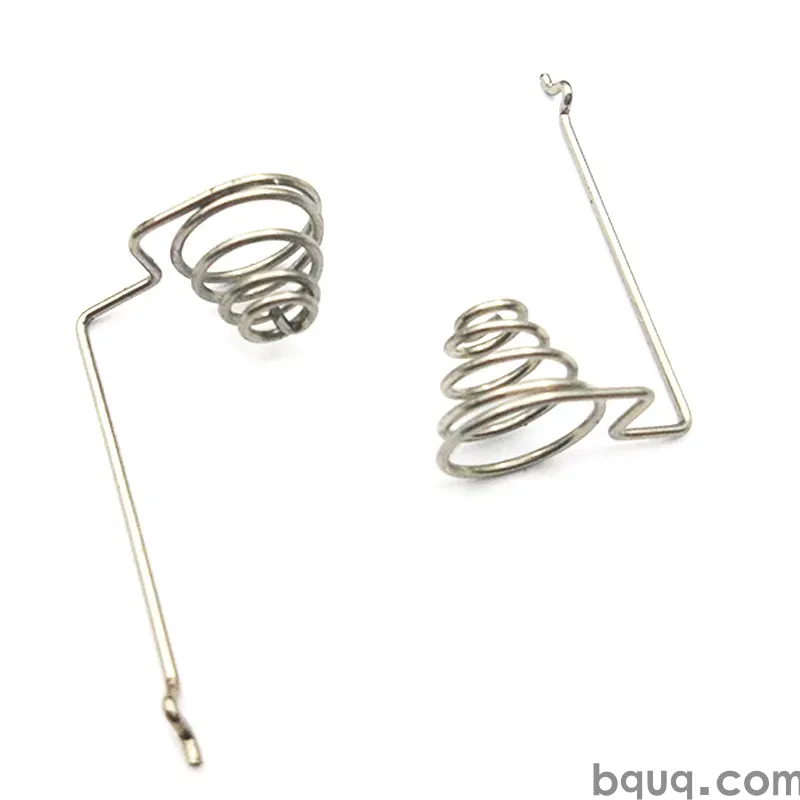
That buys real advantages in stamped parts: battery contacts and springs that see sweat and humidity, mounting clips on outdoor LED drivers, spring clips in washdown equipment, and brackets in food-adjacent machinery. The trade-offs are equally real. Stainless strip costs more, work-hardens as you form it, springs back more than carbon steel, and galls against tool steel. Before you jump from plated steel to stainless, check whether the real requirement is corrosion or just appearance — a material selection guide like ours walks through when plating is enough. If the part must also carry current, remember stainless is a poor conductor and a copper alloy is usually the better base metal.
The Three Workhorse Grades: 301, 304 and 430
All three are sold as coil and strip in the 0.1–3.0 mm thickness range most stamping uses. The differences that matter to a die shop are magnetic response, work-hardening rate, and price.
| Grade | Family | Magnetic | Corrosion resistance | Typical tensile, annealed strip | Best stamped parts | Strip cost index |
|---|---|---|---|---|---|---|
| 301 | Austenitic | Slightly magnetic after cold work | Good, less than 304 in chlorides | ~515 MPa min, up to ~1,270 MPa full hard | Springs, clips, contacts, latches | 1.0 |
| 304 | Austenitic | Slightly magnetic after cold work | Best of the three, resists pitting in most indoor/outdoor use | ~515–620 MPa min | Deep-drawn shells, brackets, exposed hardware | 1.05–1.15 |
| 430 | Ferritic | Magnetic | Moderate; fine indoors, stains in marine/chloride service | ~450 MPa min | Covers, cosmetic brackets, low-cost corrosion parts | 0.75–0.85 |
301 is the spring grade: it work-hardens aggressively, so a clip formed from annealed strip gains strength as it bends, and bought pre-hardened it is the standard answer for parts that must deflect and return millions of cycles. 304 is the all-rounder with the best corrosion margin of the three, and its drawability makes it the default for cups, shells, and deep forms. 430 is the cost play: ferritic, magnetic, and perfectly adequate for indoor parts where the aesthetic of stainless matters more than the chemistry. For current-carrying stamped parts all three are wrong — see our separate comparison of copper and brass stamping for conductive materials.
Temper and Work Hardening: What "Spring Hard" Actually Means
Austenitic grades like 301 and 304 cannot be hardened by heat treatment — strength comes from cold rolling at the mill. Strip suppliers sell tempers from fully annealed to full hard, and the temper you order changes what you can do in the die.
| 301 temper | Tensile, typical | Bend radius rule | Typical use |
|---|---|---|---|
| Annealed | ~515 MPa | Sharp bends OK | Deep draws, severe forming |
| 1/4 hard | ~860 MPa | ~1× thickness | Light clips, formed brackets |
| 1/2 hard | ~1,030 MPa | ~1–2× thickness | Contacts, spring arms |
| Full hard | ~1,270 MPa min | ~2–4× thickness, no sharp bends | Flat springs, snap clips |
Two consequences follow. First, a "springy" stainless part usually starts from hard or half-hard strip, not from heat treatment after forming — annealing after stamping destroys the spring property you paid for. Second, hard temper means limited bending: a full-hard 301 clip with a sharp 90° bend will crack at the corner. If your design needs both a spring arm and a tight bend, use 1/2 hard and let the geometry provide the force. Springback on stainless is also larger than carbon steel — a 90° bend typically springs back 2–5°, which the die maker compensates with overbend, coining, or bottoming stations. That compensation is why formed stainless tolerances land around ±0.05 mm rather than tighter, and why the stamping tolerance rules in our guide apply with extra margin to stainless.
How the Die Shop Has to Change for Stainless
Stainless abuses tooling differently than mild steel. It work-hardens at the shear zone, which makes the cut edge act like a cutting tool against the die — the classic failure is galling, where smeared stainless welds itself to the punch. The standard countermeasures are carbide punches and dies, PVD or TiN/CrN coated tool steel, and heavier-duty lubricant with extreme-pressure additives. Many shops also slow the press: 200–400 strokes per minute is normal for a stainless progressive die where the same tool in mild steel might run 500+.
Die clearance needs to grow. As a working rule, per-side clearance on stainless runs roughly 8–12% of stock thickness, versus about 5–8% on mild steel of the same gauge — for a 0.5 mm 304 strip that is roughly 0.04–0.06 mm per side. Too little clearance makes the tooling wear fast and the burr grow; too much produces a ragged break zone. Burrs on stainless are harder to remove than on carbon steel, so specify the burr side on the drawing and plan a tumbling or electropolish step if edges must be smooth for handling or sealing.
Corrosion After Stamping: Passivation and Edge Reality
Here is the fact buyers miss most often: a freshly sheared stainless edge is not yet corrosion-resistant. The cut exposes bare metal and can smear microscopic iron from the tooling onto the surface, and that free iron rusts — which is why a "stainless" part can show orange spots at the holes. The fix is passivation: a nitric or citric acid treatment that dissolves embedded iron and lets the chromium oxide film reform on the cut edges. It is a standard, inexpensive step and should be on your spec for any outdoor, medical, or food-contact part.
For marine or chloride-heavy environments, 304 is honestly marginal — pitting and crevice corrosion appear over time — and the correct move is 316L strip rather than pretending 304 will survive. Indoors, 430 with passivation covers most applications at the lowest material cost. If you also need a decorative finish, stainless can be brushed, bead-blasted, or PVD-coated after stamping, but keep the finish spec off functional surfaces where dimensional tolerance matters.
Sourcing Stainless Stamped Parts: What the RFQ Needs
Stainless stamping economics turn on material utilization and tooling life, so the RFQ details decide the price. Specify the grade and temper on the drawing — "stainless" alone is a guess that gets quoted with the most expensive interpretation. Give the coil width preference if you know it, note whether the final part is annealed or spring-tempered, and state the corrosion environment so the supplier does not quietly substitute 430 for 304 to win the price. Ask for material certificates on the heat if the part is safety-related. Tooling for stainless costs more than for mild steel — typically a premium on the die — because of carbide inserts and coatings, but per-part cost at volume stays competitive. Send the drawing with grade, temper, quantity, and finish to sc@bquq.com or WhatsApp +86 13713157787 and get a quotation within 12 working hours; if 301 full hard cannot make the bend your print asks for, we will tell you before you pay for tooling.
Frequently Asked Questions
Q: Which stainless grade is cheapest to stamp — 301, 304 or 430?
A: 430 is the cheapest, typically 15–25% below 304 strip cost, and it is fine for indoor cosmetic and structural parts. 301 and 304 cost close to each other; pick between them on spring behavior and corrosion duty, not price.
Q: Can I stamp a full-hard 301 clip with a sharp 90 degree bend?
A: Generally no — full-hard 301 needs a bend radius of roughly 2–4 times stock thickness and sharp corners will crack. Use 1/2 hard strip with the bend radius opened up, or redesign so the spring arm does the work and the bend is gentle.
Q: Do stamped stainless parts need plating or coating?
A: No. Stainless protects itself with a chromium oxide film. Specify passivation (citric or nitric) after stamping so sheared edges and tooling smears are cleaned and the film reforms. Plating on stainless is rare and usually signals the wrong grade was chosen.
Q: What tolerances can I expect on formed stainless parts?
A: Plan on ±0.05 mm for formed features and ±0.05–0.10 mm across multiple bends, because springback variation is the dominant error. Flat blanked features can hold tighter. Call out only the dimensions that truly need it and tolerance the rest openly.
Q: Why does my stamped 304 part show rust spots at the edges?
A: Sheared edges expose bare metal and can pick up microscopic iron from the tooling; that free iron corrodes even on 304. Passivation or electropolishing removes the contamination and lets the passive film reform — it is a processing gap, not a material failure.
Related Resources
- Stamping materials guide: how grade choice sets cost, formability and finish across the stamping floor.
- Stamped terminals and contacts: progressive-die production of precision stamped parts in Dongguan.
- About BQUQ: an ISO9001-certified source factory running stamping, CNC, spring and heat sink lines under one roof.
- Contact us: send the drawing for a quote within 12 working hours.
Authored by the BQUQ Engineering Team. BQUQ is an ISO9001-certified source factory in Dongguan, China, running CNC machining, metal stamping, custom springs, heat sink and collet lines under one roof. Send drawings to sc@bquq.com or WhatsApp +86 13713157787 for a quote within 12 working hours. www.bquq.com