Phosphor bronze C5210, beryllium copper C17200, and 301 stainless for stamped spring contacts: conductivity, strength, fatigue, cost, and selection.
Stamped Spring Contacts: Phosphor Bronze vs Beryllium Copper vs Steel
Short answer: beryllium copper C17200 is the top performer for stamped spring contacts — about 20–25% IACS conductivity, tensile up to ~1,400 MPa after age hardening, and fatigue life that outlasts the product. Phosphor bronze C5210 is the balanced workhorse: ~10–15% IACS, decent strength around 700–900 MPa, roughly half the cost of BeCu. 301 stainless is the strongest and cheapest of the three but conducts almost nothing (~2–3% IACS), so it only suits contacts where current takes another path. If the contact carries signal or power through its own spring fingers, choose beryllium copper or phosphor bronze; if it just pushes, steel works.
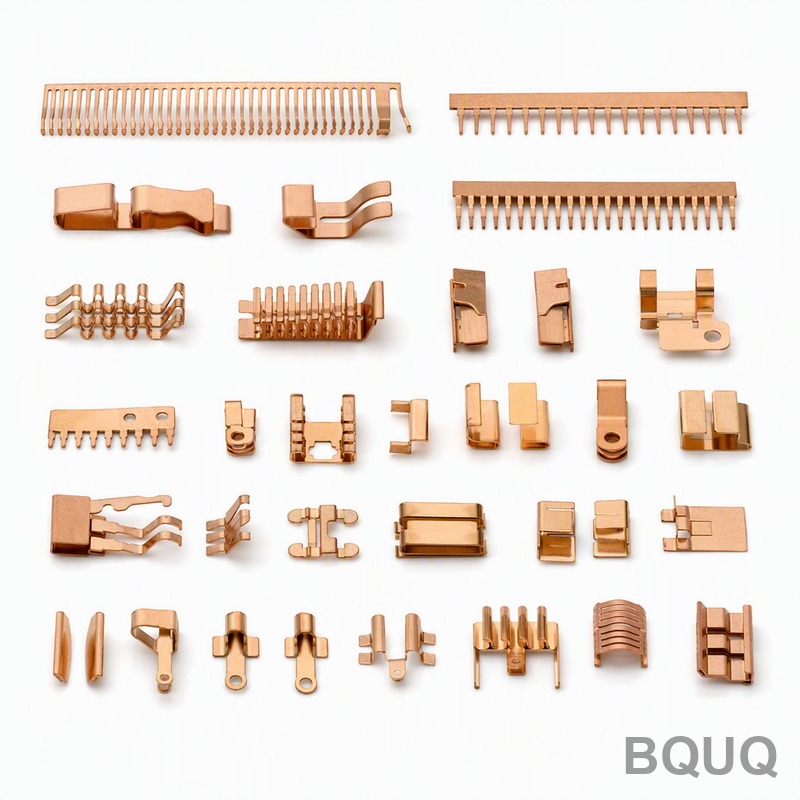
The little stamped metal fingers inside connectors, switches, battery holders, and EMI shields are the hardest-working parts nobody sees. They must push with steady force for the life of the product, carry current without heating, survive thousands of insertions, and cost fractions of a cent. The material choice decides all of it before the die ever cuts steel. Here is how the three standard spring contact alloys compare and when each one earns its place. For the broader picture — dies, volumes, and tolerances — our precision metal stamping guide covers the process end to end.
What Does a Stamped Spring Contact Actually Do?
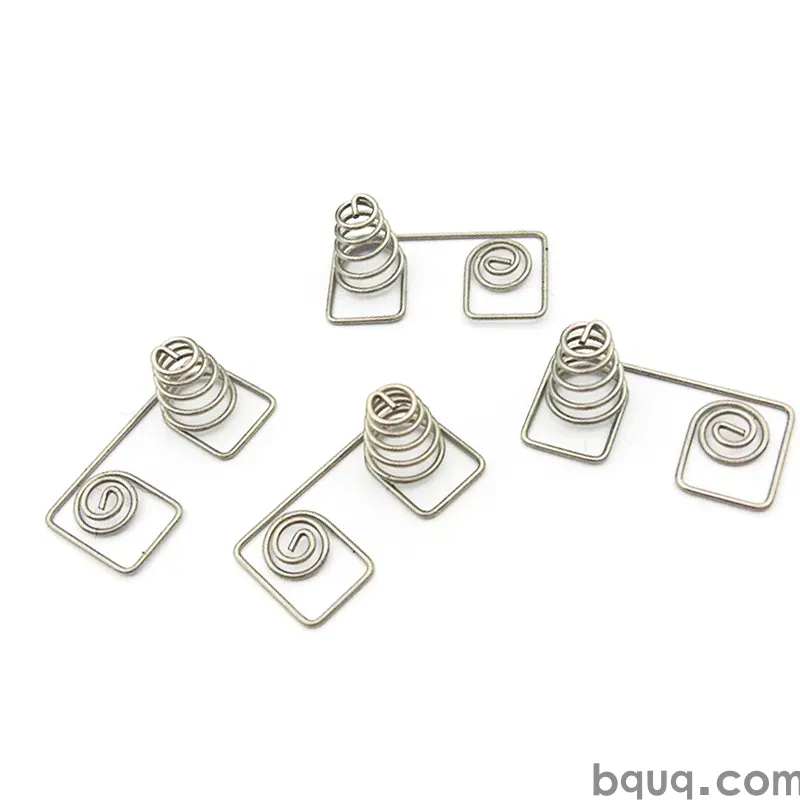
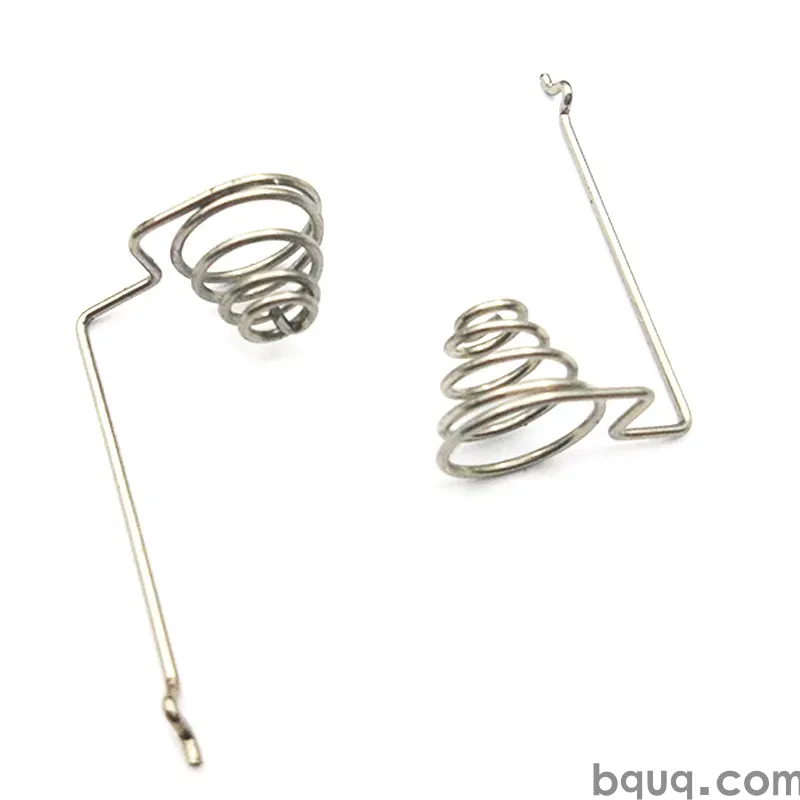
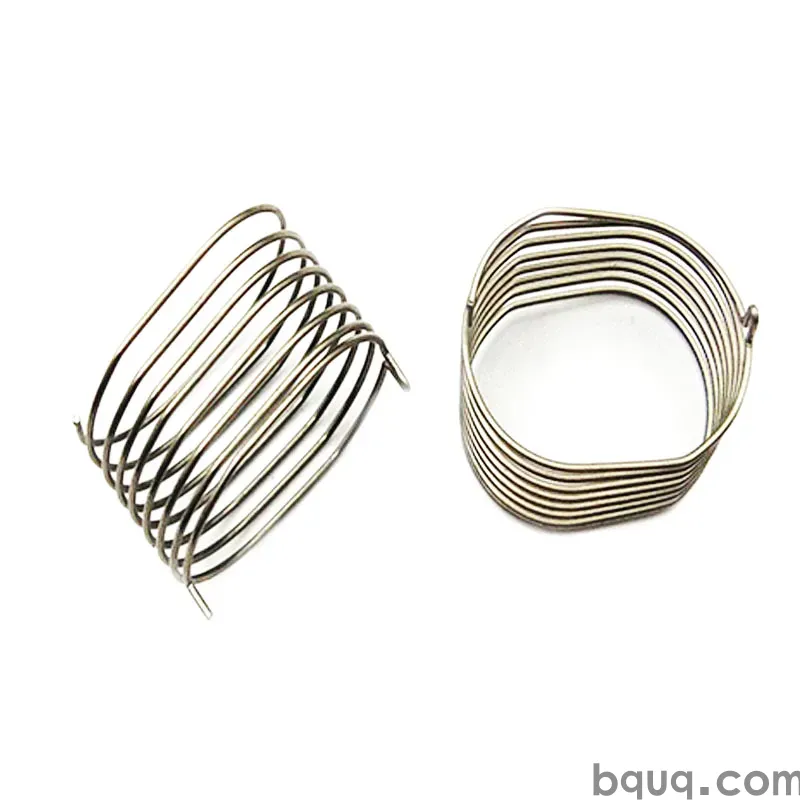
A stamped spring contact — often called a spring contact finger or, in the trade, a shrapnel spring for the way it snaps — is a flat strip formed into a cantilever or folded beam. It does two jobs at once. Mechanically it presses against a mating surface with a controlled force: enough to make reliable contact, not so much that it wears or takes a permanent set. Electrically it carries current through that same pressed interface, which means the contact surface must stay clean, conductive, and corrosion-free.
Because the contact is a bending beam, the governing property is the ratio of strength to modulus: the material must yield a useful force at a deflection that stays inside its elastic limit. Push it past yield and the finger takes a set, contact force collapses, and the product fails intermittently. That is why spring contact materials are specified by tensile strength in spring temper, not by the annealed values on the general datasheet.
Which Properties Matter in a Contact Spring?
Five properties decide the material, and they trade against each other. Strength sets how much force a finger can deliver for its geometry. Modulus sets how the force grows with deflection — stiffer materials give more force per millimeter of travel but reach their stress limit sooner. Conductivity sets how much current the contact can carry without heating. Fatigue resistance decides whether the finger still pushes after 10,000 insertions. And corrosion resistance keeps the contact surface clean where it touches.
Formability belongs on the list too. A contact is bent sharply — often to an inside radius of one to two times the material thickness — and the material must bend without cracking at full-hard temper. Every spring contact alloy is a compromise between formability and strength: the harder the temper, the stronger the spring, and the easier it cracks on a tight bend. Die design navigates that by choosing bend radii the material can survive.
How Do the Three Contact Materials Compare?
| Property (typical values) | Phosphor bronze C5210 | Beryllium copper C17200 | 301 stainless |
|---|---|---|---|
| Tensile, spring temper strip | ~700–900 MPa | ~1,240–1,450 MPa | ~1,270–1,550 MPa |
| Elastic modulus | ~110 GPa | ~128 GPa | ~193 GPa |
| Electrical conductivity | ~10–15% IACS | ~20–25% IACS | ~2–3% IACS |
| Fatigue in repeated flexing | Good | Excellent | Good, but see below |
| Corrosion resistance | Good | Very good | Good; avoid stressed parts in chlorides |
| Max continuous service temp | ~150 °C | ~200 °C | ~300 °C |
| Relative strip cost | 1.0× | ~4–7× | ~0.7× |
Read the table as a triangle. Steel is strong, stiff, and cheap but electrically dead. Phosphor bronze sits in the middle on every axis. Beryllium copper tops strength (after aging), conductivity, and fatigue — and charges for it. Note also the modulus column: steel's 193 GPa means a steel finger delivers roughly 1.5 times the force of a phosphor bronze finger at the same geometry and deflection, which is why steel contacts feel "hard" and need careful stress design to avoid taking a set.
Match the material to the actual duty and the choice stops being abstract:
| Contact duty | Recommended material | Why |
|---|---|---|
| High-cycle connector contact carrying current | Beryllium copper C17200 | Fatigue life plus ~20–25% IACS conductivity |
| Card slot or battery clip, moderate cycles | Phosphor bronze C5210 | Balanced strength, conductivity, and cost |
| EMI grounding finger, negligible current | 301 stainless | Strong and cheap; conductivity irrelevant |
| High-current power contact | Beryllium copper, silver-plated | Best conductivity, lowest heating |
| Dry-circuit signal contact | Phosphor bronze + gold flash | Stable low resistance over life |
| Marine or chemical environment | Beryllium copper | Corrosion resistance in harsh service |
When Does Phosphor Bronze Make Sense?
Phosphor bronze — C5191 and C5210, the difference being tin content — is the default contact material when beryllium copper is overkill. It springs well, conducts reasonably, resists corrosion and tarnishing better than brass, and costs a fraction of BeCu. C5210 with more tin runs stronger but slightly less conductive; C5191 leans the other way. Most everyday stamped contacts live on this alloy: SIM card and memory card contacts, battery clips, switch springs, terminal springs in consumer connectors.
Phosphor bronze also solders and welds cleanly, which matters when the contact is assembled into a connector housing and terminated to a wire. It takes tin, gold, or silver plating well, and for dry-circuit signal contacts a gold flash on the contact zone gives years of stable resistance. If the application is indoor, ordinary temperature, and moderate cycle counts, phosphor bronze is usually the right answer and beryllium copper is the expensive one.
When Does Beryllium Copper Justify Its Price?
Beryllium copper earns its 4–7× premium in three situations. First, high cycle counts: connectors rated for thousands of insertions, card slots, probe contacts — BeCu's fatigue behavior keeps the finger pushing when phosphor bronze would have relaxed. Second, high current density in a small contact: its 20–25% IACS conductivity lets a small finger carry more amperes without heating. Third, reliability in demanding environments: telecom, automotive, and industrial contacts where a field failure costs far more than the material saving.
BeCu contacts are usually stamped from mill-hardened strip and then age-hardened after forming to develop full strength — a process step that adds cost and lead time. The good news for designers: at the small sizes contacts occupy, the per-part material difference is often only fractions of a cent, so the premium rarely decides the product's cost. It decides the product's reputation.
When Does 301 Stainless Steel Work?
301 stainless in full-hard strip is the strongest and cheapest spring contact material of the three, and it is everywhere in one specific role: grounding and shielding. EMI shield fingers, grounding clips, and spring brackets press against enclosure surfaces to complete a conductive path — and in those roles the current is negligible and the conductivity gap does not matter. What matters is spring force and price, and 301 delivers both.
The cautions are real. At ~2–3% IACS, a 301 contact cannot carry power; it is a mechanical spring that happens to ground. Stressed 301 in chloride environments — marine air, salt-laden dust — risks stress corrosion cracking, so keep it indoors or specify a more resistant grade. And its high stiffness makes deflection-limited designs tricky: the same force needs more deflection than a copper alloy, which can push the finger past yield in tight envelopes. For pushing, shielding, and clipping duty where current takes another path, 301 is hard to beat on cost — our stamped brackets and mounts line runs exactly these parts.
What About Forming, Plating, and Grain Direction?
Three manufacturing habits separate contacts that work from contacts that fail young. Bend radius: keep inside radii at least one material thickness on copper alloys and more on full-hard steel — sharper bends crack or weaken the outer fiber. Grain direction: strip is rolled, and bending across the grain is safer than bending along it; a good die layout respects that. Stress relief: after severe forming, copper alloys benefit from a low-temperature stress relief, and beryllium copper needs its full age-hardening cycle to reach the strength the table promises.
Plating is where contact performance is actually bought. Gold flash (typically 0.05–0.5 µm) on the contact zone gives stable low resistance for dry circuits and low insertion-force connectors. Silver suits high-current contacts but tarnishes in sulfurous air. Tin plates solderability but oxidizes under fretting, so it suits terminals more than wiping contacts. And bare beryllium copper or phosphor bronze is sometimes the best contact surface of all — clean, conductive, and one less interface to fail. If the design questions come down to material versus plating economics, our stamped terminals and contacts overview connects the dots, and the die itself is priced in our progressive die stamping cost guide.
Email sc@bquq.com or WhatsApp +86 137 1315 7787 with your PDF/DXF/STEP file. An engineer reviews it and replies with price, lead time and DFM notes on working days.
Stamped or machined? (Decision tree)
| If the part... | Choose | Why |
|---|---|---|
| Is thin, flat or formed from strip, at 1,000+ pcs | Stamping | Tooling pays back at volume |
| Is a prototype or under a few hundred pcs | Laser cut + form, or CNC | Avoids die cost |
| Is thick or has complex 3D form | CNC machining | Stamping is limited by strip thickness |
| Needs smooth edges and a tight profile | Fine blanking | Better sheared-edge quality |
| Is a contact or terminal with spring property | Stamped + heat treat/plating | Material and finish decide performance |
Frequently Asked Questions
Which material is best for stamped spring contacts?
A: Beryllium copper C17200 for high cycles, high current, or high reliability. Phosphor bronze C5210 for everyday contacts at moderate cost. 301 stainless when the contact only pushes or grounds and current takes another path.
Why are spring contacts often made of beryllium copper?
A: It combines spring strength up to ~1,400 MPa, conductivity around 20–25% IACS, and excellent fatigue life. One small stamped finger can deliver contact force and carry current reliably for the product's whole life.
Is phosphor bronze good for electrical contacts?
A: Yes. With ~10–15% IACS it conducts well enough for most signal and moderate current duty, springs reliably, resists tarnish, and costs roughly half of beryllium copper. It is the default for consumer connector contacts.
Can stainless steel be used as a spring contact?
A: Yes, for mechanical and grounding duty. Full-hard 301 is strong and cheap, but at ~2–3% IACS it cannot carry power. Avoid stressed stainless contacts in chloride-rich environments due to stress corrosion risk.
What plating should a stamped spring contact have?
A: Gold flash on the contact zone for stable low-resistance signal contacts, silver for high current, tin for solderability. Bare beryllium copper or phosphor bronze also works when the alloy itself provides the contact surface.
Related Articles
- Precision Metal Stamping: Terminals, Contacts & Enclosures from a China Source Factory — Progressive die stamping from a Dongguan source factory: terminals, contacts, brackets, enclosures, materials and plating, and die development.
- Progressive Die Stamping Cost: How Tooling and Part Price Work — How stamping quotes work: tooling $3,000–$50,000 (indicative) plus per-part price, what drives both, and when stamping beats CNC machining on cost.
Data Sources and Verification
Tolerances, cycle times and price ranges in this guide come from BQUQ production records at our Dongguan plant, where CNC machining (±0.005 mm), stamping, custom springs and heat sinks run under one roof. BQUQ is an ISO 9001:2015 certified factory; the certificate and batch inspection reports are available on request with every quotation.
Related Resources
- About BQUQ: an ISO9001-certified source factory in Dongguan running four production lines under one roof.
- Stamping products: explore stamped terminals and contacts, stamping brackets and mounts, and sheet metal enclosures.
- Industry trends: manufacturing, material market, and sourcing analysis for buyers.
- Technical articles: engineering guides on CNC, heat sinks, springs, and stamping — more where this one came from.
- FAQ hub: quick answers on CNC, stamping, springs, and heat sinks.
- Case studies: real parts and real numbers from projects we engineered and delivered.
- Contact us: send your drawing and get a quote within 12 working hours.
Authored by the BQUQ Engineering Team. BQUQ (Dongguan) runs CNC machining (±0.005 mm), metal stamping, custom springs, and heat sink production in one ISO9001 factory. Source-direct from Dongguan, China — quote in 12 hours: sc@bquq.com | WhatsApp +86 13713157787 | www.bquq.com