BQUQ compares stamping vs wire forming for contacts and clips: cross-section, tooling cost, volume crossover and tolerances from a factory running both.
Stamping vs Wire Forming: Choosing for Contacts and Clips
Short answer: stamping wins when the part is flat, thin and produced in high volume — think blades, flat springs and contact tongues from strip 0.05–2 mm thick, where a progressive die runs at hundreds of strokes per minute and holds ±0.05 mm. Wire forming wins when the part needs a round cross-section, a 3D bend, or a spring that flexes in service — pins, hooks, coil-spring clips and retaining rings — with no die investment, from wire 0.1–8 mm in diameter. The crossover in unit cost typically sits somewhere between a few thousand and a few hundred thousand parts, depending on geometry. The shape of the cross-section decides more than the production rate does.
Contacts and clips are the same family of part — a metal element that presses against another conductor or component — but they are manufactured by two completely different processes. Stamping blanks and forms flat shapes from strip metal in a die. Wire forming bends round wire into 3D shapes on a CNC former or four-slide machine. Engineers who specify one because they have always used it pay for the mismatch in either tooling cost or piece price. This guide lays out the real decision criteria for a factory that runs both lines and therefore does not care which one you pick.
What Each Process Actually Does
Stamping feeds coil strip through a progressive die: each stroke of the press cuts and forms the next station, so the part is finished — often including plating-friendly flatness and tight holes — by the time it exits the strip. It is fast, precise, and ideally suited to parts whose working surfaces are flat or gently formed: switch blades, relay contact springs, terminal tongues, EMI shielding fingers, and the millions of flat springs inside connectors and battery compartments.
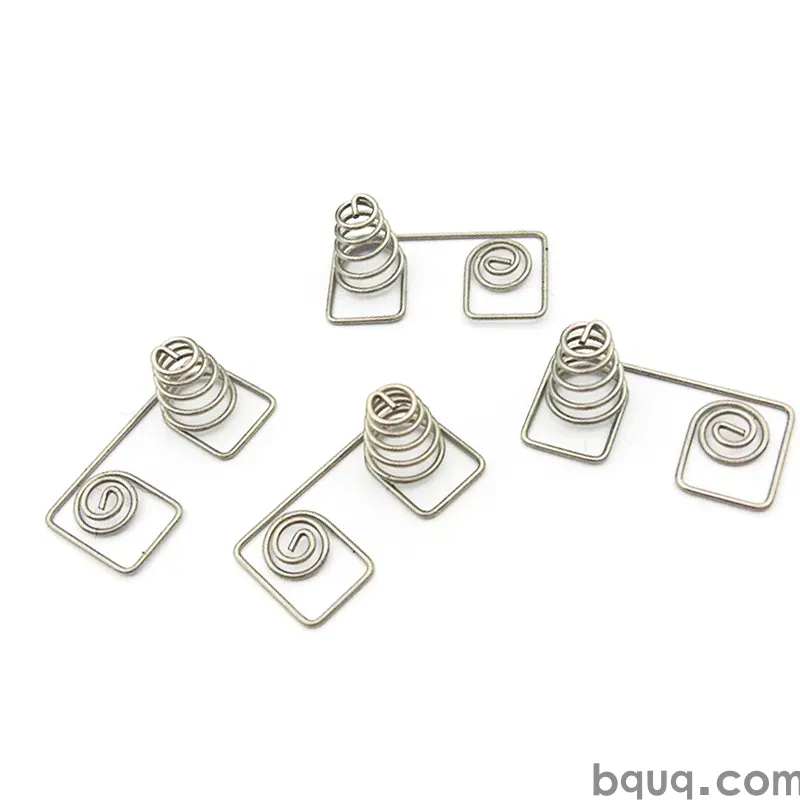
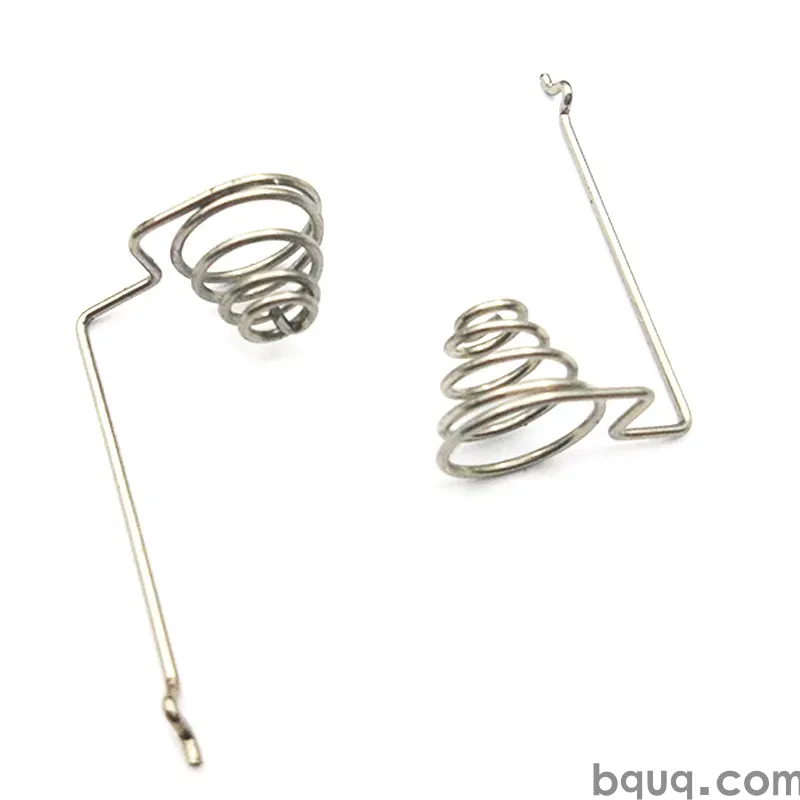
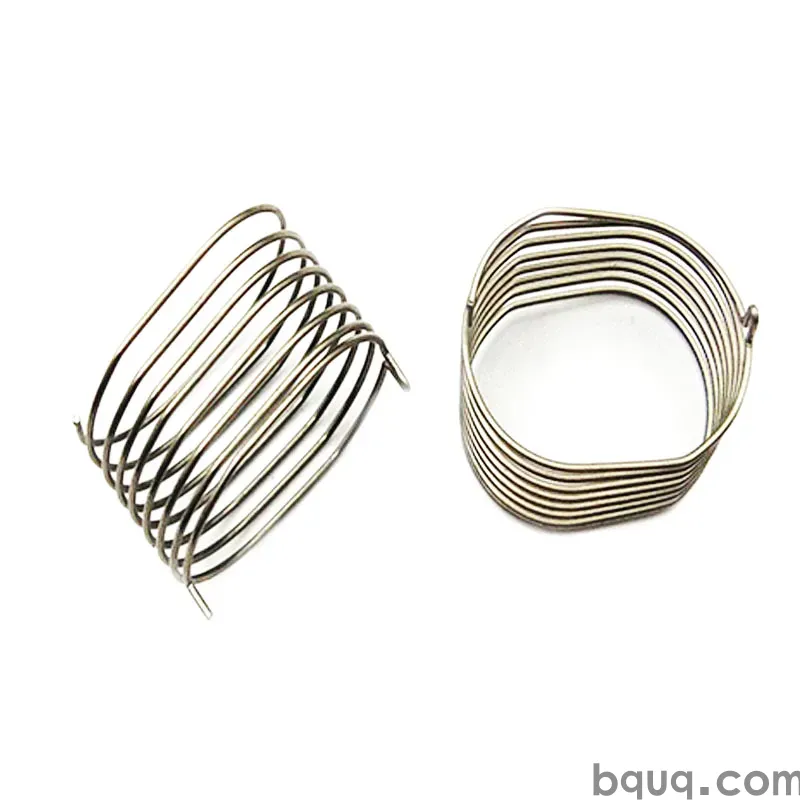
Wire forming starts from round wire and bends it through a series of tools — a CNC wire former can make complex 3D shapes in one setup, while a four-slide machine bends and cuts several axes simultaneously at high speed. There is no die to build, only forming tooling and program setup, which makes wire forming the low-entry-cost route. It produces parts with a round cross-section that stamping cannot make at all, such as coil springs, C-clips, and wire forms that must flex uniformly in every direction. Because round wire has no edges, wire forms also avoid the burr and sharp-edge issues of stamped parts, which matters when a clip slides against a wire or a battery can.
Geometry: The First Filter
Before any cost calculation, ask what shape the working part must be. A flat contact blade with a coined contact point and a locating hole is a stamped part by nature; trying to make it from wire means flattening sections and losing tolerance. A spring clip that must wrap around a round component is a wire part; stamping it flat and rolling it costs more than bending wire in the first place.
| Decision driver | Stamping | Wire forming |
|---|---|---|
| Starting material | Strip, 0.05–2 mm typical for contacts | Round wire, 0.1–8 mm typical |
| Cross-section | Flat or formed flat, controlled thickness | Round, diameter-controlled |
| Geometry | Flat with bends, holes, lances, coined details | 3D bends, coils, loops, hooks |
| Burr / edges | Shear burr present, direction controlled | Smooth wire surface, no burr |
| Spring behaviour | Flat spring rate, direction-dependent | Uniform flex, true coil springs possible |
| Typical parts | Terminals, blades, flat contact springs, shields | Pins, hooks, spring clips, coil springs |
| Tolerance (indicative) | ±0.05 mm typical; tighter on critical features | ±0.1–0.3 mm typical on formed bends |
If the part looks flat on the drawing and the cross-section is rectangular, stamping is almost certainly the process. If any dimension is a wire diameter and the part wraps in three dimensions, wire forming is. Hybrids exist — a stamped flat spring spot-welded to a wire form is common in automotive seats and battery contacts — and a factory running both lines can build those assemblies without sending them to three suppliers.
There is also a physics difference that redesigns sneak up on. The stiffness of a beam scales with the cube of its thickness for a flat stamped spring, but with the fourth power of diameter for a round wire. That means a stamped flat spring is tuned in tenths of a millimetre of strip thickness — changing a blade from 0.30 mm to 0.35 mm raises its stiffness by nearly 60% — while a wire part is tuned by diameter, coil count and arm length, and small diameter changes move it even harder. When a prototype feels wrong, the stamped part is usually corrected by a strip thickness or width change in the die, while the wire form is corrected by a program change that adds or removes a coil. Knowing which lever moves the force is the practical skill of the designer, and it is why the two processes need different tolerance thinking even for parts that look similar on a datasheet. Surface finish differs too: stamped strip carries a mill finish set by the rolling schedule, while drawn wire has a smooth die-drawn surface that is often bright enough to use as-is in visible clips.
Cost and Volume: Where the Crossover Sits
Stamping carries a die cost but a very low piece price; wire forming carries little tooling cost but a higher piece price because each part is formed individually and cycle time is longer. The crossover depends on how many features the die must add: a simple two-station blank-and-form die may cost a few thousand dollars, while a complex 20-station progressive die for a precision contact runs higher. As a rule of thumb for simple clips and contacts, wire forming is usually cheaper below a few thousand parts, and stamping takes over somewhere in the low tens of thousands — but for geometrically complex parts the crossover moves up, because the wire former's cycle time penalty grows with every bend.
| Volume (indicative) | Stamping economics | Wire forming economics |
|---|---|---|
| 100–1,000 pcs | Die cost dominates; rarely sensible | Best zone: program setup only |
| 1,000–50,000 pcs | Crossover zone; compare tooling amortization | Competitive, esp. complex 3D parts |
| 50,000–500,000 pcs | Stamping piece price wins on simple parts | Only for shapes stamping cannot make |
| 1,000,000+ pcs | Progressive die fully amortized, very low unit cost | Exceptional cases only |
Do not trust generic crossover numbers — they shift with material, part size and press speed. The honest method is to ask for both quotes, with tooling shown separately from piece price, and read the crossover point off the two curves. Any supplier that quotes only one process is quoting their schedule, not your part. We run stamping and spring/wire lines in the same ISO9001 factory, so the process recommendation you get is the one your geometry and volume justify.
Tolerance, Materials and Quality Differences
Stamped contacts inherit strip thickness tolerance and die precision, which is why a stamped blade can carry a co-planarity or hole-position spec that a wire part cannot match. Wire forms are limited by springback: bending wire 0.5–3 mm in diameter to ±0.2 mm over a formed length is normal, and holding tighter usually means straightening or secondary tooling. If your wire-formed clip needs a precise flat contact area, the design should include a coined or flattened section — or switch the contact surface to a stamped blade.
Material choices also differ. Stamping uses the full range of strip alloys: brass, phosphor bronze, beryllium copper, stainless and nickel silver, all available in precise tempers. Wire forming uses wire drawn to diameter, and the same alloys exist in wire form, but the temper and surface finish are set at the wire mill. Springs are the domain where wire truly cannot be replaced: a coil spring needs a round cross-section and uniform residual stress, and coil production is a dedicated process — see our electronic contact springs guide for where stamped flat springs stop and coiled wire springs take over.
Making the Call: A Three-Question Test
Three questions settle most contact-and-clip decisions. Is the cross-section round or flat? Round points to wire forming; flat points to stamping. Does the design need holes, coined surfaces, tight flatness or plating-friendly geometry? Those are stamping strengths. Will annual volume exceed the crossover? If yes, invest in the die. If the answer is genuinely mixed — flat contact area plus a 3D spring arm — consider the hybrid: stamp the contact, form the arm from wire, and weld or rivet them. The stamping versus deep drawing guide covers the neighbouring comparison when the part is a cup or shell, and our terminal design guide details stamped-contact geometry once stamping is chosen.
Frequently Asked Questions
Q: Which is cheaper — stamping or wire forming?
A: Below a few thousand parts, wire forming is usually cheaper because there is no die; above the crossover — typically somewhere in the tens of thousands for simple parts — stamping's low piece price wins once the die is amortized. The honest answer comes from quoting both processes with tooling shown separately.
Q: Can a wire-forming machine make flat stamped-style contacts?
A: It can bend wire into flat shapes, but the result has a round cross-section and looser tolerances than a stamped blade. Where a true flat contact surface, hole or coined detail is required, stamping is the process; wire is best reserved for round-section and 3D parts.
Q: What tolerances can wire forming hold?
A: On formed bends in round wire, ±0.1–0.3 mm is typical depending on wire diameter and shape complexity, with springback the main variable. Stamping holds tighter — ±0.05 mm on outline features is normal — which is why precision contact geometry is usually stamped.
Q: When should I combine stamping and wire forming in one product?
A: When the design needs both a flat precision contact area and a 3D spring arm — common in battery contacts and connector clips. Stamp the contact, wire-form the arm, and join them by welding or riveting; a factory running both lines can supply the assembly and control the tolerances between the two halves.
Q: What wire diameter range is available for wire-formed contacts and springs?
A: Wire-forming shops typically run 0.1–8 mm wire; most contact and clip parts fall in the 0.3–2 mm range. Very fine parts below about 0.3 mm and heavy structural forms above 6 mm narrow the supplier field, so check the range against your part early.
Related Resources
- Electronic contact springs guide — stamped flat springs versus coiled wire springs.
- Stamping vs deep drawing guide — the next comparison when the part is a cup, shell or drawn housing.
- Stamped terminal design guide — geometry rules once stamping is the chosen process.
- About BQUQ — ISO9001 factory in Dongguan running stamping, springs and wire-forming under one roof.
- Contact us — send your clip or contact drawing for a 12-hour quote at sc@bquq.com.
Authored by the BQUQ Engineering Team. BQUQ is an ISO9001-certified source factory in Dongguan, China, running CNC machining, metal stamping, custom springs, heat sink and collet lines under one roof. Send drawings to sc@bquq.com or WhatsApp +86 13713157787 for a quote within 12 working hours. www.bquq.com