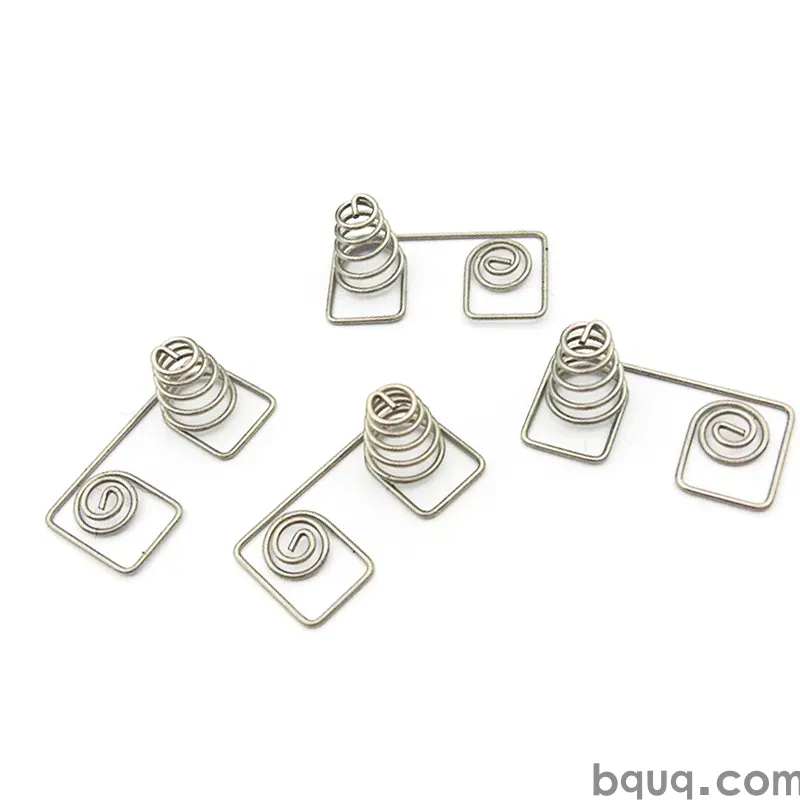
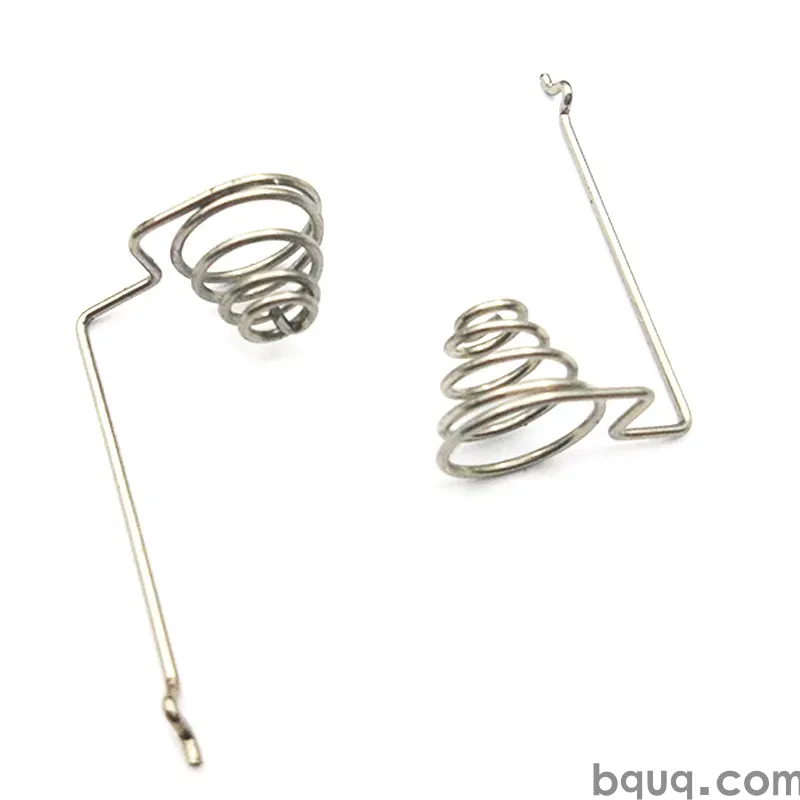
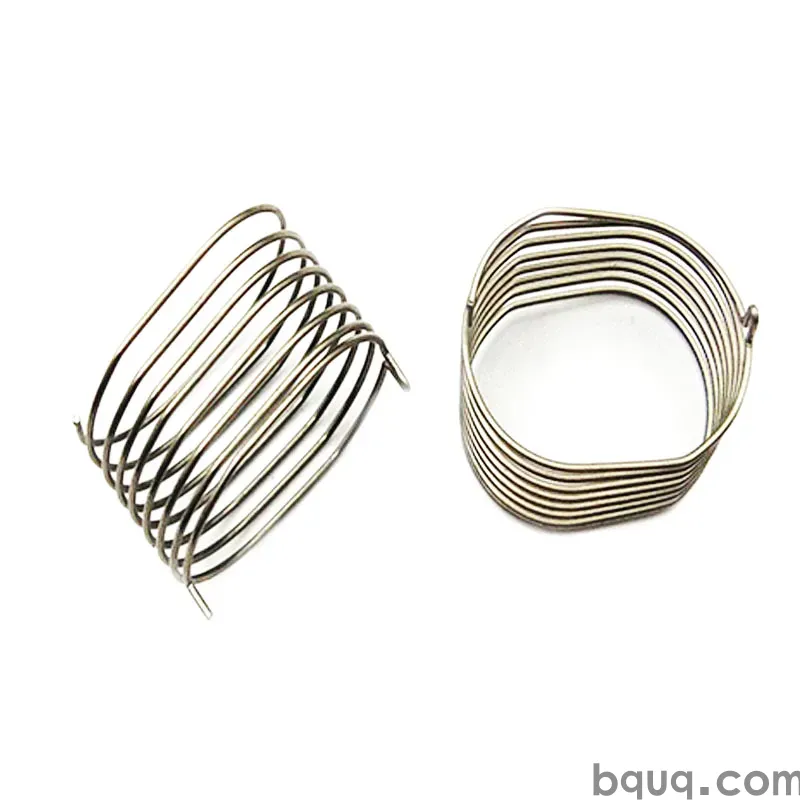
BQUQ stamps spring steel clips and latches in Dongguan: SAE 1074/1095, stainless 301, temper choice, fatigue life and load control. Quote in 12 hours.
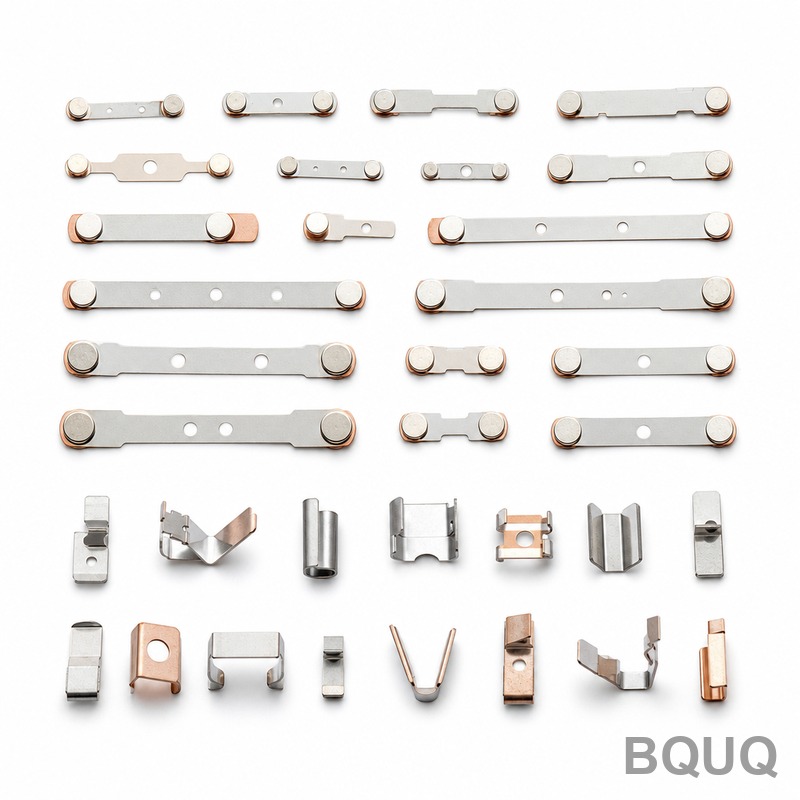
Stamping Spring Steel: Clips, Latches and Parts That Must Snap
Short answer: yes — spring steel is stamped every day, and the rule that keeps parts from cracking is temper. Stamp pre-tempered strip (SAE 1074/1095 or stainless 301) when the part must work as delivered with no heat treatment, keeping bends above about 2–3× thickness radius; stamp softer annealed strip when the part has severe forms, then harden and temper it after forming. Pre-tempered parts cost less per piece but demand spring-friendly geometry. BQUQ stamps clips, latches and flat springs from 0.1–2.0 mm strip in Dongguan and quotes from drawings within 12 working hours.
A stamped clip or latch is a spring that happens to look like a piece of hardware. It stores energy when you deflect it and releases that energy to hold a panel, a shaft, a battery, or a door closed — often for the life of the product, through temperature swings, vibration, and tens of thousands of insertion cycles. Everything that makes a coil spring reliable applies here: the material must stay elastic under repeated deflection, the stress must stay below the fatigue limit, and the part must not relax its force over time. The difference is that the spring is made by a die, not a coiler, and the design rules are written in strip thickness and bend radii.
What "Spring Steel" Means in Strip Form
Spring steel strip is high-carbon steel — typically SAE 1050, 1074, or 1095 (roughly 0.50–0.95% carbon) — supplied hardened and tempered, or stainless grades 301 and 17-7PH that work-harden instead. The carbon grades are bought pre-tempered to a hardness range; the die forms them cold and they stay springy because they never saw a soft anneal. The stainless grades get their strength from cold rolling, so specifying the right temper (1/4 hard, 1/2 hard, full hard) sets the strength before the die ever touches it.
| Grade | Type | Typical tensile (strip) | Max service temp | Typical parts |
|---|---|---|---|---|
| SAE 1050/1074 tempered | Carbon spring steel | 1,200–1,600 MPa | ~150°C (stress-relieves above) | Clips, retainers, latch springs |
| SAE 1095 tempered | Carbon spring steel | 1,400–1,800 MPa | ~150°C | Heavy clips, automotive latches |
| C67S/C75S (EN) | Carbon spring steel | 1,200–1,600 MPa | ~150°C | EU-spec equivalents |
| Stainless 301 full hard | Austenitic, work-hardened | 1,300–1,800 MPa | ~250–300°C | Corrosion-resistant clips, springs |
| Stainless 17-7PH (CH900) | Precipitation-hardened | 1,500–1,900 MPa | ~315°C | Aerospace-grade, high temp |
| Stainless 302/304 | Austenitic | 700–1,200 MPa | ~250°C | Light clips, non-magnetic needs |
The choice between carbon and stainless is usually corrosion first, temperature second. Carbon spring steel is cheap, strong, and completely fine inside a housing where it never sees moisture — most consumer clips, fuse clips, and internal latches run carbon with a plating such as zinc or nickel if any corrosion risk exists. Stainless 301 takes over when the clip is exposed, must pass salt-spray, or lives near heat. What you almost never want is a generic "spring steel" callout with no grade and no temper — the die builder cannot pick a strength or a bend allowance, and the first trial run becomes the spec by accident. For force and fatigue math on spring materials more broadly, the spring material selection guide covers the same alloy logic in wire form.
Pre-Tempered vs Annealed-and-Hardened: The Real Decision
This is the fork in the road for stamped spring parts. Pre-tempered strip is stamped at final hardness, so the die must handle a material at 1,300+ MPa — carbide tooling, generous clearances, and generous bend radii. The payoff is zero heat treatment after stamping, no scale, no distortion, and a part that is done when it leaves the press. Annealed strip stamps like butter, can take severe forms and tight radii, and then goes through hardening and tempering (austenitize, quench, temper to a hardness range). The payoff there is formability; the cost is an extra heat-treat operation, potential distortion that needs straightening, and surface scale that needs cleaning.
| Factor | Pre-tempered stamping | Annealed then heat-treated |
|---|---|---|
| Formability | Limited — brittle at tight radii | Excellent — severe forms possible |
| Minimum inside radius | ~2–3× thickness typical | ~0.5–1× thickness possible |
| Die wear | Higher (carbide recommended) | Lower |
| Post-processing | None for hardness | Harden, temper, clean, maybe straighten |
| Distortion risk | Low | Real — thin parts move in quench |
| Unit cost | Lower at volume | Higher, but enables harder-to-form designs |
| Typical use | Clips, latches, flat springs | Complex auto latch springs, heavy sections |
The volume sweet spot usually lands on pre-tempered: it removes an entire process step and its quality risk. But pre-tempered stamping punishes design mistakes — a sharp inside corner or a lancing cut that leaves a notch acts as a stress raiser in material that has no ductility in reserve, and parts snap at the press or in the first assembly. If the part must survive millions of flexes, that stress raiser question decides its life, not the material grade. Parts that must genuinely spring hard and repeatedly, like contact springs, share these rules; the electronic contact spring guide details force, deflection and plating for that family.
Designing the Snap: Bends, Holes and Stress Raisers
A clip or latch fails in one of two ways: it takes a set (the deflection pushes the material past yield, so the part stops pushing back), or it fatigues and cracks after thousands of cycles. Both are design failures before they are material failures. The check is simple: the maximum bending stress at full deflection must stay below the material's yield strength with margin, and below the fatigue limit for cyclic duty. For a cantilever clip of thickness t deflecting a distance y over a length L, stress scales with t and y and inversely with L² — lengthening the beam is the cheapest fix, thickening it is the most expensive one, because stress climbs linearly with thickness but only with the square root of the length change in the other direction.
Practical numbers from die shops: pre-tempered carbon strip deflects safely to roughly 70–80% of yield in a one-time snap, but cyclic clips should run closer to 50–60% of yield or below the ~700–900 MPa fatigue band for hardened carbon steel. Stainless 301 runs lower stress limits per strength because its fatigue behavior is less forgiving without shot peening. Three geometry rules carry most designs. First, radius every corner — an inside bend radius below 1× thickness in pre-tempered material is a crack waiting for a cycle count. Second, keep holes, lances and notches out of the bending zone or at least 3× thickness away from the bend line, because a punched edge is a line of micro-cracks and burrs. Third, control burr direction so the burr side faces the compression side of a bend, never the tension side — a burr on the tension face is a starter crack. Our contact spring materials guide digs into how burr, grain direction, and plating interact on thin spring contacts.
| Design variable | Good practice | Consequence of ignoring it |
|---|---|---|
| Bend radius vs thickness | ≥1× t annealed, ≥2–3× t pre-tempered | Cracking at bend, field breakage |
| Hole/bend separation | ≥3× t from bend line | Distortion, edge cracking |
| Burr direction | Toward compression side | Fatigue cracks from tension-side burr |
| Grain direction | Bends across the rolling direction | Cracking along rolling direction |
| Deflection stress | ≤50–60% yield for cyclic, ≤80% one-time | Set, fatigue failure, early return springs |
| Edge condition | Deburr or coin functional edges | Stress raisers and cut hazards |
Grain direction is the one nobody draws. Strip has a rolling direction, and bending parallel to it (grain running along the bend line) cracks far more easily than bending across it. A die designer will orient the blank on the strip to make critical bends run across the grain; if the part has bends in two directions, expect a compromise and say which bend is structural.
Force, Finish and the Parts That Must Last
Load control on a stamped spring is looser than on a machined spring and buyers should know the numbers. Thickness tolerance of the strip itself (±0.03–0.05 mm on typical gauges) plus temper spread means cantilever force on a simple clip can vary ±15% part to part; tighter force demands either tighter strip, load-test sorting, or a design that is less sensitive to thickness. If the application truly needs a narrow force band, presetting or load testing each batch is the answer — a coil spring shop does the same with scragging. Flat stamped springs share the trade-off; for wire springs of the same steel family the force tolerances follow spring tolerance standards, and the lesson carries over: specify force at a deflection, not a vague "springy" note.
Finishing matters more than it looks. Plating carbon spring steel carries an embrittlement risk: zinc or cadmium plating baths can introduce hydrogen, and hardened steel above ~1,200 MPa is susceptible to hydrogen embrittlement cracking. The standard defenses are a low-temperature bake after plating (typically 190–220°C for a few hours, which must not exceed the tempering temperature), or specifying mechanical plating, or switching to stainless where corrosion resistance is the goal anyway. Oil or phosphate finishes avoid the issue entirely for internal parts. If the spring clip also carries current — a battery contact or ground clip — the finish becomes an electrical decision too, and plating thickness and contact force interact; that combination is covered in the battery contact spring design guide.
Volume economics close the argument. Stamping is the cheapest way to make a spring-shaped metal part in quantity, but it is a quantity game: die cost for a clip progression is typically $2,000–$10,000 (indicative), and the crossover against wire forming or CNC sits in the thousands-of-pieces range. When the design is frozen and the volume is real, stamping pre-tempered strip gives the lowest landed cost per reliable snap. Send the drawing with grade, temper, thickness, force-at-deflection, cycles, and environment to sc@bquq.com or WhatsApp +86 13713157787 for a quote within 12 working hours.
Frequently Asked Questions
Q: Can spring steel be stamped without cracking?
A: Yes, if the temper and geometry match. Pre-tempered strip needs inside bend radii of roughly 2–3× thickness and radiused corners. For tight bends and severe forms, stamp annealed strip and harden and temper it afterward. Cracking almost always traces back to a sharp corner, a tight radius, or bending parallel to the rolling direction.
Q: What is the difference between stamping pre-tempered and annealed spring steel?
A: Pre-tempered strip is already hard, so parts work as delivered but the die needs carbide tooling and generous radii. Annealed strip forms easily and can take tight shapes, but parts then need hardening, tempering, cleaning and possibly straightening — extra cost and distortion risk.
Q: Why do my stamped spring clips break after a few thousand cycles?
A: Cyclic breakage is fatigue from stress above the material's fatigue limit, almost always concentrated at a stress raiser: a tight bend radius, a punched edge or hole near the bend, or a burr on the tension side. Lengthen the beam, reduce deflection, radius the corners, and control burr direction.
Q: Do I need to worry about hydrogen embrittlement when plating spring steel clips?
A: Yes, for hardened carbon spring steel above about 1,200 MPa. Zinc or cadmium plating baths can introduce hydrogen that cracks the part later under load. Bake after plating at 190–220°C for a few hours, use mechanical plating, or switch to stainless 301 if corrosion resistance is the reason for plating.
Q: What thickness range is practical for stamped spring steel parts?
A: Typically 0.1 to 2.0 mm strip. Below 0.1 mm the material is fragile in the die and sensitive to handling; above 2.0 mm, forces get large and the bend radii required by tempered material make parts bulky — that is usually wire or machined spring territory.
Related Resources
- Contact and shrapnel spring materials — burr, grain direction and finish effects on thin spring contacts.
- Electronic contact springs: design guide — force, deflection and plating for spring contacts that carry signal.
- Stamped terminals, contacts and flat springs — BQUQ's stamping line for electronics hardware.
- About BQUQ: an ISO9001-certified Dongguan factory running stamping, springs, CNC and heat sinks under one roof.
- Contact us: send your clip or latch drawing for a quote within 12 working hours.
Authored by the BQUQ Engineering Team. BQUQ is an ISO9001-certified source factory in Dongguan, China, running CNC machining, metal stamping, custom springs, heat sink and collet lines under one roof. Send drawings to sc@bquq.com or WhatsApp +86 13713157787 for a quote within 12 working hours. www.bquq.com