Springs in Medical Devices: Sterilization and Biocompatibility
Short answer: Springs in medical devices must survive the sterilization cycle the device is validated for, and their alloys must meet the biocompatibility requirements of the contact category they sit in. For most reusable instruments, 302 or 316 stainless steel springs pass autoclave cycling and ISO 10993-1 testing without difficulty. For implants and long-term body contact, titanium, MP35N, or platinum-iridium are typical choices. The practical rule: pick the alloy from the sterilization method and contact duration first, then design the spring geometry. BQUQ machines and winds these springs in one Dongguan ISO9001 factory, quotes in 12 working hours, and works from prototype to production volumes with flexible MOQ.
A spring is one of the smallest components in a medical device and one of the hardest to replace once a design is locked. It also sits at the intersection of two regulatory worlds that engineers often handle separately: sterilization validation and biocompatibility assessment. Get the alloy wrong and the spring either corrodes in the autoclave, sheds particles into a fluid path, or fails a cytotoxicity screen. Get the geometry wrong and it will not fit the housing you already tooled.
This article walks through the decision sequence in the order that actually matters — sterilization method, contact category, alloy, then spring geometry — with the numbers and trade-offs that come up in real programs.
Why sterilization drives spring material selection
Sterilization is not a gentle process. Depending on the method, a spring may see saturated steam at 121–134 °C for repeated cycles, gamma radiation doses of 25–50 kGy, ethylene oxide at 37–63 °C with residual outgassing, hydrogen peroxide vapor, or dry heat above 140 °C. Each of these attacks a spring differently.
The dominant failure modes are:
- Corrosion and pitting from repeated steam exposure, especially in 302 and 304 alloys with residual drawing stresses.
- Stress relaxation — loss of load — when a spring sits at elevated temperature under load. This is the quiet killer in reusable instruments: the spring still looks fine but delivers 20% less force after 200 autoclave cycles.
- Polymer cross-linking or embrittlement in any coating, sleeve, or insert attached to the spring after gamma or e-beam exposure.
- Residual EtO or H₂O₂ trapped in tight-wound coils or between a spring and its bore, which then fails residual-limit testing.
The takeaway is that "medical grade stainless" is not a specification. The specification is: which sterilization method, how many cycles, what temperature, what load, and what contact category.
Sterilization methods and their effect on spring alloys
The table below summarizes what each common method does to the spring alloys used most often in medical hardware. Values are typical and indicative — always validate with your own cycle.
| Sterilization method | Typical conditions | Spring alloys that hold up well | Watch-outs |
|---|---|---|---|
| Steam autoclave | 121–134 °C, 15–30 min, many cycles | 316/316L, 17-7PH (CH900), titanium, MP35N | 302 relaxes; 304 pits in chloride-rich steam |
| Gamma / e-beam | 25–50 kGy, ambient temp | 302, 316, 17-7PH, titanium, MP35N, Pt-Ir | Coatings and adhesives degrade; no metal issue at these doses |
| Ethylene oxide (EtO) | 37–63 °C, 4–12 h + aeration | All common spring alloys | Residual gas trapped in tight coils; aeration time must be validated |
| Hydrogen peroxide vapor | 45–55 °C, short cycle | 316, titanium, MP35N | 302 and carbon steel corrode; lubricants must be H₂O₂-compatible |
| Dry heat | 160–180 °C, 1–2 h | 17-7PH, titanium, Inconel, MP35N | 302/304 relax badly; polymer inserts fail |
| Radiation + steam combo | Both, sequential | 17-7PH, titanium, MP35N | Double thermal + oxidative load; test the full sequence, not each step |
The pattern is clear: if the device is steam-sterilized or dry-heat sterilized, you need an alloy with high relaxation resistance, which usually means a precipitation-hardening grade (17-7PH, 17-4PH) or a titanium/nickel-cobalt alloy. If the device is gamma-sterilized only, standard 302 is often perfectly adequate and much cheaper.
Biocompatibility: matching the spring to the contact category
Biocompatibility in ISO 10993-1 is organized by nature and duration of body contact. A spring buried inside a sealed instrument housing has a very different testing burden from a spring in a blood contact path or an implant.
| Contact category | Typical spring use | Common alloys | Typical testing focus |
|---|---|---|---|
| No patient contact (enclosed) | Latch springs, actuator returns | 302, 304, music wire | Material certification only |
| Surface contact, limited (<24 h) | External clamps, straps | 302, 316 | Cytotoxicity, sensitization, irritation |
| Mucosal / external communicating | Endoscope mechanisms, catheters | 316L, MP35N, nitinol | Cytotoxicity, sensitization, irritation, sometimes hemolysis |
| Blood path, indirect | Infusion pumps, valve springs | 316L, MP35N, Pt-Ir | Hemocompatibility, cytotoxicity, particulate |
| Implant, long-term (>30 days) | Fixation, stent, valve springs | Ti-6Al-4V, MP35N, Pt-Ir, nitinol | Full battery incl. chronic toxicity, carcinogenicity |
Two practical points that catch teams out. First, biocompatibility is assessed on the finished, sterilized device surface, not on raw wire. Drawing lubricants, passivation residues, and electropolishing chemistry all become part of the test article. Second, particulate generation matters: a spring rubbing against a bore can shed metal particles, which is a separate and often more difficult finding than a cytotoxicity result.
Choosing the alloy: a working shortlist
302 and 304 stainless steel
The default for non-implant, non-blood-contact springs. 302 has higher tensile strength and is the standard for compression and extension springs. 304 is more corrosion-resistant but weaker. Both are inexpensive, widely available, and easy to wind. They are a poor choice for repeated steam cycles under load and for any chloride-rich environment.
316 and 316L stainless steel
The workhorse for reusable instruments and moderate corrosion exposure. 316L (low carbon) is preferred when welding or when sensitization at grain boundaries is a concern. Good for autoclave cycling at moderate stress levels, and acceptable for short-term mucosal contact.
17-7PH and 17-4PH
Precipitation-hardening stainless steels with excellent relaxation resistance at autoclave temperatures. 17-7PH in the CH900 condition is a common upgrade when a 302 spring loses load after a few hundred steam cycles. Higher cost, tighter heat-treat control, and slightly harder to source in fine wire.
Titanium (Grade 5 / Ti-6Al-4V) and nitinol
Titanium is the standard for implant-adjacent and MRI-compatible hardware: excellent corrosion resistance, good biocompatibility, non-magnetic. Its modulus is roughly half that of steel, so a titanium spring needs different geometry to deliver the same load. Nitinol adds superelastic behavior for devices that need large deflection in a small envelope.
MP35N, platinum-iridium, and other premium alloys
MP35N (nickel-cobalt-chromium-molybdenum) is the go-to for implantable springs and leads: high strength, excellent corrosion resistance, and a long biocompatibility history. Platinum-iridium is used where radiopacity and electrochemical stability matter, such as electrode springs. These alloys are expensive and require specialized winding, which is why they are usually reserved for implant and blood-contact applications.
For more on high-performance alloys in spring work, see our notes on Hastelloy and Inconel springs, which follow the same selection logic for extreme corrosion and temperature environments.
Design rules that keep medical springs cleanable and stable
Material selection gets you most of the way, but geometry decides whether the spring can actually be cleaned and whether it holds load over its service life.
- Avoid closed-coil contact in fluid paths. Tightly closed coils trap soil and sterilization residuals. Specify a small gap or an open-coil design where cleaning is required.
- Design for stress relaxation, not just static stress. If the spring sits compressed at autoclave temperature, keep the working stress well below the alloy's recommended maximum — as a rule of thumb, stay under about 40% of tensile for 302 in repeated steam service, and higher for 17-7PH or titanium.
- Specify passivation and, where appropriate, electropolishing. ASTM A967 passivation removes free iron and drawing residue. Electropolishing improves surface finish and corrosion resistance, and reduces particulate.
- Control end conditions. Closed and ground ends give better squareness and load repeatability than open ends, which matters for valve and latch springs.
- Document the wire lot. Traceability from wire heat lot to finished spring is expected in medical supply chains and is straightforward if it is designed into the process.
If a spring has already failed in the field, our spring failure analysis guide covers the fracture and relaxation signatures to look for before you re-specify.
Manufacturing and validation: what to expect from a supplier
A medical spring program usually moves through three phases: prototype, pilot, and production. The prototype phase is where alloy and geometry get settled, and it is worth keeping it fast and cheap. BQUQ runs prototype and short-run spring work alongside production on the same four production lines in one Dongguan factory, which shortens the loop between a design change and a tested sample. Our prototype and short-run spring overview explains how that works in practice.
For production, expect the following from any serious supplier:
- Material certifications with heat lot traceability
- Dimensional inspection reports (free length, OD, wire diameter, load at deflection)
- Passivation and cleaning per an agreed specification
- First article inspection and, where required, PPAP-style documentation
- Change control that notifies you before any process or material change
BQUQ holds ISO9001 and machines and winds to ±0.005 mm on CNC operations, which covers the tight tolerances medical mechanisms often demand. We do not hold IATF or ISO 13485, so if your program requires those certifications, plan for that in supplier qualification. What we do offer is source-direct manufacturing, flexible MOQ, and quotes returned in 12 working hours.
Frequently Asked Questions
Q: Can 302 stainless steel springs be autoclaved?
A: Yes, but with limits. 302 survives autoclave temperatures without corroding badly, yet it loses load through stress relaxation when held compressed at 121–134 °C over many cycles. For reusable instruments expected to see hundreds of steam cycles, 17-7PH or 316 is usually the better choice. Validate the actual cycle count against your load tolerance.
Q: What is the best spring material for an implantable device?
A: MP35N, titanium alloys, platinum-iridium, and nitinol are the typical choices for long-term implant contact, based on corrosion resistance and biocompatibility history. The final selection depends on the contact duration, load requirement, and whether the device needs MRI compatibility or radiopacity. Biocompatibility must be validated on the finished, sterilized device.
Q: Does gamma sterilization damage metal springs?
A: At typical doses of 25–50 kGy, gamma radiation does not meaningfully change the mechanical properties of steel, titanium, or nickel-cobalt spring alloys. The risk is elsewhere: coatings, adhesives, lubricants, and polymer inserts attached to the spring can cross-link or embrittle. Test the assembled device, not the bare spring.
Q: How do I prevent a medical spring from shedding particles?
A: Specify electropolishing or a controlled passivation finish, avoid metal-on-metal sliding contact where possible, and keep coil gaps open enough for cleaning. Particle generation is usually a wear issue between the spring and its bore, so tolerance stack-up and surface finish on the mating part matter as much as the spring itself.
Q: What tolerances can BQUQ hold on medical springs?
A: BQUQ machines to ±0.005 mm on CNC operations and winds springs to standard commercial tolerances, with tighter control available on request for critical dimensions such as load at deflection and free length. We quote in 12 working hours and support flexible MOQ from prototype through production. Send drawings and sterilization requirements to sc@bquq.com.
Related Resources
- About BQUQ and our Dongguan factory: /about/
- Compression springs for medical and instrument mechanisms: /compression-springs/
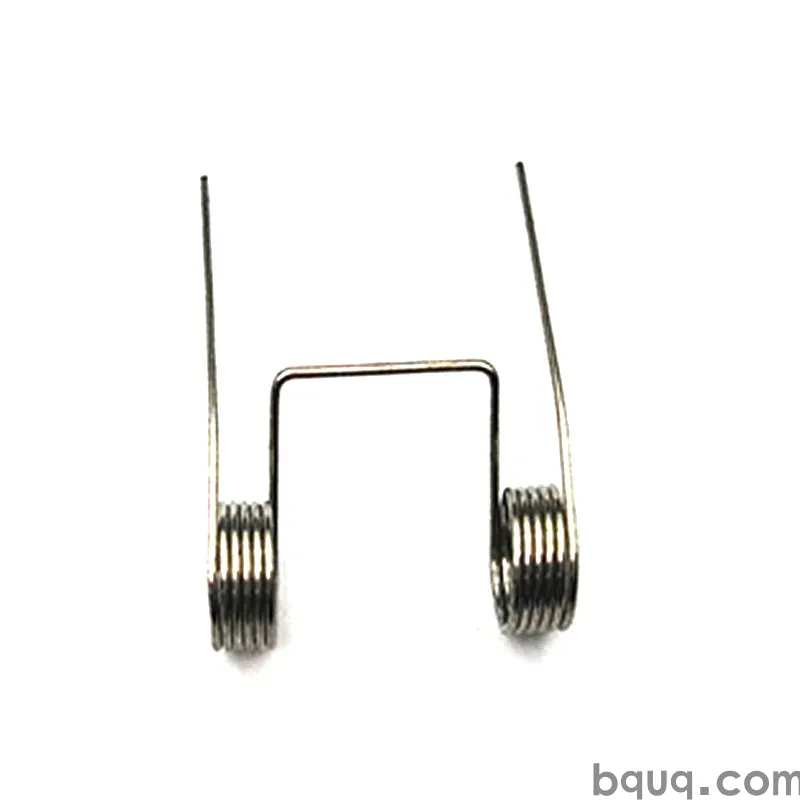
- Torsion springs for latches, clamps, and actuators: /torsion-springs/
- Custom extension springs: /extension-custom-springs/
- Industry trends in medical device sourcing: /industry-dynamics/
- Technical articles and engineering guides: /bquq-blog/
- Frequently asked questions: /faq/
- Case studies: /case/
- Contact the engineering team: /contact/
Authored by the BQUQ Engineering Team. BQUQ (Dongguan) runs CNC machining (±0.005 mm), metal stamping, custom springs, and heat sink production in one ISO9001 factory. Source-direct from Dongguan, China — quote in 12 hours: sc@bquq.com | WhatsApp +86 13713157787 | www.bquq.com